

No. Answer engine optimization (AEO) is not the same as SEO, but it is built on top of it. SEO earns you a ranked link in 2026; AEO earns you a named citation or recommendation inside an AI-written answer. The two share foundations and diverge on what you measure.
- AEO is not SEO rebranded: SEO targets ranked links, AEO targets citations and recommendations inside AI answers.
- They overlap on crawlable pages, clear content and earned authority, so SEO work is the base layer.
- Rank tracking cannot see a citation that never produced a click; AEO needs its own measurement.
- Add AEO to your SEO workflow in 2026. Do not replace SEO with it.
Is answer engine optimization the same as SEO?
No. The overlap is real, but the goal and the scoreboard differ.
| SEO | AEO | |
|---|---|---|
| Goal | Rank a page in a results list | Get named inside a generated answer |
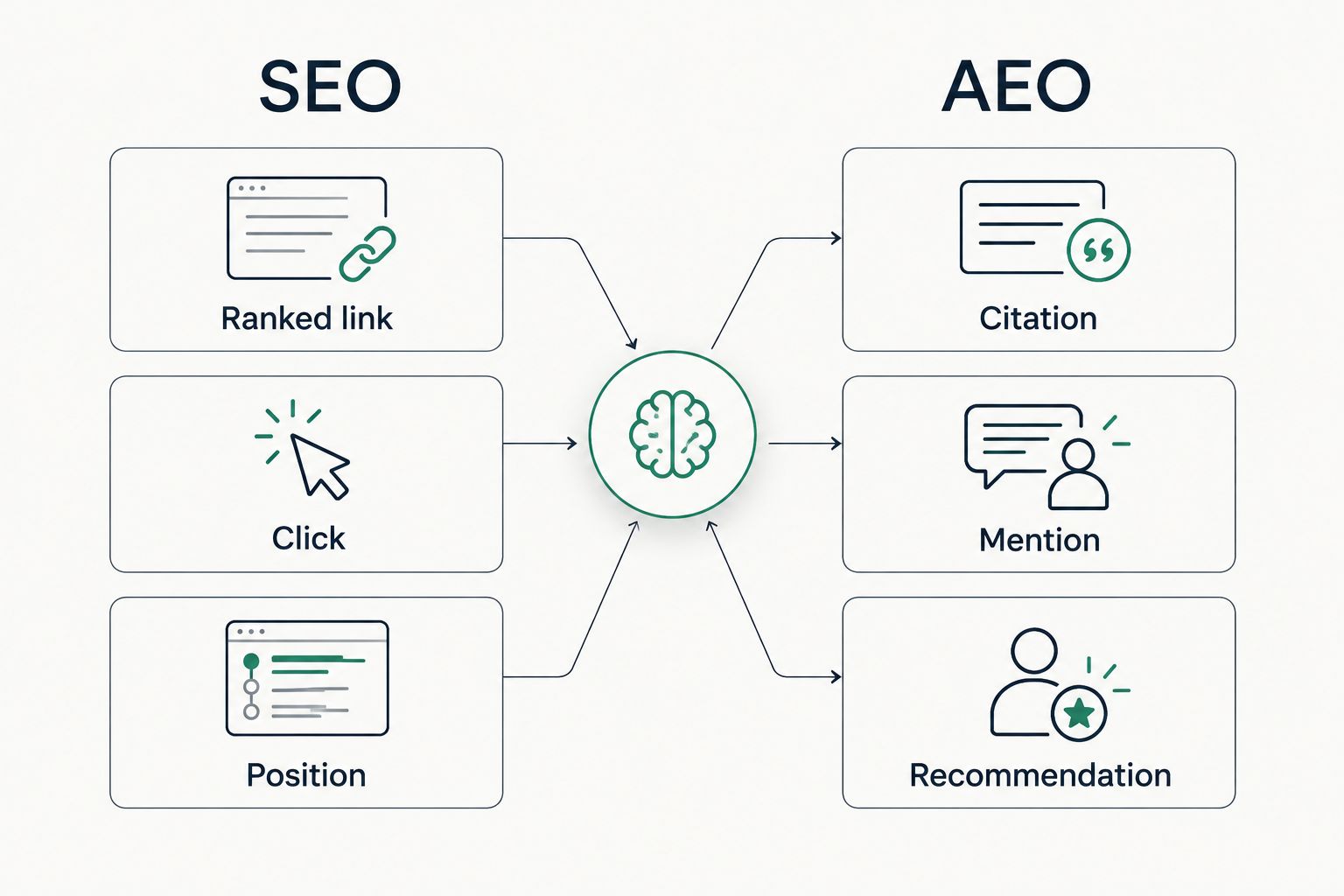
| Unit of success | Position, click | Citation, mention, recommendation |
| Where it plays | Google and Bing results pages | ChatGPT, Gemini, Perplexity, Claude, Copilot, Google AI Overviews |
| Core metric | Rankings, impressions, traffic | Share of Voice, citation rate, AI Visibility Score |
| Failure mode | Ranking below page one | Being absent, or being cited wrongly |
Verdict: SEO gets you found; AEO decides whether an AI names you when a buyer asks for a recommendation. Teams in 2026 need both.
Where AEO and SEO overlap
AEO does not replace the SEO fundamentals. It depends on them.
- Crawlable, indexable pages. An AI engine cannot cite what it cannot fetch. Technical readiness for AI crawlers is a prerequisite, covered in auditing your site's technical readiness for AI crawlers.
- Clear, specific content. Pages that answer a question directly in the first paragraph win in both systems.
- Earned authority. Third-party mentions and links still shape which sources models trust.
- Structured data. Schema markup helps search engines parse a page and supports citation, as explained in using schema markup to improve AI citation rates.
If your SEO foundation is weak, AEO will not rescue it. Fix that first.
Where AEO differs from SEO
The output is an answer, not a list
A search results page shows ten links and lets the user choose. An AI answer picks for the user. Most of the time that means a handful of named sources, and your brand is either in the answer or it is not. There is no page two.
A citation, a mention and a recommendation are different outcomes
- Citation: your page is linked as a source.
- Mention: your brand is named in the text, with or without a link.
- Recommendation: the engine tells the user to choose you.
Rankings collapse all three into one number. AEO has to separate them, because only a recommendation reliably moves a buyer.
Measurement changes
GA4 and rank trackers measure clicks and positions. They cannot see a citation that never produced a click. AEO tracking runs a defined prompt set across engines and records whether you appear, how, and next to which competitors. The setup is covered in building a prompt library for AI visibility tracking and measuring share of voice in AI search results.
Each engine behaves differently
ChatGPT, Gemini, Perplexity, Claude, Copilot and Google AI Overviews do not cite the same sources for the same question. A page that ranks first on Google can be absent from a Perplexity answer. That is why a single rank report is not a visibility report.
Why the "rebrand" claim persists
Three reasons:
- The tactics overlap enough that an SEO can start on AEO with existing skills.
- Some agencies relabel a standard SEO retainer as AEO without changing the deliverables.
- Generative engine optimization (GEO), AEO and "AI SEO" are used loosely and often interchangeably.
A useful test: if the deliverable is still rankings and organic sessions, it is SEO under a new name. If it includes prompt-level tracking, citation analysis and competitor share of voice in AI answers, it is AEO.
What to do in 2026
- Keep your SEO programme running. It is the base layer.
- Define a prompt set of the questions your buyers ask AI engines, weighted by intent. See weighting prompts by buyer intent.
- Baseline your visibility across the major engines before changing any content.
- Fix content that should be cited and is not. Compare against competitors that are, as in reverse-engineering why a competitor's page gets cited.
- Report both systems together so leadership sees SEO traffic and AI visibility side by side.
For the combined view, see combining AI visibility data with SEO rank tracking.
See where AI names your brand
Track citations and recommendations across the major AI engines.
Is AEO the same as GEO?
Mostly yes. AEO and GEO describe the same discipline: optimising for AI-generated answers. GEO leans on generative engines, AEO on answer engines. Treat the terms as near-synonyms and pick the one your team will use consistently. A practical starting point is approaching generative engine optimisation for your brand.
Does good SEO guarantee AI visibility?
No. Strong rankings raise your odds but do not guarantee a citation. Engines weigh sources differently and often favour content that answers the question directly. Only prompt-level tracking shows where you stand.
Will AEO replace SEO?
Not in 2026. Search results pages still drive demand, and AI engines draw on the same web content. AEO is an addition to the workflow, not a swap.
FAQ
Is answer engine optimization the same as SEO?
No. SEO aims to rank pages in search results; AEO aims to get your brand cited or recommended inside AI-generated answers. They share foundations like crawlable pages and quality content.
Is AEO just SEO with a new name?
No. The tactics overlap, but AEO measures citations, mentions and recommendations across AI engines, which rank tracking cannot see.
Do I need AEO if I already do SEO?
Yes, if buyers use AI assistants to research purchases. SEO does not show whether ChatGPT, Gemini or Perplexity name you, so you need separate tracking.
What is the difference between AEO and GEO?
They are near-synonyms. Both describe optimising content so AI engines cite or recommend your brand in generated answers.
What is the difference between a citation and a recommendation?
A citation links your page as a source. A recommendation tells the user to choose your brand. A recommendation is the stronger outcome.
Can Google rankings predict AI citations?
Only loosely. A page that ranks well can still be missing from answers in other engines, so check each engine directly.
How do I measure AEO?
Run a fixed prompt set across AI engines and record whether you are cited, mentioned or recommended, then compare against competitors over time.
One last thing
The sharpest signal that a vendor is selling renamed SEO: ask what they report. If the report has no prompt set, no per-engine results and no competitor comparison inside AI answers, you are buying a 2026 label on a familiar service.


