

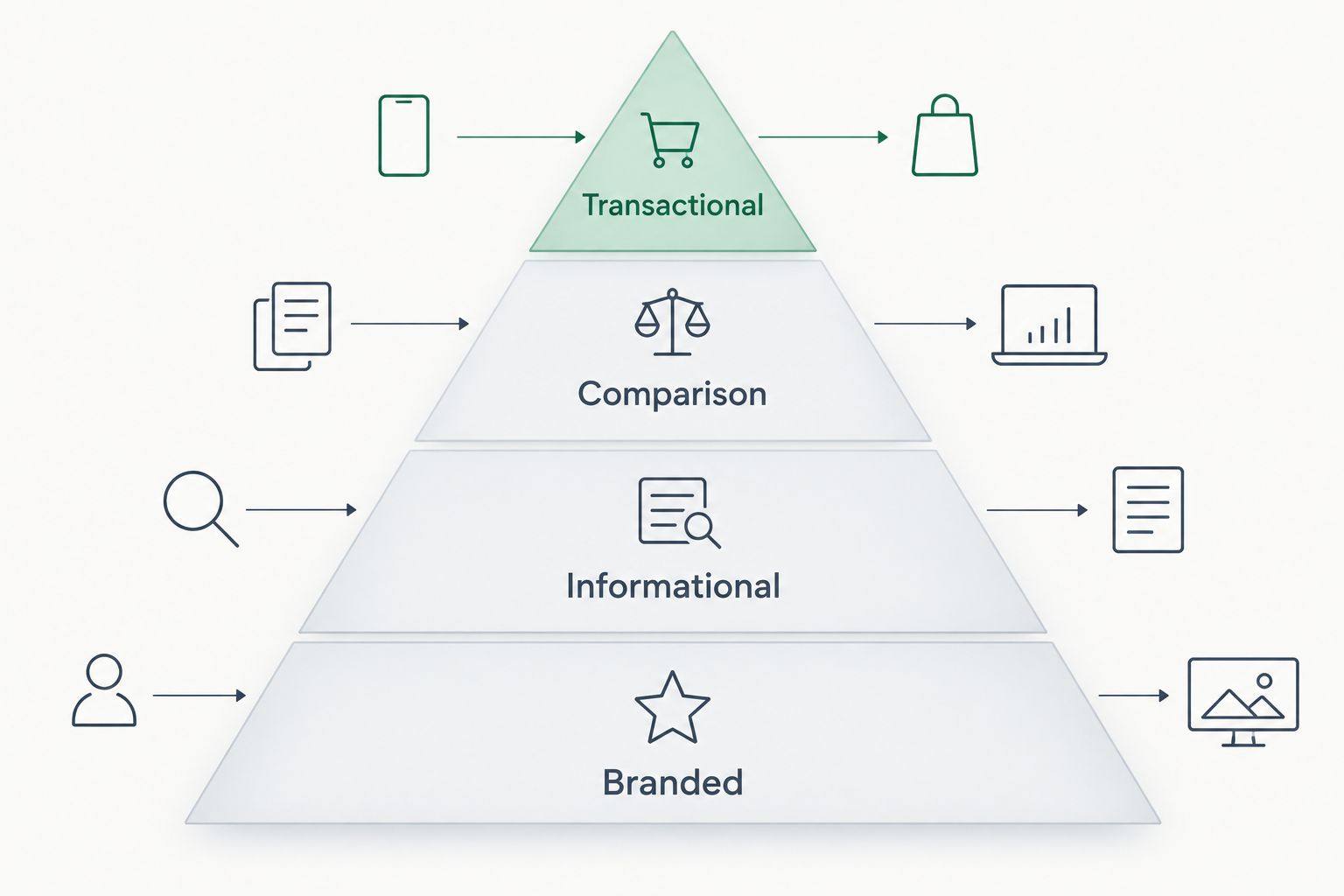
Weighting prompts by buyer intent means giving transactional and comparison prompts more pull in your AI visibility score than informational prompts, because a citation on 'best AI visibility tool for B2B SaaS companies' predicts pipeline better than a citation on 'what is generative engine optimisation'. A four-tier split, transactional, comparison, informational and branded, with weights around 3x, 2x, 1x and a separate branded track, is a workable starting point for 2026 AI tracking programmes.
- Transactional and comparison prompts should carry 2x to 3x more weight than informational prompts in an AI visibility score.
- Branded prompts get tracked on a separate line, never blended into the unbranded weighted score.
- A prompt library without intent tags hides whether citations sit near the buying decision or nowhere near it.
- Re-tag and re-weight the prompt set every quarter as new AI-generated queries enter the buying journey.
Why this matters
Most AI visibility dashboards count every citation the same way. A mention on an awareness prompt like 'what is AI search optimisation' shows up as one point, same as a mention on a bottom-funnel prompt like 'best AI visibility tool for enterprise brand portfolios'. Treat those as equal and the score moves on volume, not on buying intent.
The fix starts with the prompt set itself, not the scoring formula. Build a prompt library for AI visibility tracking with no intent tags and there is nothing to weight yet, only citation counts that look sophisticated on a dashboard and mean almost nothing about buyer readiness.
How do you weight prompts by buyer intent in AI tracking?
Buyer intent in AI tracking works the same way it does in paid search: tier the query, then weight the tier. Four tiers cover most B2B and B2C buying journeys tracked through 2026.
| Intent tier | Example prompt | Suggested weight | What it signals |
|---|---|---|---|
| Transactional | best ai visibility tool for retail brands | 3x | Ready to shortlist a vendor |
| Comparison | Koalr vs a named competitor for AI tracking | 2x | Actively evaluating options |
| Informational | what is a GEO audit | 1x | Early research, no vendor decision yet |
| Branded | does Koalr track ChatGPT citations | tracked separately | Existing awareness, in-funnel prospect |
The weight is a multiplier applied to whether the brand gets cited on that prompt, not to the prompt's search volume. A brand cited on five transactional prompts and zero comparison prompts should score higher than a brand cited on twenty informational prompts and nothing else.
Transactional prompts: weight 3x
Transactional prompts name an action the buyer is about to take: best, top, for [use case], pricing for. These prompts sit closest to a purchase decision, so a missed citation here costs more than a missed citation on ten informational prompts combined.
Before assigning a prompt a 3x weight, confirm the brand can actually surface on it. Testing whether a prompt triggers your brand in AI answers stops a phantom prompt, one no model ever cites the brand on, from dragging the whole score down for no reason.
Comparison prompts: weight 2x
Comparison prompts pit the brand against a named competitor or a category shortlist: X vs Y, alternatives to X, X or Y for a given use case. The buyer already knows the category exists and is narrowing the field, so a citation here is worth more than a generic mention but less than a straight transactional hit.
Comparison prompts also carry the highest churn risk in a prompt set. Models change which competitors they surface month to month, so this tier needs the most frequent re-check of the four in any 2026 tracking cadence.
Branded prompts: tracked separately, not blended in
Branded prompts include the brand name directly: is Koalr good for tracking AI visibility, Koalr pricing, Koalr vs a named competitor. These prompts measure whether an AI model already knows and trusts the brand, not whether the brand can win an unbranded shortlist.
Blending branded and unbranded citations into one weighted score inflates the number for any brand with existing name recognition and hides the real gap: unbranded discovery. Tracking branded versus unbranded prompts separately keeps 'do they know us' and 'do they find us' from collapsing into one misleading figure.
Informational prompts: weight 1x
Informational prompts are definitional or educational: what is, how does, why does. They matter for top-of-funnel visibility and content strategy, but a citation here rarely reflects a buyer ready to act, so it earns the baseline weight.
Dropping informational prompts to zero is a mistake too. They are usually the highest-volume tier and the first place a new category narrative shows up before it moves down-funnel.
Why the weighting scheme varies
The 3x, 2x, 1x split is a starting point, not a fixed rule. Several things push a team to adjust it:
- Sales cycle length: a six-month enterprise deal cycle gives more value to comparison-stage citations than a same-day D2C purchase does.
- Category maturity: a new category with few named competitors has almost no comparison prompts yet, so more weight sits on transactional and informational tiers.
- Which AI platform buyers actually use: research-heavy tools skew toward informational and comparison queries, while purchase-adjacent queries lean transactional.
- Volume imbalance in the prompt set: if 80% of tracked prompts are informational, a flat weighting scheme lets that tier dominate the score by sheer count alone.
- Existing brand recognition: a well-known brand's branded prompt volume can dwarf its unbranded volume, which is exactly why the two need separate tracking instead of one blended number.
- Actual conversion data: a monthly AI visibility benchmarking review lets a team check which tier's citations correlate with pipeline and adjust the multipliers instead of guessing.
“A citation on an informational prompt and a citation on a transactional prompt are not the same event, even when the dashboard shows them as one number.”
Once the tiers and weights are set, the next step is checking the numbers against a real dashboard rather than a spreadsheet built once and never revisited.
Track prompts by intent, not just volume
See which prompt tiers cite your brand across ChatGPT, Gemini and Perplexity.
Do you need to re-weight prompts every quarter?
Yes, re-check the weighting every quarter in 2026 because new AI-generated queries enter the buying journey faster than a static prompt list can track. A comparison prompt that did not exist in Q1 can become the highest-volume prompt in a category by Q3 once a new competitor enters a model's retrieval data.
Should branded prompts count toward your unbranded visibility score?
No, branded prompts should never count toward an unbranded visibility score because they measure existing awareness, not discovery. Keep branded and unbranded numbers on separate lines so a strong brand name does not mask a weak unbranded citation rate.
What weight should a comparison prompt get without a named competitor?
A comparison prompt without a named competitor, such as top AI visibility platforms, still sits above informational weight because the buyer is already shortlisting, not just learning. Treat it as a 2x weight alongside named-competitor comparisons.
FAQ
What's the best way to weight prompts by buyer intent in AI tracking?
The best way is a four-tier system, transactional, comparison, informational and branded, with transactional prompts weighted around 3x and comparison prompts around 2x. Informational prompts hold the baseline 1x weight and branded prompts run on a separate, unblended line.
How many prompts should each intent tier have?
There is no fixed count, but a prompt set skewed 80% toward one tier usually means the tagging needs review before the weights mean anything. Balance the set toward the tiers that map to how buyers in the category actually search in 2026.
Is a branded prompt more valuable than a transactional prompt?
Branded and transactional prompts answer different questions, so ranking one above the other misses the point. Branded prompts show existing awareness, transactional prompts show discovery among buyers who do not yet know the brand.
How often should intent weighting be reviewed?
Review the weighting every quarter alongside the prompt list itself, since new AI-generated queries and new competitors shift which tier drives pipeline. A weighting scheme set once in January 2026 and left alone by December is tracking a buying journey that no longer exists.
Does Koalr weight prompts by buyer intent automatically?
Koalr tracks brand citations across ChatGPT, Gemini, Perplexity, Claude, Copilot and Google AI Overviews and lets a team tag prompts by intent tier when building out a prompt set. The weighting multipliers still come from the team's own read of which tier correlates with pipeline.
What happens if all prompts get the same weight?
An unweighted score rewards whichever tier has the most prompts in the set, usually informational, and hides how a brand performs on the transactional prompts closest to a buying decision.
Can comparison prompts and transactional prompts share the same weight?
They can, but it flattens a real distinction. Comparison prompts show a buyer narrowing options, transactional prompts show a buyer ready to act, and transactional citations usually correlate more tightly with pipeline.
One last thing
The biggest mistake in AI prompt weighting is not picking the wrong multiplier, it is never checking whether the multiplier matches reality. Pull the AI referral traffic that converted in 2026, tag which prompt tier most likely produced it, and adjust the weights to match that pattern instead of a spreadsheet assumption.


