

Optimising content for Google AI Overviews means restructuring pages so the direct answer sits in the first 40-60 words, backed by a clear source and machine-readable structure — not just ranking well in classic blue links. Google's AI Overviews pull from pages that already rank in the top results, then favour the one paragraph that answers the query cleanly, cites a specific number or fact, and sits under a heading that mirrors the search query. A page can rank #3 in classic search and still lose the Overview citation to the page in position #7 if that page answers faster.
- Answer the query in the first 40-60 words under a heading that mirrors the query, not a clever headline.
- Google AI Overviews pull from pages already ranking on page one, then pick the clearest direct-answer paragraph, not always the top result.
- FAQPage, HowTo and Article schema markup raises the odds a paragraph gets lifted into the Overview box.
- Track citations separately from clicks — AI Overviews often satisfy the query without a click to the source page.
- Koalr tracks whether your brand's pages get cited across Google AI Overviews, ChatGPT, Gemini, Perplexity and Copilot in one dashboard.
Why this matters
Google AI Overviews now sit above the organic results for a large share of informational queries in 2026, and a citation there can satisfy the searcher before they ever scroll to a blue link. That's a traffic loss for pages that used to hold position one, and a traffic gain for pages structured to get pulled into the box regardless of their classic rank. Treating AI Overview optimisation as a bolt-on to old SEO habits misses the point — the unit Google extracts is a paragraph, not a page, and that paragraph has to survive being lifted out of context.
Marketing teams that only track organic sessions in Google Analytics miss this shift entirely, because a citation with zero click still shapes what the searcher believes about a brand.
How to optimise content for Google AI Overviews
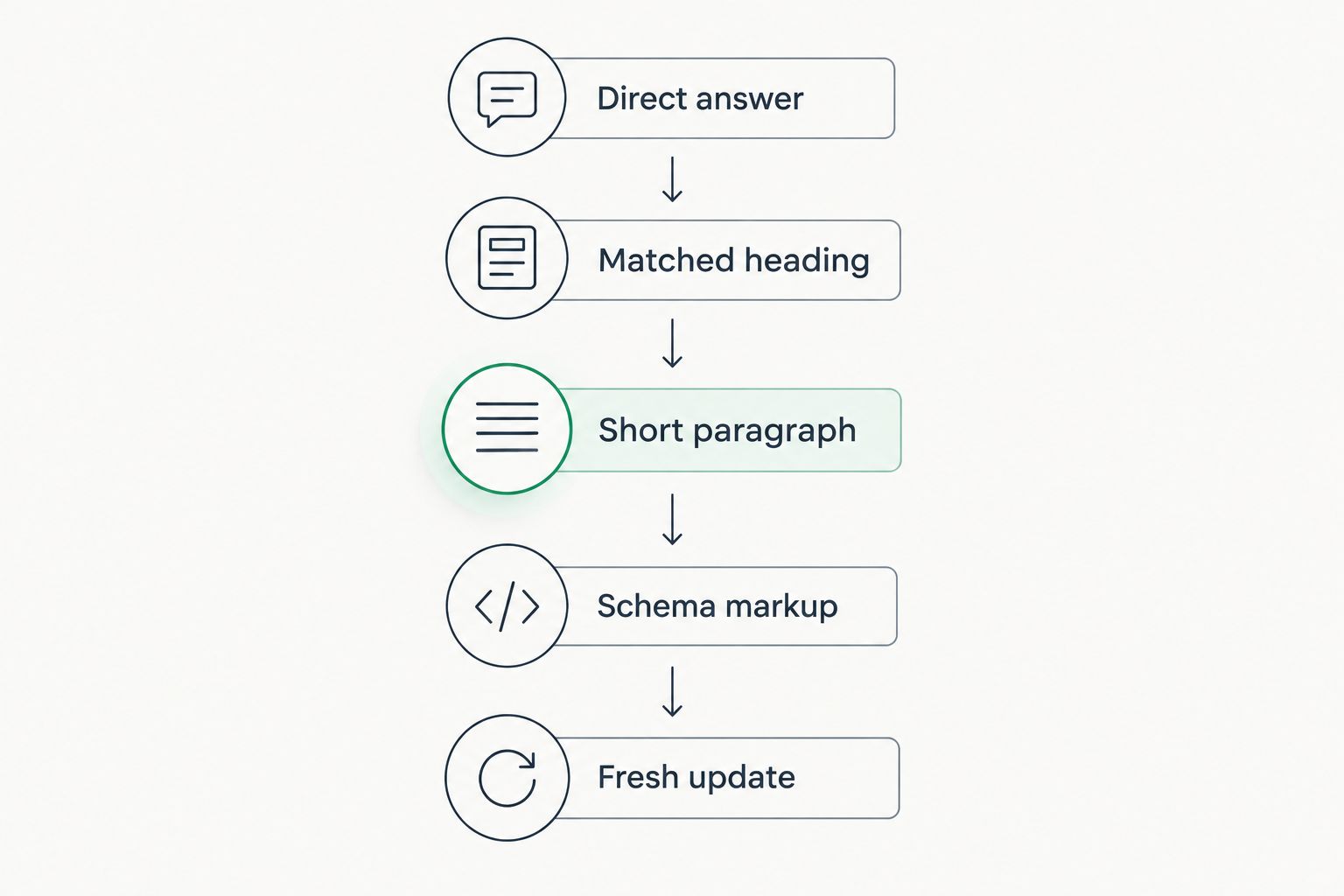
The fix is structural, not stylistic. Six changes move a page from "ranks well" to "gets cited":
- Open with the direct answer. First sentence states the number or verdict, not a definition. "A walk-in tub costs $X" beats "Walk-in tubs are a popular accessibility upgrade."
- Match the heading to the query. If people search "how to optimise content for AI Overviews," your H2 should read almost exactly that, not "Content Strategy Considerations."
- Keep the answer paragraph short. 40-60 words is the range that survives extraction without losing meaning — longer paragraphs get truncated or skipped.
- Add schema markup. FAQPage and HowTo schema give Google a structured shortcut to the answer; see the breakdown on schema markup for AI citation rates.
- Cite a real number or source in the first paragraph. Overviews favour paragraphs with a specific figure, date or named entity over vague claims.
- Refresh dated content. Pages last updated years ago lose citations to fresher competitors — check what changes after an update using tracking AI visibility after a content refresh.
| Structure element | Classic SEO priority | AI Overview priority |
|---|---|---|
| First paragraph | Intro/hook | Direct answer, 40-60 words |
| Heading wording | Keyword-optimised | Query-matched, near-verbatim |
| Schema markup | Optional enhancement | Near-mandatory for extraction |
| Freshness | Ranking signal | Extraction signal — stale pages get skipped |
| Citations elsewhere | Backlink signal | Trust signal for AI source selection |
FAQ pages get cited at a disproportionate rate
FAQPage-formatted content answers one question per block, which is exactly the unit Google's Overview system extracts. A page with six tightly scoped Q&A pairs gives the algorithm six separate chances at a citation instead of one. Structuring these correctly is covered in how to structure FAQ pages so AI engines cite them — the same logic applies whether the citing engine is Google AI Overviews, Perplexity or Copilot.
Why some pages get pulled into AI Overviews and others don't
- Answer position. Pages that bury the answer in paragraph three lose to pages that lead with it.
- Source authority. Google favours pages that already show up as citations elsewhere for the same topic.
- Schema presence. FAQPage and HowTo markup make extraction mechanical rather than probabilistic.
- Update recency. A 2026-dated update outranks a 2022 page making the same claim with no refresh.
- Specificity. A paragraph with a number, date or named entity beats a paragraph with only qualitative claims.
- Sentence length. Shorter, single-claim sentences extract cleanly; nested clauses get cut mid-sentence.
A page written for AI Overviews reads like a page written for a rushed editor, not a bored reader.
“A page can rank third in classic search and still lose the AI Overview citation to the page sitting in position seven.”
Monitoring which of your pages actually get pulled into Overviews — and which get skipped despite ranking well — is the only way to know if these changes are working. That's a different measurement problem than tracking organic clicks, and it's covered in the best tools for monitoring Google AI Overviews.
See which pages get cited in AI Overviews
Track citations across Google AI Overviews, ChatGPT, Gemini and Perplexity in one view.
Is optimising for AI Overviews different from optimising for SEO?
Optimising for AI Overviews adds a structural layer on top of standard SEO rather than replacing it — the page still needs to rank on page one before an Overview will consider it. The difference is that classic SEO rewards a page for the whole document, while Overview extraction rewards one specific paragraph or list, so the winning move is often restructuring an existing top-ranking page rather than writing something new.
How long does it take to see AI Overview citations after a content update?
Citation changes can show up within days of a schema or structure update, but it varies by query volume and how often Google refreshes that Overview. The only reliable way to know is checking before and after an update rather than assuming a fixed timeline, which is why tracking citation changes around a refresh matters more than guessing at a schedule.
Do you need schema markup to appear in Google AI Overviews?
Schema markup isn't strictly required, but pages with FAQPage or HowTo schema get extracted more consistently in 2026 because the markup removes ambiguity about where the answer starts and ends. Pages without markup can still get cited if the paragraph structure is clean enough, but they're competing on a weaker signal.
Marketing teams running this kind of restructuring at scale eventually need to see it in one place rather than checking each page by hand — Koalr's dashboard shows which pages hold an AI Overview citation this week versus last, alongside citations in ChatGPT, Gemini, Perplexity and Copilot.
FAQ
What is the fastest way to optimise content for AI Overviews?
Rewrite the first paragraph so it answers the query directly in 40-60 words, then add FAQPage or HowTo schema. This is the single change most likely to move a page from ranked-but-ignored to cited in 2026.
Do AI Overviews reduce organic clicks?
AI Overviews can satisfy a searcher's query without a click through to the source page, which lowers click-through even when the citation itself is a visibility win. Tracking citations separately from GA4 sessions is the only way to see both sides.
Is Google AI Overview optimisation the same as ChatGPT or Perplexity optimisation?
The core habits overlap — direct answers, schema, specificity — but each engine weighs sources differently. Perplexity leans on live web citations while Google AI Overviews lean on pages already ranking well organically.
How often should you check if a page is still cited in AI Overviews?
Monthly checks catch most drift, but pages tied to a launch, rebrand or content refresh need a check within days of the change since Overviews can drop a citation quickly after a page update.
Does page length affect AI Overview citation?
Overall page length matters less than the length of the specific answer paragraph — a 3,000-word page with a tight 50-word answer block still gets extracted cleanly.
What content format gets cited most often in AI Overviews?
FAQ-formatted content and numbered how-to steps get cited most consistently in 2026 because each block is a self-contained answer unit Google can lift without editing.
One last thing
The pages that lose AI Overview citations first are rarely the weakest ones — they're the strong, well-ranking pages nobody has touched since 2023, because Google's freshness signal for Overview extraction moves faster than its signal for classic ranking. A page can hold position two for two years and quietly lose every AI Overview citation to a newer competitor without the classic ranking ever slipping.


