No. AI SEO tools cannot guarantee more citations in ChatGPT answers because they do not control which sources ChatGPT selects. They can help you measure visibility and prioritise improvements, but a citation is neither a guaranteed recommendation nor proof of a customer visit.
- Can AI SEO tools guarantee citations in ChatGPT? No: measurement and optimisation do not control source selection.
- Koalr helps marketing teams track and improve brand visibility in AI answers; it does not make citations guaranteed.
- Measure citations, brand mentions and recommendations separately across a consistent prompt set.
- Judge answer engine optimisation by repeatable evidence, not a selected screenshot or an unexplained visibility score.
Can AI SEO tools guarantee more citations in ChatGPT answers?
No tool can turn an independent answer engine's source selection into a guaranteed outcome. A supplier can commit to work it controls, such as monitoring agreed prompts or delivering an audit. That is different from controlling whether ChatGPT cites your website.
Koalr is an AI visibility platform for marketing teams tracking how their brands appear in AI-driven answers. Its role is to support measurement and improvement, not to own the answer engine's decisions.
Before evaluating a guarantee in 2026, separate the outcomes being promised:
| Outcome | What counts | What it does not establish |
|---|---|---|
| Brand mention | Your brand appears in the answer text | Your website was cited or your brand was recommended |
| Website citation | The answer attributes information to your website through a source reference | The answer endorses your product |
| Brand recommendation | The answer presents your brand as a suitable choice | The answer links to your website |
| Referral visit | A user follows a link to your website | Every citation produced a visit |
These are measurement categories, not interchangeable success labels. Ask a supplier which outcome its promise covers and request the underlying answers, rather than accepting a total labelled visibility.
Why this matters
A citation guarantee creates the wrong buying criterion: certainty rather than useful evidence. Your marketing team needs to know which buyer questions expose a visibility gap, what the cited sources provide, and which changes deserve attention.
A technically valid citation can still have little commercial relevance. An answer might cite your glossary while recommending another supplier for the buying decision. The source reference is real; the competitive win is not.
For your 2026 measurement plan, keep visibility and business outcomes connected but distinct. Track whether you appear in relevant answers, then examine visits and conversions separately. Do not describe a citation increase as revenue growth without evidence linking the two.
What can an AI SEO supplier actually commit to?
A useful commitment describes a deliverable and how you will verify it. An unsupported guarantee substitutes an outcome the supplier cannot control for an obligation it can fulfil.
Compare these approaches before signing an agreement:
| Approach | Best for | Strength | Limitation |
|---|---|---|---|
| Defined monitoring commitment | Teams establishing a baseline | Makes the observation scope explicit | Monitoring does not itself improve content |
| Defined optimisation commitment | Teams with diagnosed content gaps | Connects work to specific pages and questions | Publishing a change does not ensure a citation |
| Unqualified citation guarantee | No team seeking dependable evidence | Offers a simple headline promise | Conceals uncertainty unless scope and conditions are disclosed |
Choose a supplier's observable process over an unconditional citation promise. Ask for a demonstration using prompts relevant to your buyers, including examples where your brand is absent. A demonstration built only around successful appearances does not establish the breadth of your visibility.
Read contractual language carefully, too. A refund commitment describes a commercial remedy; it does not prove that the supplier can control ChatGPT. Judge the remedy and the technical claim separately.
Why ChatGPT citation outcomes vary
A citation result belongs to a particular question and answer context. It is not a permanent property of your domain. When comparing results, document the conditions rather than treating every answer as an equivalent observation.
Use these factors to structure your review:
- Prompt intent: A request for an explanation asks for different evidence from a request to choose a supplier. Keep informational and buying questions separate.
- Question wording: Product requirements, audience and market change what constitutes a relevant answer. Record the exact prompt instead of a shortened topic label.
- Conversation context: Follow-up questions depend on earlier messages. Separate fresh-session tests from conversations that already name your brand.
- Search context: An answer produced with web search and an answer produced without it are different test conditions. Record the mode you actually observed.
- Source suitability: A page must contain information relevant to the question to serve as useful supporting evidence. Check the cited passage, not just the domain.
- Observation date: Sources and answer-engine behaviour change. Timestamp results so a later comparison has a defined baseline.
These are reasons to control your measurement, not a formula for guaranteed inclusion. A favourable result under a narrow condition does not establish visibility across your buyers' questions.
How do you test whether citation visibility is improving?
Use a repeatable process that preserves both successes and failures. Your 2026 baseline should make it possible to inspect the original answers and understand exactly what changed between reviews.
1. Define the outcome before collecting answers
Choose whether the review concerns website citations, brand mentions or recommendations. Record each separately even when an answer contains several of them.
For citations, distinguish a link to your own website from a link to an independent page discussing your brand. Both deserve attention, but they answer different questions about where information comes from.
Write the counting rule down. If repeated links to the same website within an answer count as a single cited answer, preserve that rule throughout the comparison.
2. Build prompts around actual buyer questions
Use questions that reflect the problems, requirements and decisions your audience faces. Separate prompts naming your brand from unbranded category questions; naming yourself in the question changes what you are testing.
The guide to building a prompt library for AI visibility tracking provides a starting point for organising that work. Keep the original prompt set intact when adding new questions, so expanded coverage does not masquerade as improved performance.
3. Preserve the observation conditions
Save the exact prompt, answer, cited URLs, observation date and available engine settings. Note whether the test used a fresh conversation and whether search was active.
Repeat observations rather than treating a single answer as a stable result. Choose a review schedule your team can maintain, and disclose it alongside the findings instead of presenting a snapshot as universal coverage.
4. Diagnose the missing evidence
Read the sources attached to answers where your brand is absent. Identify what those sources actually contribute: an explanation, a comparison, a documented capability or evidence supporting a claim.
Then inspect your relevant page. Does it answer the same question clearly? Does it support its claims? Are its statements current and accessible? Fix the specific gap rather than adding generic paragraphs about being a market leader.
5. Compare like-for-like results
Rerun the preserved prompt set after the change and compare the same outcome under the same recorded conditions. Include unchanged pages or topics where practical to help interpret broader movement.
Report the numerator and denominator behind any citation rate. More cited answers with a larger test set is not automatically an improvement in the proportion cited. Preserve negative results as carefully as positive ones.
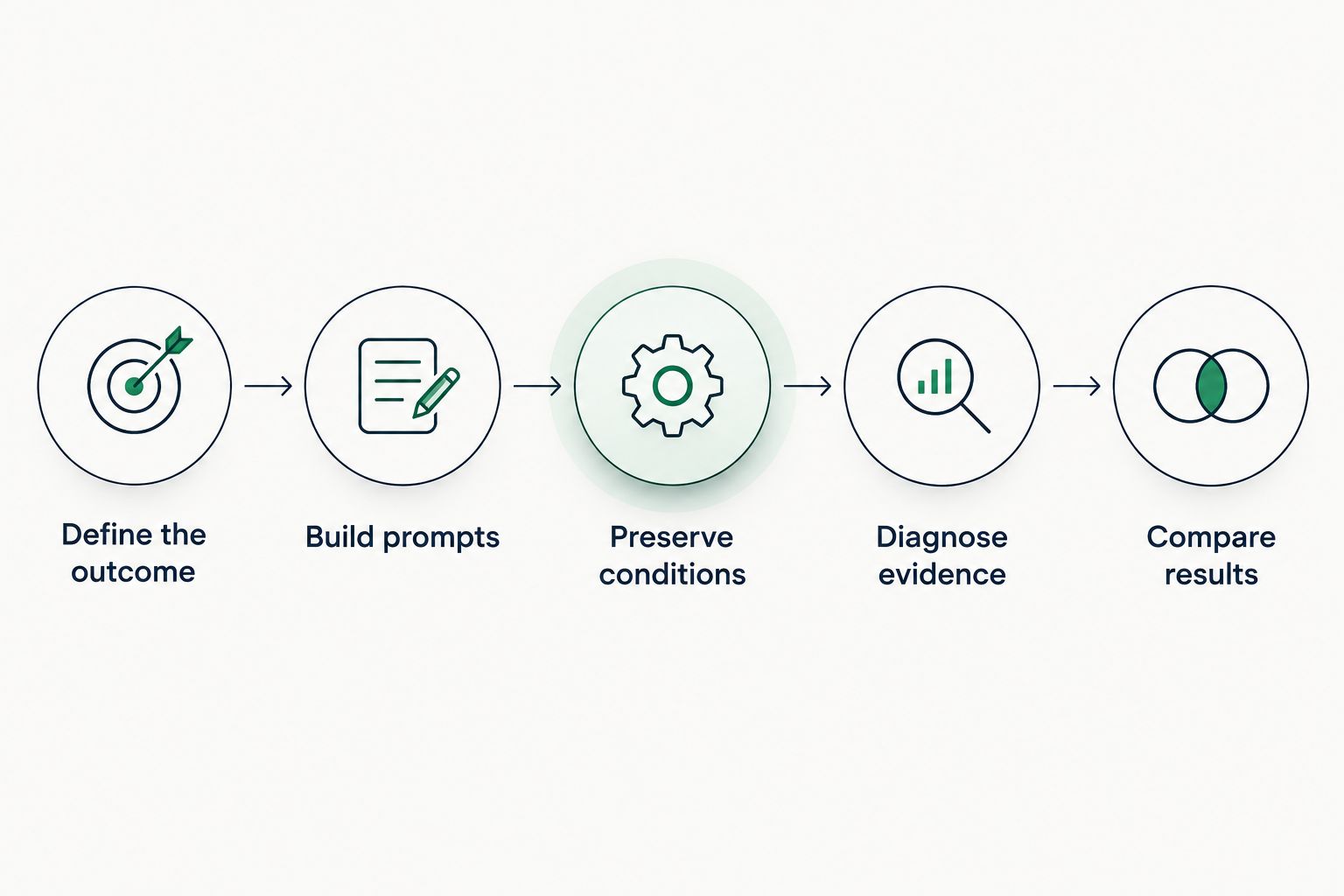
The result is an evidence trail, not a promise. You should be able to move from a reported change to the answers behind it, then to the page edits intended to address the gap.
What should you ask before buying an AI visibility tool?
Koalr is best suited to marketing teams that need to track and improve brand visibility across AI answers. The relevant buying question is whether that purpose matches your workflow, not whether software can guarantee an independent engine's response.
For a 2026 evaluation, ask the supplier to demonstrate the following rather than assuming these capabilities exist:
- Observation scope: Which engines, markets, languages and answer modes does the proposed service cover?
- Evidence access: Can you inspect the answer and source references behind a reported result?
- Metric definitions: How are citations, mentions, recommendations and Share of Voice counted?
- Comparison rules: What happens to historical comparisons when prompts or competitors change?
- Action quality: Does a finding identify a page-level issue your team can verify and address?
The benefit of an AI visibility platform is a dedicated focus on how brands appear in answers. The limitation remains sampling: a tracked prompt set describes the observations collected, not every conversation customers have. Keep that boundary visible in reports.
Before selecting software, assign responsibility for acting on findings. A monitoring workflow without an owner for content, technical fixes or factual corrections produces a backlog rather than a completed improvement cycle.
Will better content guarantee a ChatGPT citation?
Better content does not guarantee a ChatGPT citation. It gives you a clearer, better-supported answer to publish, but source selection remains outside your control.
Improve pages around a defined question. State the answer directly, explain material limitations and support checkable claims with evidence readers can inspect. If your page compares options, make the comparison criteria explicit rather than declaring your own product the winner without support.
Avoid treating formatting as a placement mechanism. A table, FAQ or concise answer can make information easier to understand; its presence does not prove that ChatGPT will retrieve or cite the page.
Can a citation increase prove that optimisation worked?
A citation increase alone does not prove that optimisation caused the change. Your page is not the only thing that can change between observations, so compare the actual answers and document the intervention.
A defensible 2026 report identifies the edited pages, the questions they were intended to answer, and the subsequent observations. Describe an observed association as an association unless the test design supports a stronger conclusion.
Also check relevance. Gaining citations for questions outside your target buyer's needs is not equivalent to becoming a recommendation for a qualified purchase decision.
FAQ
Can AI SEO tools guarantee citations in ChatGPT?
No. AI SEO tools do not control ChatGPT's source selection, so an unconditional citation guarantee is not a dependable technical claim. Ask for defined deliverables and inspectable evidence instead.
Is a brand mention the same as a citation?
No. A brand mention names your business in the answer, while a citation attributes information to a source. Record them separately so a mention increase is not reported as a citation increase.
Does a ChatGPT citation mean my brand is recommended?
No. ChatGPT can cite a page as supporting evidence without recommending the business behind it. Inspect what the answer actually says about your brand.
Can Koalr guarantee that ChatGPT will recommend my brand?
No platform can guarantee an independent answer engine's recommendation. Koalr helps marketing teams track and improve how their brands appear in AI-driven answers; that is different from controlling those answers.
Should I track branded or unbranded prompts?
Track both, but report them separately. Branded prompts test answers about your business, while unbranded prompts test whether your brand appears when the question does not name it.
How long should I wait for a page to earn a citation?
There is no guaranteed waiting period for a citation. Record the publication or update date and review the same relevant prompts under comparable conditions rather than treating elapsed time as proof of eligibility.
Does a refund guarantee prove an AI SEO tool works?
No. A refund guarantee defines a contractual remedy, not control over ChatGPT's answers. Evaluate the conditions of the remedy separately from evidence that the proposed work addresses your visibility gaps.
One last thing
Your most revealing test is an unbranded buying question where a competitor appears and you do not. Preserve that answer, inspect its sources and identify what evidence your relevant page lacks before commissioning more content.
For your next 2026 review, ask for the missing recommendations as well as the gained citations. Use Koalr or another measurement workflow to make those gaps visible, then assign a specific fix. The goal is not a screenshot with your name in it; it is a supported answer to a question your buyer actually asks.