
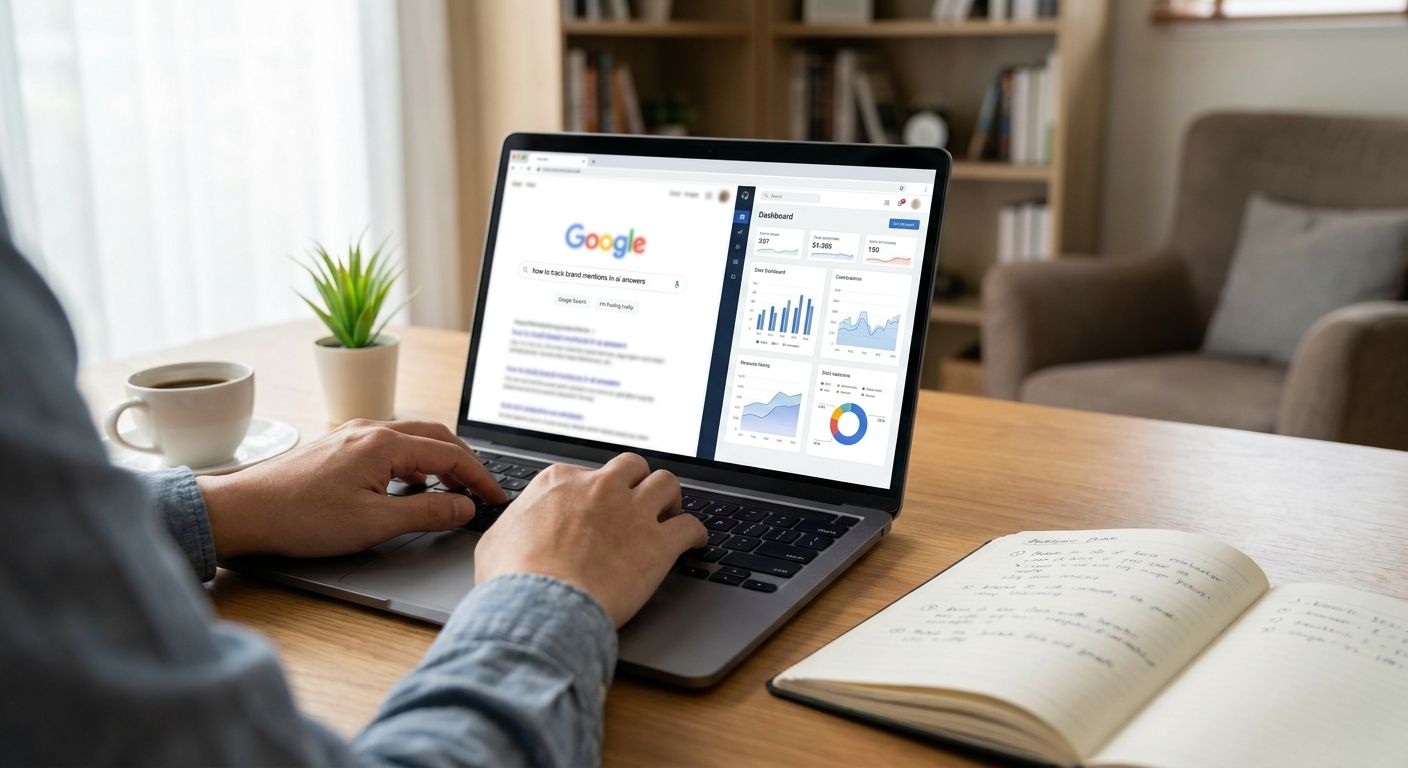
Most marketing teams still find out their brand got cited in ChatGPT by accident — a customer mentions it, or someone screenshots an AI Overview. Tracking brand mentions in AI answers deliberately means running a fixed set of prompts on a schedule and logging what each engine actually says.
- Manual spot-checks in ChatGPT miss most citations — build a fixed prompt set and run it weekly instead.
- A citation (named + linked) is not the same as a mention (named only) — track them separately.
- Koalr logs AI Visibility Score and Share of Voice across ChatGPT, Gemini, Perplexity, Claude and Copilot from one dashboard.
- Re-run the same prompts after every content change to see if the fix actually moved the answer.
Why this matters
Google Search Console tells you what ranked. Nothing built for search tells you what an AI engine said about your brand when nobody clicked through. Ahrefs and Semrush can flag AI Overview appearances for a URL, but they can't tell you if Perplexity named a competitor first, or if Claude recommended you at all in a comparison prompt.
That gap matters more every quarter. Buyers now ask ChatGPT and Gemini to shortlist vendors before they ever open a search results page, and if your brand isn't in that shortlist, you lose the deal before a session ever gets logged in Koalr or any other analytics tool. Tracking brand mentions in AI answers in 2026 is the only way to see that shortlist forming.
What you'll need
- A list of 15-30 buyer-intent prompts your customers would plausibly type into an AI assistant ("best [category] for [use case]", "[competitor] vs [your brand]", "is [your brand] good for [job]")
- Access to at least ChatGPT, Gemini, Perplexity and Claude — Copilot and Google AI Overviews if your buyers use Microsoft or search-heavy workflows
- A spreadsheet or a dedicated AI visibility tool to log results consistently (doing this by hand past 10 prompts breaks down fast)
- 2-3 direct competitor names to track alongside your own brand
- A weekly or bi-weekly slot on the calendar — AI answers shift faster than organic rankings
The steps
1. Build a prompt set that matches real buyer language
Write prompts the way a prospect actually phrases them, not the way your marketing team phrases your positioning. Split the set into three buckets: category questions ("best AI visibility tool 2026"), comparison questions ("[your brand] vs [competitor]"), and problem questions ("how do I know if ChatGPT mentions my brand"). Skip prompts stuffed with your own brand name as the only variable — that inflates results and tells you nothing about discovery.
Common mistake: testing 5 prompts and calling it a tracking process. Five prompts don't cover enough phrasing variation to catch real patterns — 15 is the practical floor.
2. Run every prompt across each engine, not just ChatGPT
ChatGPT, Gemini, Perplexity and Claude each pull from different sources and weight them differently, so a citation in one is no guarantee of a citation in another. Run the identical prompt text in each engine and record the raw answer verbatim, not a paraphrase. This is the step most teams skip because it's repetitive — it's also the step that reveals which engine actually matters for your category.
Common mistake: assuming Google AI Overviews behaves like Gemini chat. They pull from different indexes and often disagree on the same query.
3. Log citations separately from mentions
A mention names your brand in passing. A citation names your brand and links or attributes a source. A recommendation goes further and tells the user to pick you. These are three different outcomes and conflating them makes your tracking sheet useless for prioritization. Mark each answer with one of the three labels every time.
Common mistake: counting any appearance of your brand name as a "win." A mention buried in a list of ten brands with no link carries far less weight than a direct citation.
4. Score share of voice per prompt, not just brand presence
For every comparison or category prompt, count how many times your brand appears versus each competitor across the full prompt set. A brand that shows up in 40% of category prompts but 0% of comparison prompts has a specific, fixable gap — not a general visibility problem. This is the same logic behind the Share of Voice metric Koalr calculates automatically across your tracked prompt set.
Common mistake: treating "we got mentioned once" as validation. One citation out of thirty prompts is a rounding error, not a trend.
5. Track the same competitors every cycle
Pick 2-3 competitors and stay consistent — swapping the comparison set every month makes trend lines meaningless. Log whether they got cited, mentioned, recommended, or ignored on the exact same prompts you ran for your own brand. This tells you whether a gap is your problem or a category-wide blind spot for AI engines.
Common mistake: benchmarking against a competitor who barely shows up either. Pick the one buyers actually compare you to.
6. Run the check weekly, not monthly
AI answers change with model updates, source refreshes and even the phrasing of your own prompt — a monthly cadence misses shifts that matter for a live campaign or launch. Weekly tracking catches the week a new page starts getting cited, or the week a competitor's PR push knocks you out of an answer. Bi-weekly is the minimum acceptable cadence for 2026; monthly is too slow to act on.
Common mistake: running the audit once, filing the results, and never repeating it. A single snapshot tells you where you stood, not where you're heading.
7. Turn every gap into a specific content or PR fix
If a prompt keeps returning a competitor and not you, ask what source that engine is likely pulling from — a comparison page, a review site, a forum thread — and go fix or seed that source. Vague gaps ("we're just not visible") don't get fixed; specific gaps ("Perplexity cites G2 for this comparison prompt and our G2 profile is thin") do.
Common mistake: rewriting your homepage copy in response to a gap that's actually caused by a third-party review site or forum answer.
8. Re-run the exact prompt set after you publish the fix
AI engines don't refresh instantly, so give it 1-2 weeks before re-testing, then run the identical prompts again and compare the labels side by side. If the citation didn't move, the fix targeted the wrong source or the wrong prompt entirely — go back to step 7.
Common mistake: changing three things at once and re-testing, so you can't tell which fix worked.
Track every AI citation automatically
See your AI Visibility Score and Share of Voice across ChatGPT, Gemini and more.
Troubleshooting
- Same prompt gives different answers on repeat runs. AI engines are non-deterministic by design — run each prompt 2-3 times and log the majority result, not a single pass.
- Your brand shows up in ChatGPT but nowhere else. That's a source problem, not a brand problem. Check which sources ChatGPT tends to browse for your category and confirm you have presence there.
- Competitor gets cited constantly and you can't find why. Search the exact phrasing the AI used — it's often lifted near-verbatim from a specific page, and finding that page tells you exactly what to compete against.
- Mentions are climbing but recommendations aren't. That usually means engines know you exist but don't trust you as the top pick yet — look at review volume and third-party validation, not just owned content.
- Tracking sheet gets abandoned after month one. Manual tracking past 20-30 prompts across 4+ engines is a real time cost — this is the exact workload a dedicated AI visibility tool like Koalr is built to carry instead of a spreadsheet.
- Google AI Overviews results seem to vanish and reappear. They're query- and location-sensitive and roll out unevenly — treat single disappearances as noise unless the pattern holds for 2+ weeks.
Tools and resources
- A prompt-tracking spreadsheet (fine under 20 prompts, painful past that)
- Direct access to ChatGPT, Gemini, Perplexity, Claude and Copilot for manual spot-checks
- Google Search Console, still useful for confirming whether AI Overview traffic is landing on the right page
- A dedicated AI visibility platform such as Koalr for automated prompt runs, citation logging and Share of Voice scoring across engines in one place
- Your existing SEO and content calendar, since most citation gaps get fixed with an actual page, not a settings change
What to do next
Once tracking is running weekly, the next move is a full GEO audit — mapping every prompt gap to a specific source fix rather than reacting one citation at a time. That's a bigger project than a tracking sheet, and it's where most teams find the two or three fixes that move Share of Voice the fastest.
FAQ
How do I track my brand mentions in ChatGPT?
Run a fixed set of buyer-intent prompts through ChatGPT on a weekly schedule and log whether your brand is mentioned, cited with a source, or actively recommended. Manual checks work under 20 prompts; past that, a dedicated tool becomes necessary to stay consistent.
What's the difference between a mention and a citation in AI answers?
A mention just names your brand in the answer text, while a citation names your brand and attributes or links a source. Citations carry more weight because they show the engine trusts a specific piece of content enough to point to it.
Can Google Analytics or Semrush track AI visibility?
No — GA4, Semrush and Similarweb track referral traffic from AI engines, not what those engines said before a user ever clicked. A citation that never produces a click is invisible to traffic-based tools entirely.
How often should I check my AI Overview and ChatGPT visibility?
Weekly at minimum in 2026, since AI answers shift with model and source updates faster than organic search rankings. Monthly checks miss short-lived spikes and drops that matter for active campaigns.
Is it better to track ChatGPT, Gemini, or Perplexity first?
Track all of them from the start if your buyers use more than one, since each engine pulls from different sources and often gives different answers to the same prompt. Prioritizing one alone leaves blind spots in the other two.
How many prompts do I need to track brand visibility accurately?
15 to 30 prompts covering category, comparison and problem-based phrasing is the practical floor for 2026. Fewer than 10 prompts don't cover enough variation to reveal a real pattern.
What is Share of Voice in AI search?
Share of Voice measures how often your brand appears across a tracked prompt set compared to named competitors. It's calculated per prompt category, since a brand can score high in category prompts and near zero in direct comparisons.
Does a GEO audit replace manual AI mention tracking?
A GEO audit builds on tracking data rather than replacing it — it takes the citation gaps you've logged and maps each one to a specific source or content fix. Ongoing tracking is what tells you if the audit's fixes actually worked.
One last thing
The teams that get cited consistently in 2026 aren't the ones with the most content — they're the ones who noticed which single third-party source an engine kept quoting and fixed that page first. Chasing your own homepage copy while ignoring the G2 profile or comparison page an AI keeps citing is the single most common wasted effort in this process.


