

Answer engine optimization is the practice of getting a brand named and cited inside AI-generated answers from ChatGPT, Gemini, Perplexity, Claude, Copilot and Google AI Overviews, and a real strategy for it in 2026 treats prompt coverage, citation rate and Share of Voice as tracked numbers, not guesses. The hidden cost most teams miss: a page can rank #1 in Google and still never get quoted by an AI answer, because ranking and citation are measured differently and require different fixes.
- An answer engine optimization strategy starts with a prompt set built from real buyer questions, not a keyword list.
- Citation rate and Share of Voice must be tracked per platform because ChatGPT, Perplexity and Gemini cite differently.
- A baseline GEO audit across the major AI platforms comes before any content rewrite in 2026.
- Structured, quotable content and schema markup raise citation odds, but the prompt set decides what gets measured at all.
- Koalr tracks AI Visibility Score, citations and Share of Voice across six AI platforms for teams running this strategy.
Why this matters
Google Analytics and tools like Semrush report AI referral traffic, the clicks that land on your site from an AI answer. They cannot see a citation that never produced a click, which is most of them. A prompt library built for AI visibility tracking is what closes that gap, because it defines exactly which questions you're measuring your brand against before you ever check whether you got named.
This distinction is why so many 2026 content plans stall: teams optimize pages for search rankings and then wonder why ChatGPT never mentions them. Answer engine optimization and SEO share some mechanics but measure different outcomes entirely.
How to build an answer engine optimization strategy
Building the strategy is six steps, done in this order:
- Build a prompt set from real buyer language. Pull the questions your sales team actually hears, not head-term keywords, and weight them by how close each one sits to a purchase decision.
- Run a baseline GEO audit across major AI platforms. Test the same prompt set against ChatGPT, Gemini, Perplexity, Claude and Copilot before changing a single page, so you have a before-and-after.
- Separate mentions from citations from recommendations. A mention names your brand in passing; a citation links back to a specific page; a recommendation tells the user to buy from you. Only the last two move revenue.
- Fix structural blockers. FAQ schema, clear headings, and direct-answer paragraphs raise citation odds more reliably than adding more content.
- Track Share of Voice against named competitors. A single citation means nothing without knowing how often a competitor got cited on the same prompt.
- Review monthly, not quarterly. AI answers shift faster than search rankings; a model update can change your citation rate inside a single reporting cycle.
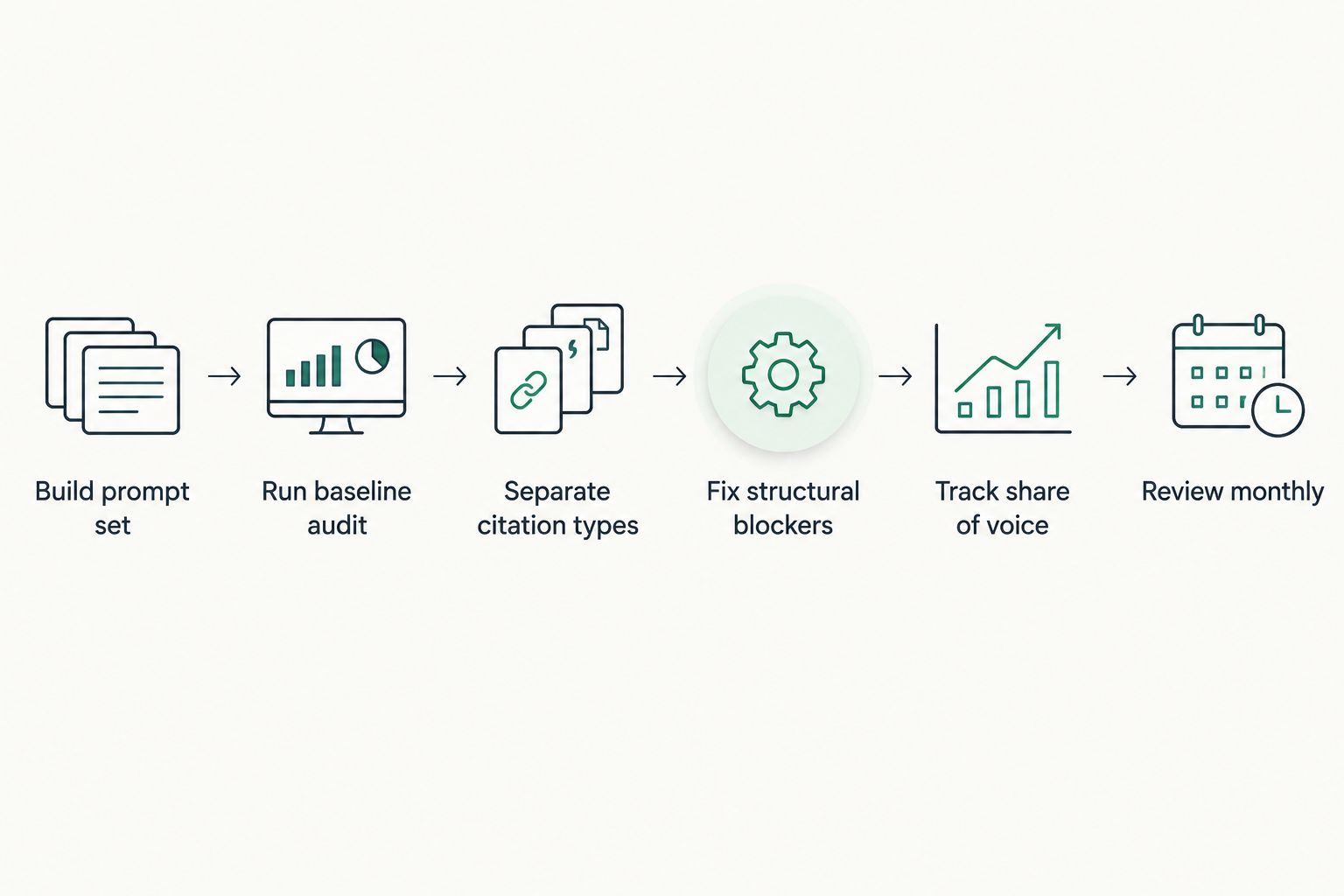
The verdict: an answer engine optimization strategy only works if it starts with a fixed prompt set and a baseline audit, before a single page gets rewritten. Skip the baseline and every later number is just a guess about whether things improved.
What determines whether your AEO strategy works
The factors that separate a strategy that moves citations from one that just produces reports:
- Prompt set breadth. A set of 20 branded prompts tells you nothing about unbranded discovery; you need both.
- Intent weighting. Not every prompt matters equally — weighting prompts by buyer intent stops low-value chatter from diluting the score.
- Cross-platform coverage. A brand cited heavily in Perplexity and invisible in Gemini has a real gap, not a win.
- Content structure. Direct-answer paragraphs, comparison tables and FAQ schema are what AI models pull from, not marketing copy.
- Refresh cadence. Models re-crawl and re-weight sources; content that hasn't changed since 2024 loses ground to fresher pages.
- Reporting cadence. A strategy nobody reviews monthly drifts; AI visibility moves faster than the quarterly marketing review cycle most teams still run.
See where your brand gets cited
Track AI Visibility Score and citations across six platforms in one dashboard.
Is answer engine optimization the same as SEO?
No — answer engine optimization measures whether a model names and cites your brand inside a generated answer, while SEO measures whether a page ranks in a results list. The two overlap on technical basics like schema and page structure, but the metrics diverge completely: SEO tracks rank and organic sessions, AEO tracks citation rate and Share of Voice across ChatGPT, Gemini, Perplexity, Claude and Copilot.
How long does it take to see AI visibility results?
There's no fixed timeline in the data, because model updates and re-crawling happen on the AI provider's schedule, not yours. What a monthly benchmarking review does show is direction — whether your citation rate and Share of Voice moved between reviews, which is a more reliable signal in 2026 than waiting for a single before-and-after snapshot.
Do you need a tool to track answer engine optimization?
Running the same prompt set by hand across five or six AI platforms every month is the practical limit for a person without software, and most teams hit that limit fast. Measuring Share of Voice in AI search results manually means logging into each platform, running each prompt, and recording what got cited — Koalr automates that tracking across ChatGPT, Gemini, Perplexity, Claude and Copilot so the monthly review takes minutes instead of a full afternoon.
FAQ
What is answer engine optimization?
Answer engine optimization is the practice of getting a brand named and linked inside AI-generated answers from tools like ChatGPT, Gemini, Perplexity, Claude and Copilot. It's measured through citation rate and Share of Voice, not organic rank.
Is answer engine optimization the same as GEO?
Yes — generative engine optimization (GEO) and answer engine optimization (AEO) describe the same discipline: optimizing content so AI models cite it in generated answers.
How do I start an answer engine optimization strategy in 2026?
Start with a prompt set built from real buyer questions, then run a baseline audit across the major AI platforms before changing any content. The audit is what tells you if later changes actually worked.
What's the difference between a mention and a citation in AI answers?
A mention names your brand without a source link; a citation links back to a specific page on your site. Citations are the ones that can drive traffic and matter more for AEO tracking.
Does schema markup help AI citation rates?
Structured schema, especially FAQ schema, helps AI models parse and quote a page more reliably, but it's a structural fix, not a substitute for having answer-shaped content in the first place.
How often should I check AI visibility?
A monthly benchmarking review is the practical cadence in 2026, since AI models update and re-crawl faster than quarterly marketing cycles account for.
Can I track answer engine optimization without a tool?
You can run prompts manually across each platform, but tracking six platforms every month by hand is slow and inconsistent. Dedicated tracking is what makes month-over-month comparison reliable.
Do unbranded prompts matter for AEO?
Yes — unbranded prompts show whether AI models recommend you during discovery, before a buyer knows your name, which is a different and often more valuable signal than branded citation rate.
One last thing
Most teams building an answer engine optimization strategy in 2026 spend the first month writing content and the audit never happens — which means three months later nobody can say whether the citation rate actually moved or whether the model just changed its own weighting. Run the baseline audit first, even if it takes a week longer than you'd like.


