Yes—AI mode SEO tracking is worth it for small teams when the findings change which pages you improve, which brand errors you correct or which competitors you investigate. The hidden commitment is staff time: someone must review the answers, make changes and check the results. Start with a bounded pilot, not a reporting programme with no owner.
- Is AI mode SEO tracking worth it for small teams? Yes, when findings lead to specific content or brand corrections.
- Google AI Mode and Google AI Overviews are separate surfaces; verify exactly what your tracking covers.
- Koalr helps marketing teams track brand visibility across AI answers; confirm coverage for your required search surface.
- Keep citations, mentions, recommendations and referral traffic separate. They answer different questions.
Why this matters
A referral report measures visits. It does not record a recommendation that someone reads without clicking, or a competitor named instead of your brand. Answer tracking addresses that different question: what does the buyer see before reaching a website?
For a small marketing team in 2026, the decision is about workload as much as visibility. A dashboard earns its place when it helps you choose the next useful action; another number to explain at a meeting does not.
Start by documenting the questions you intend to monitor. The guide to building a prompt library for AI visibility tracking provides a separate workflow for organising that scope.
Is AI mode SEO tracking worth it for small marketing teams?
Yes, if you have commercially relevant questions to monitor and the capacity to act on the answers. Wait if you cannot name the decision the tracking will support. Neither team size nor an impressive visibility score establishes the business case.
Choose your approach around the question you need answered:
| Approach | Best for | What it helps you assess | Limitation | Verdict |
|---|---|---|---|---|
| Manual answer checks | Establishing an initial baseline | Exact wording, cited sources and competitor appearances in recorded answers | You must preserve the evidence and repeat the checks yourself | Start here when scope is narrow |
| Dedicated answer tracking | Repeated monitoring across a defined prompt set | Changes in the sampled answers, subject to the platform's coverage | Coverage and measurement definitions need checking; tracking does not make the fixes | Evaluate when repeated checking becomes a recurring task |
| Referral analytics | Measuring visits and on-site outcomes | Sessions and conversions attributed to identifiable referrals | It cannot show an answer that produced no visit | Keep alongside answer tracking |
These approaches are complementary, not interchangeable. Manual checks establish what you are observing, dedicated tracking supports repetition, and referral analytics measures what happens after a recorded visit.
For your 2026 evaluation, write a decision statement before choosing software: ‘Use the findings to prioritise buyer-facing pages where competitors receive recommendations and our brand does not.’ That is more actionable than ‘increase our AI score’.
Define what “AI mode SEO tracking” means
Google AI Mode, Google AI Overviews and answers from standalone assistants are not interchangeable reporting categories. Record the specific surface you want to measure rather than treating an AI-related product label as proof of coverage.
Ask a prospective provider to demonstrate the required surface with an actual captured answer. Check the prompt, capture date, location, language and cited sources; then establish which settings remain consistent between checks.
Do not accept a Google AI Overviews example as evidence of Google AI Mode coverage. Likewise, an answer from Gemini does not establish what appeared in either Google Search surface.
This distinction matters when reviewing Koalr or any other AI visibility platform. Confirm the exact surface first; assess the reporting second. Otherwise, you risk making a valid measurement of the wrong experience.
Measure the answer, not just your name
Use separate fields for mention, citation, recommendation and referral visit. These are working definitions for your reporting, not claims that every tracking platform uses identical terminology.
| Signal | Working definition | What it does not establish |
|---|---|---|
| Mention | The answer names your brand | That the answer endorses your brand |
| Citation | The answer identifies a source through a reference or link | That your brand is the recommended choice |
| Recommendation | The answer presents your brand as suitable for the stated need | That the reader visits or buys |
| Referral visit | Analytics records a visit attributed to an answer service | What every reader saw before the visit |
An answer can cite your educational content while recommending another supplier. It can also name your brand while describing it incorrectly. Counting either outcome as an unqualified success hides the work you need to do.
Retain the answer text alongside its classification. When someone challenges the report, you should be able to show the evidence rather than defend a score whose meaning nobody agreed.
Run a bounded pilot before expanding
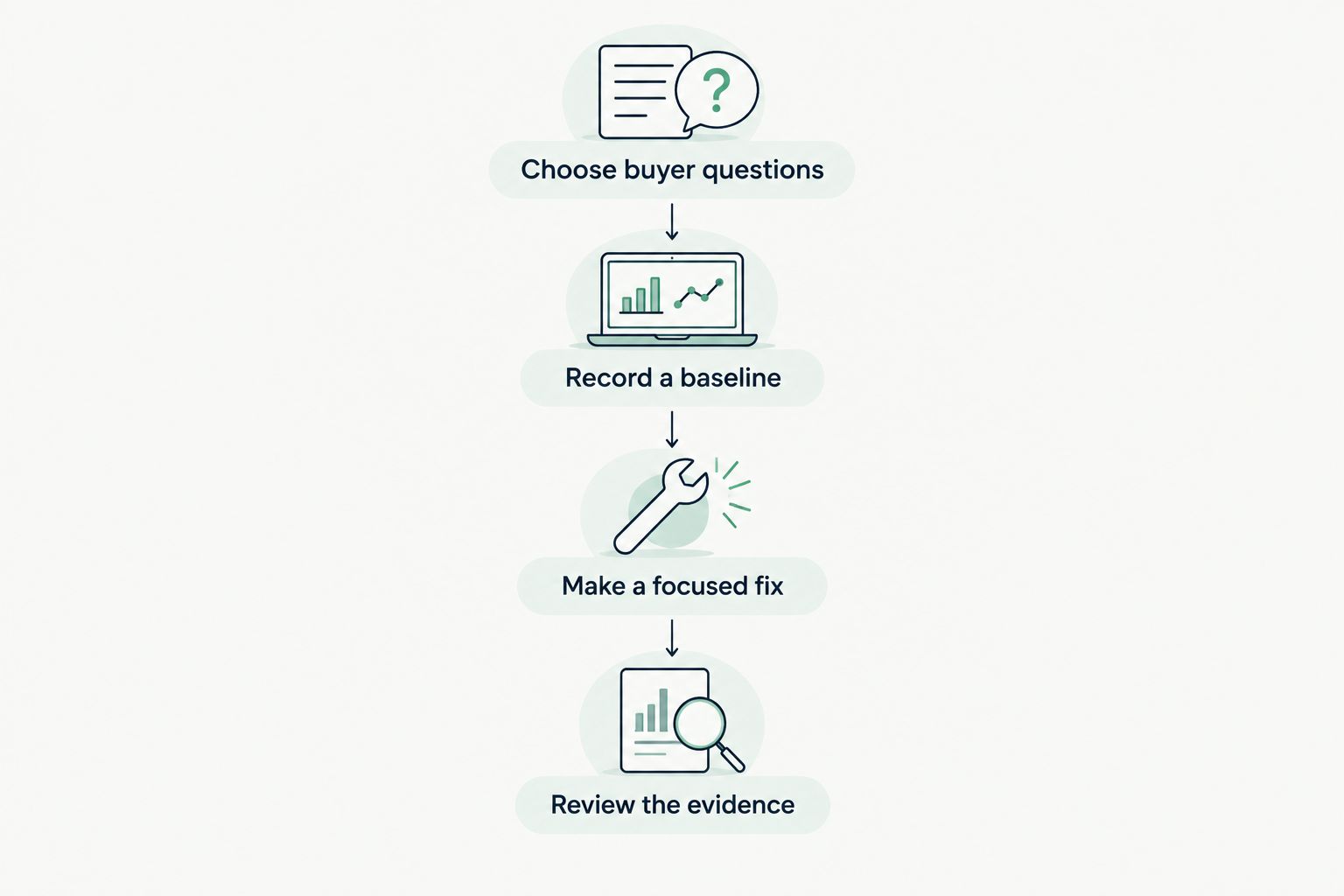
Use this proposed pilot for a 2026 evaluation: 12 prompts, 2 relevant answer surfaces and 4 weeks of review. These are starting constraints for managing workload, not industry benchmarks or a statistically representative sample of your market.
The pilot should establish whether the findings are useful enough to justify continued monitoring. It should not promise a ranking improvement or prove that every change in an answer came from your work.
Choose buyer questions
Build the 12-prompt set from questions your team already encounters in sales conversations, customer research or content planning. Include discovery, comparison and suitability questions rather than only prompts containing your brand name.
For example, a branded question tests how an answer describes you after the user supplies your name. An unbranded category question tests whether the answer introduces you at all. Keep those results separate.
Write each prompt exactly as you intend to repeat it. Changing the question and the page simultaneously makes the comparison harder to interpret.
Record a baseline
Choose 2 answer surfaces based on their relevance to your buyers and your ability to inspect them consistently. Do not assume that presence in one predicts presence in another.
For each recorded answer, save the prompt, surface, date, language, location where available, brand mentions, cited sources and recommendations. Include factual errors and the page you would investigate next.
Keep capture conditions documented. If the interface or settings change, mark the comparison rather than silently treating the observations as identical.
Make a focused fix
Choose a finding that leads to a specific action. Examples include correcting an inaccurate product description on your own site, clarifying an eligibility condition or improving a page that leaves a buyer question unanswered.
Assign an owner and record the publication date. Avoid changing unrelated pages simply to create more activity for the pilot report.
A competitor recommendation is a research lead, not an instruction to copy the competitor's page. Inspect the question, answer and sources before deciding what your content lacks.
Review the evidence
At the end of 4 weeks, review the captured answers, completed fixes and unresolved questions. Compare the same prompts under the documented conditions, and separate observed changes from explanations you have not established.
The useful output is a decision: continue the scope, revise the prompt set or stop recurring tracking. A pilot that identifies no actionable work does not justify expansion merely because the dashboard is available.
Why the value of tracking varies
The same reporting process can support a useful decision or consume time without changing anything. Evaluate these factors before adding more prompts or surfaces:
- Buyer relevance. A prompt should reflect a question your audience asks, not simply produce an answer that mentions your company.
- Surface coverage. Your conclusions apply to the environments you actually checked, not every assistant or search experience.
- Actionable findings. A factual error, an unanswered buyer question and an unexplained competitor recommendation require different responses.
- Implementation capacity. Findings need an owner who can change content, investigate sources or coordinate a correction.
- Measurement consistency. Keep prompt wording and capture conditions documented so comparisons remain interpretable.
For a small team in 2026, expansion should follow a useful finding and a completed response. Adding scope before establishing that connection creates a larger review queue, not a stronger business case.
Where dedicated software earns its place
Koalr is best for marketing teams that need to track and improve brand visibility in AI answers, rather than measure referral clicks alone. Its stated scope covers answers from ChatGPT, Gemini, Perplexity, Claude, Copilot and Google AI Overviews.
That makes Koalr relevant when the problem is understanding how your brand appears across those answer environments. The boundary is equally important: that stated scope does not, by itself, establish Google AI Mode coverage or guarantee that monitoring will improve your results.
Use the pilot evidence to assess a platform. Ask whether you can inspect the underlying answer, understand the measurement definitions and connect findings to work your team can complete. Confirm each capability rather than assuming it from a category label.
Choose software for a repeatable workflow, not a promised visibility outcome. A tool subscription cannot substitute for accurate source material, clear buyer-facing pages or someone responsible for acting on the findings.
How do you decide whether to continue?
Keep the 2026 review focused on decisions, completed work and attributable outcomes. Do not turn every appearance in an answer into a revenue claim.
Can you connect a finding to a completed action?
A useful record names the prompt, the observed issue, the supporting answer, the owner and the change made. This shows how tracking influenced your team's priorities without pretending the action has already delivered commercial value.
If the report repeatedly produces observations nobody acts on, reduce the scope or pause it. More frequent reporting will not resolve a missing owner.
Can you separate visibility from commercial results?
Report answer appearances separately from referral visits, leads and sales. Describe the attribution method when you connect a commercial outcome to a recorded visit or customer response.
Do not assign revenue to an uncaptured recommendation. Visibility provides evidence about an answer; it does not identify every person who read it or what they did next.
Can you distinguish change from causation?
A different answer after a page update is an observation, not proof that the update caused the difference. Preserve both captures and note other changes in prompts, settings or surfaces.
Continue when the process produces useful evidence and manageable work. Stop treating the pilot as an experiment capable of proving more than its design supports.
FAQ
Is AI mode SEO tracking worth it for a small marketing team?
Yes, when the findings guide specific content improvements, brand corrections or competitor investigations. Start with a bounded pilot and assign an owner before expanding recurring monitoring.
Can I track AI answers manually instead of buying software?
Yes, manual checking is a valid starting point for a narrow prompt set. Save the exact questions, answers, dates and conditions so you can compare evidence rather than rely on memory.
Does Google AI Overviews tracking include Google AI Mode?
Google AI Overviews tracking does not establish Google AI Mode coverage. Ask the provider to demonstrate the exact surface you need before choosing a platform.
Will tracking AI answers improve my Google rankings?
Tracking AI answers does not itself improve Google rankings. It records evidence that can inform your work; any ranking changes require separate measurement.
How many prompts should a small team start with?
Start with 12 prompts as a proposed pilot scope, not a market benchmark. Choose questions from buyer research and keep branded and unbranded results separate.
How long should an initial tracking pilot last?
Use 4 weeks as a proposed review window for evaluating workload, findings and completed actions. That window is not a guaranteed deadline for new citations or commercial results.
Can AI referral analytics replace answer tracking?
No, referral analytics measures recorded visits rather than every answer appearance. Keep referral outcomes separate from mentions, citations and recommendations.
One last thing
A citation is not necessarily a recommendation. Before celebrating a visibility increase, read the sentence that names your brand and the section that tells the buyer what to choose.
Put that distinction in your next review. Ask: ‘Did the answer use our content, name our brand or recommend our offer?’ Those are different outcomes, and each points to a different next move.