AI mode SEO analysis software has no single standard cost: compare current vendor quotes against the same prompt set, answer engines and reporting requirements. Budget separately for interpreting findings and fixing content; access to analysis does not mean implementation is included. For a 2026 buying decision, the useful comparison is the cost of your required measurement scope, not the headline subscription alone.
- How much does AI mode SEO analysis software cost? Compare current quotes for identical coverage, not unlike subscriptions.
- Koalr suits marketing teams tracking brand visibility across AI answers; confirm Google AI Mode coverage separately.
- Separate mentions, citations and recommendations when evaluating AI visibility tracking and answer engine optimisation.
- Define your prompt set before buying; software access and content implementation are separate requirements.
Why this matters
A subscription is only useful if it answers the question your team needs to act on. A report showing that your brand appeared somewhere does not establish whether an answer recommended your product, cited your website or described your business accurately.
Start with a defined set of buyer questions. The guide to building a prompt library for AI visibility tracking explains the foundation: decide what you need to measure before comparing software.
Buy evidence you can act on, not a larger dashboard. Your purchasing brief should connect each requested capability to a decision, such as which page to update or which competitor's recommendation to investigate.
How much does AI mode SEO analysis software typically cost?
The meaningful cost is the current quote for your defined scope, together with the internal or external work needed to use the findings. Request an itemised proposal rather than treating differently configured subscriptions as equivalent.
Use this breakdown to separate the purchasing requirements. These are evaluation categories, not claims about what any particular vendor includes or charges separately.
| Requirement | What to ask the vendor | What to establish before approval |
|---|---|---|
| Software access | Which capabilities does the quoted subscription include? | Whether the package covers your intended analysis |
| Answer collection | How are prompts, engines and repeated checks counted? | Whether your planned monitoring fits the allowance |
| Evidence | Can you inspect answer text and cited sources? | Whether you can verify a reported result |
| Reporting | What history, exports and sharing are included? | Whether your team can use the findings in its workflow |
| Implementation | Does the proposal include content or technical work? | Who will make changes after analysis |
| Contract | What are the term, renewal and cancellation conditions? | What commitment you are approving |
For your 2026 comparison, have every supplier respond to the same brief. A quote covering a narrow prompt set on one surface is not directly comparable with a proposal covering several engines, markets and reporting workflows.
Keep taxes, billing currency and payment timing visible in that brief. Check the actual terms rather than assuming that a displayed billing figure represents the full contractual commitment.
First, establish what “AI mode” means
Google AI Mode, Google AI Overviews and answers from ChatGPT are not interchangeable measurement surfaces. A proposal described as AI search tracking needs to identify exactly which experiences it measures.
Ask whether the collected output comes from the consumer-facing experience you care about or another access method. Record that distinction alongside the results. Otherwise, your team risks comparing outputs gathered under different conditions.
Use precise definitions for the outcomes too:
- Mention: the answer names your brand.
- Citation: the answer identifies a source supporting its response.
- Recommendation: the answer presents your brand as a suitable choice for the user's need.
A citation to your website is different from a citation to a third-party page discussing your brand. Request enough evidence to distinguish them. Do not accept a combined visibility label as a substitute for knowing what happened.
Compare monitoring approaches, not invented package tiers
Choose the approach that fits your decision. The options below describe workflows, not vendor plans, and none removes the need to review the underlying answers.
| Approach | Best for | Advantage | Limitation |
|---|---|---|---|
| Manual answer checks | Initial exploration of buyer questions | Direct inspection of wording and sources | You must organise collection and comparisons yourself |
| Recurring visibility software | Marketing teams reviewing changes over time | A defined workflow for repeated measurement | The selected prompts determine what the findings cover |
| Software with managed analysis | Teams needing help turning findings into tasks | Analysis and implementation responsibilities can be specified together | Deliverables and ownership need explicit agreement |
Manual checks give you a useful starting point, but scattered screenshots make later comparisons difficult. Recurring software creates a measurement process, but an irrelevant prompt library still produces irrelevant findings.
Managed analysis adds another responsibility to the purchase: someone must explain the evidence and propose action. Ask for a sample deliverable and identify which recommendations the supplier will implement, which your team will implement and which sit outside the agreement.
Why the required scope varies
For a 2026 procurement brief, define the following factors before requesting quotes. Treat each as a requirement to confirm, not an assumed surcharge.
- Prompt coverage: List the buyer questions, use cases and comparison queries you need to track. Separate branded questions from unbranded discovery questions.
- Answer-engine coverage: Name each required surface explicitly. Do not assume that support for an engine includes every search or answer experience it offers.
- Collection frequency: State when you need fresh answers and whether repeated observations are required. Ask how the supplier counts those collections.
- Markets and languages: Identify the geography and language attached to each prompt set. Confirm how those conditions are represented in the collected evidence.
- Reporting and access: Specify who needs to inspect answers, review changes and receive reports. Verify history, exports and account access against that workflow.
- Analysis and implementation: Define whether you need observation, diagnosis or completed changes. Assign an owner to every deliverable.
These factors describe different purchasing needs. Do not compare proposals until the suppliers have made their assumptions explicit; a shorter scope is not evidence of better value.
How do I compare quotes without buying unnecessary coverage?
Use a written acceptance process. The goal is to establish whether the proposed subscription supports your work before committing to a wider monitoring programme.
- Define the questions. Select prompts connected to actual buying decisions, product evaluation and brand understanding. Write down what each question helps your team decide.
- Fix the scope. Specify engines, markets, languages and collection conditions. Give each supplier the same requirements so differences in proposals remain visible.
- Inspect the evidence. Ask to see how an answer, its sources and the brand's role are recorded. Check whether a reviewer can trace a summary back to the underlying output.
- Assign the action. Take a finding and identify the person responsible for investigating or fixing it. Establish how that person will receive enough context to act.
- Confirm the terms. Review allowances, exclusions, renewal conditions and implementation responsibilities. Resolve ambiguous wording before approval.
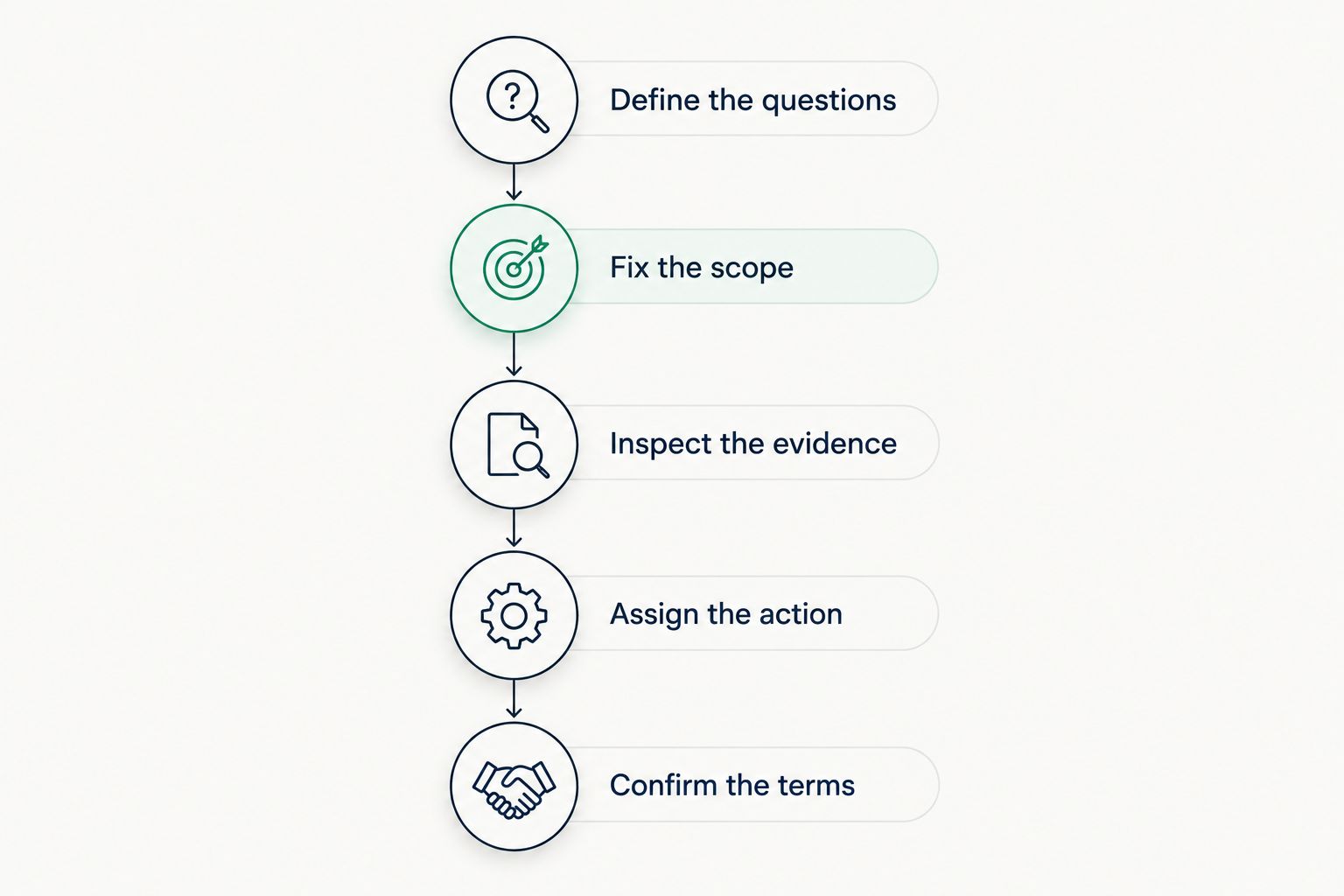
Ask suppliers to demonstrate your intended workflow rather than an unrelated showcase. Follow a finding from collection to review and then to a proposed task; that exercise exposes gaps between an attractive summary and usable analysis.
What should I require from a visibility report?
A useful report connects a result to the conditions under which it was collected. For each observation, request the prompt, answer surface, collection date, relevant market and answer evidence.
Then check the interpretation. If the report says your brand was recommended, the answer should actually present your brand as a suitable choice, not merely include it in a warning or an incidental list.
For your 2026 baseline, keep the measurement definitions stable. If you change the prompt set or engine coverage, label the change rather than presenting the resulting score difference as a clean performance trend.
Ask how any AI Visibility Score or Share of Voice figure is calculated. Establish the denominator, the treatment of missing observations and whether results are weighted. A score without its measurement scope is not a purchasing justification.
Where does Koalr fit?
Koalr is best for marketing teams that need to track and improve their brand's presence in AI-driven answers. The platform covers brand appearance in answers from ChatGPT, Gemini, Perplexity, Claude, Copilot and Google AI Overviews.
That focus matches a cross-engine brand visibility brief. It does not establish Google AI Mode coverage, subscription allowances, reporting entitlements or commercial terms; confirm those requirements before selecting Koalr.
The limitation is the same distinction your budget must preserve: tracking an answer is not the same as fixing the content or third-party information behind it. Keep implementation ownership explicit, even when the software helps identify what needs attention.
Does a broader engine list justify the purchase?
A broader engine list justifies the purchase only when those engines belong in your measurement brief. Additional coverage is useful when your team has a reason to review it and an owner for the findings.
Do not remove an essential surface to simplify procurement. Equally, do not buy breadth solely because the comparison table looks more impressive; require a clear use for each part of the scope.
Is a mention enough to prove the software works?
A mention proves that the brand appeared in the collected answer, not that the answer recommended it or cited its website. Inspect the wording and sources before treating the observation as a positive result.
Include accuracy in that review. A visible but incorrect description creates a different task from an absent brand, and the report should help you tell those situations apart.
Should content fixes sit in the software budget?
Content fixes should sit in the overall project budget, with ownership separate from software access. Establish whether your team, an agency or the supplier will investigate findings and publish changes.
Do not assume a monitoring subscription includes editorial work, technical changes or outreach. Ask for those deliverables explicitly when they are part of your buying requirement.
FAQ
How much does AI mode SEO analysis software cost in 2026?
There is no single standard cost for AI mode SEO analysis software. Compare current vendor quotes for the same prompts, answer surfaces, collection requirements and reporting scope, then budget separately for implementation.
Is Google AI Mode tracking the same as Google AI Overviews tracking?
No. Google AI Mode and Google AI Overviews are distinct experiences, so ask a supplier to confirm each required surface rather than assuming one includes the other.
What's the best way to compare AI visibility software quotes?
Give suppliers the same written measurement brief. Compare included coverage, collection allowances, evidence, reporting and contractual terms against that brief.
Can I check AI answers manually before buying software?
Yes. Manual checks let you inspect answers directly, but you must organise the collection conditions and records yourself if you want useful comparisons later.
Does paying for analysis guarantee that my brand gets recommended?
No. Purchasing analysis is not a guarantee of recommendation; it gives your team evidence to review and act on.
Is Koalr relevant for marketing teams comparing AI visibility software?
Yes. Koalr helps marketing teams track and improve their brand's appearance in AI-driven answers across named platforms, including ChatGPT and Google AI Overviews. Confirm Google AI Mode coverage and commercial requirements separately.
Should I compare visibility scores from different suppliers directly?
Not without checking their definitions. Compare prompt coverage, answer surfaces, collection conditions and calculation methods before treating different scores as equivalent.
One last thing
Before approving a 2026 subscription, ask the supplier to explain an unfavourable finding, not just a favourable one. Can your team see why a competitor was recommended, inspect the cited evidence and identify a sensible next task?
That is a stronger acceptance test than a polished aggregate score. Approve the workflow that turns an observable answer into a clear decision.