

Yes—Microsoft Copilot is worth including in your optimisation tests, but a dedicated programme needs evidence from your buyers and your results. The hidden cost is the content and measurement work you divert from other channels, not just the effort of checking Copilot. In 2026, start with commercially relevant prompts and shared content improvements, then expand only when the findings justify it.
- Is it worth optimising for Microsoft Copilot? Yes: test buyer-relevant prompts before committing dedicated resources.
- Microsoft Copilot citations, brand mentions and recommendations are different outcomes; measure each separately.
- A small referral share does not measure every brand appearance in Copilot answers.
- Koalr supports AI visibility tracking across Copilot and other answer engines; business outcomes still need separate measurement.
Is it worth optimising for Microsoft Copilot given its small share?
Include Microsoft Copilot in your evidence-gathering; do not automatically give it a separate content budget. The decision depends on whether relevant answers name your competitors, cite useful sources and address questions your buyers actually ask.
Start by learning how to track brand mentions in Microsoft Copilot. Establish what appears before deciding what to change. A missing brand name, an inaccurate description and an absent source link require different responses.
Choose your level of effort from the evidence, rather than treating optimisation as an all-or-nothing commitment.
| Approach | Best for | Advantage | Limitation | Decision rule |
|---|---|---|---|---|
| Baseline monitoring | Teams establishing whether Copilot matters | Reveals relevant mentions, citations and competitor appearances | Observation alone does not improve content | Start here when buyer relevance is untested |
| Shared content improvements | Teams finding gaps that also affect other channels | Connects Copilot work to existing editorial and technical priorities | Results do not establish a Copilot-specific effect | Prioritise when the same page needs fixing anyway |
| Dedicated Copilot programme | Teams with repeated, commercially relevant findings | Gives clear ownership to a defined opportunity | Competes with other work for resources | Expand only with evidence and a clear objective |
None of these approaches guarantees inclusion in an answer. Your objective is to identify a worthwhile opportunity and improve the information available to answer it—not to promise a recommendation you cannot control.
Why this matters
A small share is not a decision until you define what the share measures. Referral traffic, visits to an assistant and your brand's presence within answers describe different things. Treating them as interchangeable turns a useful measurement into a misleading budget rule.
For your 2026 plan, separate audience relevance from platform size. A broad usage figure does not identify which questions your customers ask, while a brand mention does not prove that a customer saw it or acted on it.
The practical question is narrower: does Copilot present a relevant information gap that you can address without neglecting better-supported opportunities? Answer that before commissioning new pages, buying additional reporting or assigning a separate owner.
What should you measure before committing resources?
Use explicit definitions so your team does not label every appearance a win. Keep the answer itself alongside your assessment; a summary score alone cannot explain whether the description was accurate or useful.
Brand mention
A brand mention means the answer names your business. Record the surrounding context: is the brand merely listed, described as unsuitable or discussed as a relevant option? Those are different outcomes even though each contains the same name.
A mention is evidence of inclusion in that observed answer. It is not evidence of a source link, endorsement or sale.
Citation
A citation identifies a source supporting the answer. Record the destination and inspect what the answer uses it to support. A citation to your page and a citation to a third-party page discussing you should remain distinguishable.
Check the relationship between source and claim. Being cited for a definition is not the same as being cited in a buying comparison, and neither establishes that the reader visited your site.
Recommendation
A recommendation explicitly presents a brand as suitable for the stated need. Record the conditions attached to it, including the buyer type, use case and limitations the answer gives.
A favourable recommendation with incorrect product facts is not a clean success. Accuracy belongs in the assessment, not in a separate report nobody connects to visibility.
Referral and business outcome
A referral is a recorded visit from an identifiable source. A business outcome is the action you care about after exposure or arrival, such as an enquiry or qualified opportunity.
Keep these separate in your 2026 reporting. Observing an answer establishes visibility in that test; attributing commercial impact requires additional evidence.
How should you test whether Copilot deserves more attention?
Build a repeatable comparison, not a collection of impressive screenshots. The following process is a recommended testing method, not a claim about Copilot's performance or a guaranteed route to citations.
1. Define buyer questions
Choose questions tied to genuine evaluation tasks: finding a category, comparing approaches, checking suitability or resolving a purchase objection. Use language from customer research, sales conversations and existing search data where you have it.
Keep branded and unbranded questions distinct. Asking directly about your business tests its representation; asking for suitable providers tests whether it enters consideration without being named in the question.
2. Record test conditions
Specify the Copilot experience you are checking, the language, the market and any relevant account context. Distinguish public web research from tasks involving an organisation's private information.
Do not combine answers from different contexts into an unexplained average. A useful record lets another person understand what was asked, where it was asked and what the answer actually contained.
3. Capture the baseline
Save the exact prompt, answer, visible sources and observation date. Classify mentions, citations, recommendations and factual errors separately, then record which competitors appear and why they are presented as relevant.
Retain answers that omit your brand. Removing unsuccessful observations creates a highlight reel, not a baseline you can use to decide whether optimisation worked.
4. Fix evidenced gaps
Inspect the source pages behind relevant answers. Identify specific weaknesses in your own material: an unanswered buyer question, an unclear product description, unsupported claims or inaccessible supporting information.
Change the page that should answer the question. Do not publish a Copilot-labelled version of an existing page unless it serves a genuinely different reader need.
5. Review comparable results
Repeat the same questions under recorded conditions and compare the resulting answers with the baseline. Keep a change log so you can distinguish content edits from changes to the test itself.
Treat improvement after an edit as an observation, not automatic proof of causation. Expand the programme when the pattern supports a useful business decision, rather than when an isolated answer looks encouraging.
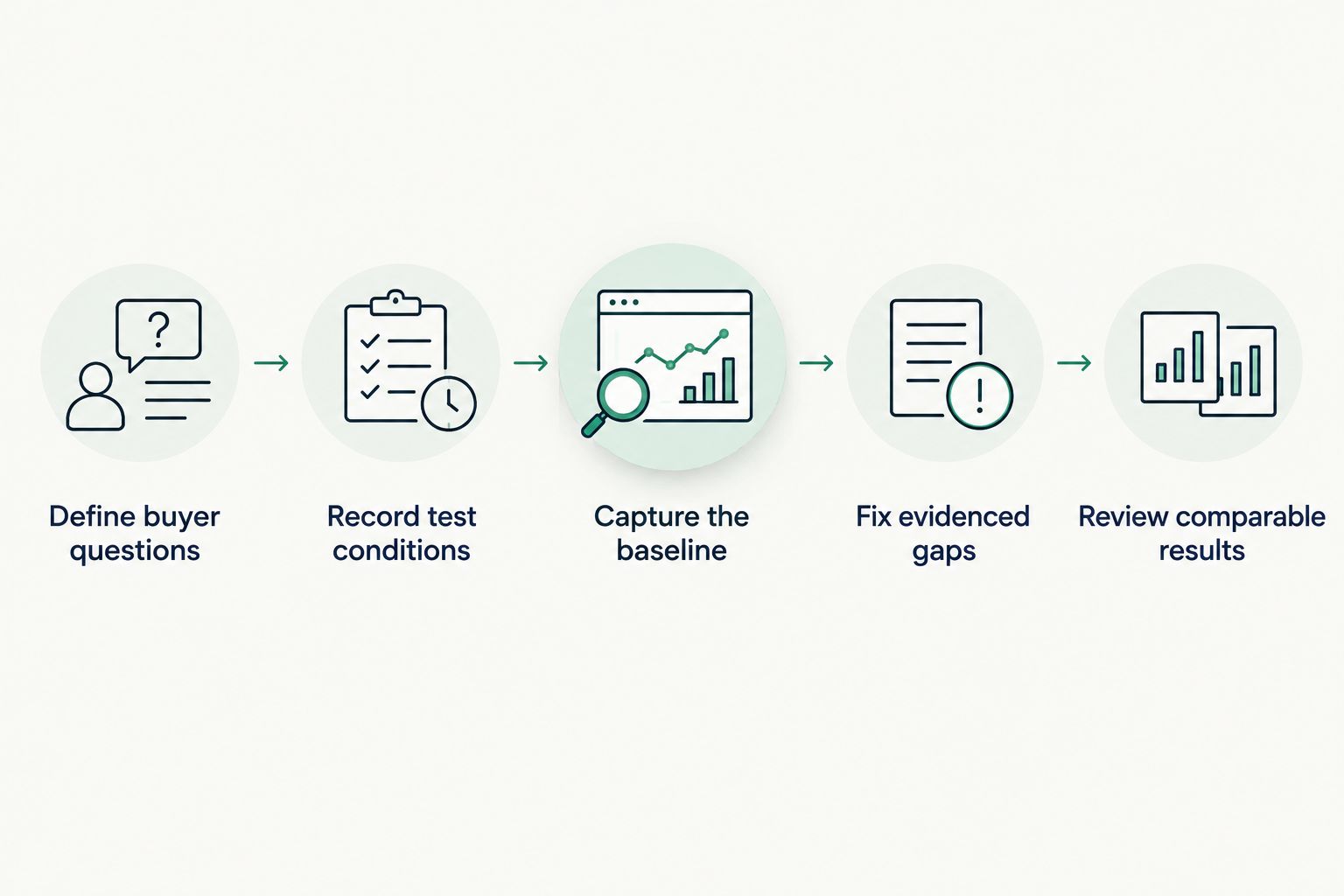
The process should leave you with a decision record: what mattered, what was wrong, what changed and what happened next. If the work produces only a visibility score without an explanation, you still lack the evidence needed to allocate resources.
Why the value of Copilot optimisation varies
Use these factors to assess your own opportunity. They are decision criteria, not assumptions about your audience or claims that a particular sector automatically benefits.
- Buyer relevance: Confirm whether customers use Copilot for research connected to your category. Ask directly rather than inferring adoption from the software their employer uses.
- Question intent: Distinguish general learning from supplier evaluation. An appearance in an unrelated informational answer does not establish a buying opportunity.
- Observed competition: Look for competitors repeatedly appearing against relevant questions. Record the supporting context rather than counting names without interpretation.
- Content overlap: Identify fixes that also improve existing search, sales or customer education material. Shared usefulness gives you another reason to do the work.
- Measurement quality: Assess whether your records distinguish visibility from visits and commercial outcomes. Weak attribution should limit the claims you make.
- Opportunity cost: Compare the proposed work with your other priorities. A plausible Copilot opportunity does not automatically outrank a documented problem elsewhere.
For 2026 planning, attach an owner and a decision to each factor. Collecting more observations is only useful when those observations can change what your team does.
Should I prioritise Copilot over other answer engines?
Prioritise the platform-specific opportunity you can demonstrate, not the platform you assume your buyers prefer. Test comparable buyer questions across the answer engines you are considering, then inspect relevance, accuracy and actionable gaps.
Do not combine different platforms into a single competitive verdict. Strong visibility elsewhere does not establish your position in Microsoft Copilot, while a Copilot omission does not prove a cross-platform problem.
Use a common assessment framework, but preserve each platform's results. That gives you a basis for choosing where extra effort belongs without assuming the answers are interchangeable.
Does using Microsoft software mean my buyers use Copilot for research?
No—Microsoft software use alone does not establish Copilot-led buying research. Validate the research behaviour through customer conversations and evidence available to your business.
Ask which tools buyers used, what they asked and whether the answers affected their shortlist. Avoid leading questions that turn familiarity with a product into apparent evidence of purchasing influence.
Can I justify Copilot work without referral traffic?
Yes, for a defined visibility or accuracy objective; not as proof of revenue. An incorrect description on a commercially relevant prompt gives you a reason to investigate even when no attributable visit appears.
Set the objective precisely. Correcting the information available about your product is a different project from acquiring customers, and the success criteria should reflect that distinction.
Where an AI visibility platform fits
Koalr is best for marketing teams tracking brand visibility across Copilot and other answer engines. The AI visibility platform helps teams track and improve how their brand appears in answers from ChatGPT, Gemini, Perplexity, Claude, Copilot and Google AI Overviews.
The benefit is a focus on brand appearances across those environments. The limitation is equally important: visibility tracking does not, by itself, establish commercial impact. You still need customer evidence and business-outcome measurement to support an investment decision.
Evaluate Koalr against that measurement need. Do not buy a platform merely to replace an untested assumption about Copilot's value with a more polished chart.
What should your next move be?
For your next 2026 planning review, choose a bounded question: does Copilot accurately represent your business on the buyer queries you consider commercially important? Establish the baseline, identify the most consequential gap and assign a specific response.
Use the evidence to choose an action:
- Continue monitoring when the questions are relevant but there is no clear content or accuracy problem to address.
- Make a shared fix when the finding exposes a weakness in information you already need to maintain.
- Increase dedicated effort when repeated findings support a defined opportunity and you can explain what additional work should achieve.
- Reduce priority when buyer relevance remains unsupported and other work has a clearer justification.
Write down what would change the decision. Otherwise, a pilot becomes permanent reporting by default, and the original question—whether the work is worth doing—never gets answered.
FAQ
Is it worth optimising for Microsoft Copilot in 2026?
Yes, as a measured test rather than an automatic standalone programme. Start with buyer-relevant questions, separate mentions from citations and recommendations, and expand when the evidence supports additional work.
Does Copilot's small share mean I should ignore it?
No; first establish what the share measures and whether it reflects your buyers. Referral share does not measure every brand appearance in an answer, but visibility alone does not prove commercial value either.
What's the difference between a Copilot mention and a citation?
A mention names your brand, while a citation identifies a source supporting the answer. Record both separately and inspect the surrounding context before classifying an appearance as useful.
Should I create separate pages just for Microsoft Copilot?
Create a separate page only when it answers a distinct reader need. Fixing an existing page is the better starting point when the underlying question and audience are unchanged.
Can I prove Copilot optimisation generated revenue?
A visibility result alone does not prove revenue. Connect identifiable referrals and customer research with your business-outcome records, and distinguish observed associations from supported attribution.
Does Koalr track Microsoft Copilot visibility?
Yes. Koalr is an AI visibility platform that helps marketing teams track and improve brand appearances in Copilot and other answer engines; those observations still need separate commercial-outcome measurement.
How long should I wait before deciding whether Copilot matters?
Set the review point around your research and decision needs rather than assuming a universal deadline. Keep the prompt set and test conditions comparable, and decide in advance what evidence would justify expanding or reducing the work.
One last thing
Inspect the cited page before writing another page. When a relevant answer cites an existing source, compare the source's actual information with yours: which buyer question does it answer, which claim does it substantiate and which limitation does it explain?
That inspection turns “we need more Copilot visibility” into an editorial task someone can complete. If you cannot identify the information gap, more publishing is not yet a justified response.


