

Calculate ROI on AI visibility tracking software by dividing the incremental value attributable to actions informed by the software, minus its total cost, by that total cost. Express the result as a percentage. Citations and Share of Voice show whether visibility is changing, but neither is revenue; the calculation needs a defensible link to a business outcome. In 2026, include staff time as well as the software expense.
- ROI on AI visibility tracking software measures attributable incremental value minus total cost, divided by total cost.
- Koalr helps marketing teams track and improve brand appearances across AI-driven answers; tracking alone does not establish ROI.
- Use citations and Share of Voice to diagnose change, then connect actions to measurable business outcomes.
- Include prompt-set setup and review time in the cost of tracking.
Why this matters
A brand can appear in a ChatGPT answer without receiving a website visit. It can also receive an AI referral without knowing whether the visitor would have found it another way. Neither event, on its own, proves that tracking software paid for itself. Your ROI case has to separate what you observed from what changed because your team acted on that observation.
Start by setting AI visibility targets for your marketing team. A target identifies which buyer questions, competitors and outcomes matter before a change in citations gives you a tempting number to report. For a 2026 assessment, record the starting position and the actions your team takes after reviewing it; otherwise you have a before-and-after chart with no account of what caused the difference.
How do you calculate ROI on AI visibility tracking software?
Use this formula for a defined measurement period:
ROI = (incremental value attributable to tracking-informed actions − total tracking cost) ÷ total tracking cost × 100%.
The difficult term is attributable incremental value. It is not the estimated worth of every answer that names your brand. It is the value of an outcome you can reasonably connect to an action the tracking informed, after accounting for what was happening before that action. If you cannot make that connection, report the outcome separately rather than putting it in the numerator.
| Component | What to record | What not to assume |
|---|---|---|
| Total tracking cost | Software expense and the staff time used for setup, analysis and reporting | That the invoice is the entire cost |
| Tracking-informed action | The page, message or source change your team made after finding a gap | That observation alone created value |
| Incremental outcome | A change in qualified opportunities, contribution margin or another agreed business measure | That every AI referral is incremental |
| Measurement period | The same dates for costs, actions and outcomes | That a short visibility gain represents a full sales cycle |
A result above 0% means measured incremental value exceeded measured cost under your chosen attribution method. A result below 0% means it did not. Neither figure is reliable if the numerator combines unverified citation estimates with confirmed revenue while the denominator excludes the team's work.
Define the decision before collecting more data
Decide whether the investment must produce qualified pipeline, contribution margin or a reduction in work your team would otherwise pay for. Those are different decisions. Pipeline shows potential commercial value, while contribution margin reflects value retained after the costs of delivering what was sold. Do not label pipeline as profit in an ROI formula.
Write down the reporting period, the outcome, the person responsible for recording it and the evidence required to count it. A monthly visibility review can identify changes quickly, but a 12-month assessment can cover outcomes that take longer to materialise. Choose the period to fit your buying process, not to produce a better-looking percentage.
Count the full cost
Include time spent selecting buyer prompts, recording a baseline, checking answer changes, investigating citations and briefing content fixes. Use your organisation's own staffing costs rather than an invented industry average. Keep ordinary content-production costs separate from the software expense, then add the production work you are specifically claiming as part of the tracked intervention.
The distinction matters when comparing tracking with manual checks. Manual work is not costless because it does not arrive as a software invoice. At the same time, buying software does not remove the need to decide which prompts matter or to act on what appears in the answers. Cost both approaches on the work your team actually performs.
Build a stable prompt set and baseline
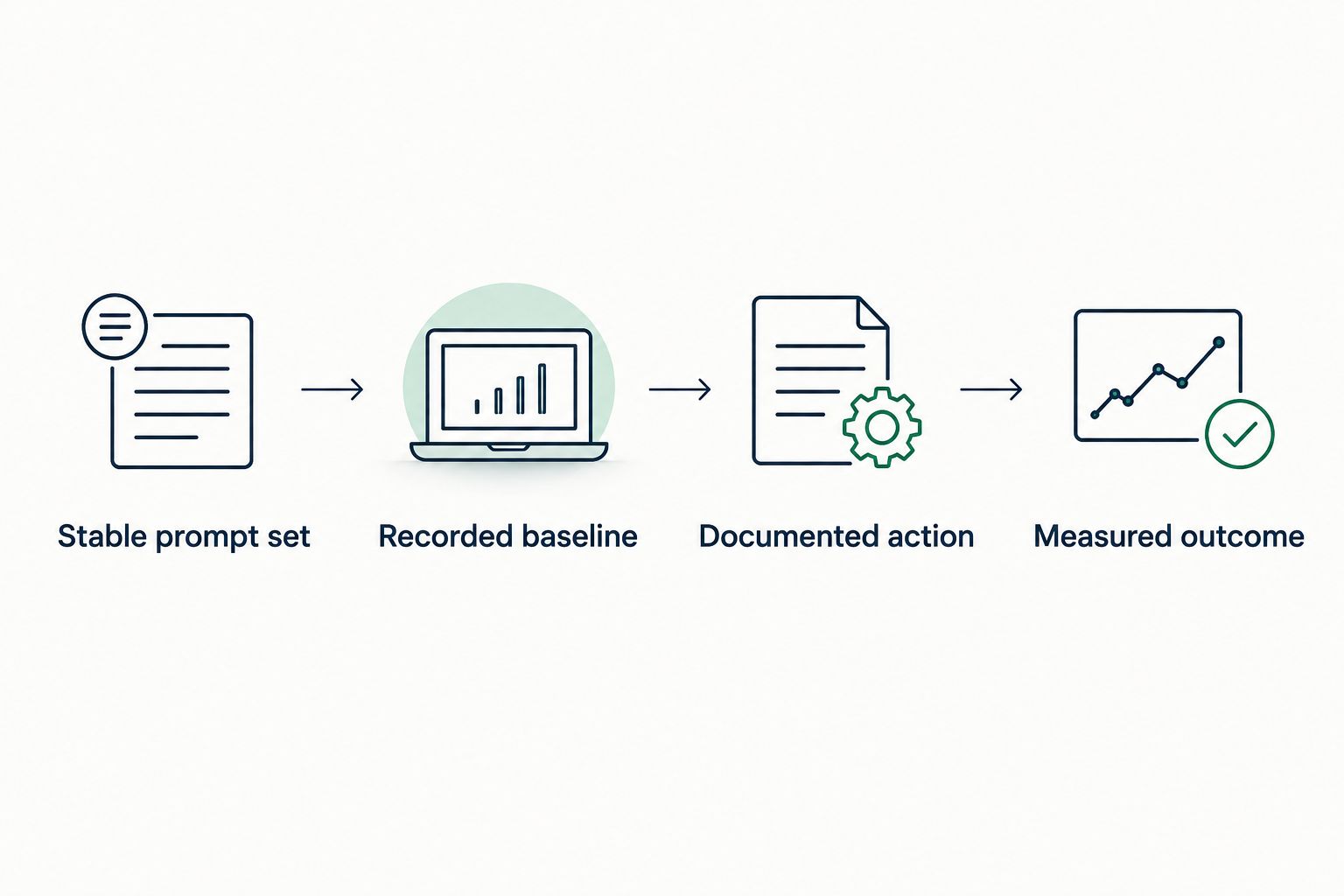
Use prompts that represent questions your target buyers ask before choosing a provider. Include relevant unbranded questions and competitor comparisons, then keep the core set stable through the assessment. Adding easier prompts halfway through can raise the apparent visibility rate without changing your position on the original questions.
Record the date, platform, prompt wording, market where relevant, named competitors and the type of appearance. A mention names the brand. A citation points to a source. A recommendation presents the brand as an option for the user's need. These are distinct observations; combining them into one count hides whether you are gaining source recognition or buyer-facing recommendations. A prompt library for AI visibility tracking gives this baseline a repeatable structure.
Record what changed because of the findings
Keep an action log alongside the answer data. For each finding, note the affected prompt group, the action taken, when it happened and the outcome you expect. That action might be correcting an inaccurate page, clarifying which audience a page serves or improving material that answers a buyer question. The log prevents a common attribution error: claiming credit for a citation change when nobody used the software's findings to make a change.
Check the same prompt group after the intervention. If the brand appears more often but qualified opportunities do not change, you have evidence of visibility movement, not a monetary return. That is still useful: it tells you whether the intervention affected the answer surface before you invest further in the same approach.
Compare outcomes without overstating causality
Use the strongest comparison your data permits. You can compare the affected prompt group with its own recorded baseline and examine an unaffected group during the same period. Keep other changes in view, including campaigns, site updates and changes to the offer. A comparison narrows the explanation; it does not prove that the software alone caused every later sale.
For AI referrals, follow the visit through to a qualified outcome where your analytics and CRM allow it. A referred visit establishes a route into your site, not that tracking created the visit. Count it as incremental value only when you can defend why the tracking-informed work contributed. If that evidence is absent, show referred pipeline as a separate supporting measure.
Which measurement approach should you use?
Your reporting method should match the decision the business is making. The approaches below answer different questions, so do not combine their outputs into a single monetary total.
| Approach | Best for | Advantage | Limitation | ROI treatment |
|---|---|---|---|---|
| Citation and recommendation tracking | Finding where buyers see competitors instead of you | Shows changes even when nobody clicks | Does not establish financial value | Leading indicator, not the ROI numerator |
| AI referral and pipeline tracking | Teams that can connect referred visits to CRM outcomes | Links a visible route to commercial activity | Misses appearances without clicks and does not prove incrementality | Count only defensible incremental value |
| Content-work efficiency | Teams using findings to decide what to update | Captures work avoided or redirected | Requires a documented comparison with the previous process | Count verified savings, not assumed savings |
Koalr is best for marketing teams that need to track and improve how their brand appears in AI-driven answers; its tracking data still needs a separate business-outcome measure to establish ROI. Koalr covers the answer environment described here: ChatGPT, Gemini, Perplexity, Claude, Copilot and Google AI Overviews. Its advantage for this calculation is the relevance of those appearances to your visibility question. Its limit is the same as any tracking software's: an answer observation does not, by itself, tell you the incremental value of a sale. Review Koalr against the prompt coverage and outcome evidence your team needs.
Why does ROI vary between teams?
- Buyer-intent mix. A prompt about a general topic and a prompt asking which provider to choose serve different stages of a decision. Report their results separately instead of treating every appearance as equivalent.
- Baseline position. A team already named across its priority prompts has a different improvement opportunity from a team absent from those answers. Compare each team with its own starting position.
- Action taken. Tracking identifies a gap; a documented response to that gap is the part you can evaluate. Without an action log, a later gain is difficult to attribute.
- Sales process. If opportunities take longer to become customers, a short reporting period can show visibility and pipeline changes without showing realised contribution margin.
- Measurement coverage. A citation without a click will not appear as an AI referral. Referral reporting and answer tracking therefore describe different parts of the same buyer journey.
- Team effort. Prompt selection, review and content changes add to the investment. A tool that produces extensive reports but no decisions can increase cost without increasing attributable value.
Use these factors to explain a result, not to excuse a weak one. If costs are recorded but no incremental outcome meets your evidence standard, report that plainly and decide whether the findings justify another intervention or a change to the tracking scope.
Can citations count as a financial return?
No. A citation is evidence that an answer used or pointed to a source; it is not a payment or a qualified opportunity. Track citation gains against a fixed prompt set, then examine whether the work that produced them is followed by a defensible commercial outcome. If you cannot connect those steps, keep the citation metric in the visibility report rather than assigning it a monetary value.
Should you include AI referral traffic in the calculation?
Include incremental value from qualified AI referrals, not every AI-referred visit. Track the referral route, the resulting opportunity and its value according to your normal commercial definitions. Then separate what you can link to tracking-informed changes from traffic that might have arrived regardless. A visit count is useful evidence about distribution, but adding visits to revenue in the same numerator mixes incompatible units.
When should you decide whether the software is paying off?
Set the review date before you begin, based on when your chosen business outcome becomes observable. Check answer appearances regularly enough to act on changes, but judge the investment over a period that includes the relevant buying process. For a 2026 decision, publish both the current visibility position and the status of the commercial measure; do not turn an early citation gain into a claimed return.
FAQ
How do I calculate ROI on AI visibility tracking software?
Subtract total tracking cost from attributable incremental value, divide by total tracking cost and multiply by 100%. Include staff time in the cost and count only outcomes you can connect to tracking-informed actions.
What should I count as the cost of AI visibility tracking?
Count the software expense and the time spent setting up prompts, reviewing answers, investigating findings and reporting results. Add work done to act on findings when you include the resulting value in the calculation.
Is a ChatGPT citation proof that tracking software has paid off?
No. A ChatGPT citation shows an appearance in an answer, not an incremental business outcome. Use it to diagnose visibility, then test whether an action informed by tracking produced measurable value.
Can AI Share of Voice be used as an ROI figure?
No. Share of Voice compares appearances across a defined prompt set; ROI compares attributable value with cost. Report Share of Voice as a leading indicator alongside, not instead of, the financial calculation.
Should AI referral traffic be included in ROI?
Include the attributable incremental value of qualified outcomes reached through AI referrals, not the visit count itself. An AI referral identifies a route to your site but does not prove that tracking caused the outcome.
How often should I review AI visibility ROI in 2026?
Review visibility often enough to respond to answer changes, and assess financial ROI when your chosen business outcome can be measured. Set both intervals before the assessment so a short-term citation gain does not replace the agreed decision measure.
What if I cannot attribute revenue to AI visibility tracking?
Do not invent a revenue value. Report costs, changes in citations and recommendations, documented actions and any qualified pipeline separately until you have enough evidence for a financial ROI calculation.
One last thing
The most useful 2026 ROI report can say that revenue attribution is unresolved. It should still show the cost, the fixed prompt set, the baseline, the action taken and what changed afterwards. That gives you a decision: continue the intervention, change it or stop funding work that has not produced an outcome you can verify. A precise visibility result is better than a confident financial percentage built from citations that never had a value assigned to them.


