

Setting AI visibility targets means picking a small set of metrics, pinning them to a fixed prompt set, and giving each one a review date — not guessing at a percentage and hoping ChatGPT cooperates. The complete answer: track citation rate, share of voice and sentiment against a locked prompt set, set a 90-day target lift for each, and re-baseline every quarter because AI answers shift without warning.
The part most teams miss is the baseline itself. A target set against last month's numbers can go stale in weeks — model updates, new competitor content and schema changes all move citation rates before your next review.
- Set ai visibility targets for your marketing team using 3-5 metrics: citation rate, share of voice, sentiment.
- Pin every target to a locked prompt set of 20-30 prompts, refreshed each quarter, not mid-cycle.
- Benchmark share of voice against 3-5 named competitors, never the whole category.
- Give every metric a 90-day target lift and an owner, or it stays a wish, not a target.
Why this matters
A marketing team that reports "we're mentioned in ChatGPT sometimes" has no target and no way to know if Q2 2026 was better than Q1. AI Visibility Score, citation rate and share of voice are measurable the same way rankings and conversion rate are — the difference is that nobody has agreed on the numbers yet inside most marketing teams.
That's the gap a target closes. Before setting one, run a baseline check on koalr.ai or an equivalent GEO audit tool across ChatGPT, Gemini, Perplexity, Claude and Copilot, because a target without a baseline is just a guess with more syllables.
How to set AI visibility targets for your marketing team
Follow this sequence in order — skipping step one is why most targets get abandoned by month two.
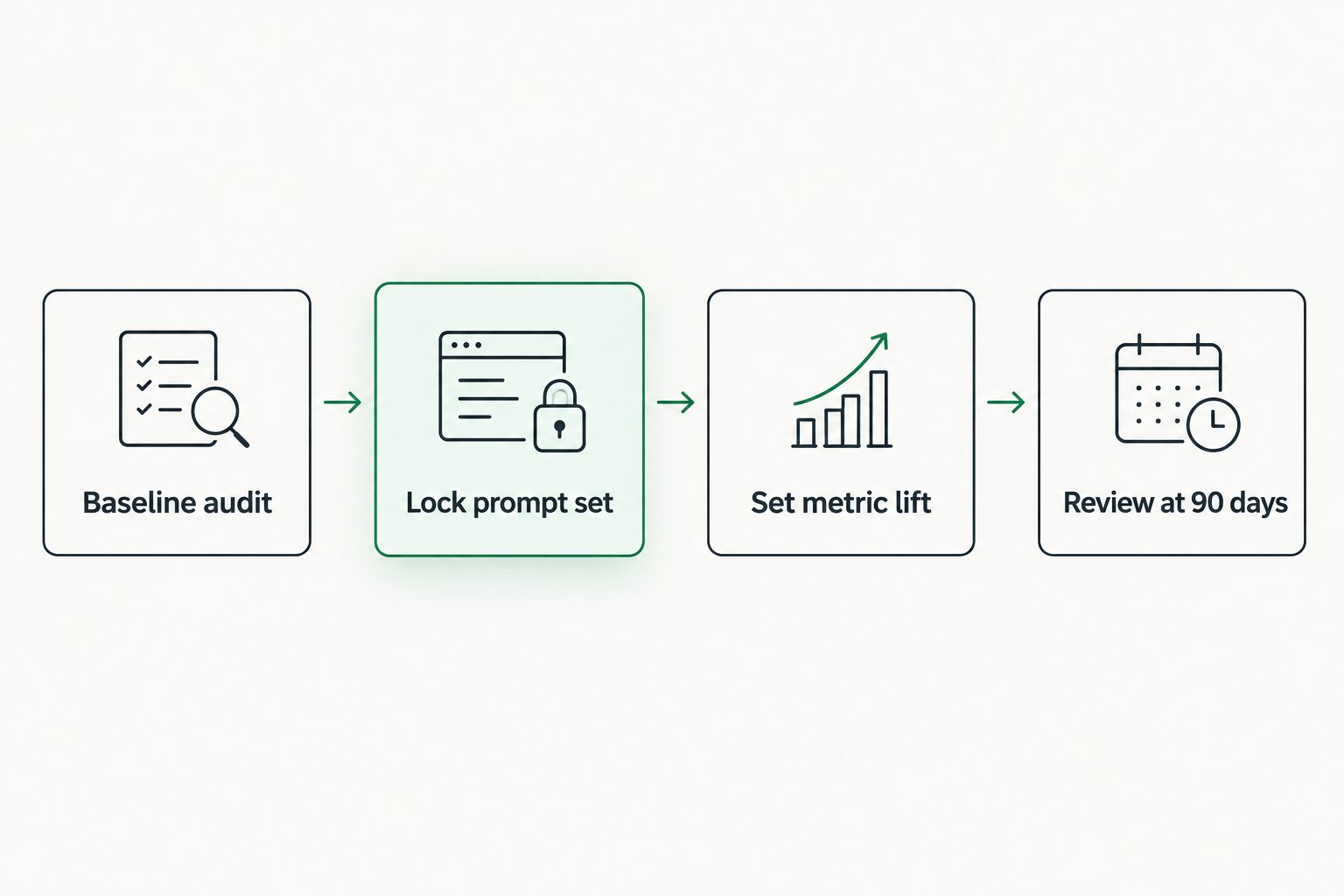
- Run a baseline audit first. Measure citation rate, share of voice and sentiment across every AI platform your buyers actually use before writing down a single target number.
- Lock the prompt set. Build the prompt library before you set targets — 20 to 30 prompts your real buyers ask, fixed for the quarter so the numbers stay comparable.
- Pick 3 to 5 metrics. Citation rate, share of voice, sentiment, and recommendation rate if your category naturally produces comparison answers ("best X for Y").
- Set a lift, not a flat number. If baseline citation rate is 12%, the target is a 90-day lift to a realistic range — not a round number pulled from a slide deck.
- Assign one owner per metric. Ambiguous ownership is why AI visibility targets die quietly between quarterly reviews.
- Re-audit at day 90 and reset the baseline. Extending last quarter's target instead of re-measuring is how teams end up chasing a number that no longer reflects reality.
Citation rate target: benchmark against your own prompt set
Citation rate is the share of prompts in your locked set where an AI answer names your brand with a source link or direct reference. Set the target as a lift from your own baseline, not an industry average nobody has published — if your baseline sits at 12%, a realistic 90-day target is a meaningful lift, tested against the same 20 to 30 prompts every time.
Share of voice target: benchmark against named competitors
Share of voice measures how often your brand appears relative to 3 to 5 named competitors across the same prompt set, not against the entire category. Measure share of voice before setting the target, because a share-of-voice number without a fixed competitor list is meaningless the moment someone swaps in a different rival next quarter.
Sentiment target: track direction, not a single score
Sentiment tracks whether AI answers describe your brand accurately and favorably, or accurately but flat, or inaccurately. The target here is directional — fewer negative or incorrect mentions quarter over quarter — because a sentiment score alone hides whether the AI is repeating a factual error about your product.
Why AI visibility targets vary by team
No two brands should set the same target numbers. What moves the realistic range:
- Category maturity — regulated spaces like finance and legal get fewer AI citations overall than consumer software
- Prompt set specificity — broad prompts ('best CRM') dilute citation rate faster than narrow ones ('best CRM for 10-person agencies')
- Number of named competitors — a 3-way market produces a different share-of-voice ceiling than a 15-way market
- Platform mix — ChatGPT, Perplexity, Gemini and Copilot cite differently, so a blended target hides which platform is dragging the average
- Content velocity — teams publishing and updating pages weekly re-baseline faster than teams publishing quarterly
- Starting visibility — a brand with zero baseline citations in 2026 should target absolute presence before it targets share-of-voice percentage points
Check your AI visibility baseline
See citation rate and share of voice before you set next quarter's targets.
How many prompts should a marketing team lock in a prompt set?
Most teams get reliable, comparable numbers from 20 to 30 prompts covering branded, unbranded and comparison queries. Fewer than that and one AI model update can swing your citation rate; more than that and the review becomes too slow to act on every quarter.
How often should AI visibility targets be reviewed?
A 90-day cycle matches how often AI platforms meaningfully update citations and how often marketing teams already run quarterly reviews. Monthly checks catch sudden drops — a monthly benchmarking review between the quarterly resets flags a competitor's new content before the next full audit.
FAQ
What metrics should be in an AI visibility target?
Citation rate, share of voice and sentiment cover most marketing teams in 2026. Add recommendation rate if your category naturally produces AI comparison answers like 'best X for Y'.
How do you set a realistic AI visibility target?
Run a baseline audit first, then set a 90-day lift from that baseline instead of a flat percentage. A target with no baseline is a guess, not a target.
Is share of voice better than citation rate as a target?
Neither is better on its own — citation rate tells you if you're named at all, share of voice tells you how you compare to 3-5 named competitors on the same prompts.
How many competitors should be in a share of voice benchmark?
3 to 5 named competitors gives a stable, comparable share of voice number. Benchmarking against the entire category makes quarter-over-quarter comparison unreliable.
Should AI visibility targets differ by product line?
Yes, when product lines target different buyers or compete against different named rivals, each line needs its own prompt set and its own baseline in 2026.
How often does an AI visibility baseline need to be refreshed?
Refresh the baseline every 90 days at minimum. Model updates and new competitor content can move citation rate between full quarterly audits, which is why a monthly check between resets catches drift early.
What's a common mistake when setting AI visibility targets?
Setting a flat target number without a locked prompt set. If the prompts change between measurements, the citation rate and share of voice numbers aren't comparable and the target is meaningless.
One last thing
Teams that hit their citation-rate target while sentiment is still drifting negative have solved the wrong problem — the AI is naming the brand more often but describing it incorrectly. Check sentiment direction before locking next quarter's citation target, not after.


