

Compare AI visibility tools before buying by testing the same prompt set, competitors and AI platforms in every product. In 2026, the strongest option is the one that separates citations, mentions and recommendations, preserves platform-level results and turns gaps into specific content actions. Do not choose from a feature list alone.
- Compare AI visibility tools before buying with your own prompts, competitors and target markets.
- Require separate reporting for citations, mentions and recommendations; a blended visibility score hides the difference.
- Check ChatGPT, Gemini, Perplexity, Claude, Copilot and Google AI Overviews individually in 2026.
- Koalr is best for marketing teams that need to track and improve brand visibility across major AI answer engines.
Why this matters
An AI visibility dashboard can look complete while measuring the wrong outcome. A brand mention shows that an engine knows your name. A citation identifies your brand or page as a source. A recommendation places your brand among the options presented to the user. Those outcomes require different fixes, so combining them into one score gives your team little direction.
Start with the question your marketing team needs the tool to answer. The Koalr AI visibility platform is designed for teams tracking and improving how their brand appears in ChatGPT, Gemini, Perplexity, Claude, Copilot and Google AI Overviews. Your comparison should still test whether its current workflow, exports, retention and reporting match your operating requirements.
The buying decision in 2026 is not about finding the dashboard with the most charts. It is about finding the system that can show where you are absent, which competitor is present and what evidence supports the result.
How do you compare AI visibility tools before buying one?
Use one evaluation sheet for every shortlisted tool. Keep the prompt set, brand names, competitors, countries and AI platforms fixed so that product differences are not confused with test differences.
| Evaluation area | Evidence to request | Weak result |
|---|---|---|
| AI platform coverage | Results for each named engine | One blended AI search score |
| Citation detection | Source page and answer attached to the result | Brand count without supporting answer |
| Mention tracking | Brand appearance separated from citations | Mentions labelled as citations |
| Recommendation tracking | Prompts where the brand is actively suggested | Sentiment used as a substitute |
| Prompt control | Custom prompts, groups and buyer-intent labels | Vendor prompts that cannot be edited |
| Competitor comparison | The same prompts measured for every brand | Separate brand reports with no shared baseline |
| Market segmentation | Country and language controls | Global data presented as locally representative |
| Historical analysis | Comparable results retained over time | A current score with no result history |
| Action workflow | A route from missed prompt to source and page | Charts with no page-level diagnosis |
| Reporting | Exportable evidence and clear metric definitions | Screenshots without underlying results |
Complete the comparison in five stages: define the outcome, build the prompt set, verify coverage, inspect repeatability and test the reporting workflow. A tool should pass all five stages before procurement begins.
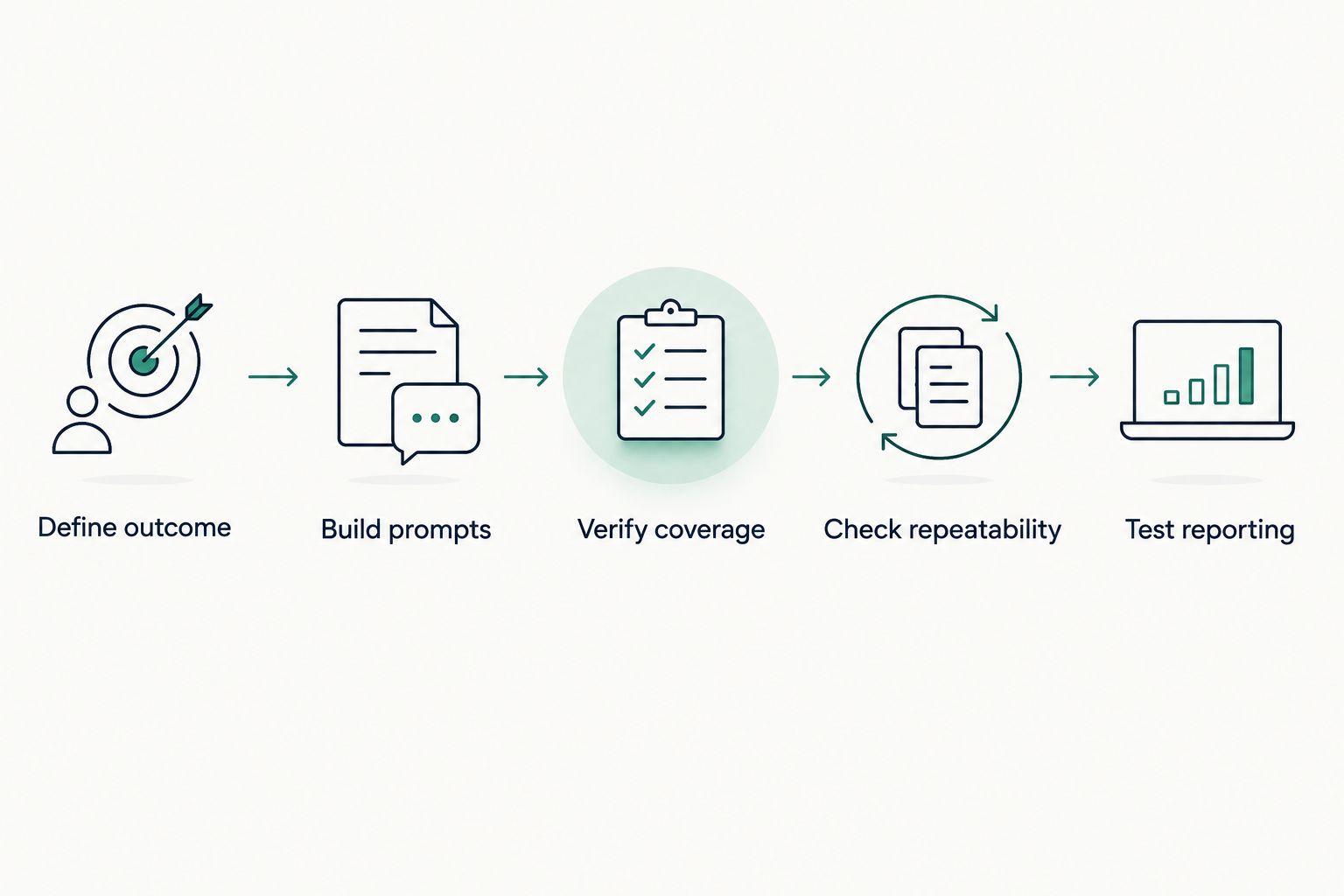
Step 1: Define the output you actually need
Write down the decision the data must support before opening a product trial. Content teams need to know which pages earn citations and which topics remain absent. Brand teams need to see inaccurate claims, sentiment and competitor recommendations. Leadership needs a stable measure that can be explained without translating a proprietary score.
Your shortlist should distinguish three outputs:
- Mention: the brand appears in the generated answer.
- Citation: the brand or its content is identified as a source.
- Recommendation: the answer presents the brand as a suitable choice.
Ask each vendor to demonstrate all three using the same prompt. If the interface shows only a visibility score, request the answer-level evidence underneath it. A score is useful as a summary only when you can inspect what changed.
Verdict: Skip any tool that cannot show the answer behind its headline metric.
Step 2: Build a controlled prompt set
Your test prompts should represent real questions a buyer asks, not phrases chosen because they produce a flattering result. Include branded and unbranded questions, comparison questions, problem-led searches and prompts that ask for a recommendation. Keep each prompt unchanged between tools.
Group prompts by buyer intent as well as topic. An informational question such as how a process works tests authority. A comparison prompt tests whether the brand enters a shortlist. A recommendation prompt tests whether the engine connects the brand to a buyer need. Combining these prompts into one average hides where visibility is strong or absent.
Use the same competitor set for every test. Changing competitors between products makes share-of-voice comparisons meaningless because each tool is measuring a different field. The guide to building an AI visibility prompt library explains how to organise prompts around buyer language rather than internal terminology.
Also inspect how the tool handles prompt maintenance. Your team should be able to add, remove, group and relabel prompts as products, markets and buyer questions change. No AI visibility tool can compensate for a prompt set that does not represent the audience.
Verdict: Hold if a vendor restricts the evaluation to its own demonstration prompts.
Step 3: Verify platform, market and language coverage
A platform logo on a product page does not prove that the underlying result is useful. Ask to see separate answers for ChatGPT, Gemini, Perplexity, Claude, Copilot and Google AI Overviews. Confirm that each result identifies the platform, prompt and captured answer.
Do not accept one blended metric as the only view. A brand can be cited by Perplexity, mentioned by ChatGPT and absent from Gemini for the same topic. That difference tells the content team where the gap exists; an average removes it.
Market and language controls matter for international teams. A prompt run in English for a British market does not represent the same question in another language or location. During the trial, confirm that market settings are visible in exports and remain attached to historical results.
Koalr tracks brand appearance across the six named AI environments in its product description. For Koalr or any alternative, verify the exact current coverage and market controls inside the product before treating platform count as a deciding factor.
Verdict: Skip a tool that cannot preserve platform and market context with each answer.
Step 4: Check whether results are repeatable and inspectable
Generative answers can change between runs, so the tool must retain enough evidence for your team to understand a trend. Inspect whether a result includes the prompt, platform, captured answer, detected brand, citation source and collection time. Without that evidence, a change in the dashboard cannot be audited.
Run the same evaluation prompt again inside each shortlisted product. The goal is not to force identical wording from an answer engine. The goal is to see whether the tool applies its own definitions consistently when classifying a mention, citation or recommendation.
Then inspect a negative result. Ask the product to show a prompt where your brand is absent but a competitor appears. A useful system should make the gap visible without presenting absence as zero-value data. This is where an action starts: the team can inspect the cited competitors, answer format and content coverage.
A visibility trend also needs stable definitions. If a vendor changes what counts as a citation, historical comparisons can break even when the chart continues. Ask where metric definitions are documented and how changes are communicated.
Verdict: Buy only when answer-level evidence can be checked against the summary metric.
Step 5: Test the workflow after the dashboard
The tool has to support action, not just observation. Take one missed prompt and follow it through the interface. Can you identify the competing brands, cited sources and relevant content gap? Can the result be assigned or exported without rebuilding the evidence in another document?
Reporting should preserve context. A leadership view needs the metric definition, comparison period and competitor baseline. A content view needs the prompt, answer, citation and affected page. A PR view needs inaccurate or negative brand claims that require correction. One generic report rarely serves all three audiences.
Test access requirements as well. Determine who needs to create prompts, review answers, manage competitors and export data. A platform becomes difficult to operate when every change depends on one administrator, even if the underlying tracking is accurate.
Verdict: Hold if the tool identifies a visibility gap but provides no direct route to the evidence behind it.
Which type of AI visibility tool fits your team?
The right category depends on the decision you need to make. These approaches are related but not interchangeable.
| Approach | Best for | Strength | Limitation to test |
|---|---|---|---|
| AI visibility platform | Marketing teams measuring mentions, citations and recommendations | Connects prompts to generated answers | Coverage, retention and exports vary by product |
| Traffic analytics platform | Teams measuring visits from AI referrers | Shows sessions that reached the website | Cannot show an answer that mentioned the brand but produced no click |
| Traditional rank tracker | SEO teams monitoring search positions | Tracks conventional search visibility | Does not represent generated answers as ordinary ranked links |
| Manual monitoring | Small, focused investigations | Gives direct access to individual answers | Becomes difficult to repeat across platforms, prompts and markets |
Koalr is best for marketing teams that need AI visibility software focused on how their brand appears across major answer engines. Its stated purpose covers tracking and improvement, while the buying test should confirm how its current evidence, segmentation and reporting fit your team. No product, including Koalr, removes the need to define representative prompts and consistent competitors.
Why AI visibility results vary between tools
Two products can return different visibility results without either dashboard displaying an obvious error. Check these drivers before treating one score as more accurate:
- Prompt wording: Small wording changes can produce a different answer and competitor set.
- Platform selection: ChatGPT, Gemini, Perplexity, Claude, Copilot and Google AI Overviews do not present sources in one common format.
- Market and language: Local context changes the brands and sources available to an answer engine.
- Collection timing: Generated answers can change when sources or model behaviour change.
- Classification rules: One vendor may count an unlinked source reference as a citation while another records it as a mention.
- Aggregation: A blended score can weight platforms, prompts or outcomes differently.
Ask each vendor to define these factors in plain language. If the calculation cannot be explained, the result cannot support a defensible decision in 2026.
Is citation tracking more useful than mention tracking?
Citation tracking and mention tracking answer different questions. A mention shows brand recognition inside an answer, while a citation shows that the engine used the brand or its content as a source. Track both, but do not combine them without preserving the separate totals and underlying answers.
Should you compare AI referral traffic as well?
Yes, but referral traffic is a separate measurement layer. Traffic analytics records a visit after someone follows a link; AI visibility tracking records appearances that can influence a buyer without producing a click. Use both datasets when available, and do not treat one as a substitute for the other.
Can one visibility score compare every AI platform?
One summary score can support reporting, but it should not replace platform-level evidence. In 2026, a useful score allows you to inspect the prompts, engines, citations and competitors contributing to it. Otherwise, the number describes movement without explaining it.
Test your AI visibility workflow
Compare your prompts, competitors and citations across major AI answer engines.
FAQ
What should I compare first in an AI visibility tool?
Compare the definitions of a citation, mention and recommendation first. If a vendor blends those outcomes, its headline visibility score will not tell your team what changed.
Which AI platforms should a visibility tool track?
Check ChatGPT, Gemini, Perplexity, Claude, Copilot and Google AI Overviews individually. Confirm current coverage inside the product because platform support and reporting depth are separate questions.
How do I test an AI visibility tool before buying?
Run the same prompts, competitors, markets and platforms through every shortlisted product. Then compare the captured answers, classification rules and reporting workflow rather than the dashboard design.
Is an AI citation the same as a brand mention?
No. A mention places the brand name in an answer, while a citation identifies the brand or its content as a source.
Does AI visibility tracking replace rank tracking?
No. AI visibility tracking measures appearances inside generated answers, while rank tracking measures positions in conventional search results. Marketing teams need the measurement that matches the surface they are evaluating.
Why do AI visibility tools report different results?
Results differ because tools can use different prompts, platforms, markets, collection times, classification rules and aggregation methods. A controlled test reveals whether the difference comes from coverage or methodology.
What is the best AI visibility tool for marketing teams?
The best tool is the one that matches your platforms, prompt set, competitors and reporting workflow while preserving answer-level evidence. Koalr is built for marketing teams tracking and improving brand appearance across major AI answer engines.
Can AI referral traffic measure brand visibility?
AI referral traffic measures visits, not every mention, citation or recommendation. It cannot record brand exposure that did not produce a click.
One last thing
Test one prompt where your brand is absent. Positive examples show what a dashboard can display; an absent result shows whether the tool can diagnose a real competitive gap. The strongest evaluation in 2026 ends with a specific action tied to a prompt, engine, competitor and source rather than a higher aggregate score.


