

Track AI visibility for seasonal marketing campaigns by measuring the same fixed prompt set before, during and after the campaign, then comparing mentions, citations, recommendations and share of voice. Keep the platforms, prompts, market and review cadence consistent so the 2026 result reflects campaign movement rather than a changed measurement method.
- Track AI visibility for seasonal marketing campaigns with one fixed prompt set and three measurement windows.
- Use branded, unbranded and comparison prompts across ChatGPT, Gemini, Perplexity, Claude, Copilot and Google AI Overviews.
- Separate mentions, citations and recommendations; they describe different levels of AI visibility.
- Koalr helps marketing teams compare seasonal AI visibility against a consistent 2026 baseline.
Why this matters
A seasonal campaign has a defined window, but an AI answer can change by platform, prompt wording and market. A clean prompt library for AI visibility tracking gives you the stable input needed to separate campaign movement from measurement noise.
Referral traffic alone cannot answer the main question. It records a visit after a click, but it does not record every answer that named your brand, cited a page or recommended a competitor without producing a visit. Your 2026 campaign report therefore needs AI visibility data beside traffic, conversions and organic search performance.
This matters most when the campaign changes what buyers ask. A general category query can become a seasonal gift, event, deadline or promotion query, bringing a different competitor set into the answer. If your tracking only covers evergreen prompts, it will miss the campaign's actual discovery surface.
How do you track AI visibility for seasonal marketing campaigns?
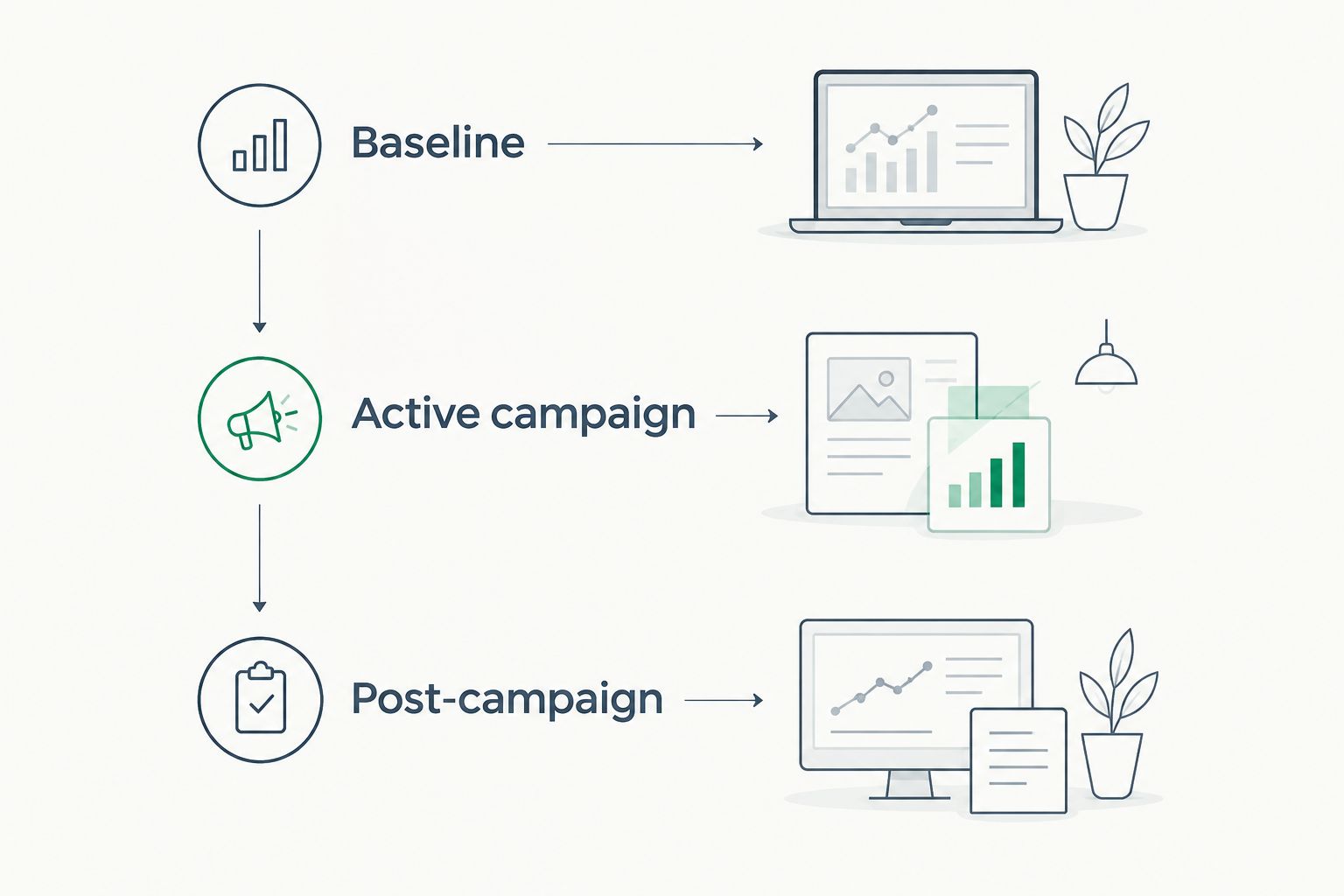
Use a six-step process built around three measurement windows: baseline, active campaign and post-campaign. The supporting evidence is the change within the same prompt set, not a comparison between unrelated prompt samples.
- Define the campaign window. Record the launch date, end date, target markets, product lines and buyer groups included in the campaign. This prevents an unrelated market or product from entering the 2026 comparison later.
- Build the seasonal prompt set. Include branded, unbranded and competitor-comparison prompts. Every prompt should map to a campaign topic, buyer question or decision your content is intended to influence.
- Capture a pre-campaign baseline. Run the complete prompt set before campaign activity begins. Record whether your brand is mentioned, cited or recommended, which page receives the citation and which competitors appear.
- Repeat the same checks during the campaign. Keep prompt wording, platform coverage and market settings unchanged. Use a fixed weekly checkpoint for a longer campaign or a tighter fixed cadence when the campaign window is short.
- Investigate changes at prompt level. An aggregate score shows direction, but the prompt-level answer reveals what moved. Check whether your brand gained a citation, lost a recommendation or appeared with inaccurate positioning.
- Run a post-campaign comparison. Repeat the prompt set after campaign activity ends. Compare baseline, active and post-campaign results to distinguish temporary visibility from visibility that remains after the seasonal message stops.
The baseline must exist before campaign content, PR and paid activity affect the answer set. Reconstructing it after launch creates a false comparison because the campaign has already changed the sources available to answer engines.
Build the seasonal prompt set around buyer intent
Start with the evergreen prompts already used for brand tracking, then add seasonal modifiers that match the campaign. Do not replace the evergreen set. Keeping both lets you see whether the campaign improved visibility only for seasonal demand or lifted the wider category position as well.
Use three prompt groups:
| Prompt group | What it tests | Example structure |
|---|---|---|
| Branded | Accuracy and positioning when the buyer already knows the brand | Is [brand] suitable for [seasonal need]? |
| Unbranded | Discovery when the buyer asks about the category or problem | What should I use for [seasonal need]? |
| Comparison | Recommendation strength against named alternatives | Which is better for [seasonal need], [brand] or [competitor]? |
Branded prompts expose factual errors and outdated campaign information. Unbranded prompts show whether your brand enters discovery without being named first. Comparison prompts show whether the answer merely includes the brand or actively selects it.
Segment the prompt set by buyer intent before calculating a total score. An informational prompt and a purchase-oriented comparison prompt do not carry the same commercial importance. A documented method for weighting prompts by buyer intent stops a large group of low-priority prompts from hiding losses on the questions closest to a decision.
Keep every prompt specific enough to produce an answer you can classify. Broad prompts create long, inconsistent responses with weak campaign relevance. A usable prompt contains a clear category, audience, market or seasonal situation.
Measure mentions, citations and recommendations separately
A mention, citation and recommendation are not interchangeable:
- Mention: the answer names the brand but does not necessarily link to it or favour it.
- Citation: the answer identifies a page or source supporting part of the response.
- Recommendation: the answer presents the brand as a suitable choice for the user's stated need.
One answer can contain all three, but it can also mention a brand negatively, cite its page without recommending it or recommend it without linking to a first-party source. Combining these events into one count removes the distinction your marketing team needs to act.
Track these fields for every prompt run:
| Platform | Record for each seasonal prompt |
|---|---|
| ChatGPT | Mention, citation, recommendation and named competitors |
| Gemini | Mention, citation, recommendation and named competitors |
| Perplexity | Mention, citation, recommendation and named competitors |
| Claude | Mention, citation, recommendation and named competitors |
| Microsoft Copilot | Mention, citation, recommendation and named competitors |
| Google AI Overviews | Mention, citation, recommendation and named competitors |
Calculate citation rate as cited prompt runs divided by eligible prompt runs, expressed as a percentage. Calculate share of voice as your brand's tracked appearances divided by all tracked brand appearances within the selected prompt group. Apply the same definition throughout the 2026 campaign; changing the denominator halfway through invalidates the trend.
Add answer sentiment and factual accuracy as review fields, not replacements for visibility. A visible but inaccurate answer requires a different fix from an accurate answer that never recommends the brand. Preserve the answer text or an auditable record so the team can verify why a classification changed.
The Koalr AI visibility platform is best for marketing teams that need one repeatable view of citations, mentions and recommendations across major AI answer engines. Its advantage is consistent multi-platform tracking; its limitation is shared by every visibility platform: sampled prompt monitoring cannot represent every answer generated for every user and context.
Measure your seasonal AI visibility
Track citations, recommendations and share of voice against a consistent campaign baseline.
Why seasonal AI visibility varies
Seasonal AI visibility changes for reasons your report must isolate:
- Prompt mix: Seasonal buyers use different modifiers, occasions and comparison criteria from evergreen buyers.
- Competitor activity: Other brands publish campaign pages, guides and supporting coverage during the same period.
- Source changes: New pages become available while existing pages are updated, removed or made less relevant to the prompt.
- Market differences: A campaign can be active in one country or language while answers in another market reflect different sources.
- Campaign timing: The baseline, active and post-campaign windows expose different versions of your content and external coverage.
- Answer type: A direct recommendation, cited explanation and product comparison create different opportunities for the brand to appear.
Do not treat every movement as a content problem. If visibility falls on only one platform, inspect that platform's answers and cited sources. If the loss appears across all six platforms for the same prompt cluster, inspect the campaign page, supporting content and third-party sources associated with that topic.
The corrective action should match the failure. Fix factual gaps when the answer is wrong, strengthen direct answers when the page is vague, and create missing comparison content when competitors appear but your brand does not. Re-run the affected prompts without changing their wording so the next result remains comparable.
How often should you check seasonal AI visibility?
Use a fixed cadence that fits inside the campaign window and keep it unchanged. A weekly checkpoint works for longer 2026 campaigns, while a short launch or event needs enough checkpoints to capture a baseline, active result and post-campaign result without changing the prompt set between runs.
Consistency matters more than adding random checks after an unexpected answer. If an issue needs immediate investigation, label the extra run separately rather than mixing it into the scheduled campaign trend.
Should you change prompts while the campaign is running?
Do not edit the core prompts during the active comparison. A wording change creates a new test, so retain the original prompt and add the new version as a separate exploratory prompt outside the core 2026 trend.
This rule does not stop you from discovering new buyer questions. It stops those discoveries from rewriting the baseline after results have started arriving.
Is AI referral traffic the same as AI visibility?
No. AI referral traffic measures visits attributed to an AI source, while AI visibility measures whether an answer mentions, cites or recommends the brand. A seasonal campaign can gain citations without generating a click, so both datasets belong in the 2026 review.
Use referral traffic to evaluate site visits and downstream behaviour. Use prompt tracking to evaluate answer presence, competitive position and citation sources.
FAQ
What is the best way to track AI visibility for seasonal marketing campaigns in 2026?
Use one fixed prompt set across baseline, active and post-campaign windows in 2026. Record mentions, citations, recommendations and competitor appearances for each prompt and platform.
Which AI platforms should a seasonal campaign track?
Track ChatGPT, Gemini, Perplexity, Claude, Microsoft Copilot and Google AI Overviews when they matter to your audience. Keep the selected platform list unchanged throughout the campaign comparison.
What should a seasonal AI visibility report include?
Include the prompt set, platform, measurement window, mention status, citation source, recommendation status, named competitors and share of voice. Add factual accuracy and sentiment so visibility gains are not mistaken for positive positioning.
Is a citation better than a brand mention?
A citation is not automatically better than a mention because they measure different events. A citation identifies a source, while a mention only names the brand and a recommendation actively presents it as a choice.
Can Koalr track seasonal AI visibility?
Koalr's AI visibility platform helps marketing teams track and improve how their brand appears in answers from major AI platforms. Use the same seasonal prompt set across each campaign window to create a comparable view.
How do you measure seasonal AI share of voice?
Divide your brand's tracked appearances by all tracked brand appearances within the selected seasonal prompt group. Use the same prompt set, competitors and calculation throughout the 2026 campaign.
Should seasonal prompts be added to evergreen brand tracking?
Yes, add seasonal prompts without removing the evergreen set. The two groups show whether the 2026 campaign changed visibility for temporary seasonal demand, the wider category or both.
One last thing
Keep the prompts where your brand did not appear. Those failures are the clearest campaign backlog because each one identifies a buyer question where another source or competitor supplied the answer.
For Koalr users, the useful 2026 review is not a single peak score. It is the prompt-level record showing which citations, recommendations and competitor positions changed, why they changed and whether the movement remained after the campaign ended.


