

Track AI visibility changes after a content refresh by comparing the same prompt set before and after publication, then measuring citations, mentions, recommendations, sentiment and share of voice at fixed checkpoints. Use a baseline, keep every test condition consistent and wait through a full 28-day observation window before judging the refresh in 2026.
- To track AI visibility changes after a content refresh, compare identical prompts across fixed checkpoints.
- Record citations, mentions, recommendations, sentiment and share of voice separately; each metric answers a different question.
- Use checkpoints at 7, 14 and 28 days rather than treating one post-refresh run as the verdict.
- Koalr is best for marketing teams tracking refresh performance across ChatGPT, Gemini, Perplexity, Claude, Copilot and Google AI Overviews.
Why tracking AI visibility after a content refresh matters
A content refresh can improve organic rankings without changing how AI engines describe or cite the page. It can also gain citations without producing referral traffic. Search rankings, AI visibility and AI referral visits are related measurements, but they are not interchangeable.
The comparison also becomes unreliable when the prompt set changes between tests. A new prompt can create a new citation opportunity, but that does not prove the refreshed content improved. The baseline and follow-up runs must use the same prompts, platforms, language, market and search mode.
In 2026, the cleanest approach is to treat each refresh as a controlled measurement period. Koalr is an AI visibility platform for marketing teams that need to track how brands appear across ChatGPT, Gemini, Perplexity, Claude, Copilot and Google AI Overviews.
How do you track AI visibility changes after a content refresh?
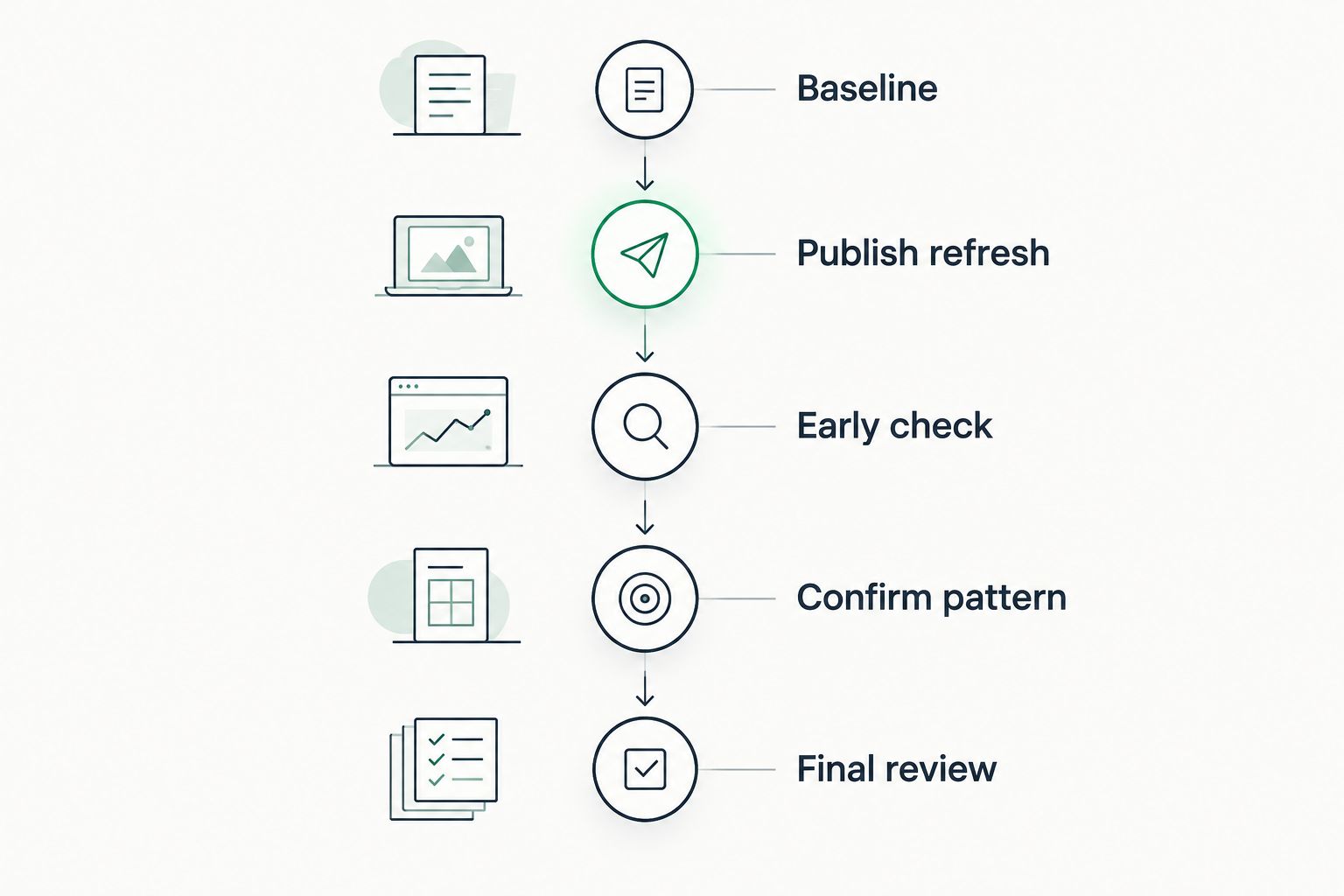
Track the refresh through six stages: define the page and prompt set, capture a baseline, document the edits, publish, repeat the same tests and compare each result with the baseline. Do not add promising new prompts halfway through the observation period; analyse them separately.
1. Map the refreshed page to a fixed prompt set
Start with prompts for which the page is a plausible answer source. Include the user questions, comparison prompts and recommendation prompts that match the page's actual subject. Exclude loosely related prompts added only because they already surface the brand.
Assign each prompt to one intent so the final result is diagnosable:
- Informational: the user wants an explanation or process.
- Comparative: the user wants differences between named approaches or providers.
- Evaluative: the user wants the best option for a defined need.
- Branded: the user asks directly about your organisation, product or claims.
A prompt library for AI visibility tracking keeps these questions stable across refreshes. Without that structure, changes in the test set can look like changes in content performance.
2. Capture the baseline before editing
Run every prompt before the refreshed version is published. Save the complete answer, cited source URLs, platform, date, market, language and whether the brand appeared as a mention, citation or recommendation.
Keep those outcomes separate:
- A mention names the brand but does not point to its page.
- A citation links or attributes information to the page.
- A recommendation presents the brand as an option for the user's need.
Record competitor appearances in the same answers. That gives the refresh a relative benchmark rather than reducing the result to whether your brand appeared at all.
3. Log exactly what the refresh changed
A refresh label is too vague for analysis. Record whether the edit changed the direct answer, supporting evidence, headings, entity descriptions, internal links, structured data or outdated claims.
Keep unrelated site work outside the same measurement window where possible. If a migration, rebrand or major template change happens simultaneously, the result cannot be attributed cleanly to the refreshed copy.
4. Publish and verify the page
Confirm that the intended copy is publicly accessible and indexable. Check the canonical target, page status and rendered content rather than assuming the publishing workflow preserved every edit.
This checkpoint prevents a technical publishing error from being reported as an AI visibility loss. It also creates a clear day 0 for the 2026 comparison.
5. Repeat the tests at fixed checkpoints
Use the same prompt wording and conditions at every checkpoint. A practical 2026 schedule is:
| Checkpoint | Purpose | Decision |
|---|---|---|
| Day 0 | Preserve the pre-refresh baseline | Do not judge the refresh |
| Day 7 | Detect early answer or citation movement | Investigate only large structural changes |
| Day 14 | Check whether movement persists | Separate isolated changes from a pattern |
| Day 28 | Complete the initial comparison | Keep, revise or roll back the tested edit |
AI answers can vary between runs even when the source material has not changed. A result that appears once and disappears at the next checkpoint is weaker evidence than a change repeated across consecutive checks.
6. Compare metrics individually
Do not compress every outcome into one pass-or-fail label. A page can gain citations, lose recommendation presence and retain the same share of voice after one refresh. Each movement requires a different next action.
Use the complete 28-day comparison to decide whether the refreshed answer should stay, be revised again or return to its earlier form. Preserve both versions so the next edit starts from evidence rather than memory.
Which metrics show whether the refresh worked?
Five metrics give the clearest before-and-after view. Compare them by prompt, platform and checkpoint before looking at an overall AI Visibility Score.
| Metric | What it measures | What the refresh result means |
|---|---|---|
| Citation presence | Whether the refreshed page is used as a source | Shows source selection, not just brand recognition |
| Mention presence | Whether the brand appears without attribution | Shows awareness but not ownership of the answer |
| Recommendation presence | Whether the brand is proposed for the user's need | Shows commercial positioning inside the answer |
| Share of voice | Brand appearances relative to tracked competitors | Shows whether gains exceed category-wide movement |
| Sentiment | How the answer characterises the brand | Exposes negative, vague or inaccurate descriptions |
Citation presence
Citation presence is the primary metric when the refresh aims to make a page more useful as a source. Inspect the cited URL as well as the brand name. An answer can mention the organisation while citing a competitor for the supporting evidence.
Prompt coverage
Prompt coverage measures how much of the fixed prompt set surfaces the brand or refreshed page. Increased coverage across closely related informational prompts signals broader relevance. Movement driven by one branded prompt is much narrower.
Share of voice
Share of voice puts your appearances beside named competitors across the same prompt set. If every tracked brand gains visibility at the same checkpoint, the movement can reflect a broader answer change rather than the refresh alone.
Sentiment and factual accuracy
Read the surrounding answer, not only the citation marker. A refresh has not succeeded if citation presence rises while the answer attaches an inaccurate claim to the brand. Sentiment and factual accuracy need their own review because neither is captured by referral traffic.
Why AI visibility changes vary after a refresh
The result varies because a refresh, an AI answer and its source selection contain several moving parts. Control what you can and label the rest.
- Prompt intent: informational, comparative and recommendation prompts use sources differently.
- Scope of the edit: a rewritten answer section creates a different test from a date or wording update.
- Platform: ChatGPT, Gemini, Perplexity, Claude, Copilot and Google AI Overviews can return different sources for the same question.
- Market and language: changing either condition changes the test rather than repeating it.
- Competitor movement: a rival can refresh or publish content during the same 28-day window.
- Technical changes: canonical, indexing, rendering or structured-data changes can affect source discovery alongside the copy.
If a previously stable page disappears across several consecutive checkpoints, use the diagnostic process for content AI models have stopped citing. Check source accessibility and factual consistency before rewriting the page again.
How long should you track a refresh before judging it?
Track the refresh for 28 days, with checks at day 7, day 14 and day 28. The final checkpoint provides a better decision point than an isolated test immediately after publication.
Continue monitoring monthly after the initial period if the page influences important prompts. The 28-day window evaluates the refresh; monthly tracking checks whether the gain persists.
Should you change the prompt set after the refresh?
No, keep the original prompt set fixed throughout the 28-day comparison. New prompts belong in a separate discovery group because adding them changes the denominator and breaks the baseline.
You can promote a new prompt into the standing set after the refresh review closes. Record that change so later reporting does not compare two different measurement scopes as if they were identical.
What should you do if citations rise but recommendations fall?
Treat the refresh as a mixed result, not a win. Rising citations show that the page is being used as a source, while falling recommendations show that the brand is less often presented as the answer to the user's need.
Review the sections that explain who the offering is for, what category it belongs to and how it differs from alternatives. Keep the evidence that attracted citations, then make the commercial positioning clearer without turning the page into unsupported promotion.
Where Koalr fits into the refresh workflow
Koalr is best for marketing teams that need repeatable AI visibility tracking across major answer engines after content changes. It tracks how a brand appears in ChatGPT, Gemini, Perplexity, Claude, Copilot and Google AI Overviews, giving teams a consistent place to compare prompt-level movement.
The benefit is measurement consistency across platforms and prompt sets. The constraint is causation: Koalr can show that visibility changed, but no AI visibility tool can prove one paragraph caused the movement when several content, technical or competitive changes happened at once.
Keep the refresh narrow, preserve the baseline and document the publication date. That gives Koalr AI visibility data a clean event against which to compare citations, recommendations and share of voice in 2026.
Measure your next content refresh
Track mentions, citations and recommendations across major AI answer engines.
FAQ
How do I track AI visibility changes after a content refresh?
Compare the same prompt set before publication and at day 7, day 14 and day 28 after publication. Measure citations, mentions, recommendations, sentiment and share of voice separately.
How long should I wait after refreshing content?
Use a 28-day observation window before making the final decision. Early checks are useful for spotting movement, but they do not replace the full comparison.
Should I use the same prompts before and after a refresh?
Yes, use identical prompts and test conditions throughout the comparison. Changing the prompt set breaks the baseline and can create a false gain or loss.
Is an AI citation the same as a brand mention?
No, a citation attributes information to a source, while a mention only names the brand. A recommendation goes further by presenting the brand as an option for the user's need.
Can AI visibility improve without referral traffic increasing?
Yes, AI visibility can improve when a brand gains mentions or citations that produce no click. Measure answer presence and referral traffic separately.
What should I do when AI citations fall after a refresh?
Check whether the fall persists across consecutive checkpoints, platforms and prompts before reversing the edit. Then inspect source accessibility, factual consistency and the specific sections changed.
What is the best AI visibility metric for a content refresh?
Citation presence is the best primary metric when the refresh aims to make a page more useful as a source. Pair it with recommendation presence, share of voice and sentiment to avoid a one-dimensional verdict.
One last thing
Preserve a copy of the page before every refresh. If AI visibility drops after the 28-day review, that earlier version becomes a control rather than a vague memory of what the page used to say. Koalr AI visibility tracking tells you where the answer changed; version discipline gives you something precise to restore or retest in 2026.


