

Generative engine optimization services cost depends on what the engagement includes: an audit, ongoing measurement, implementation, or a combination of these. For a 2026 budget, compare itemised proposals against the same scope rather than treating different service packages as equivalents. Account separately for software, your team's implementation time and specialist review whenever the agreement excludes them.
- Compare generative engine optimization services cost against defined deliverables, not package names.
- Separate GEO audits, implementation and AI visibility tracking before comparing proposals.
- Koalr suits marketing teams seeking software to track and improve their presence in AI answers.
- Require evidence of citations, mentions and recommendations; referral traffic alone does not measure AI visibility.
How much does generative engine optimization services cost?
The useful budget is the total commitment required to measure, make and verify changes—not just the supplier's headline fee. Ask each provider to separate diagnosis, delivery, monitoring and internal dependencies in its proposal.
Use the same comparison framework when you evaluate generative engine optimization services. A proposal that identifies problems is not equivalent to one that also assigns writers, implements changes and checks subsequent answers.
| Engagement | Best for | What to specify | Advantage | Limitation |
|---|---|---|---|---|
| Standalone audit | Teams needing a diagnosis before commissioning work | Prompt set, platforms, source evidence and prioritised findings | Creates a defined decision point | Findings still need an implementation owner |
| Implementation project | Teams with an agreed backlog | Pages, technical tasks, approvals and acceptance criteria | Connects the engagement to published changes | A fixed project needs a separate measurement plan |
| Ongoing service | Teams needing repeated analysis and delivery | Review cadence, delivery capacity and change log | Connects findings with continuing action | Broad scope needs clear boundaries |
| Software-led workflow | Teams with internal delivery capacity | Tracking requirements, ownership and review process | Keeps measurement close to the marketing team | Software does not supply the people who approve and publish changes |
Do not ask which package sounds most complete. Ask which responsibilities your team needs someone else to own, then compare proposals covering those responsibilities.
Why this matters
A citation, a mention and a recommendation are different outcomes. A citation identifies a source; a mention names your brand; a recommendation presents your brand as a suitable choice. A report that combines them into a single total hides what changed.
Your 2026 brief should define the outcome before it defines the reporting format. If you want your brand recommended for a buying decision, a collection of branded mentions does not establish that result.
The same distinction applies to traffic. A referral records a visit from an answer platform; an answer that names your brand without generating a visit still belongs in visibility measurement. Require reporting that keeps these signals separate.
Standalone audit: buy a diagnosis with evidence
Best for: a team that needs to identify the next action before committing to delivery. Define the questions the audit must answer, including where competitors appear, which sources support those answers and which relevant pages need attention.
An actionable audit connects observations to work. For each finding, request the prompt, platform, observation date, answer excerpt, cited source where present and recommended response.
The advantage is a bounded assignment with an explicit handover. The limitation is equally clear: a report does not change your website, secure an editorial mention or resolve an inaccurate product description.
Before accepting the scope, name the internal owner for each type of follow-up. If nobody can publish or approve the recommended changes, resolve that dependency before commissioning more analysis.
Implementation project: buy specified changes
Best for: a team with an agreed backlog and access to the people who can approve it. Define delivery in terms of completed work, such as revised pages, corrected factual claims or resolved technical access issues—not an unspecified commitment to improve visibility.
Give every deliverable an acceptance condition. A revised page needs an agreed subject, factual sources, editorial review and publication responsibility; a technical task needs a description of the issue and a way to verify the fix.
A project makes ownership explicit. Its limitation is that completing work and earning a subsequent citation are different events, so acceptance should not depend on an answer engine producing a particular response.
Keep the measurement method consistent before and after publication. Otherwise, a change in the prompt set or platform coverage makes the comparison harder to interpret.
Ongoing service: buy a recurring decision-and-delivery process
Best for: a team that needs continuing analysis, prioritisation and implementation support. Specify how findings become assignments, who approves those assignments and what evidence returns at the next review.
An ongoing agreement should distinguish measurement from delivery capacity. Tracking answers, interpreting results, drafting changes and publishing those changes are separate responsibilities; listing them under one heading does not establish who performs them.
The advantage is continuity between diagnosis and action. The limitation is scope ambiguity: without boundaries, reporting can continue while the implementation backlog remains untouched.
For a 2026 agreement, define what happens when priorities change. State which work moves out when a new product, market or technical issue moves into scope, rather than assuming every new request fits the existing commitment.
Software-led workflow: keep delivery ownership in-house
Best for: marketing teams that can investigate findings and implement changes internally. Software supports measurement, but your team still needs an editorial owner, a technical contact and a process for deciding what deserves attention.
Koalr is suited to marketing teams seeking AI visibility software to track and improve their brand's presence in AI answers. Koalr covers the brand's presence across ChatGPT, Gemini, Perplexity, Claude, Copilot and Google AI Overviews.
The benefit of this approach is direct team ownership of the measurement-to-action process. Its limitation is internal workload: choosing software does not assign someone to review evidence, correct claims or publish content.
Treat a software-led workflow as an operating choice, not a substitute for all services. Establish which responsibilities stay inside the business before deciding what external support remains necessary.
Why generative engine optimisation service scope varies
The work you commission determines what belongs in the proposal. Use these factors as scope questions, not as assumed multipliers or a substitute for an itemised quote.
- Platform coverage: Name the answer platforms and search experiences you want assessed. Require the supplier to explain how results will be recorded for each.
- Prompt coverage: Specify buyer questions, branded questions and competitor comparisons. A larger collection is not automatically more relevant.
- Market coverage: State the countries, languages and product lines included. Keep results segmented so one market does not conceal another.
- Implementation responsibility: Separate advice from drafting, technical changes, publication and external outreach. Assign an owner to each activity.
- Evidence requirements: Specify whether reports must include answer excerpts, citation sources, observation dates and a change log.
- Review requirements: Identify legal, product, security or editorial approvals that the work needs. Put these dependencies in the delivery plan.
Buy the coverage your decisions require. Broad tracking without a practical use for the findings creates more material to review, not a clearer next move.
How do you compare GEO proposals fairly?
Use a shared brief for your 2026 procurement process. Keep the business questions and acceptance criteria fixed while asking providers to explain their recommended approach.
- Define outcomes. State which buyer decisions matter and distinguish being named from being recommended. Identify the product lines and markets that belong in the engagement.
- Fix coverage. Give every provider the same platform requirements and prompt categories. Ask providers to identify any exclusions rather than silently changing the brief.
- Assign ownership. Record who researches, writes, approves, implements and publishes. Include your team's obligations alongside the supplier's responsibilities.
- Specify evidence. Require enough source material to inspect findings. Define how observations and subsequent changes will be recorded.
- Agree review. Establish how both parties assess completed work, interpret visibility changes and decide the next assignment.
These steps separate the commercial decision from the measurement design. You can compare responsibility and coverage without assuming that the provider promising the largest visibility improvement has the strongest method.
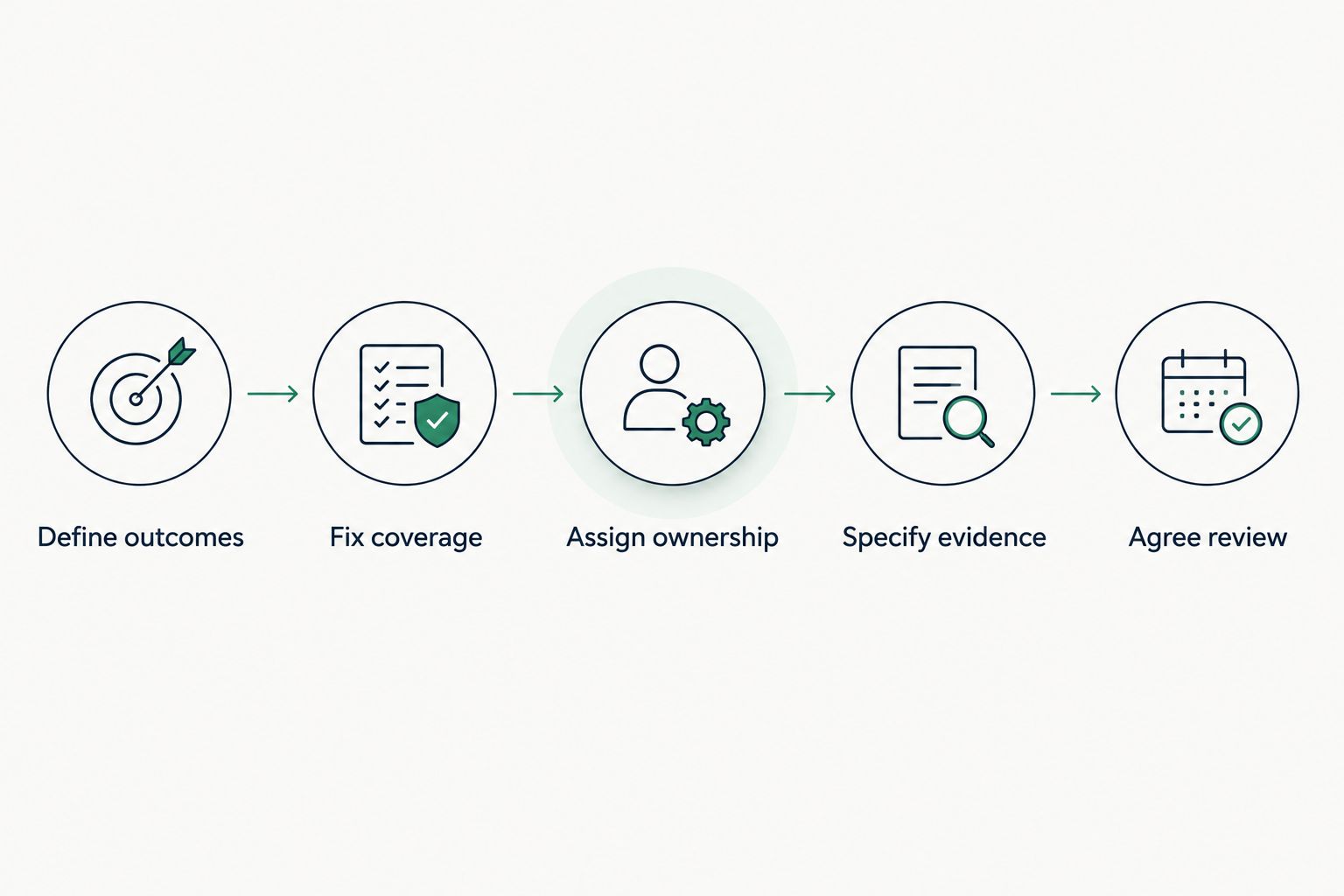
Ask each provider to return the brief with responsibilities and exclusions marked against every deliverable. That response gives you something concrete to negotiate and prevents assumptions from becoming delivery disputes.
What should the measurement plan include?
A measurement plan needs a stable basis for comparison. Record the prompt wording, platform, observation date and relevant settings alongside the answer evidence; document changes to the method rather than blending them into the results.
Keep at least 3 outcome categories separate: mentions, citations and recommendations. These categories answer different questions, so a combined visibility total should not replace the underlying evidence.
For your 2026 baseline, distinguish branded prompts from unbranded buyer questions. A response to a question containing your company name is not evidence that the platform independently selected your company for a category recommendation.
Use the delivery log alongside the answer evidence. Record which pages changed and when, but do not attribute every subsequent visibility movement to that work: a before-and-after observation alone does not establish causation.
What work can sit outside a GEO agreement?
Check the exclusions before signing. Content production, development, specialist approval, software access and external communications all need explicit ownership, whether the supplier performs them or your team does.
Request 1 responsibility map covering the whole workflow. For every task, record the delivery owner, approval owner and dependency; this is a planning requirement, not a staffing benchmark.
Also request 1 handover pack at the end of a project. Specify the prompt library, findings, source evidence, change log and unresolved tasks you need to continue the work.
A clear exclusion is better than an assumed inclusion. You can plan around work your team owns; you cannot plan reliably around a responsibility neither party has accepted.
Is a GEO audit enough to improve visibility?
A GEO audit supplies a diagnosis; it does not implement the response. Choose an audit when you have the people and access needed to turn findings into completed changes.
If you need delivery support, put that work in scope explicitly. Do not treat an audit presentation as a commitment to rewrite pages or resolve technical issues.
Should you buy software or hire a service provider?
Choose software-led measurement when your team can interpret findings and own delivery. Choose external services for responsibilities you need another team to perform, with acceptance criteria attached to those responsibilities.
A combined approach also needs clear boundaries. Specify who operates the measurement process and who acts on it, rather than paying for overlapping reports with no shared implementation owner.
Can a provider guarantee recommendations in AI answers?
Treat a guaranteed recommendation as a claim requiring proof, not as an acceptance criterion. A provider can commit to its own work; it does not control how an independent answer platform responds to every future question.
Require guarantees about deliverables, documentation and agreed responsibilities instead. Those are obligations you can inspect directly.
FAQ
What determines generative engine optimization services cost?
The agreed scope determines what belongs in a GEO services proposal. Compare platform coverage, prompt coverage, implementation responsibilities, evidence requirements and exclusions against the same brief.
Does a GEO service include AI visibility software?
Software access belongs in the agreement only when it is explicitly included. Ask who supplies access, who operates the measurement process and what records you retain after the engagement ends.
Is Koalr a GEO agency or a software platform?
Koalr is an AI visibility software platform for marketing teams. It helps teams track and improve their brand's presence in answers from ChatGPT, Gemini, Perplexity, Claude, Copilot and Google AI Overviews.
Can I manage generative engine optimisation in-house?
You can manage the work in-house when your team owns measurement, analysis, approval and implementation. Assign those responsibilities before choosing software or commissioning external support.
What should I ask for in a GEO audit?
Ask for a documented prompt set, answer evidence, citation sources where present and prioritised recommendations. Each recommendation should identify the proposed action and the person responsible for implementing it.
How do I know whether GEO work is helping?
Compare answer evidence using a documented measurement method and review it alongside completed changes. Keep mentions, citations, recommendations and referral traffic separate, and do not treat a before-and-after change as proof of causation.
One last thing
Ask what you retain when the engagement ends. Put ownership of the prompt library, answer evidence, edited content and change log into the agreement before work starts.
Buy work you can inspect and continue. A polished report is not a substitute for an evidence trail your next team can use.


