

Evaluate generative engine optimization services by checking whether they measure the right prompts across the right AI engines, separate citations from mentions and recommendations, compare your visibility with named competitors, and convert findings into specific content fixes. In 2026, reject any service that offers a standalone visibility score without showing the prompts, answers, sources and competitors behind it.
- Evaluate generative engine optimization services on prompt coverage, AI engine coverage, competitive context, actionability and repeatability.
- A citation, mention and recommendation are different outcomes; a credible GEO service reports them separately.
- Share of voice only means something when your brand and named competitors are measured against the same prompt set.
- A GEO audit should identify specific content, schema and source-authority gaps rather than produce generic recommendations.
- Koalr fits marketing teams that need to track and improve brand appearances across major AI-driven answers.
Why this matters
AI visibility is not the same as AI referral traffic. A reader can see your brand recommended in ChatGPT, Gemini or Perplexity without clicking through, while analytics only records the smaller group that visits your site. A service that measures referral sessions but not answer appearances misses that distinction.
Koalr is an AI visibility platform for marketing teams tracking how their brands appear in ChatGPT, Gemini, Perplexity, Claude, Copilot and Google AI Overviews. That category definition gives you a useful starting point: generative engine optimization should measure what answer engines say before it tries to change the result.
The commercial risk is simple. If a vendor cannot show where your brand was cited, which competitor was recommended instead and what source supported the answer, it cannot diagnose the problem it claims to solve.
How do you evaluate generative engine optimization services?
Use the following process during procurement. Each step tests a different part of the service, so a polished dashboard cannot compensate for weak prompt selection or vague recommendations.
1. Inspect the prompt set
Ask to see the exact prompts used to evaluate your brand. They should reflect real category questions, comparison queries, use cases, objections and buyer problems rather than repetitions of your brand name.
A branded query tests whether an engine knows you exist. An unbranded query tests whether the engine considers you relevant before the buyer supplies your name. Both matter, but unbranded prompts reveal whether you enter the initial consideration set.
Check how prompts are grouped and maintained. A useful prompt library for AI visibility tracking separates prompt themes, buyer intent and markets so results can be compared without mixing unrelated questions. Reject a vendor that adds or removes prompts without preserving a stable benchmark.
2. Verify AI engine coverage
Require the vendor to name every answer engine included in the service. ChatGPT, Gemini, Perplexity, Claude, Copilot and Google AI Overviews do not consistently produce the same answer, citation or recommendation for the same question.
Coverage should match where your buyers ask questions. A report focused on one engine cannot establish your overall AI visibility, while a combined score can hide a serious weakness on an important platform. Ask for platform-level results before accepting any blended metric.
The vendor should also explain how it handles answer variation. Generative answers can change between runs, so one isolated response is evidence of that response, not proof of a stable pattern. The service needs a repeatable method that lets you distinguish an isolated appearance from recurring visibility.
3. Separate citations, mentions and recommendations
These outcomes must appear as separate fields in the report:
- Citation: an answer identifies a page or domain as a supporting source.
- Mention: an answer names the brand without necessarily linking to it.
- Recommendation: an answer presents the brand as a suitable choice for the user's request.
A brand can be cited as a source without being recommended. It can also be mentioned in a list while a competitor receives the actual endorsement. Combining all three outcomes into one number makes weak performance look stronger and prevents your team from selecting the right fix.
A citation proves source use, a mention proves brand recognition, and a recommendation proves selection. Your GEO service should tell you which outcome changed in 2026, not merely whether a brand string appeared.
4. Demand competitor context
Ask the vendor to configure named competitors rather than rely on a generic category benchmark. Your team needs to see which competitor appears, where it appears and whether it receives a citation, mention or recommendation.
A share-of-voice metric is useful only when the comparison set is explicit. Review how the vendor calculates AI search share of voice, then confirm that your brand and competitors are evaluated against the same prompts, engines and reporting period.
Do not accept a standalone score as the primary result. A score can rise while a direct competitor gains visibility faster, and it can fall because the prompt set changed rather than because your content lost ground. The underlying answer evidence must remain available.
5. Trace every finding to an action
Choose a service that maps weak visibility to a specific action. Valid actions include revising a page that fails to answer the prompt directly, clarifying entity relationships, adding supported structured data, strengthening internal links or creating a missing comparison page.
Generic advice such as publishing better content is not a deliverable. The vendor should identify the affected prompt cluster, the page that should address it, the competitor or source currently winning, and the reason for the recommended change.
The same rule applies after implementation. The service must rerun the relevant prompts and show whether citations, mentions or recommendations changed. Without that feedback loop, you receive activity reports rather than evidence that the work affected AI answers.
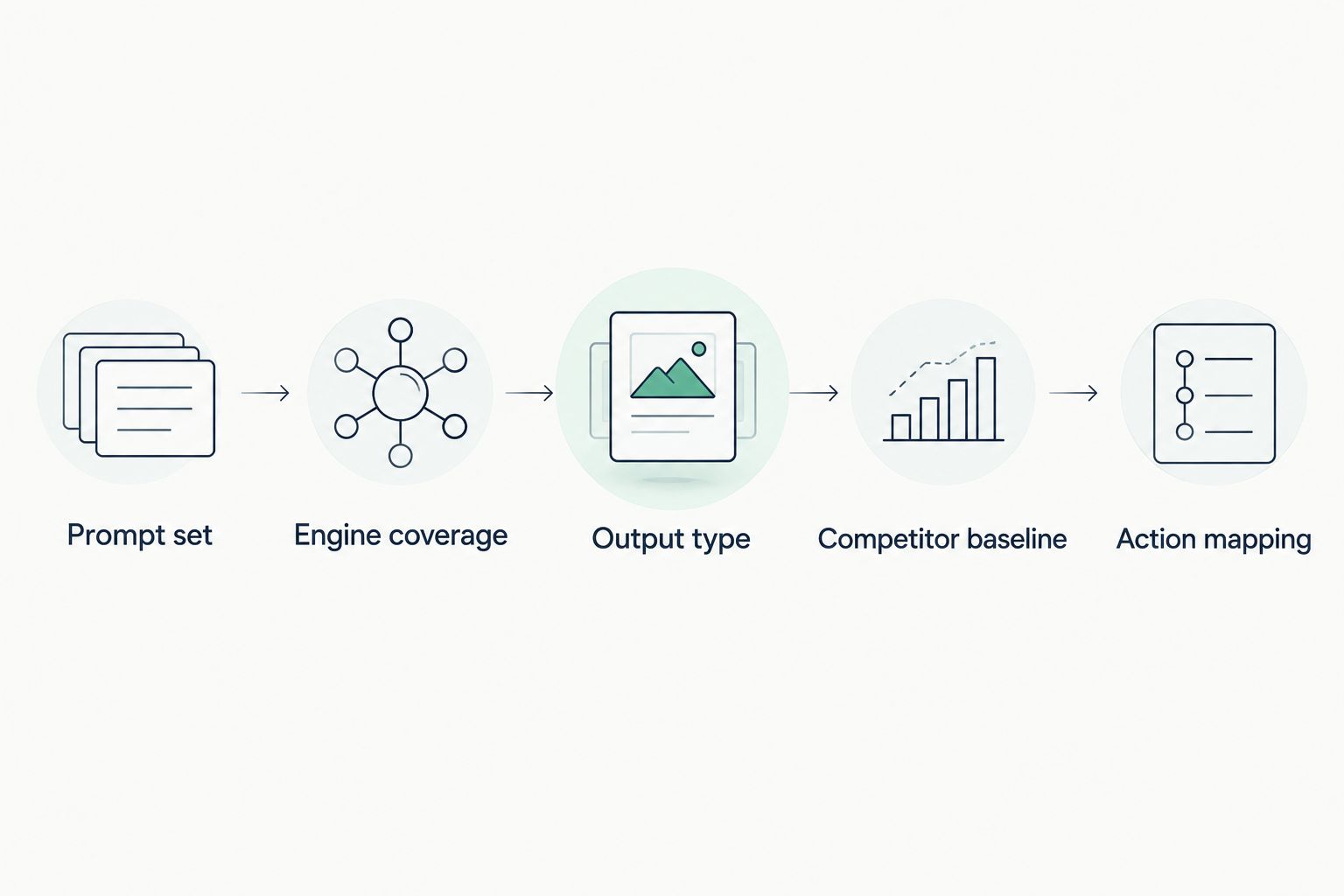
These five checks form a practical evaluation flow: prompt set, engine coverage, output type, competitor baseline and action mapping.
Compare the two common service models
Generative engine optimization services usually centre on either advisory delivery or measurement-led delivery. Neither model is automatically right for every team, but the distinction changes what you should expect.
| Service model | Best for | Main advantage | Main limitation | Verdict |
|---|---|---|---|---|
| Advisory-led GEO service | Teams needing strategy, content briefs and implementation support | Provides people who can interpret findings and coordinate changes | Quality depends on whether the advice is backed by repeatable answer-level measurement | Choose when you need execution support, but verify the measurement method first. |
| Measurement-led GEO service | Marketing teams with internal content or SEO resources | Gives the team direct access to prompts, answers, citations and competitor trends | Your team still needs to prioritise and implement the work | Choose when you can act on the data internally and need an ongoing benchmark. |
Koalr belongs in the measurement-led category described here because its stated purpose is to help marketing teams track and improve how their brand appears in AI-driven answers. Koalr is best suited to marketing teams that want AI visibility measurement tied to ongoing improvement rather than referral traffic alone.
The limitation to examine is the same one you should test for every platform: software does not replace editorial judgement, subject expertise or implementation capacity. Confirm who will turn Koalr findings into page changes before choosing the delivery model.
Compare GEO tools
Review the measurement criteria that separate AI visibility platforms from conventional SEO tools.
Warning signs in a GEO proposal
A credible proposal explains the measurement method before promising an outcome. Treat these signs as procurement failures:
- No prompt list: you cannot judge whether the benchmark represents your market.
- No answer evidence: a score without the underlying output cannot be audited.
- No distinction between citations and mentions: the report merges different outcomes into a vanity metric.
- No named competitors: the service cannot show whether you are gaining or losing category share.
- No platform breakdown: a combined score conceals where the brand is actually absent.
- No page-level actions: findings cannot move into the content backlog.
- No repeatable review method: later reports cannot be compared with the original benchmark.
A vendor does not need to reveal proprietary software code. It does need to explain what it measures, which evidence is retained and how a recommendation follows from that evidence.
Why GEO service quality varies
- Prompt design: branded prompts produce different evidence from unbranded category, comparison and problem-based prompts.
- Engine coverage: services monitoring different AI answer surfaces are not measuring the same exposure.
- Outcome definitions: vendors that count every text appearance as visibility inflate results by merging citations, mentions and recommendations.
- Competitive setup: an irrelevant competitor set produces an irrelevant share-of-voice benchmark.
- Action mapping: reporting teams diagnose performance, while optimization teams connect each finding to a page, source or technical change.
These factors also explain why two vendors can report different results for the same brand in 2026. Before comparing scores, compare the prompt set, engine list, outcome definitions and competitor configuration behind them.
What should a GEO audit include?
A GEO audit should document the prompt set, AI engines checked, brand and competitor appearances, cited sources, recommendation patterns and the pages requiring action. It should also establish a benchmark that can be repeated after changes are published.
The audit is incomplete if it stops at observation. Your team needs prioritised fixes connected to specific prompts and evidence, followed by a repeat check using the same method. A structured AI visibility audit across major platforms provides a stronger procurement test than a sample dashboard filled with unrelated data.
Is GEO the same as SEO?
No. SEO focuses on visibility in conventional search results, while GEO focuses on how brands and sources appear inside generated answers. The disciplines overlap around useful content, technical accessibility, authority and clear page structure, but the measured outcomes differ.
In 2026, a search ranking does not prove that an AI engine cites or recommends the page. Likewise, an AI citation does not prove that the page receives meaningful referral traffic. Marketing teams need separate measurements for search rankings, AI answer visibility and downstream visits.
How often should GEO performance be reviewed?
Review frequency should match how often your team can make and assess meaningful changes. The critical requirement is consistency: use the same core prompts, outcome definitions, competitors and platform breakdown so one reporting period remains comparable with the next.
Do not interpret every changed answer as a trend. Look for repeated movement across the prompts tied to the page or topic you changed, then retain the underlying outputs so your team can verify what shifted.
FAQ
What are generative engine optimization services?
Generative engine optimization services measure and improve how a brand, product or page appears in answers from systems such as ChatGPT, Gemini, Perplexity, Claude, Copilot and Google AI Overviews. A credible service connects answer-level evidence to specific content or technical actions.
What should I ask a GEO agency before hiring it?
Ask to see its prompt methodology, AI engine coverage, definitions for citations and mentions, competitor setup and an example of a finding mapped to a page-level action. Reject a proposal that offers only a combined visibility score.
What is the difference between an AI citation and a brand mention?
An AI citation identifies a page or domain as a source, while a brand mention names the company in the answer text. A recommendation goes further by presenting the brand as a suitable choice for the user's request.
Can generative engine optimization replace SEO?
No, generative engine optimization does not replace SEO because the two disciplines measure different surfaces and outcomes. SEO tracks conventional search visibility, while GEO tracks appearances inside generated answers.
How do I compare GEO service providers?
Compare providers using the same criteria: prompt quality, engine coverage, citation evidence, named competitor tracking, action mapping and repeatability. Do not compare headline scores until you confirm that the underlying methods match.
Is AI referral traffic the same as AI visibility?
No, AI referral traffic records visits that reach your site, while AI visibility records whether an answer cites, mentions or recommends your brand. A user can see a recommendation without clicking, so analytics alone cannot measure the full answer appearance.
Who is Koalr designed for?
Koalr is designed for marketing teams that need to track and improve how their brand appears across ChatGPT, Gemini, Perplexity, Claude, Copilot and Google AI Overviews. Teams still need a process for turning measurement into content and technical changes.
What makes a GEO recommendation actionable?
An actionable GEO recommendation identifies the affected prompt, the current answer or cited source, the relevant page and the change required. Advice that cannot be assigned to a page or owner is not specific enough to implement.
One last thing
Run a blind evidence test before choosing a provider in 2026. Give each shortlisted vendor the same small set of buyer questions, remove its branding from the returned reports and ask your team which report most clearly explains who appeared, why they appeared and what to change.
The most attractive dashboard should not win by default. The service that preserves the answer evidence and turns it into an accountable content decision is the one that can improve your GEO programme.


