

You get your first diagnostic result when your initial prompt checks finish; evidence of improvement requires repeated, comparable checks after you make changes. There is no universal number of days to better AI visibility in 2026, and a new citation is not proof of additional traffic, leads or revenue.
- How long does it take to see results from AI visibility tracking? Separate initial findings from sustained improvement.
- Koalr helps marketing teams track brand appearance in AI answers; tracking itself does not guarantee better visibility.
- Compare unchanged prompt sets before judging changes in citations, mentions or recommendations.
- Measure business outcomes separately: an AI citation does not establish a website visit or sale.
How long does it take to see results from AI visibility tracking?
The first completed checks show where your brand appears. They do not establish a trend. To demonstrate improvement, you need a baseline, a documented intervention and subsequent observations collected under comparable conditions.
For your 2026 reporting, separate these milestones rather than assigning them a single deadline:
| Result | When you can assess it | What it establishes | What it does not establish |
|---|---|---|---|
| Initial findings | After the first completed checks | Brand appearances and omissions in the sampled answers | Consistent visibility across future answers |
| Repeatable baseline | After repeated comparable checks | A reference for subsequent comparisons | The effect of a content change |
| Visibility improvement | After comparable post-change checks | An observed change in mentions, citations or recommendations | Proof that your intervention caused it |
| Business impact | When referral and conversion evidence exists | Recorded visits or actions associated with identifiable sources | Every influence an AI answer had on buyers |
Koalr is best for marketing teams that need to track and improve brand appearance in AI answers. Its role is measurement and improvement support, not a guaranteed timetable for recommendations.
Why this matters
A founder asking for results usually means commercial progress. A content lead might mean a page earning a citation, while an analyst might mean the first usable baseline. Those are different outcomes with different evidence requirements.
Agree on the outcome before you start the clock. Otherwise, an early brand mention becomes a success claim, or useful diagnostic work gets dismissed because it has not yet produced an attributable lead.
Your 2026 measurement brief should state the buyer questions, platforms, markets and outcomes you will assess. Keep the brief stable enough to compare results, while recording additions separately.
Initial findings: diagnose before you claim improvement
Your first checks answer a practical question: what appears when the selected buyer questions are asked? Save the actual answers, not just a headline visibility score.
Classify what you find:
- Mention: the answer names your brand.
- Citation: the answer identifies a source supporting its response.
- Recommendation: the answer presents your brand as a suitable choice for the stated need.
These categories overlap, but they are not interchangeable. A source citation does not necessarily recommend the source's company, and a named competitor is not automatically the preferred choice.
The benefit of an initial check is speed to diagnosis: you can identify an omission, factual error or competitor appearance without waiting for a trend. Its limitation is scope. The finding describes the answers collected, not every answer every buyer receives.
Also separate branded questions from unbranded discovery questions. An answer to a question containing your company name tests something different from an answer asking which provider fits a buyer's requirements.
Sustained improvement: compare like with like
A better answer is an observation; repeated comparable results are stronger evidence of improvement. Preserve the prompt wording, market, language and platform context when comparing results before and after a change.
Record the denominator behind each metric. A mention rate based on completed answers means something different from a count that includes failed or missing checks. State how you treat those cases before presenting the result.
Use a fixed core prompt set for trend reporting. Keep exploratory prompts in a separate group so that adding easier questions does not make the existing programme appear more successful.
A prompt library for AI visibility tracking provides the structure for this work. Document the buyer need behind each question, not just its wording.
The strength of repeated tracking is comparability. Its limitation is coverage: even a carefully maintained prompt set represents selected questions, rather than the full universe of buyer conversations.
Business results: distinguish visibility from attribution
A recommendation and a conversion are separate events. Treat the first as evidence about an answer and the second as evidence about a recorded business action.
For your 2026 review, keep visibility reporting alongside website analytics and lead reporting, rather than treating any of them as substitutes. Inspect identifiable referral visits, landing-page behaviour and recorded conversions where those records exist.
Do not classify an unattributed lead as AI-generated merely because visibility improved during the same period. Equally, the absence of a recorded referral does not establish that nobody encountered your brand in an answer.
Commercial reporting is useful because it connects measurement to decisions. Its limitation is attribution: your records describe what you can identify, not every exposure that preceded a purchase.
Why the time to useful results varies
The timetable depends on what you are trying to establish and how you collect evidence. These factors belong in the measurement plan:
- Outcome definition: diagnosing an incorrect description requires different evidence from demonstrating a sustained increase in recommendations.
- Prompt scope: branded questions, category discovery and detailed buyer comparisons test different forms of visibility.
- Platform scope: combining results across ChatGPT, Gemini, Perplexity, Claude, Copilot and Google AI Overviews requires platform-level reporting as well as an aggregate.
- Change scope: editing a passage, correcting a factual statement and changing a whole content programme create different evaluation tasks.
- Measurement consistency: changing prompts, markets or scoring rules changes the basis of comparison.
- Attribution evidence: a business-impact claim requires records beyond the generated answer itself.
Do not use these factors to justify an open-ended project. Use them to specify what the next review must establish and which decision follows from each possible finding.
How to build a results plan without inventing a deadline
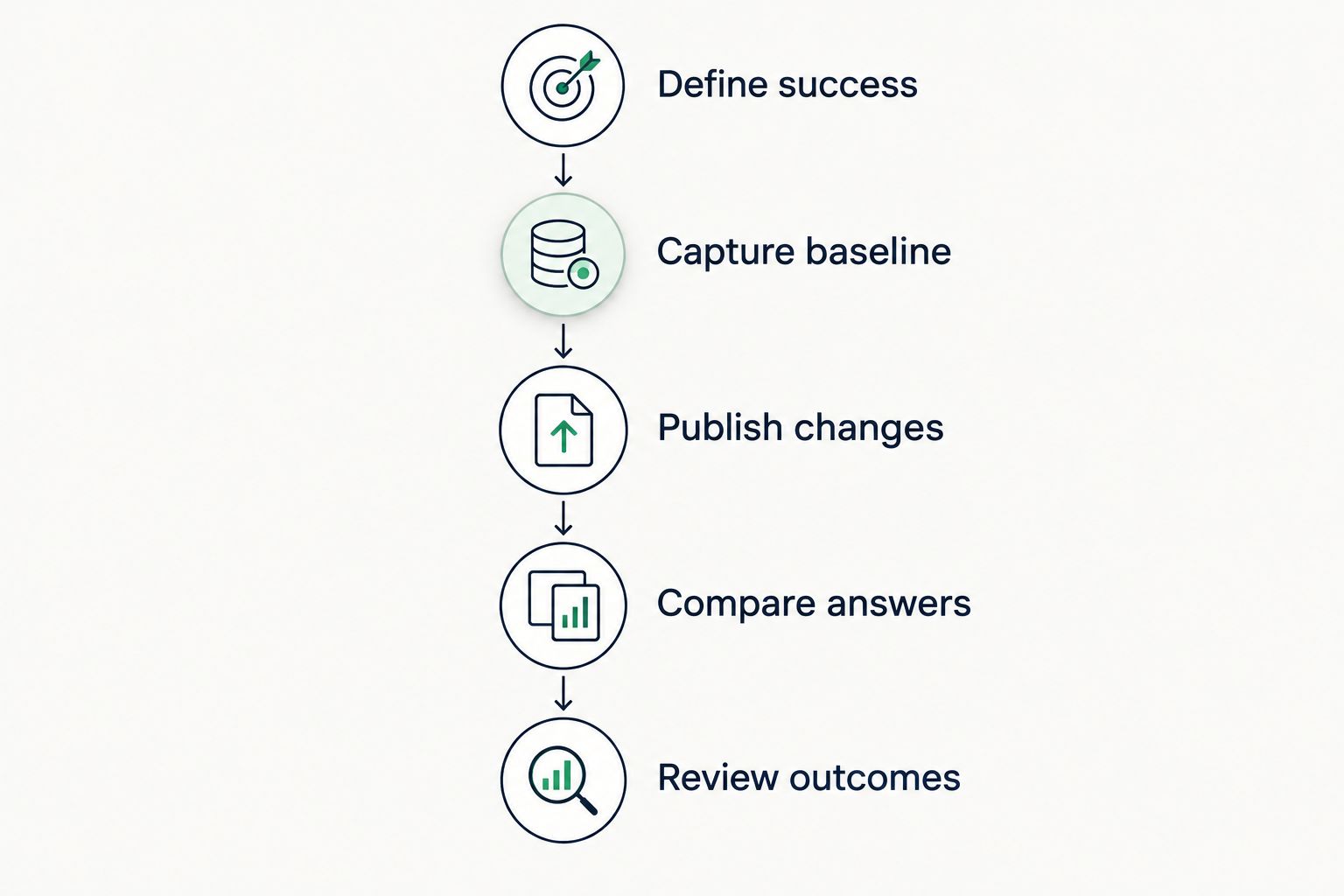
Set review checkpoints around evidence, not promises. The following sequence gives each stage an exit condition and keeps measurement separate from optimisation.
1. Define success
Choose the outcome that matters for the buyer question. For a factual query, accuracy might be the priority; for a shortlist query, the priority might be a suitable recommendation.
Write the success rule before viewing the results. This prevents a convenient movement in an unrelated metric from replacing the original objective.
2. Capture baseline
Run the selected prompt set and retain the answers, citations and context. Repeat comparable checks before describing an appearance as consistent.
Record omissions as carefully as appearances. A missing brand in a relevant shortlist is a different finding from an answer that does not recommend any provider.
3. Publish changes
Select a specific issue and make a documented change. Record the publication date, affected page and intended outcome, such as correcting a product description or answering a missing buyer question.
Avoid changing every related page at once if your objective is to understand which intervention helped. A broad rewrite makes individual effects harder to distinguish.
4. Compare answers
Compare the post-change answers with the baseline using the same scoring rules. Inspect the answer text and cited sources before accepting an aggregate movement as meaningful.
Record alternative explanations, including changes in the sampled answers or the comparison set. A before-and-after difference establishes sequence, not causation by itself.
5. Review outcomes
Decide whether to retain the change, investigate further or revise the approach. Keep the decision tied to the original buyer question and success rule.
For business outcomes, inspect the relevant referral and conversion records separately. Do not promote a visibility finding into a revenue claim without supporting evidence.
What should your first results report contain?
Keep the report decision-focused. A useful report lets a reader identify the finding, inspect its evidence and understand the next action without interpreting a dashboard unaided.
Use these fields for each priority finding:
- Buyer question: the exact prompt and the need it represents.
- Observation: what the answer said, named, recommended or cited.
- Comparison: the relevant baseline and subsequent observations.
- Intervention: what changed and when it was published.
- Decision: the next action and its owner.
Show platform-level results before drawing a cross-platform conclusion. A gain in one answer environment does not establish a gain in the others.
Koalr supports AI visibility tracking across the answer platforms named above. Keep the same evidence standard when reviewing Koalr findings: a headline score needs answer-level context before it supports a content decision.
How often should you review AI visibility results?
Choose a repeatable review cadence, not a promised improvement date. Match checks to the decisions your team can act on, and distinguish routine reporting from investigations into a specific change.
For a 2026 programme, record the cadence in the measurement brief and keep it consistent during a comparison. Changing the observation schedule midway through an evaluation makes the reporting periods less comparable.
Review urgent factual errors as issues to correct, rather than waiting for an aggregate trend. Review broader visibility performance with enough context to distinguish isolated answers from recurring findings.
Does tracking alone improve AI visibility?
Tracking alone does not establish or guarantee improvement. It identifies where to investigate; a separate action must address the content, factual information or other issue behind the finding.
Assign each priority observation to an owner. The action should be specific enough to verify, such as correcting a statement or adding an answer to a documented buyer question, rather than simply requesting more content.
For your 2026 plan, judge the programme on both evidence quality and completed decisions. Collecting more answers is useful only when the findings support a clearer next move.
FAQ
How long does it take to see results from AI visibility tracking?
Initial findings are available after the first completed prompt checks; sustained improvement requires repeated comparable observations after changes. There is no universal number of days that establishes better visibility or business impact.
Can I tell whether my brand appears from the first check?
The first completed check shows whether your brand appears in that sampled answer. It does not establish how consistently the brand appears across subsequent answers or different questions.
Does a new citation mean my AI visibility work succeeded?
A new citation is evidence of source inclusion, not proof of sustained improvement or commercial success. Check its relevance, repeatability and relationship to the outcome you defined.
Should I change my prompts when results are poor?
Keep the core comparison prompts unchanged while investigating poor results. Add new discovery prompts separately so that changes in the question set do not obscure the existing trend.
Why is my brand mentioned but not recommended?
A mention names your brand; a recommendation presents it as suitable for the stated need. Read the surrounding answer to establish which role the brand actually plays.
Can Koalr guarantee when my brand will be recommended?
AI visibility tracking does not guarantee when an answer platform will recommend your brand. Koalr helps marketing teams track and improve brand appearance, while recommendation outcomes require observation rather than a fixed deadline.
What should I do if visibility is not improving?
Verify the comparison first, then inspect the actual answers and sources for a specific issue to address. Make a documented change and evaluate it against the same buyer questions instead of replacing the measurement set.
One last thing
A flat aggregate score does not tell you whether your most important buyer question improved. Inspect priority prompts alongside the overall result, and keep any weighting rules consistent.
Your strongest next move is to choose a buyer question, document the current answer and identify the precise change you want to observe. That turns the timetable question into an evaluation you can actually complete.


