

Yes, Google AI Overviews can hurt organic traffic by answering a query directly on the results page, removing a reason to visit your website even when your page remains visible. But fewer clicks do not prove that an AI Overview caused the decline, and appearing as a cited source does not guarantee a visit or a conversion.
- Can Google AI Overviews hurt organic traffic? Yes: an answer on Google can replace a website visit.
- Separate ranking losses, lower click-through rates and changing search demand before attributing a traffic decline.
- Track citations, brand mentions and recommendations separately; none proves that someone visited your website.
- Koalr suits marketing teams tracking AI visibility alongside organic traffic, not instead of it.
Can Google AI Overviews actually hurt your organic traffic?
Yes. The mechanism is answer substitution: Google supplies information that the searcher previously needed your page to obtain. A visit is no longer necessary when the answer itself completes the task.
That is different from losing a ranking. Your page can remain eligible to appear in search while the results page gives users another way to satisfy their query. An AI Overview also changes the arrangement of results, so ranking position alone does not describe everything a searcher sees.
For your 2026 reporting, separate the following patterns before choosing a response:
| Observed pattern | What it establishes | What to check next |
|---|---|---|
| Clicks fall while impressions and average position stay similar | Your results receive fewer clicks relative to exposure | Inspect click-through rate and the actual results page |
| Clicks and impressions fall together | Your recorded search exposure has declined | Check demand, query coverage, rankings and indexing |
| Average position worsens alongside lost clicks | Ranking changes are part of the diagnosis | Investigate competitors, page changes and technical issues |
| Your page appears as an AI Overview source | Google links to your page within that answer | Measure visits and conversions separately |
| Your brand is named without your page being linked | The answer contains a brand mention | Record the wording and whether it recommends your brand |
Use Koalr for the AI visibility side of this work: tracking how your brand appears in AI-driven answers. Keep search performance and website outcomes beside that evidence, rather than treating answer visibility as traffic.
Why this matters
A traffic decline and a visibility decline require different fixes. Rewriting a page will not diagnose a tracking failure, and a stronger citation presence does not repair a broken conversion journey.
The reporting problem runs both ways. A team can lose clicks while retaining a useful presence in answers, or maintain organic visits while competitors become the named recommendations. Neither situation is visible through a single traffic total.
Your 2026 search report needs separate measures for exposure, visits and business outcomes. Report their relationship without claiming that one automatically caused another.
A citation is not a mention or a recommendation
An AI Overview can use your content without recommending your business. It can also recommend your business while linking to a third-party source rather than your website.
Keep these observations distinct:
- Citation: a linked source supporting the answer. Record the destination page and the claim it supports.
- Mention: your brand appears in the answer text. Record the surrounding context, not just the name.
- Recommendation: the answer presents your brand as a suitable choice for a stated need. Record the buyer requirement attached to it.
- Visit: someone reaches your website. Measure the session and its source using your analytics configuration.
- Conversion: someone completes a defined business action. Measure that action separately from visibility and visits.
A citation demonstrates inclusion as a source, not endorsement of your product. A recommendation is stronger evidence of favourable positioning, but it still does not establish that a buyer acted.
This distinction prevents a misleading exchange: replacing a lost-click metric with a growing citation metric and calling the problem solved. Both observations belong in the report. They answer different questions.
How do you check whether AI Overviews are affecting your traffic?
Use a repeatable investigation rather than a screenshot taken after traffic fell. The objective is to establish which explanation fits the evidence and which explanations remain unresolved.
Establish the baseline
Choose comparable periods and keep the country, device, search type and page scope consistent. Record the comparison dates in your 2026 reporting so later reviews use the same reference point.
Inspect queries and landing pages together. A site-wide average can conceal a decline in informational content behind stable performance from branded searches or product pages.
Segment the queries
Separate branded searches from unbranded searches, then group queries by the task the searcher wants to complete. A definition, a troubleshooting question and a supplier comparison do not represent the same opportunity.
Keep the groups stable between reviews. If you change their membership, annotate that change rather than presenting the resulting movement as a performance gain or loss.
Inspect the results
Check whether an AI Overview appears for the affected queries. Record the date, location, device context, linked sources and brands named in the answer.
Treat each observation as a sample. Search results vary, so a single check cannot establish what every user saw throughout your comparison period.
Check alternatives
Review indexing, redirects, canonical tags, recent deployments and analytics changes. Check whether competitors have displaced your results or whether demand has changed across the query group.
Do not skip these checks because an AI Overview is visible. Its presence and a traffic decline can occur together without establishing that the answer caused the entire decline.
Measure outcomes
Compare the affected landing pages with your defined conversion events and downstream lead quality. Keep the traffic question separate from the commercial question.
Fewer visits with stable conversions is a different business result from fewer visits and fewer qualified enquiries. Neither result, by itself, proves that AI Overviews improved or damaged visitor quality.
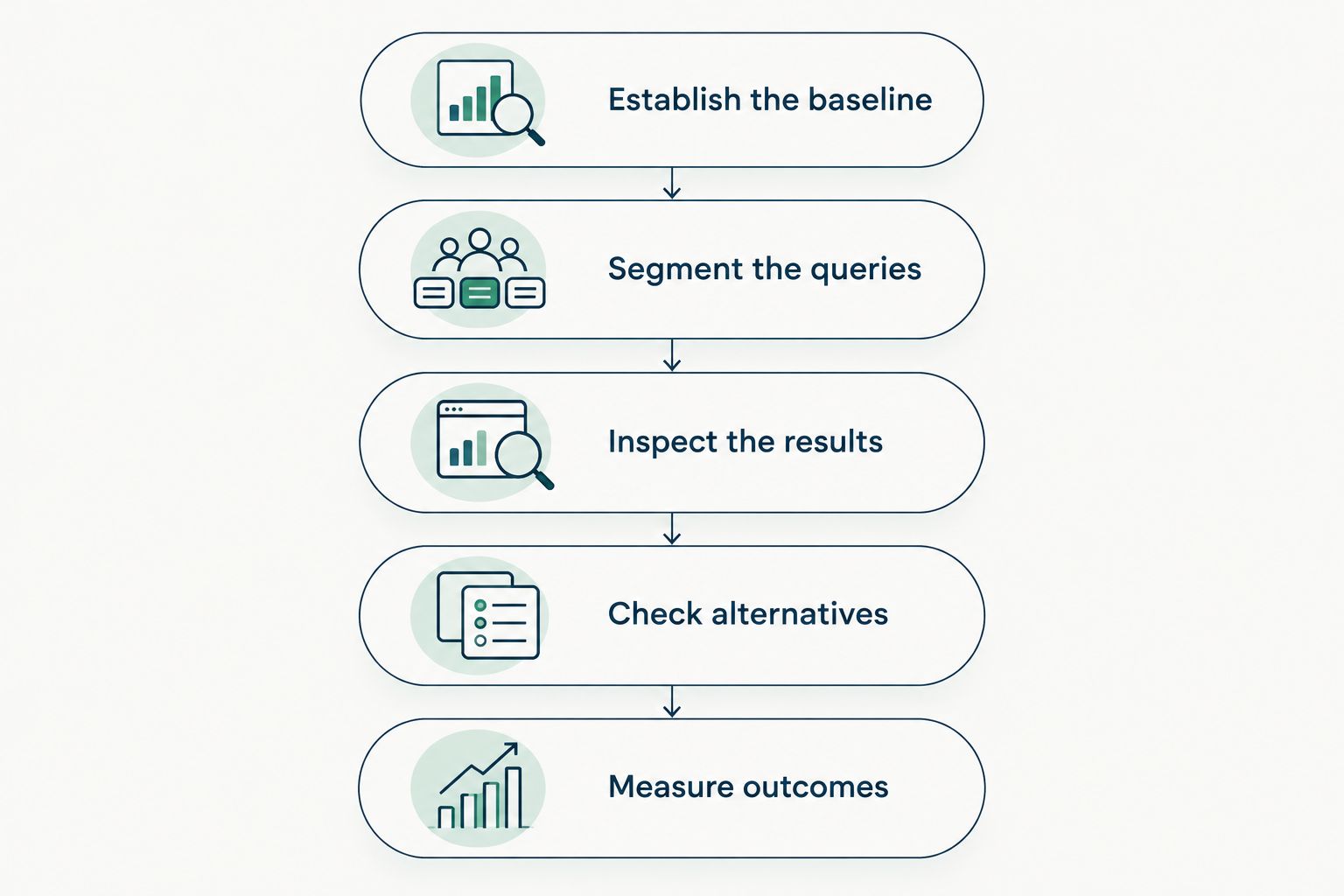
The strongest diagnosis combines search performance, repeated observations of the results page and website outcomes. It also states the limit clearly: observational evidence supports an explanation, but does not establish a controlled causal effect.
Why the traffic impact varies
There is no universal traffic-loss percentage you can apply to your website. The effect depends on the query, the answer shown and the action the searcher still needs to take.
- Task completion: A concise factual answer can complete a search without a visit. A task requiring an account, transaction or interactive tool still requires somewhere to act.
- Answer coverage: An Overview that resolves the full question leaves a different reason to click from one that provides only a starting point.
- Result layout: Judge the page the user sees, including other search features, rather than treating an organic position as a complete visibility measure.
- Source placement: A source link and a prominent brand recommendation communicate different things. Record each rather than counting them as equivalent exposure.
- Query mix: A shift between branded, informational and purchase-oriented searches changes aggregate performance. Compare like with like before assigning a cause.
- Website value: A page offering only the same summary faces a different challenge from a page containing evidence, functionality or decision support unavailable in the answer.
Use these factors to prioritise investigation, not to predict an unsupported loss figure. Your own query and page evidence determines the next move.
What should you change when clicks fall?
Fix the diagnosed problem, not the most visible search feature. A ranking loss calls for a different response from stable exposure with fewer clicks.
If rankings have declined, investigate the affected pages, competing results and technical changes. If rankings remain similar but click-through rate falls, inspect how the query is now answered and whether your page still offers a clear reason to visit.
For content work in 2026, distinguish the answer your page gives from the value someone receives after opening it. Answer the question directly, then provide useful depth rather than forcing a click through an incomplete introduction.
Useful additions include:
- Original evidence with a stated source and scope.
- Worked examples that explain how to apply the answer.
- Decision criteria that expose meaningful trade-offs.
- Practical instructions covering exceptions and failure points.
- Tools or resources that help the reader complete the task.
Do not add these as decoration. A generic checklist does not become original evidence because it sits below an answer paragraph, and a longer page is not automatically more useful.
For the page-level work, use the guide to optimising content for Google AI Overviews. Keep the objective explicit: make the page useful as a source and useful as a destination, without promising either a citation or a click.
Which measurements belong together?
Search reporting, website analytics and AI visibility tracking serve different purposes. Use each for the question it can answer; do not ask one dataset to stand in for the others.
| Measurement approach | Best for | Strength | Limitation |
|---|---|---|---|
| Google Search Console | Search exposure and clicks | Connects queries and pages with recorded search performance | Does not establish why an individual user did not click |
| Website analytics | On-site behaviour and conversions | Shows what happens after a recorded visit | Cannot observe a citation that produces no visit |
| AI visibility tracking | Brand presence in generated answers | Adds evidence about mentions, citations and recommendations | Does not prove traffic or revenue impact |
| Manual results checks | Examining a particular search experience | Shows the answer and source context directly | A snapshot does not represent every searcher |
Koalr is best for marketing teams that need AI visibility tracking alongside organic traffic reporting. That is its role in this measurement plan, not a reason to replace search or conversion reporting.
Maintain separate records for Google AI Overviews and other answer engines. An appearance in ChatGPT, Gemini, Perplexity, Claude or Copilot is not evidence that your brand appeared in a Google AI Overview.
Should you stop publishing informational content?
No. A decline in informational clicks is a reason to reassess the content's role, not to remove the category from your strategy.
Judge a page against a named purpose: attracting relevant visits, explaining a buying decision, supporting existing users or providing evidence others can reference. Then check whether it performs that purpose.
For your 2026 editorial plan, prioritise content with a clear audience and a useful contribution. Avoid publishing another interchangeable answer solely because the keyword has an attractive traffic forecast.
Can a cited page still lose organic traffic?
Yes. A source citation gives users a route to your page, but the answer can satisfy the query before they use that route.
Record the citation as visibility evidence and the traffic change as a separate outcome. Neither cancels the other, and neither establishes the value of the page without context.
Does lower organic traffic always mean lower revenue?
No. Organic traffic counts visits, while revenue depends on what those visits produce and how your business attributes the result.
Inspect conversion volume, qualified enquiries and relevant sales outcomes before changing investment. Do not assume that remaining visitors are more valuable simply because total traffic fell.
FAQ
Can Google AI Overviews hurt organic traffic even if my rankings stay the same?
Yes. An AI Overview can answer the query before someone visits your page, so stable rankings do not guarantee stable clicks. Check query-level click-through rate and the results page before assigning a cause.
How do I know whether AI Overviews caused my traffic drop?
Compare affected queries and pages, inspect their search results repeatedly, and rule out ranking, technical, demand and tracking changes. An Overview appearing alongside a decline does not prove it caused the whole decline.
Does getting cited in an AI Overview guarantee more traffic?
No. A citation creates a route to your page, but the searcher can finish the task without following it. Measure source inclusion and visits separately.
Is a brand mention the same as an AI recommendation?
No. A mention names your brand; a recommendation presents it as a suitable choice for a particular need. Record the surrounding wording to distinguish them.
Should I block Google from using my content in AI Overviews?
Do not make that decision from a traffic decline alone. Review Google's current search appearance controls and their documented effects before changing them, then assess the wider search visibility trade-off.
Can Koalr replace website analytics for measuring AI search?
Use Koalr for AI visibility tracking alongside website analytics, not instead of it. Brand presence in an answer and behaviour after a website visit are different measurements.
What should I show leadership when organic clicks fall?
Show the affected query groups, search exposure, clicks, observed AI visibility and conversion outcomes separately. Label the supported explanation and any unresolved attribution instead of presenting correlation as proof.
One last thing
Before commissioning a rewrite, save the evidence behind your diagnosis: query, page, date, search context, answer text and linked sources. Without that record, your next review risks comparing a measured traffic change with a remembered search result.
For your next 2026 review, ask a sharper question than whether traffic fell: what changed in the path from search exposure to a qualified action? That question identifies work your team can actually prioritise.


