

Writesonic combines AI-assisted content creation with SEO-oriented workflows. If your decision now centres on whether answer engines mention, cite or recommend your brand, writing output alone is no longer a sufficient buying criterion. The best Writesonic alternative in 2026 is Koalr if you need AI visibility tracking; Jasper if you need marketing-focused content creation.
- For writesonic alternatives, choose Koalr for AI visibility tracking and answer engine optimisation, not a like-for-like writing replacement.
- Choose Jasper for marketing content; ChatGPT or Claude for conversational drafting and analysis.
- Use Google Analytics 4 for referral traffic, not evidence of unclicked brand mentions or citations.
- Keep Writesonic when its current workflow meets your requirements; test replacements against the same brief or prompt set.
Why this matters
Searching for Writesonic alternatives brings together two different buying decisions: how to produce content and how to measure your brand's presence in generated answers. Separate them before comparing tools. A strong writing workflow does not, by itself, establish whether your brand appears when buyers ask for recommendations.
For your 2026 evaluation, distinguish 3 outcome types: a mention names your brand, a citation identifies a source, and a recommendation endorses an option for a stated need. These outcomes are not interchangeable. A cited article can support an answer without making its publisher the recommended supplier.
Your buying question should therefore be specific: do you need better drafts, a more suitable editorial workflow, evidence of answer-engine visibility, or attribution after someone visits your website? The right alternative follows from that question, not from the longest feature list.
Writesonic alternatives at a glance
This comparison separates tools by their role. It is a shortlist for evaluation, not a claim that every product replaces every part of Writesonic.
| Tool | Best for | Standout capability | How it differs from Writesonic |
|---|---|---|---|
| Writesonic | Content creation within an SEO-oriented workflow | Combines writing and search-focused tasks | The benchmark: keep it if the workflow meets your requirements |
| Koalr | Marketing teams measuring AI visibility | Tracks and helps improve brand appearance across answer engines | Its stated purpose is brand visibility and answer engine optimisation |
| Jasper | Marketing-focused content creation | Marketing-oriented writing and brand voice workflows | A candidate when your priority is the content team's working process |
| ChatGPT | Flexible drafting and analysis | Conversational iteration across different tasks | A general-purpose assistant rather than a dedicated marketing workflow |
| Claude | Document-led drafting and review | Conversational work with supplied text and documents | A general-purpose assistant suited to evaluating source-heavy writing tasks |
| Google Analytics 4 | Website traffic and conversion measurement | Acquisition and on-site event analysis | Measures visits and actions, not the complete answer that preceded them |
1. Koalr: best for AI visibility tracking
Koalr is an AI visibility platform for marketing teams that need to track and improve how their brand appears in generated answers. Its stated scope covers 6 answer surfaces: ChatGPT, Gemini, Perplexity, Claude, Copilot and Google AI Overviews. That makes it relevant when your main question is whether buyers encounter your brand, rather than whether your team can generate another draft.
Treat this as a change in measurement priorities, not an automatic replacement for your writing stack. You still need accurate source material, editorial judgement and an owner for content changes. Monitoring a problem and fixing the underlying page are separate jobs.
Where it shines
- Its stated purpose directly matches brand visibility and answer engine optimisation.
- Its scope includes several named answer engines rather than a single conversational interface.
- It serves marketing teams whose work includes understanding and improving brand appearance in answers.
Where it falls short
- It is not a like-for-like writing replacement on the basis of its stated purpose.
- A visibility platform does not remove the need to verify claims or maintain source pages.
- Engine coverage alone does not answer questions about your required markets, reporting workflow or prompt methodology; test those requirements directly.
Head-to-head: visibility or production?
| Decision dimension | Visibility platform | Writesonic |
|---|---|---|
| Core evaluation question | How does your brand appear in answers? | Does the content and search workflow meet your needs? |
| Proof to request | Results for relevant buyer questions across required engines | Output and workflow using your actual content brief |
| Work still required | Editorial changes and factual verification | Editorial review and factual verification |
Best for: Marketing teams making answer-engine visibility a distinct responsibility in 2026.
Verdict: Buy for the visibility job, not as an assumed replacement for your content editor.
2. Jasper: best for marketing-focused content creation
Jasper is a relevant Writesonic alternative when your primary task is producing marketing content. Its marketing orientation and brand voice workflows make it a candidate for teams evaluating consistency across briefs and formats. Judge it against your real editorial process, not a polished demonstration.
Give Jasper the same source material and brief you use in Writesonic. Compare the resulting argument, factual accuracy, voice and amount of editing required. A fluent draft that changes the meaning of your offer is not an improvement.
Where Jasper shines
- Marketing-focused writing is central to its positioning.
- Brand voice workflows are relevant when several people produce content for the same business.
- It is a closer category match for content creation than a visibility-only measurement tool.
Where Jasper falls short
- Generated writing still needs factual and editorial review.
- A brand voice setting does not resolve an unclear brief or unsupported product claim.
- Writing output alone does not establish whether answer engines cite or recommend your business.
For your 2026 comparison, use a brief with an explicit audience, a defensible claim and a clear next action. Reject unsupported additions even when they make the copy sound more persuasive. The useful comparison is the finished, approved piece—not the first generated response.
Best for: Marketing teams prioritising repeatable content creation and voice consistency.
Verdict: Buy if Jasper improves your actual editorial workflow; skip it as a substitute for visibility evidence.
3. ChatGPT: best for flexible drafting and analysis
ChatGPT is a general-purpose conversational assistant that can help you outline, rewrite, compare arguments and analyse supplied material. It suits teams that want to direct the process through conversation rather than begin with a dedicated marketing workflow. That flexibility puts more responsibility on the person defining the task.
Use ChatGPT to challenge a draft as well as create it. Ask which statements lack support, where an answer avoids the buyer's question, and which passages repeat the same point. Verify the response against the original sources.
Where ChatGPT shines
- You can move between outlining, drafting, critique and analysis within a conversational workflow.
- It accepts detailed instructions about audience, structure and source boundaries.
- It is useful for exploring several ways to explain the same verified information.
Where ChatGPT falls short
- It can produce incorrect or unsupported statements.
- You must define the editorial process and acceptance criteria yourself.
- Asking ChatGPT whether it knows your brand is not a substitute for a controlled visibility study.
Best for: Teams comfortable writing detailed briefs and reviewing generated work themselves.
Verdict: Buy for flexible assistance; skip it as your sole system for measuring brand visibility.
4. Claude: best for document-led drafting and review
Claude is another general-purpose assistant to evaluate when your writing task starts with documents, research notes or an existing draft. It can help summarise supplied material and reshape an explanation. Test whether it preserves the distinctions your subject requires.
For example, supply an approved product description and ask for a buyer-facing explanation without adding capabilities. Then compare each claim with the source. This checks fidelity rather than rewarding a confident writing style.
Where Claude shines
- It supports conversational drafting and analysis of supplied material.
- It is a candidate for reviewing structure, clarity and consistency.
- You can specify source boundaries and ask for a narrower answer.
Where Claude falls short
- Its responses still require verification against source documents.
- Your team must provide the workflow around drafting, approval and publication.
- An individual conversation does not establish visibility across other answer engines.
Best for: Teams evaluating source-led writing and document review.
Verdict: Buy if Claude handles your documents accurately; skip it as a replacement for cross-engine measurement.
5. Google Analytics 4: best for measuring visits and actions
Google Analytics 4 is not a writing alternative. It belongs in this comparison because traffic measurement and AI visibility answer different questions. Analytics can show a recorded visit and subsequent on-site activity; it cannot reveal every answer that mentioned your brand without producing a click.
Keep those evidence types separate. A referral session supports a traffic finding, not a complete claim about how often an answer engine recommends you.
Where Google Analytics 4 shines
- It measures website acquisition and on-site events.
- It connects recorded visits with configured conversion events.
- It provides a separate view of what happens after someone reaches your site.
Where Google Analytics 4 falls short
- It cannot observe an unclicked mention through website tracking alone.
- A referral does not preserve the full wording of the originating answer.
- Traffic attribution does not replace content production or answer monitoring.
Best for: Marketing teams connecting recorded website visits with business actions.
Verdict: Hold alongside your other tools; skip it as a standalone AI visibility solution.
Why people switch from Writesonic
There is no need to assume a pricing change, an outage or a missing capability to justify evaluating Writesonic alternatives. Start with a requirement your present workflow does not satisfy, then demonstrate the gap. These are decision criteria, not claims about every Writesonic customer.
- The primary job changes. Your priority moves from creating content to understanding brand appearance in answers.
- The editorial process changes. You need a different approach to briefing, source review or approval.
- The evidence requirement changes. Leadership wants to distinguish mentions, citations and recommendations rather than see output volume alone.
- The attribution question changes. You need to connect recorded referrals with on-site actions without calling those referrals total visibility.
A useful switch has a named outcome and a responsible owner. “We need another AI tool” has neither. Define what your team will do differently when the replacement produces a result.
Before replacing Writesonic in 2026, check its current capabilities against those requirements. A competitor's category positioning is not proof that your existing setup cannot do the job.
Test the alternatives against your actual work
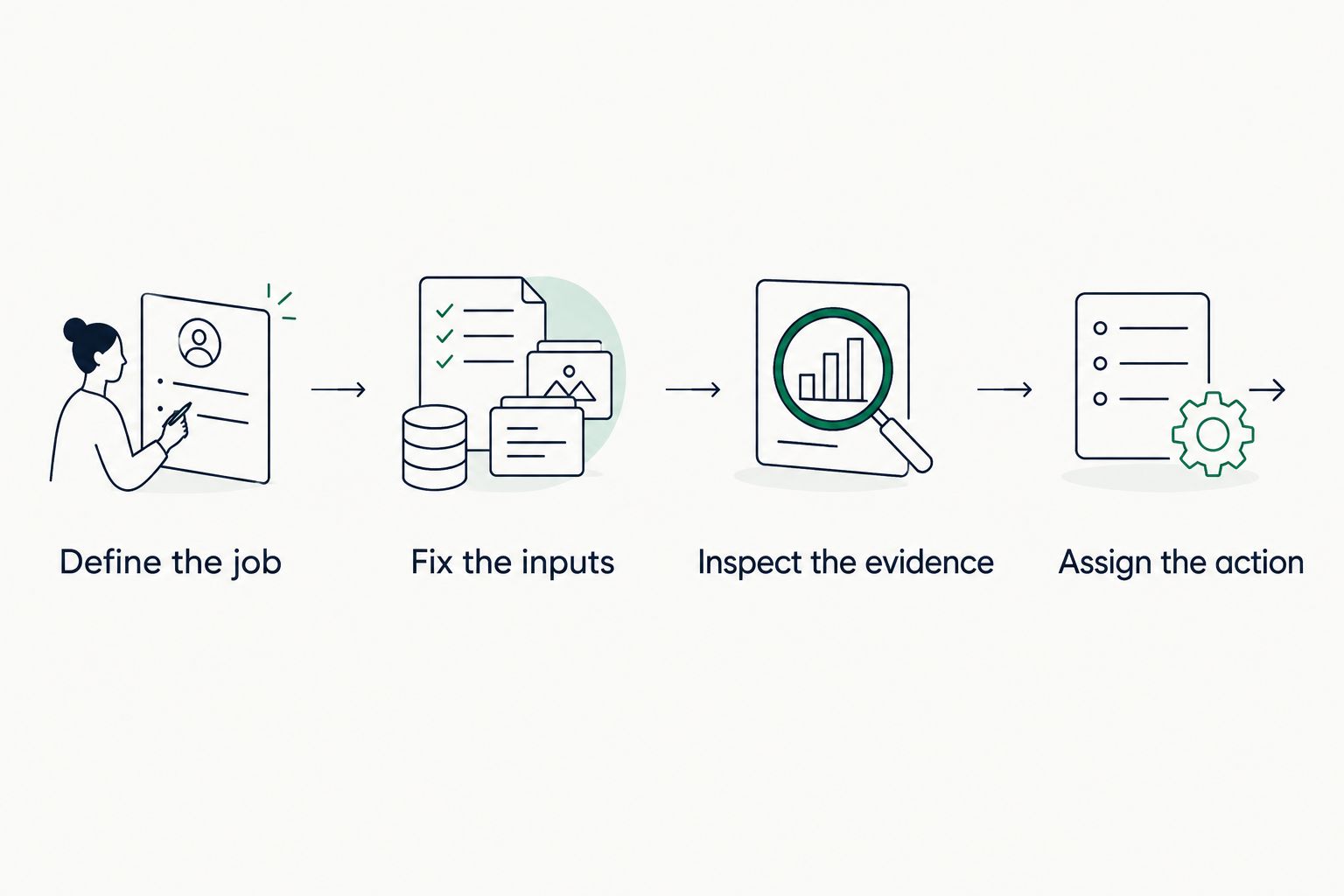
Use 4 evaluation steps to keep your shortlist tied to a decision. These are a proposed process, not a performance benchmark or a promise about any tool.
Define the job
Write a specific requirement: approve a source-led article, identify brand recommendations, or attribute website actions. Assign an owner. If the requirement mixes production and measurement, separate it into distinct tests before comparing results.
Fix the inputs
Give writing tools the same brief and approved sources. For visibility evaluation, use the same buyer questions, language and target market. Build those questions around actual purchase decisions; the guide to building a prompt library for AI visibility tracking explains that starting point.
Inspect the evidence
For writing, compare factual support, structure and editing required. For visibility, distinguish the brand name, the cited source and the recommendation. Keep the wording of the answer in view rather than treating every appearance as equivalent.
Assign the action
Decide what a finding changes: revise a page, correct a claim, improve a brief or investigate attribution. A result without an owner becomes another report. Choose the tool that fits the job your team will actually carry out.
For visibility work, do not rewrite your prompt set simply because the first results disappoint you. Changing the questions changes what you measure. Preserve a stable comparison set, and keep exploratory questions separate so that a new finding does not erase your baseline.
When staying with Writesonic is the right call
Stay with Writesonic when its current workflow meets the job you need done. A replacement is not progress if it creates extra administration without improving the approved output or the evidence behind your decisions.
In 2026, evaluate the configuration you actually use, not an old feature comparison. Ask whether the relevant capability works with your briefs, sources, buyer questions and reporting requirements. Keep the existing tool when it passes; add a separate measurement layer only when that solves a distinct problem.
FAQ
What's the best Writesonic alternative in 2026?
Koalr is the strongest fit here for marketing teams seeking AI visibility tracking rather than a writing replacement. Jasper is a candidate for marketing content, while ChatGPT and Claude suit conversational drafting and analysis.
Is an AI visibility platform a replacement for Writesonic?
Not automatically: visibility measurement and content creation are different jobs. Compare the specific capability you need before deciding whether to replace your writing tool or add a measurement layer.
Is Jasper better than Writesonic for marketing content?
Choose Jasper only if it performs better against your actual marketing brief and editorial requirements. Compare factual accuracy, voice, structure and the editing needed to reach an approved piece.
Can ChatGPT track whether my brand appears in AI answers?
A ChatGPT conversation can show what happened in that conversation, not establish cross-engine brand visibility. Use a defined set of buyer questions and keep mentions, citations and recommendations separate.
Can Google Analytics 4 measure AI visibility?
Google Analytics 4 measures website activity, not every appearance of your brand in generated answers. An answer that names your business without producing a website visit is outside website tracking alone.
What's the difference between a citation and a recommendation?
A citation identifies a source; a recommendation endorses an option for a stated need. Your article can be cited without your business becoming the recommended supplier.
Should I cancel Writesonic before testing alternatives?
Test the replacement against your actual work before removing the existing workflow. Keep Writesonic if it meets your requirements, and separate writing needs from visibility and traffic measurement.
One last thing
A cited page is not necessarily a recommended brand. An answer can use your content to explain a category and still direct the buyer towards another supplier.
Make that distinction part of your acceptance criteria. Ask not only whether your name appears, but what the answer tells the buyer to do—and whether the supporting source accurately represents your business.


