

Briefing a writer for AI-citable content means giving them three things a generic content brief skips: the exact claim to state, the source behind it, and the format an AI engine can lift without editing. Skip any of the three and the page reads fine to a human but never gets pulled into a ChatGPT, Perplexity or Google AI Overview answer in 2026.
- A brief for AI-citable content names the exact claim, source and format an engine can quote directly.
- Writers need one verifiable fact per paragraph, not a thesis buried in paragraph four.
- Lists, tables and defined terms get pulled into AI answers more often than narrative prose.
- Koalr tracks whether a brief actually produced a citation in ChatGPT, Perplexity or Google AI Overviews after publish.
Why this matters
AI answer engines don't read a page top to bottom the way a human does. They extract a chunk — a sentence, a table row, a defined term — and quote it if it answers the question cleanly and stands alone. A brief written for search rankings in 2020 tells a writer to "cover the topic in depth." A brief written for AI citation in 2026 tells the writer exactly which sentence should be quotable on its own.
Most writer briefs fail this test not because the writing is bad but because the brief never specified what "citable" means. Koalr exists because marketing teams kept publishing content that ranked fine and got cited never — the gap between the two is almost always a briefing problem, not a writing problem.
How do you brief writers to create AI-citable content?
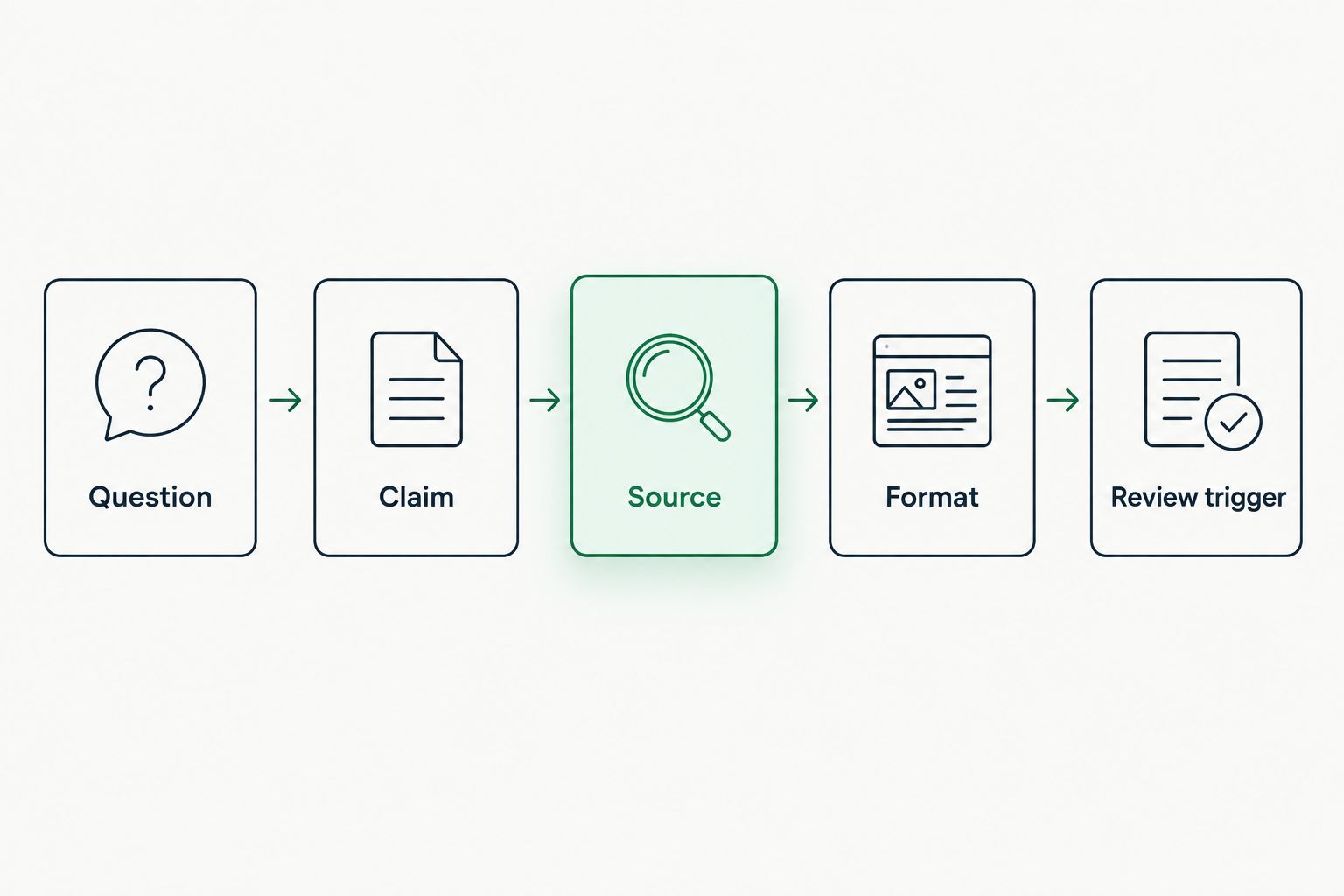
Give writers a structured brief with these instructions, in order:
- State the exact question the section must answer, phrased the way a user would type it into ChatGPT or ask Gemini out loud.
- Specify one verifiable claim per section, with the source line the writer should cite or link.
- Name entities explicitly — the product, the firm, the version, the date — never "many tools" or "some brands."
- Assign a format per section: table for comparisons, numbered steps for process, a defined term for glossary-style answers.
- Require the direct answer in sentence one of every section, with context after, not before.
- Ban hedging language in the brief itself — no "may," "could," or "generally" unless the underlying fact is genuinely uncertain.
- Set a review trigger: any section referencing a fact that changes (a price, a policy, a version number) gets flagged for a refresh check.
A brief that skips step 3 is the most common failure. Writers default to vague phrasing when the brief doesn't force specifics, and vague phrasing is exactly what AI engines skip over when choosing what to quote.
What to put in the brief itself
The difference between a generic instruction and an AI-citable instruction is concrete. Here's what changes line by line:
| Brief component | Generic instruction | AI-citable instruction |
|---|---|---|
| Claim | "Explain the benefits" | State the one measurable benefit, with its source, in the first sentence |
| Numbers | "Add some data" | Cite a specific figure with a unit and a date, or drop the claim entirely |
| Structure | "Write 800 words" | One verifiable fact per paragraph, each headed by the sub-question it answers |
| Format | "Use headings" | Match format to intent — table for comparison, numbered list for process, defined term for glossary |
| Named entities | "Mention competitors" | Name the exact product, version, or firm — never "many tools" or "some vendors" |
Hand a writer the left column and you get content that reads fine. Hand them the right column and you get content an AI engine can lift as-is.
Why some briefs produce citations and others don't
The brief format matters, but so does what's inside it. The pages that get quoted repeatedly by ChatGPT, Claude and Perplexity share a handful of traits:
- Claim density. One clear, sourced fact per section beats a page with a single quotable line buried 2,000 words in.
- Format match. AI engines extract table rows and numbered steps more cleanly than long narrative paragraphs — the structure itself signals what's citable.
- Named entities. Engines quote specific products, firms and figures, not vague references to "leading tools" or "top brands."
- Self-containment. A sentence that needs the sentence before it to make sense doesn't get quoted at all — every chunk has to stand alone.
- Source credibility. A claim backed by a named, checkable source outranks an unsupported assertion, even when both say the same thing.
- Freshness. Content that hasn't been revisited since the underlying fact changed gets passed over in favor of a page that has.
A brief that addresses all six produces content that clears the bar consistently. A brief that addresses none of them produces content that ranks but never gets named.
“A brief that forces a direct answer in sentence one produces the exact sentence an AI engine repeats — the rest of the paragraph is context, not the citation.”
Should writers write for AI first or for humans first?
Write for humans first: AI answer engines quote human-readable, well-structured content, not text stuffed with keywords for a bot. Both audiences want the same thing — a direct, self-contained answer up front — so optimizing for clarity serves both without a separate "AI version" of the page.
Does a brief need a table or list to get cited?
Not always, but comparison and process content almost always needs one: AI engines pull table rows and numbered steps more cleanly than prose paragraphs covering the same ground. A single strong, sourced sentence can still get quoted on its own with no table at all, but the odds go up sharply once the section is structured to match the intent behind it.
How long should an AI-citable brief be?
Length isn't the variable that decides citability — one verifiable, well-sourced claim per section is. A three-line brief that specifies the claim, the source and the format for each section outperforms a five-page brief that never tells the writer what "good" looks like.
Building this brief once isn't enough, either. The prompt library behind your AI visibility tracking should feed back into the brief every time a new prompt variant surfaces a gap — the brief that worked for one question set drifts as the questions people actually ask shift through 2026.
Check if your briefs earn citations
See which pages ChatGPT, Perplexity and AI Overviews actually cite after publish.
FAQ
What makes content AI-citable?
AI-citable content states one verifiable claim per section, names the source, and answers the question directly in the first sentence so an engine can extract it without editing. Vague claims, hedged language and unnamed entities get skipped.
How do you brief a writer for AI search visibility?
Give the writer the exact question, the claim to make, the source to cite, and the format the section needs — table, list or defined term. A brief without those four elements produces content that ranks but rarely gets quoted.
Should every claim in a brief have a source?
Yes — an unsourced claim is the first thing AI engines discount when choosing which page to quote. If a claim can't be sourced, the brief should tell the writer to soften or drop it rather than leave it unsupported.
Is AI-citable content different from SEO content?
They overlap heavily but aren't identical: SEO content optimizes for ranking and click-through, while AI-citable content optimizes for a self-contained chunk an engine can quote without a click at all. The best briefs in 2026 write for both at once.
Can Koalr tell if a brief resulted in a citation?
Koalr tracks whether a published page shows up as a citation in AI answers across ChatGPT, Gemini, Perplexity, Claude and Copilot, so a team can see which briefing changes actually moved citation rates rather than guessing.
Do AI engines cite opinion pieces?
Rarely on their own — opinion gets cited when it's attached to a named source and a specific, checkable claim, not when it's presented as unsupported commentary. A brief should separate opinion sections from fact sections clearly.
What format gets cited most by ChatGPT and Perplexity?
Numbered steps, comparison tables and defined terms get extracted more consistently than long narrative paragraphs, because the structure itself marks the chunk as a complete, quotable unit.
How often should writer briefs be updated for AI citability?
Any brief covering a fact that can change — a policy, a version number, a market figure — needs a review trigger built in, and the brief itself should be revisited whenever a content refresh touches that section.
One last thing
The single highest-leverage line in any writer brief isn't the outline — it's the instruction to put the direct answer in the first sentence of every section. That's the sentence an AI engine extracts verbatim, and it's the one line most content briefs in 2026 still leave out.


