

Yes. Your brand can rank well on Google and still be absent from ChatGPT answers because a Google ranking does not guarantee a brand mention, citation or recommendation. To establish whether you are invisible, test relevant buyer prompts and inspect the answers directly; referral traffic alone cannot tell you whether your brand appeared.
- Is my brand invisible in ChatGPT even if I rank well on Google? Possibly; rankings cannot establish answer visibility.
- Measure brand mentions, source citations and buyer recommendations separately; they answer different questions.
- Test unbranded buyer prompts, not just questions that already name your company.
- Koalr suits marketing teams that need AI visibility tracking alongside their existing SEO measurement.
Is my brand invisible in ChatGPT even if I rank well on Google?
Google rankings cannot answer that question. ChatGPT answers can. Start with a repeatable prompt library for AI visibility tracking built around the decisions your buyers actually make.
Use the following distinctions in your 2026 reporting. Each signal establishes something different, and each has a limit.
| Signal | What it establishes | What it does not establish |
|---|---|---|
| Google ranking | Your page's position for a particular search query and context | Whether ChatGPT names or recommends your brand |
| Brand mention | Your brand appears in the answer text | Whether the answer endorses your brand |
| Source citation | The answer references a source | Whether your brand is recommended or the source receives a visit |
| Recommendation | The answer proposes your brand for the buyer's stated need | Whether the buyer clicks or converts |
| Referral visit | A recorded visit arrives from an identifiable referring source | Every answer in which your brand appeared |
A cited page and a recommended brand are not interchangeable. An answer can use your educational content while recommending another supplier, or name your company without linking to your website.
Why this matters
Your SEO report and your answer-visibility report describe different parts of discovery. Treating either as a substitute leaves a measurement gap.
A strong Google position is still useful evidence about organic search performance. It is not evidence that a buyer asking ChatGPT for a shortlist will see your brand. Equally, an absent referral session is not proof that your brand was absent from an answer.
Keep SEO performance, answer visibility and website outcomes separate before connecting them. That gives your team a diagnosis instead of a single score that hides the problem.
What counts as being visible in ChatGPT?
Use 3 answer outcomes: mention, citation and recommendation. Record each independently rather than assigning every appearance the same meaning.
Mention: your brand is named
A mention establishes presence. Read the surrounding sentence before counting it as a positive result.
Your brand might appear as an example, an alternative or an option the answer advises against. Record that context, including factual errors, rather than reporting a name match as an endorsement.
Citation: a source is referenced
A citation establishes that the answer references a source. Inspect the destination and the claim it supports.
If the answer cites your website, identify the actual page. If it cites an independent source discussing your brand, distinguish that from a citation to your own domain. Neither automatically means your brand received a recommendation.
Recommendation: your brand fits the stated need
A recommendation connects your brand to the buyer's request. Capture the stated reason, any qualification and the alternatives presented alongside it.
This is closer to the competitive question: are you in the buyer's consideration set? It still does not establish a commercial outcome. Keep visits, enquiries and conversions in your website reporting.
How do you test whether ChatGPT overlooks your brand?
Use these 5 diagnostic steps for your 2026 baseline. They are a working procedure, not a claim about how many prompts every business needs.
1. Define buyer needs
Start with the problem, audience and constraints your product genuinely serves. Use sales questions, support conversations and existing search queries where those sources are available.
Write prompts that ask for help with a decision, not prompts designed to make your brand appear. A SaaS buyer might describe a workflow, an integration requirement or a reporting need before asking which approach fits.
2. Separate prompt types
Keep branded questions apart from unbranded discovery questions. Asking whether your named product supports a workflow tests brand understanding; asking which product suits that workflow tests discovery.
Both are useful. Mixing them makes it difficult to tell whether buyers can discover you without already knowing your name.
3. Record test context
Save the exact prompt, answer, date, available model identifier and whether web search was used. Note the language and market you intended to test.
Use a fresh conversation for standalone discovery checks so your earlier messages do not introduce your brand. Keep follow-up conversation tests in a separate group when that journey is what you want to examine.
4. Classify answer outcomes
Record mentions, citations and recommendations separately. Include competing brands and cited source pages so the result contains evidence, not just a pass or fail.
Also record whether the answer correctly describes your product. A prominent recommendation based on an unsupported capability is an accuracy problem, not a result to celebrate.
5. Compare repeated checks
Repeat the same prompt set under recorded conditions. Keep new exploratory prompts separate from your baseline so changing the test does not masquerade as changing visibility.
Report the scope precisely: absent from the sampled answers for a particular buyer need, rather than invisible everywhere. A bounded finding is more useful than an absolute claim you cannot demonstrate.
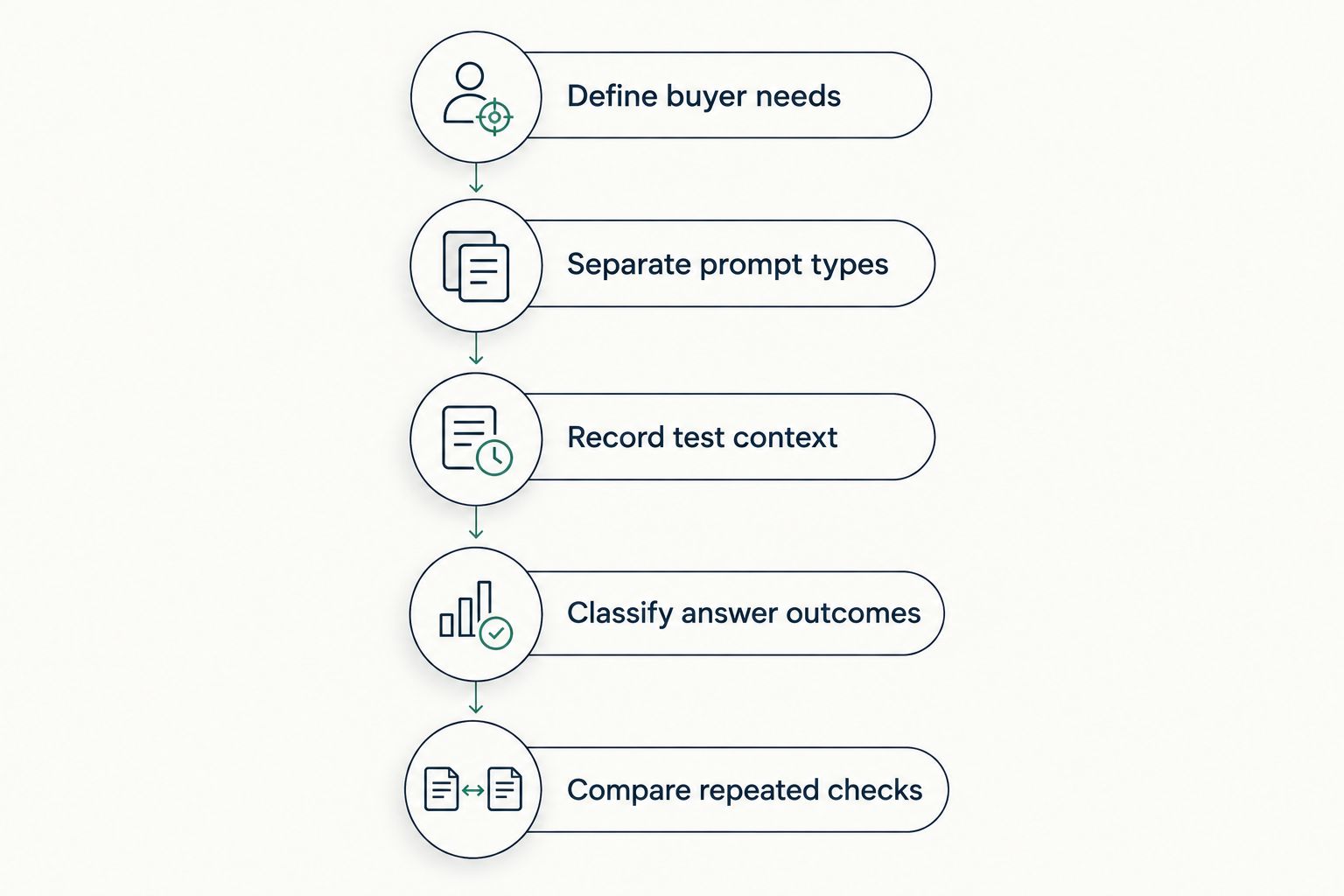
This process gives you an inspectable baseline. Another team member should be able to read the saved answers and understand why each result received its classification.
Why does visibility vary between Google and ChatGPT?
A Google result and a generated answer are different outputs. Do not assign a cause to a missing brand until you have inspected the prompt, answer and available source evidence.
For a 2026 audit, organise that investigation around these factors:
- Question wording: Check whether the prompt asks the same thing as the Google query you rank for. A broad educational query and a supplier-selection question are different tests.
- Buyer constraints: Check whether the answer seeks a particular audience, market or capability, and whether your content explicitly addresses those requirements.
- Search context: Record whether the answer used web search and which sources it referenced. Do not assume every answer is a fresh search result.
- Conversation context: Separate an independent question from a follow-up influenced by earlier messages. Your brand's presence in the conversation changes what you are testing.
- Source evidence: Inspect the cited material and its claims. Identify whether the missing information concerns your product, the buyer's problem or an independent description of your brand.
- Test scope: Separate results by platform, language and prompt group. A result from one environment does not establish visibility in another.
These factors guide the investigation; they do not prove why a particular answer omitted you. Preserve that distinction when reporting to leadership.
What should you fix when Google rankings are strong?
Fix the evidenced gap, not the channel label. Start with the answer and work back to the page or factual issue your team can address.
If an answer misunderstands who your product serves, check whether your product descriptions state the audience and use case clearly. If it attributes an unsupported capability to your brand, establish the correct claim before changing content.
If a cited competitor page directly answers a buyer question that your page only touches on, review the missing substance. Add a clear answer, relevant constraints and supportable evidence where you have it. Do not copy the competitor's wording or assume its formatting caused the citation.
Technical access belongs in the investigation too. Check relevant crawler controls, page accessibility and whether essential product information is available in readable page content. Passing those checks removes an access concern; it does not guarantee a citation.
Make content easier to assess
Give each important page a clear purpose. State who the product serves, what it does and where its limits apply, using claims your business can substantiate.
Put direct answers near the questions they address. Use descriptive headings and comparisons only where they help the buyer evaluate a real decision. More FAQ sections are not a substitute for missing product information.
Preserve what already works
Do not dismantle a useful ranking page because a single ChatGPT answer omitted your brand. Preserve its search intent and useful content while addressing the specific gap you found.
For your 2026 change log, record the original issue, the edited page and the publication date. Retest the same prompts afterwards, and describe any difference as an observed change rather than proof that the edit caused it.
Should you use manual checks or AI visibility software?
Choose the method around the question you need answered. Manual review helps you understand individual answers; a tracking platform is relevant when your marketing team needs an ongoing visibility workflow.
| Approach | Best for | Strength | Limitation |
|---|---|---|---|
| Manual answer checks | Investigating specific prompts | You can inspect the complete wording and context directly | You must organise the records and comparisons yourself |
| Koalr AI visibility software | Marketing teams tracking brand presence across answer engines | Focuses on tracking and improving how the brand appears in answers | Answer visibility alone does not establish website conversions |
| Website analytics | Measuring recorded visits and website outcomes | Connects identifiable visits with on-site behaviour | Does not capture an answer appearance that produces no visit |
Koalr is best for marketing teams that need to track and improve brand visibility across AI answer engines. Its stated scope includes ChatGPT, Gemini, Perplexity, Claude, Copilot and Google AI Overviews.
Use Koalr AI visibility tracking alongside your existing SEO and website measurement. The limitation is straightforward: appearing in an answer is not the same as winning a customer. Keep the evidence for each stage distinct.
Does no ChatGPT referral traffic mean nobody sees my brand?
No. An answer can name your brand without generating a website visit, so referral reporting cannot establish total answer exposure.
Use referral data to evaluate recorded visits. Use saved answers to establish whether your brand was mentioned, cited or recommended in the tested prompts.
Can I make ChatGPT recommend my brand?
You cannot guarantee a recommendation. You can improve the accuracy, clarity and accessibility of the information your business publishes, then test whether observed answers change.
Treat answer engine optimisation as an evidence-led content and measurement workflow. A promised recommendation is not a reliable deliverable.
Should I stop investing in SEO?
No. A visibility gap in ChatGPT does not invalidate your Google results or establish that SEO investment should stop.
For 2026 planning, keep organic search outcomes visible and add a separate answer-visibility baseline. Allocate work against demonstrated gaps rather than assuming one discovery channel replaces another.
FAQ
Can my brand rank well on Google but not appear in ChatGPT?
Yes. A Google ranking does not guarantee a mention, citation or recommendation in ChatGPT. Test relevant buyer prompts directly to establish whether your brand appears.
How do I check whether ChatGPT knows my brand?
Ask branded questions to test how ChatGPT describes your company, then test unbranded buyer questions separately. The first checks brand understanding; the second checks discovery.
Is a ChatGPT citation the same as a recommendation?
No. A citation references a source, while a recommendation proposes a brand for the user's stated need. An answer can cite your content without recommending your product.
Why does ChatGPT recommend a competitor instead of my company?
The answer alone does not establish the cause. Inspect the prompt constraints, recommendation wording and cited sources before deciding what to change.
Does no referral traffic mean my brand is invisible?
No. Your brand can appear in an answer without generating a visit. Referral analytics measures recorded visits, not every mention or recommendation.
Will adding FAQ schema guarantee ChatGPT citations?
No. FAQ schema is not a guarantee of citation or recommendation. Prioritise accurate answers, accessible content and evidence that supports your claims.
What should I measure alongside Google rankings in 2026?
Measure mentions, citations and recommendations in a defined prompt set, alongside referral visits and website outcomes. Keep the metrics separate so each retains a clear meaning.
One last thing
A branded prompt can hide a discovery problem. If you put your company name in the question, you have already supplied the brand you are trying to find.
Make the buyer's problem the starting point. Then ask whether the answer introduces your brand without help, explains it correctly and recommends it for a reason your product can support.


