

To get cited by ChatGPT, publish crawlable pages that answer specific prompts directly, support factual claims with identifiable sources and make each answer easy to extract. Test those prompts repeatedly, compare your cited pages with competing sources and revise the passages that lose. No page can force a citation because ChatGPT can answer without web search or select a different source between runs.
- To learn how to get cited by ChatGPT, start with direct answers, crawl access and clear sourcing.
- A citation links a source; a mention names a brand; a recommendation presents it as an option.
- Test at least three prompt variants for each buyer intent instead of checking one favourable answer.
- Schema clarifies page structure but does not replace useful content, crawlability or external evidence.
- Koalr AI visibility software tracks citations, mentions and recommendations across major answer engines.
Why this matters
Start with a prompt library for AI visibility tracking, because isolated ChatGPT checks do not show whether your visibility is repeatable. A useful prompt set covers the questions buyers ask before they know your brand, while comparing options and before making a decision.
A citation, mention and recommendation are different outcomes. Referral analytics only register the citation when someone clicks, so they miss cited answers without clicks and every unlinked mention. Koalr helps marketing teams track these AI visibility outcomes across ChatGPT, Gemini, Perplexity, Claude, Copilot and Google AI Overviews.
In 2026, the job is not to make every page sound as if it were written for a chatbot. It is to publish the clearest useful source for a defined question, then measure whether answer engines actually select it.
How to get your website cited as a source in ChatGPT answers
Use this seven-step process in 2026. It separates technical access, page structure, evidence and measurement so you can diagnose why a page is not being cited instead of rewriting everything at once.
1. Choose a prompt your page can answer completely
Start with one buyer question and assign one page as its strongest answer. The page can cover related subquestions, but its opening must resolve the primary prompt without asking the reader to interpret a slogan or piece together several sections.
Use at least three prompt variants for the same intent. For example, test a direct question, a comparison and a recommendation request. Variants reveal whether ChatGPT associates the page with the underlying topic or only responds to one convenient wording.
Do not mix discovery, comparison and troubleshooting prompts into one measurement group. They ask for different evidence and often surface different sources.
2. Put the complete answer near the top
State the answer within the first 100 words, then explain the reasoning. A useful opening names the subject, gives the verdict and includes the qualification that changes the decision. Definitions and company background belong below that answer unless the query explicitly asks for them.
Use short, self-contained paragraphs. Each passage should still make sense when removed from the surrounding page because an answer engine can cite a specific passage rather than summarise the entire article.
Headings should match real questions where that phrasing is natural. A heading such as Does schema help ChatGPT cite a page? is more precise than Technical considerations because it establishes the question and expected answer.
3. Make the page accessible to search and browsing systems
A useful answer cannot be selected if the relevant crawler cannot retrieve it. Confirm that the canonical URL returns an HTTP 200 response, does not require a login and is not blocked unintentionally by robots.txt, authentication or a firewall rule.
OpenAI documents OAI-SearchBot for search discovery and ChatGPT-User for user-initiated page visits. Treat their access separately from the permissions you set for training crawlers. Blocking training access does not require blocking search visibility.
Check the rendered page, not only the source HTML. The core answer, heading structure and supporting text must remain available when scripts fail or execute slowly.
4. Show where factual claims come from
Citable pages distinguish an original claim from evidence borrowed elsewhere. Name the organisation, document or dataset behind a factual claim, include the relevant publication date and link to the primary source when that source is available.
Do not add a long reference list that has no connection to individual claims. Place evidence beside the sentence it supports. That makes the relationship clear for readers and reduces ambiguity when a passage is extracted.
Your own evidence also needs scope. Explain what was measured, which market or audience it covers and when the measurement occurred. A number without that context is difficult to compare and easy to misrepresent.
5. Use formats that expose the answer clearly
Match the format to the question. Use numbered steps for a process, a table for a comparison and concise question headings for an FAQ. Do not turn every paragraph into a list; structure should clarify the answer rather than decorate it.
Add Article, FAQPage or Product structured data only when the visible page supports that markup. Schema can identify authorship, dates, entities and page sections, but it does not make weak content authoritative. Incorrect markup creates conflicting signals instead of solving the citation problem.
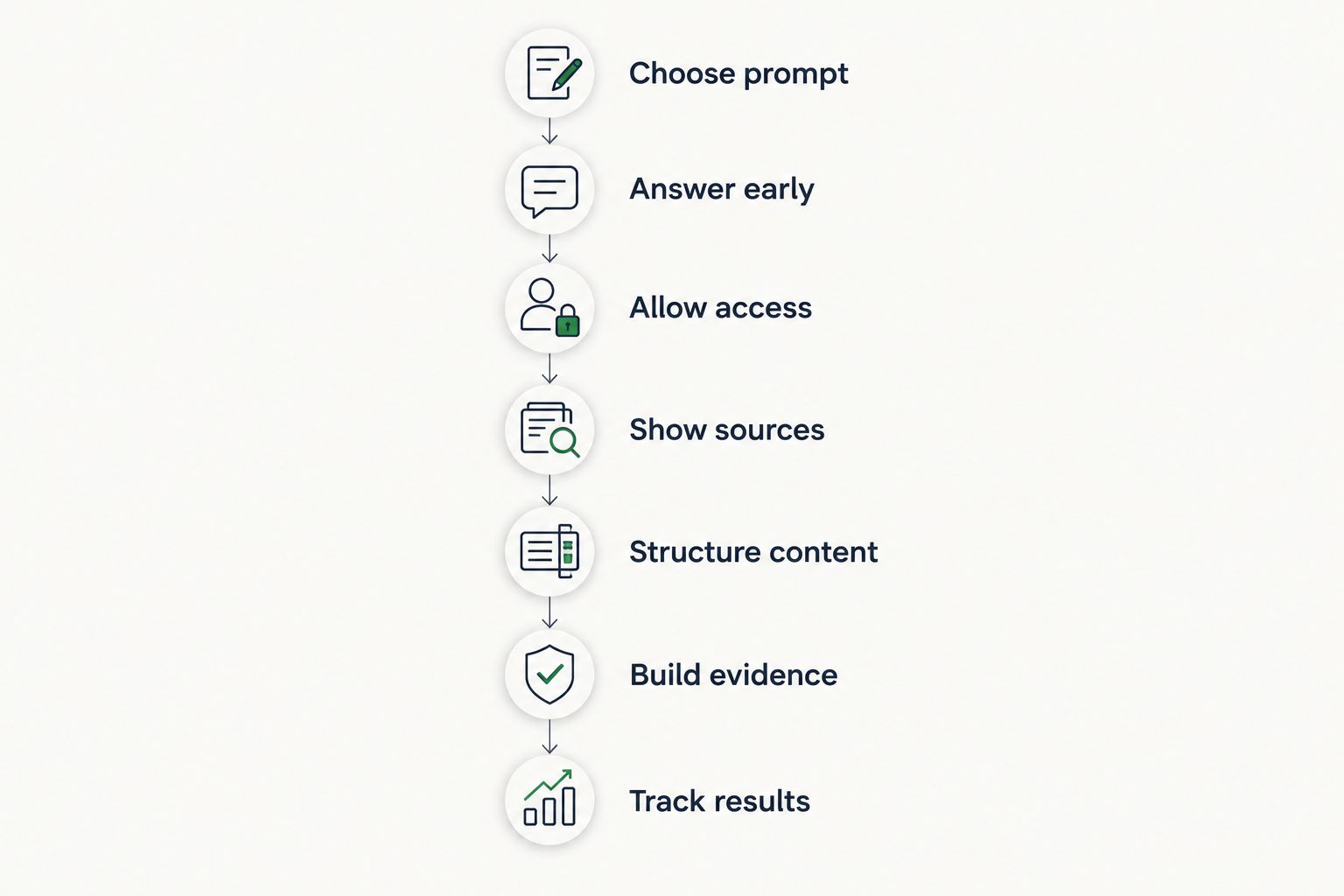
6. Build evidence beyond your own website
A page claiming that its own company is the best source is still a first-party assertion. Support important category claims with primary research, official documentation or clearly attributed expert material. Keep descriptions of your own product factual and separate from broader market claims.
Consistent information across profiles, documentation and independent references also reduces entity ambiguity. Use one brand name, one preferred domain and accurate descriptions of what the organisation provides. Conflicting names or outdated descriptions make the source harder to identify correctly.
7. Track the answer, source and prompt together
Record the prompt, platform, date, answer outcome and cited URL for every test. Classify the result as a citation, mention, recommendation or absence. Those four states require different actions and should not be collapsed into one visibility score without retaining the underlying result.
Run the same prompt set on a fixed cadence. A 30-day review cycle is suitable for stable topics, while launches and fast-changing categories require more frequent checks. Keep the prompts constant during a comparison period so a wording change does not masquerade as a visibility change.
The practical target for 2026 is repeatable citation coverage across commercially relevant prompts, not one screenshot of a favourable ChatGPT answer.
Why ChatGPT citation results vary
Citation results change because the answer, prompt and available sources can change. Diagnose these five factors before treating a lost citation as a content failure:
- Browsing behaviour: ChatGPT does not search the web for every answer, so some runs contain no external citations.
- Prompt wording: A research question, product comparison and brand lookup can produce different source requirements even when they concern the same topic.
- Page access: Crawler blocks, authentication, redirects and rendering failures can prevent retrieval despite an otherwise useful answer.
- Source competition: A competing page can provide a clearer passage, newer evidence or a source closer to the original claim.
- Answer volatility: Repeated runs can select different sources, which is why one manual check cannot establish a citation rate.
Control what you can: page access, answer clarity, evidence, internal consistency and testing discipline. Treat the model's final source selection as an observed outcome, not a promise.
Is a ChatGPT citation the same as a brand mention?
No. A citation identifies a source used in the displayed answer, while a mention only names the brand. A recommendation goes further by presenting the brand as a suitable option, but it can appear with or without a citation.
| Outcome | What appears in the answer | What it tells you |
|---|---|---|
| Citation | A source reference or link | The displayed answer attributes information to a source |
| Mention | The brand name without source attribution | ChatGPT recognises or introduces the brand |
| Recommendation | The brand is presented as an option | The answer connects the brand with the user's need |
| Absence | No brand or cited page appears | The prompt does not surface the brand in that run |
Track all four outcomes in 2026. A cited article can establish authority without recommending the company, while an uncited recommendation can influence consideration without sending measurable referral traffic.
Does schema markup make ChatGPT cite a page?
Schema markup does not guarantee a ChatGPT citation. It describes visible page information in a machine-readable form, which can reduce ambiguity around the article, author, date, product or FAQ, but the underlying answer still needs to be useful and retrievable.
Validate that structured data matches the page a reader sees. Do not mark promotional statements as independent reviews, add FAQ markup for hidden content or use an organisation name that conflicts with the canonical brand identity.
For 2026, treat schema as technical clarification rather than a ranking switch. Fix blocked pages, incomplete answers and unsupported claims before expanding markup.
How often should you check ChatGPT citations?
Use a fixed 30-day review cycle for stable prompt sets, then shorten the interval around launches, major content changes or sudden competitor movement. Run each important prompt at least three times per review because a single response cannot show whether the result is persistent.
Keep a version history for the prompt and target page. When a citation changes, compare the page content, source selected, answer wording and test date. That record prevents teams from crediting a rewrite when the actual change came from a different prompt or browsing outcome.
The same rule applies throughout 2026: compare like with like. Stable prompts and documented page changes create evidence you can act on.
Where Koalr fits
Koalr's AI visibility software is built for marketing teams that need to track how their brand appears across ChatGPT and other AI-driven answers. It separates citations, mentions and recommendations, giving the team a clearer basis for deciding which prompts and pages need work.
Koalr is best for marketing teams that need repeatable citation and brand visibility tracking across multiple answer engines. Its strength is measurement across prompt sets and platforms. Its limitation is equally clear: tracking exposes the gap, but it cannot guarantee that ChatGPT will select a page or replace the editorial and technical work needed to improve that page.
Track your AI citations
Measure citations, mentions and recommendations across major AI answer engines.
FAQ
How do I get my website cited by ChatGPT?
Publish a crawlable page that answers one specific prompt directly, supports factual claims with identifiable sources and exposes the answer in a clear structure. Then test repeated prompt variants to see whether the citation persists.
Can ChatGPT cite a page that does not rank first on Google?
Yes, a page does not need to rank first on Google to appear as a ChatGPT source. Search position and answer-engine citation are different outcomes, so measure both rather than treating one as proof of the other.
Does ChatGPT cite every answer it gives?
No, ChatGPT does not provide external citations for every answer. Citations depend on the experience being used, whether web search is involved and which sources are selected for that response.
Is a ChatGPT citation better than a mention?
A citation and a mention serve different purposes. A citation attributes information to a source and can send referral traffic, while a mention shows that the brand appears in the answer without source attribution.
Does FAQ schema help a page get cited by ChatGPT?
FAQ schema can clarify question-and-answer content when it matches the visible page, but it does not guarantee citation. Direct answers, crawl access and reliable evidence remain necessary.
How many times should I test each ChatGPT prompt?
Test each important prompt at least three times during a review. Repeated tests reveal whether a citation is persistent or only appeared in one variable response.
How often should I review ChatGPT citations in 2026?
Review stable prompt sets every 30 days in 2026 and check more frequently around launches or major content changes. Keep the prompt wording constant during each comparison period.
Can Koalr improve a page that ChatGPT does not cite?
Koalr identifies citation, mention and recommendation gaps across tracked prompts and platforms. Your team still needs to make the editorial, sourcing and technical changes identified by that evidence.
One last thing
Do not start by rewriting the page with the most organic traffic. Start with the commercially relevant prompt where a competitor is repeatedly cited and your brand is absent. That gap gives you a defined question, a visible competing source and a result you can measure after the change.
In 2026, citation work becomes manageable when every task connects one prompt, one intended page and one observed outcome. Anything broader turns into a content project with no clear test.


