

Yes. An AI visibility tool with citation tracking can show the source URLs attached to answers about your brand, but those citations do not reveal every influence on the model’s response. Choose a tool that preserves the answer, prompt and cited pages together—not just a brand mention count or a list of domains.
- A tool that shows which sources AI uses to answer questions about my brand should preserve citations alongside answers.
- Visible citations identify linked sources, not every influence on an answer.
- Koalr is for marketing teams that need to track their brand in AI answers.
- Evaluate citation tracking with fixed prompt sets, source URLs and separate mention and recommendation labels.
Is there a tool that shows which sources AI cites for my brand?
Yes: look for answer-level citation tracking within an AI visibility platform. The evidence you need is a saved answer linked to its original prompt, execution date, platform and cited URLs. A domain leaderboard alone cannot show which page supports which statement.
Start with a repeatable set of buyer questions. The guide to building a prompt library for AI visibility tracking explains how to organise that foundation before comparing results.
Different measurement methods answer different questions. Use this comparison when assessing a tool in 2026:
| Approach | Best for | Useful evidence | Limitation |
|---|---|---|---|
| Manual answer checks | Investigating a specific question | The answer and citations visible during that check | Repeating checks and maintaining records requires manual work |
| Citation tracking | Comparing cited sources across a defined prompt set | Saved answers connected to source URLs, where captured | Observes sampled answers, not every user conversation |
| Referral analytics | Measuring visits that reach your website | Recorded sessions with identifiable referral information | Cannot show a citation that produced no visit |
For source discovery, prioritise citation evidence; for website outcomes, measure referral traffic separately. Neither replaces the other.
Why this matters
A brand mention tells you that your name appeared. It does not tell you what the answer said, whether the answer recommended you, or which page supported the statement.
That distinction changes the next move. An inaccurate description calls for a factual correction; an absent recommendation calls for investigating buyer criteria; a third-party citation calls for examining a source you do not control.
For your 2026 reporting, keep these outcomes separate. Combining them into a single visibility total hides the difference between being named and being chosen.
Citation, mention and recommendation are different signals
Use 3 separate labels when reviewing an answer:
- Citation: the answer attaches a source reference or link. Inspect the destination and the surrounding statement.
- Mention: the answer names your brand. Record whether the description is accurate and relevant.
- Recommendation: the answer presents your brand as a suitable choice for a stated need. Preserve the conditions attached to that recommendation.
An answer can mention your brand while citing a publisher’s comparison page. It can also cite your documentation without recommending your product. Record what happened rather than treating either event as an endorsement.
How do you check which sources an answer cites?
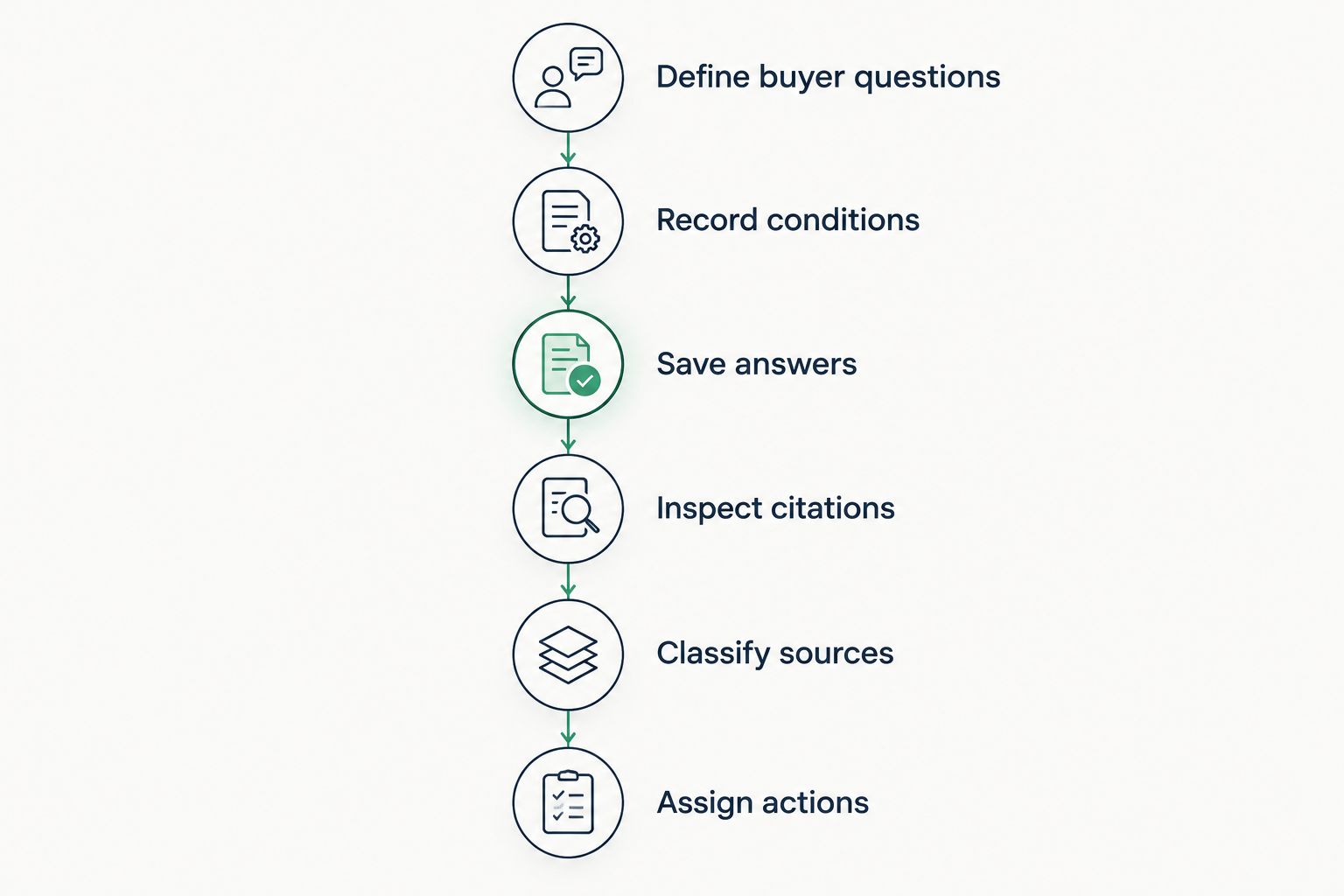
Use the following 6 steps as an evaluation workflow, not as a claim about any particular platform’s features. Ask vendors to demonstrate the workflow with questions relevant to your business.
1. Define buyer questions
Separate branded questions from unbranded questions. A question about your product’s capabilities tests how the answer describes you; a question about solving a buyer’s problem tests whether you enter the consideration set.
Keep the exact wording. If you change the question between checks, you lose a clean basis for comparing the answers and their citations.
For a SaaS team, useful themes include implementation, integrations, security requirements and suitability for a particular workflow. Include only themes that reflect your actual product and buyers.
2. Record conditions
Save the platform, date, language and any visible search or browsing setting alongside the prompt. Record whether the test begins in a fresh conversation or follows earlier messages.
Treat your initial 2026 records as a baseline, not a permanent description of how an engine answers. A result without its conditions is difficult to interpret later.
3. Save answers
Preserve the full response rather than extracting only your brand name. You need the surrounding language to distinguish a recommendation from a passing mention, a warning or a factual description.
Check whether the monitoring method represents the experience you want to measure. A response obtained through an API is evidence of that execution; do not automatically label it as the answer every user sees in the consumer interface.
4. Inspect citations
Open each cited page and record its destination URL. Retain the page-level detail even if you also group results by domain.
Read the relevant passage. A source appearing in an answer’s citation list does not, by itself, establish that it supports every nearby claim about your brand.
5. Classify sources
Separate your own pages from third-party pages. Then classify the cited content by purpose, such as documentation, editorial comparison, directory listing or discussion.
Record whether the cited page discusses your brand, a competitor or the wider category. Otherwise, a frequently cited category resource can be mistaken for evidence of brand coverage.
6. Assign actions
Connect each finding to a specific task. Examples include correcting an inaccurate owned page, documenting a missing product fact, investigating an outdated external description or improving an answer that lacks supporting evidence.
Keep the finding, owner and intended change together. A source report becomes useful when someone can act on the underlying page or claim.
What should a citation-tracking tool show you?
Ask for inspectable evidence before accepting a summary score. Your 2026 evaluation should establish whether you can move from an overview to the exact answer and then to its cited page.
Use these acceptance criteria during a demonstration:
- Answer traceability: can you retrieve the response behind a reported citation?
- Page-level sources: can you distinguish individual URLs from their parent domain?
- Prompt context: can you identify the question, platform and execution conditions?
- Separate outcomes: can you distinguish mentions, citations and recommendations?
- Historical evidence: can you compare saved observations without overwriting the earlier record?
- Clear coverage: does the vendor explain which platforms and answer experiences its measurements represent?
These are buying criteria, not assumed features. If a vendor cannot demonstrate an item, exclude it from your assessment rather than filling the gap with a sales description.
Koalr is AI visibility software for marketing teams tracking how their brand appears in answers from ChatGPT, Gemini, Perplexity, Claude, Copilot and Google AI Overviews. That makes Koalr relevant to the wider brand-monitoring task; for this specific source-tracing requirement, verify answer-level citation evidence during your evaluation. Brand visibility alone does not establish source-tracing depth.
Why do cited sources vary between checks?
Treat a citation result as an observation under recorded conditions, not a permanent position. When comparing answers, check these factors before attributing a change to your content:
- Prompt wording: a product comparison and an implementation question request different information.
- Conversation context: earlier messages add requirements that a fresh conversation does not contain.
- Answer engine: different platforms are separate measurement environments; keep their results distinct.
- Search setting: an answer generated with web retrieval is not the same test as one generated without it.
- Language and location: record the market and language requested instead of merging unlike tests.
- Execution date: sources and answers change, so retain dated observations rather than only the latest result.
These factors are controls for interpreting evidence. They do not establish why a particular source was selected; that requires a narrower investigation of the saved answer and pages involved.
Can a tool reveal everything a model used to answer?
No. Visible citations are not a complete provenance record. They show the sources presented with an answer, not a full account of the model’s training data, internal processing or every document considered during retrieval.
Keep 2 questions separate: which sources did the answer cite, and why did the model produce this answer? Citation tracking addresses the first; it does not fully answer the second.
Be equally careful with follow-up prompts asking a model where its answer came from. Treat the resulting explanation as another generated response, not independent proof of hidden source usage.
Does a citation mean the source supports my brand?
No. A citation identifies a referenced source; it does not establish positive coverage or a recommendation. Read both the answer and the source passage before assigning a favourable label.
For example, a hypothetical answer could cite a comparison page while recommending another vendor. The actionable finding is not simply that the comparison page appeared, but how it framed the decision and what it said about your brand.
How do you turn source findings into a useful report?
Build your 2026 report around decisions rather than a catalogue of domains. Group findings by the buyer question, the observed answer and the action the evidence supports.
A useful reporting row contains:
- The exact prompt and its intended buyer need.
- The platform, date and recorded test conditions.
- The saved answer and cited page.
- The brand outcome: mention, recommendation, factual issue or absence.
- The source owner and proposed next action.
Keep evidence and interpretation in separate fields. “The answer cited a publisher’s comparison” is an observation; “the publisher caused our absence” is a causal claim that the citation alone does not prove.
When reporting change, keep the prompt set and measurement method consistent. If you expand coverage, label that change rather than presenting additional observations as improved performance.
FAQ
What tool shows which sources AI cites about my brand?
Look for an AI visibility tool with answer-level citation tracking. Require a demonstration connecting the saved prompt and answer to the exact cited URLs, rather than accepting a domain list alone.
Can Koalr help me track my brand in AI answers?
Koalr helps marketing teams track and improve how their brand appears in AI-driven answers. For source tracing specifically, verify the citation evidence, answer records and platform coverage available during your evaluation.
Can I see the sources behind an answer that has no citations?
An answer without visible citations does not provide a source list you can inspect. Asking the model to explain its sources does not independently verify the influences behind its original response.
Is a brand mention the same as a citation?
No. A mention names your brand, while a citation references a source; neither automatically means the answer recommends your product.
Can website analytics show every AI citation?
No. Website analytics measures recorded visits and activity, not every appearance of a link in an answer. A citation that produces no visit is not established by referral traffic data.
Should I track source domains or individual pages?
Track individual cited pages and use domains as a grouping layer. Page-level evidence lets you inspect the relevant content and distinguish different articles or documents on the same website.
How do I compare citation results fairly?
Keep the prompt wording and recorded test conditions consistent, then compare saved answers and cited pages. Report changes to platform coverage, language or methodology separately from changes in brand outcomes.
One last thing
Investigate the citation that does not mention you. A cited category guide can explain the criteria presented in an answer even when your brand is absent from both the guide and the response.
Read it for the buyer question it addresses, the evidence it supplies and the distinctions it makes. Use those findings to identify a content task—not to assume that copying the page will earn the same citation.


