
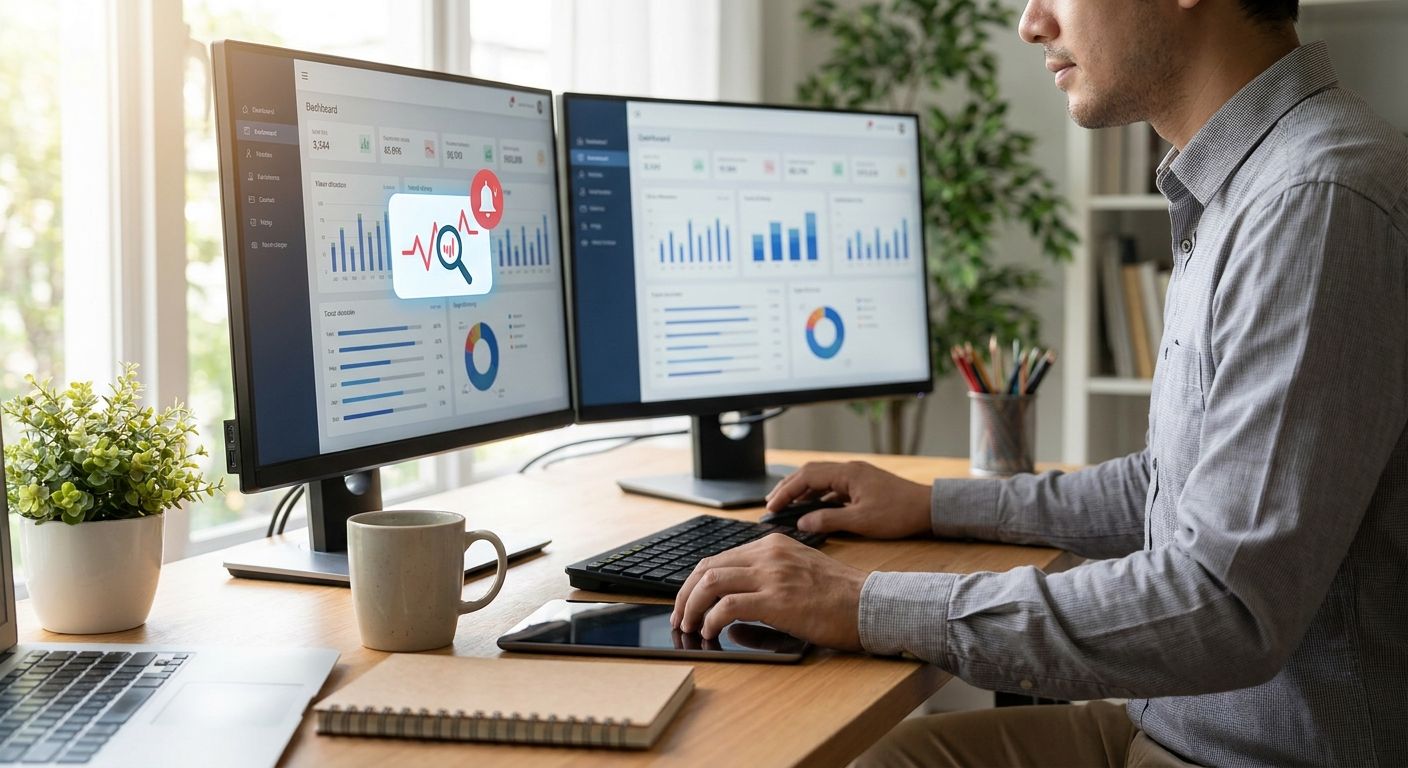
Setting up AI visibility alerts means configuring your monitoring tool to notify you the moment your brand's citation status changes in ChatGPT, Gemini, Perplexity, Claude, Copilot or Google AI Overviews — not waiting for a monthly report to find out you got dropped from an answer three weeks ago.
- AI visibility alerts fire on three trigger types: citation loss, competitor overtake, and Share of Voice drops past a threshold.
- Koalr alerts by prompt set, not just brand name, so you catch losses on specific buyer questions.
- Check Google AI Overviews daily; weekly is enough for ChatGPT and Claude, which shift less often.
- Set thresholds relative to your baseline Share of Voice, not an arbitrary percentage.
Why this matters
AI answer engines rewrite their source list constantly. A brand cited in a Perplexity answer for "best AI visibility tools for agencies" this week can vanish from that same answer next week, because the underlying retrieval refreshed or a competitor published a page that out-cited you.
Manual checking does not scale past a handful of prompts. If your AI visibility tracking covers 50 prompt sets across five engines, that is 250 answer surfaces to recheck by hand every week. Alerts are the only way to catch a citation loss the day it happens instead of the month you happen to run a manual audit.
How to set up AI visibility alerts for your brand
The setup follows the same five steps in 2026, regardless of which engines you track:
- Build your prompt set first. Alerts are only as good as the questions behind them — pull the 20-50 buyer-intent prompts your audience actually types into ChatGPT or Gemini, not generic brand-name searches.
- Establish a baseline. Run the full prompt set once to capture your current AI Visibility Score and Share of Voice per engine. Alerts measure change against this number, so skipping the baseline makes every alert noise.
- Set trigger types, not just keywords. Configure separate triggers for citation loss, competitor overtake, and Share of Voice movement past a set point.
- Choose check frequency per engine. Google AI Overviews refresh fastest and justify daily checks; ChatGPT and Claude answers are more stable, and daily checks there mostly generate false positives.
- Route alerts to the right channel. A citation loss on a high-intent prompt should hit Slack or email immediately; a minor Share of Voice dip on a low-priority prompt belongs in a weekly digest.
Citation loss alerts
A citation loss alert fires when your brand was named in an AI answer during the last check and is absent in the current one. This is the highest-priority trigger because it is a direct, measurable loss — not a ranking dip, an actual removal from the answer a buyer is reading.
Best for: brands with an established citation baseline who need to catch regressions fast. Verdict: set this up first, before any other alert type.
Competitor overtake alerts
This trigger fires when a named competitor appears in an answer where they were not cited before, especially on a prompt where you currently hold the citation. It is the earliest signal that a rival published new content or picked up a fresh source the model now trusts.
Best for: competitive categories where two or three brands trade citations on the same prompts. Verdict: essential in crowded B2B SaaS and financial services categories, lower priority in niches with few competitors.
Share of Voice drop alerts
Share of Voice measures what percentage of tracked prompts cite your brand versus competitors, aggregated across the full prompt set. A drop alert fires when that percentage falls past a threshold you set — for example, a 10-point fall over a rolling seven-day window.
Best for: teams tracking overall brand health rather than individual prompt wins and losses. Verdict: use this as the executive metric and citation loss alerts as the day-to-day fix list.
Why alert thresholds vary
The right threshold depends on your starting position and category, not a fixed number:
- Baseline Share of Voice — a brand at 60% can absorb a 5-point swing as normal variance; a brand at 15% cannot.
- Prompt set size — a 15-prompt set produces noisier percentage swings than a 60-prompt set, so smaller sets need wider thresholds.
- Engine volatility — Google AI Overviews churn more week to week than Claude or ChatGPT, so one threshold behaves differently per engine.
- Category competitiveness — categories with five or more credible competitors see far more citation swapping than categories with one dominant brand.
- Competitor publishing cadence — a rival shipping new comparison pages weekly triggers more overtake alerts against you than a slower one.
- Prompt intent mix — commercial prompts ("best X for Y") shift more than informational prompts ("what is X"), so mixed sets need per-type thresholds rather than one blanket rule.
Get alerted before a citation drops
Track citations, Share of Voice and competitor overtakes across every major AI engine.
How often should you check AI visibility in 2026?
Check Google AI Overviews daily and ChatGPT, Gemini, Claude and Perplexity at least weekly in 2026, because Overviews refresh their source list far more often than the chat-based engines. A monthly check catches broad Share of Voice trends but misses individual citation losses on high-value prompts entirely.
Is a citation the same as a mention or a recommendation?
No — a citation names your brand as a source, a mention is your brand name appearing in the answer text without being credited, and a recommendation is the engine actively suggesting your brand as the choice. Track all three separately, because losing a recommendation slot to a competitor costs more than losing a passing mention.
Can you track AI visibility alerts with the analytics tools you already have?
GA4, Similarweb and Semrush track AI referral traffic — the clicks that arrive after a citation — but none of them can see a citation that never produced a click. A dedicated AI visibility tool is built to catch the citation itself, not just the downstream traffic, which is why tracking your brand in ChatGPT and AI answers needs its own measurement layer.
FAQ
What are AI visibility alerts?
AI visibility alerts are automated notifications that fire when your brand's citation status changes in an AI answer engine, such as losing a citation, a competitor overtaking a prompt, or Share of Voice dropping past a threshold. They replace manual periodic checks with scheduled monitoring.
Which AI engines should I set alerts for first?
Start with the engine where your prompt set already shows the highest Share of Voice, because that is where a loss does the most damage. Most B2B brands prioritise ChatGPT and Google AI Overviews first, then add Perplexity and Claude.
How is a citation loss alert different from a ranking drop alert?
A citation loss alert tracks whether your brand is named as a source in an AI answer, which is a binary in-or-out event. A ranking drop tracks position in a list of blue links, a different mechanism with no 1:1 mapping to AI citation behaviour.
Do AI visibility alerts work across ChatGPT, Gemini, Perplexity and Copilot?
Yes, when the tool runs the same prompt set against each engine on a schedule and compares results run over run. Engine coverage varies by tool, so confirm which are included before choosing one.
How many prompts do I need before alerts are useful?
20 to 50 buyer-intent prompts is enough to establish a stable baseline in 2026. Fewer than 10 prompts produces alert noise, because a small sample swings the Share of Voice percentage sharply on normal variance.
Can I get alerts for competitor citations specifically?
Yes. A competitor overtake alert fires when a named rival appears in an answer where they were not previously cited, which is distinct from a citation loss alert on your own brand.
What is the best AI visibility alert setup for a small marketing team?
Start with citation loss alerts on your top 10 to 15 highest-intent prompts, routed to one Slack channel. Add Share of Voice and competitor overtake alerts once the team has bandwidth to act on the first tier.
How much of AI visibility does referral traffic actually show?
Referral traffic only shows the answers that produced a click, so any citation a reader consumed without clicking is invisible in GA4. Alerts built on citation checks capture both.
One last thing
Most teams set alerts on their own brand name and stop there. The bigger miss is not alerting on the prompts buyers ask before they know your brand exists — a citation loss on "what is AI visibility tracking" costs more over a year than a loss on your exact company name, because that is the prompt where the buyer is still choosing.


