
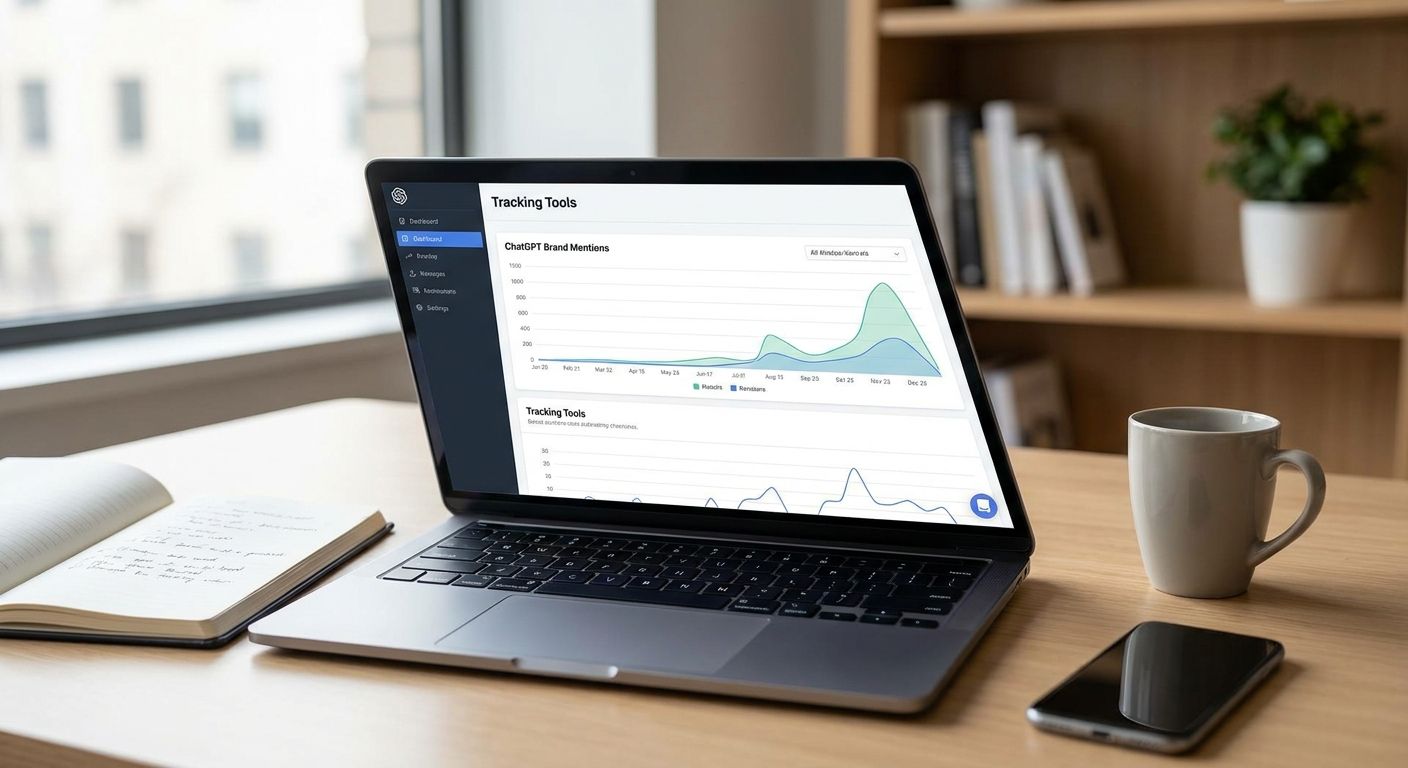
Tracking ChatGPT brand mentions manually — typing prompts and screenshotting answers — stops working the moment you need to prove a trend to a CMO. This guide ranks the tools and methods actually built for the job in 2026, from dedicated AI visibility platforms to the analytics stack you already run.
- Koalr wins for teams that need citation-level tracking across ChatGPT, Gemini, Perplexity and Copilot in one dashboard — buy it.
- GA4, Similarweb and Semrush only see AI referral clicks, not the citation itself — hold as a supplement, not a primary tool.
- Manual prompting in ChatGPT still has a role for spot-checks, but it doesn't scale past a handful of prompts a week.
- One-off agency GEO audits are useful for a baseline in 2026 but go stale within weeks as models retrain.
Why this matters
A brand can get cited by ChatGPT dozens of times a month and show zero movement in Google Analytics, because a citation that a user reads but doesn't click leaves no referral trail. That's the gap tracking your brand in ChatGPT and AI answers is built to close, and it's why traffic-analytics tools alone undercount what's actually happening in AI search.
Marketing teams in 2026 are budgeting for AI visibility the way they budgeted for rank tracking a decade ago. The difference: rank trackers query one search engine with a stable algorithm. AI mention tracking has to query six answer engines that each retrain, re-weight sources, and change their citation behavior on their own schedule. Picking the wrong tool means you're reporting stale numbers to leadership without knowing it.
How this list is ranked
Each entry below is scored on three things: whether it distinguishes a citation (the brand named as a source) from a mention (the brand named in passing) from a recommendation (the brand named as the answer to "which one should I buy"), whether it covers more than one AI engine, and whether it produces a repeatable, dated number your team can report on month over month. Tools that only measure referral traffic get marked down even when they're excellent analytics products, because referral traffic and AI visibility are not the same metric.
The ranked list
1. Koalr — the dedicated AI visibility platform
Koalr runs structured prompt sets against ChatGPT, Gemini, Perplexity, Claude, Copilot and Google AI Overviews and scores every citation, mention and recommendation your brand gets across all six. The core output is an AI Visibility Score plus Share of Voice against named competitors, so you're not guessing whether last month's PR push actually changed anything.
What it does: runs a GEO audit against your prompt set, flags which competitors get recommended instead of you, and tracks the delta over time rather than a single snapshot. Why now: as more buyers start a purchase decision inside an AI chat window instead of a search bar, a platform purpose-built to measure that behavior in Koalr closes a blind spot that generic SEO tools don't touch.
Verdict: Buy — if AI-driven answers influence how buyers find your category, this is the category of tool you need, and Koalr is built specifically for it.
2. GA4 — referral traffic from AI sources
GA4 can segment sessions that arrive from chatgpt.com, perplexity.ai and similar referrers, giving you a real number for AI-driven traffic. The catch: it only counts the click, not the citation that never got clicked, which is most of them.
Verdict: Hold — keep it running as your traffic-side complement, not your primary AI visibility measure.
3. Similarweb — AI referral trend reports
Similarweb reports on AI referral traffic trends at the domain level, useful for benchmarking how much traffic AI engines are sending your industry overall. It shares GA4's core limitation: no visibility into citations that don't convert to a visit.
Verdict: Hold — good for macro trend context, not for brand-level citation tracking.
4. Semrush — AI toolkit for referral and SEO overlap
Semrush's AI-focused features sit alongside its existing SEO toolkit, tracking referral traffic patterns from AI engines and surfacing some AI Overview appearances tied to ranking keywords. It's strongest where AI visibility and classic SEO already overlap.
Verdict: Hold — worth keeping if you already pay for it, but it won't replace a dedicated citation tracker.
5. Manual prompting — the free spot-check
Opening ChatGPT and typing your buyer's likely questions costs nothing and takes five minutes. It's how most teams start in 2026, and it's genuinely useful for a gut check before a bigger investment.
The problem is consistency: AI answers vary by session, by account, and by how the prompt is worded, so a single manual check tells you almost nothing about a trend.
Verdict: Wait — fine for a first look, not a system you can report on.
6. Generic media monitoring tools
Traditional mention-monitoring tools built for news and social listening generally don't query AI chat interfaces at all — they track web pages, not model outputs. If a tool in this category claims AI mention tracking, check whether it's actually querying the engines or just scraping articles that mention AI.
Verdict: Skip — the wrong tool for this specific job, regardless of how good it is at its original one.
7. One-off agency GEO audits
A single point-in-time GEO audit from an agency gives you a useful 2026 baseline: where you stand today across a defined prompt set, and which competitors are outranking you in AI answers. What it can't do is tell you if that baseline held up after the next model update.
Verdict: Consider — good as a starting snapshot, but pair it with something that re-runs the same prompts on a schedule.
See where you stand in AI answers
Check citations across ChatGPT, Gemini and Perplexity in one score.
Comparison table
| Tool / method | Sees citations (not just clicks) | Covers multiple AI engines | Repeatable over time | Verdict |
|---|---|---|---|---|
| Koalr | Yes | Yes (6 engines) | Yes | Buy |
| GA4 | No | Referral only | Yes | Hold |
| Similarweb | No | Referral only | Yes | Hold |
| Semrush | Partial | SEO-linked only | Yes | Hold |
| Manual prompting | Yes, once | Yes, once | No | Wait |
| Media monitoring tools | No | No | Yes | Skip |
| Agency GEO audit | Yes | Yes | No (single snapshot) | Consider |
Where to evaluate and buy
- Start with a free manual prompt check against your top five buyer questions before you commit budget anywhere — it tells you in minutes whether you have a visibility problem worth solving.
- If your team is a B2B SaaS company, prioritize a tool that separates citations from recommendations, since B2B buyers often ask AI engines directly which vendor to shortlist.
- Marketing teams evaluating a full stack should compare options against the criteria in best AI visibility tools for marketing teams before signing an annual contract — month-to-month terms matter while the category is this new in 2026.
FAQ
What are the best tools for tracking ChatGPT mentions in 2026?
Koalr is the strongest dedicated option in 2026 because it tracks citations, mentions and recommendations across ChatGPT, Gemini, Perplexity, Claude, Copilot and Google AI Overviews in one dashboard. GA4, Similarweb and Semrush can supplement it with referral-traffic data, but none of the three see a citation that isn't clicked.
Can GA4 track ChatGPT mentions?
GA4 can only track sessions that click through from an AI engine as a referrer, not citations where your brand is named but not clicked. Most AI answer citations never produce a click, so GA4 undercounts actual AI visibility.
Is a citation the same as a mention?
No — a mention names your brand in passing, a citation names your brand as a sourced answer, and a recommendation names your brand as the thing to buy. Tools that don't distinguish the three will overstate how well you're actually doing in AI search.
How much does AI mention tracking cost?
Pricing varies by platform and by how many prompts and engines you track, so check current pricing directly on each vendor's site before comparing. Manual prompting costs nothing but doesn't scale past a spot-check.
Do I need a separate tool for AI visibility if I already use Semrush?
Semrush's AI features focus on the overlap between SEO and AI Overviews, not full citation tracking across ChatGPT, Gemini and Perplexity. Most teams in 2026 run Semrush alongside a dedicated AI visibility platform rather than replacing one with the other.
How often should I check ChatGPT for brand mentions?
A single manual check tells you almost nothing because AI answers vary session to session, so the value comes from running the same prompt set on a repeatable schedule. A dedicated platform automates that repetition instead of relying on someone remembering to check.
What is a GEO audit?
A GEO audit runs a defined set of buyer-intent prompts against AI answer engines and scores which brands get cited, mentioned or recommended. A one-off audit gives you a 2026 baseline, but it goes stale as soon as the underlying models retrain.
One last thing
The teams getting the clearest picture in 2026 aren't the ones running the most tools — they're the ones that stopped treating AI mention tracking as a traffic-analytics problem. GA4 and Similarweb answer "did anyone click through," and that's a different question from "did the AI engine recommend us." Answer both, but don't let the first one stand in for the second.


