

There is no defensible universal monthly traffic figure for AI answer engines in 2026: forecast from your own recorded referrals, not from citation counts or a share of total website traffic. That forecast excludes visibility that produces no attributable visit, so measure brand mentions, citations and recommendations separately from sessions and conversions.
- How much traffic can you get from AI answer engines? Forecast from recorded referrals, not citation counts.
- A brand mention, a linked citation and a recommendation measure different outcomes; none proves a website visit.
- Koalr helps marketing teams track AI visibility; website analytics measures the visits that follow.
- Set separate targets for AI referral traffic, qualified conversions and visibility across a consistent prompt set.
Why this matters
Being named is not the same as being visited. An answer can introduce your brand, cite your research or recommend your product without sending a measurable session to your website.
That distinction changes your budget decisions. A visibility programme judged only on clicks ignores answer-level exposure; a traffic programme judged only on citations never establishes whether people arrive. Start by tracking AI chatbot referral traffic in Google Analytics, then keep visibility evidence alongside the traffic report rather than treating it as traffic.
How much traffic can you realistically get from AI answer engines?
Your recorded AI referrals establish your starting point, not your maximum opportunity. A realistic forecast needs a comparable reporting period, consistent source classification and a documented reason for expecting a change. Without those inputs, a monthly sessions target is an ambition rather than an estimate.
Use this sequence to build a forecast you can defend:
- Establish the baseline. Count sessions attributed to identifiable AI referral sources. Keep the source, landing page and reporting period attached to each result.
- Check comparability. Confirm that tracking, consent settings and source-classification rules have not changed between periods. Annotate changes rather than interpreting them as audience growth.
- Separate observation from expectation. Show recorded sessions separately from forecast sessions. State which content changes or distribution activity support the forecast.
- Connect visits to outcomes. Measure the actions those visitors complete. For a SaaS team, choose the conversion events that match your actual sales process.
- Revise against results. Compare the next completed period with the forecast. Retain the assumptions that held and remove those the results did not support.
For your 2026 reporting, choose a 28-day baseline window as a working convention, not an industry benchmark. Review classifications every 7 days, and schedule 1 forecast review per month. These are operating recommendations, not promised traffic levels.
The result should be a conditional forecast: what you expect, why you expect it and what evidence would change your view. Do not fill the gap between your target and your baseline with an assumed AI click-through rate.
What counts as AI traffic—and what does not?
Keep the following evidence types separate. Each answers a different question, and none substitutes for the others.
| Evidence type | What it establishes | Best for | Limitation |
|---|---|---|---|
| Brand mention | The answer names your brand | Checking brand inclusion | Does not establish endorsement or a visit |
| Citation | The answer identifies a source | Checking source attribution | Does not establish that anyone clicked |
| Recommendation | The answer suggests your brand for a need | Checking buyer-facing positioning | Does not establish a purchase or session |
| Attributed referral session | Analytics records a visit from an identifiable source | Measuring recorded website traffic | Does not capture every prior influence |
| Qualified conversion | A recorded visitor completes your chosen business action | Assessing commercial outcomes | Attribution alone does not establish incremental impact |
A citation also needs inspection. An answer that links to a publisher discussing your company is different from an answer linking directly to your product page. Both deserve visibility reporting, but they do not create the same direct route to your website.
Count a visit when your analytics records a visit—not when an answer displays a link. Keep answer text or other supporting evidence with visibility observations so your team can check what the answer actually said.
Why AI answer-engine traffic varies
Do not apply a universal traffic multiplier to ChatGPT, Gemini, Perplexity, Claude, Copilot and Google AI Overviews. Compare the evidence available for each platform before combining results.
Use these factors to structure your analysis rather than assigning them invented weights:
- Platform and answer format. Record where the answer appeared and whether it provided a route to your website. A brand name without a link is not a direct referral opportunity.
- Buyer intent. Separate questions about understanding a topic from questions about choosing a supplier. They represent different information needs.
- Mention, citation or recommendation. Label the actual appearance. Do not count every reference to your brand as a recommendation.
- Destination page. Record the linked URL and inspect whether the page answers the question that preceded the visit.
- Attribution conditions. Keep recognised referral sessions separate from direct or otherwise unattributed visits. Do not reassign the latter to AI without evidence.
- Prompt coverage. Document which questions, languages and markets you monitor. Your monitored prompt set describes a sample, not total audience demand.
In 2026, your useful comparison is not a platform popularity ranking. It is the relationship between the answers you observe, the visits you record and the business outcomes those visits produce.
How do you build a forecast without inventing demand?
Start with observed website activity. Keep prompt monitoring in a parallel measurement track, because a tracked prompt is not a count of real users asking that question.
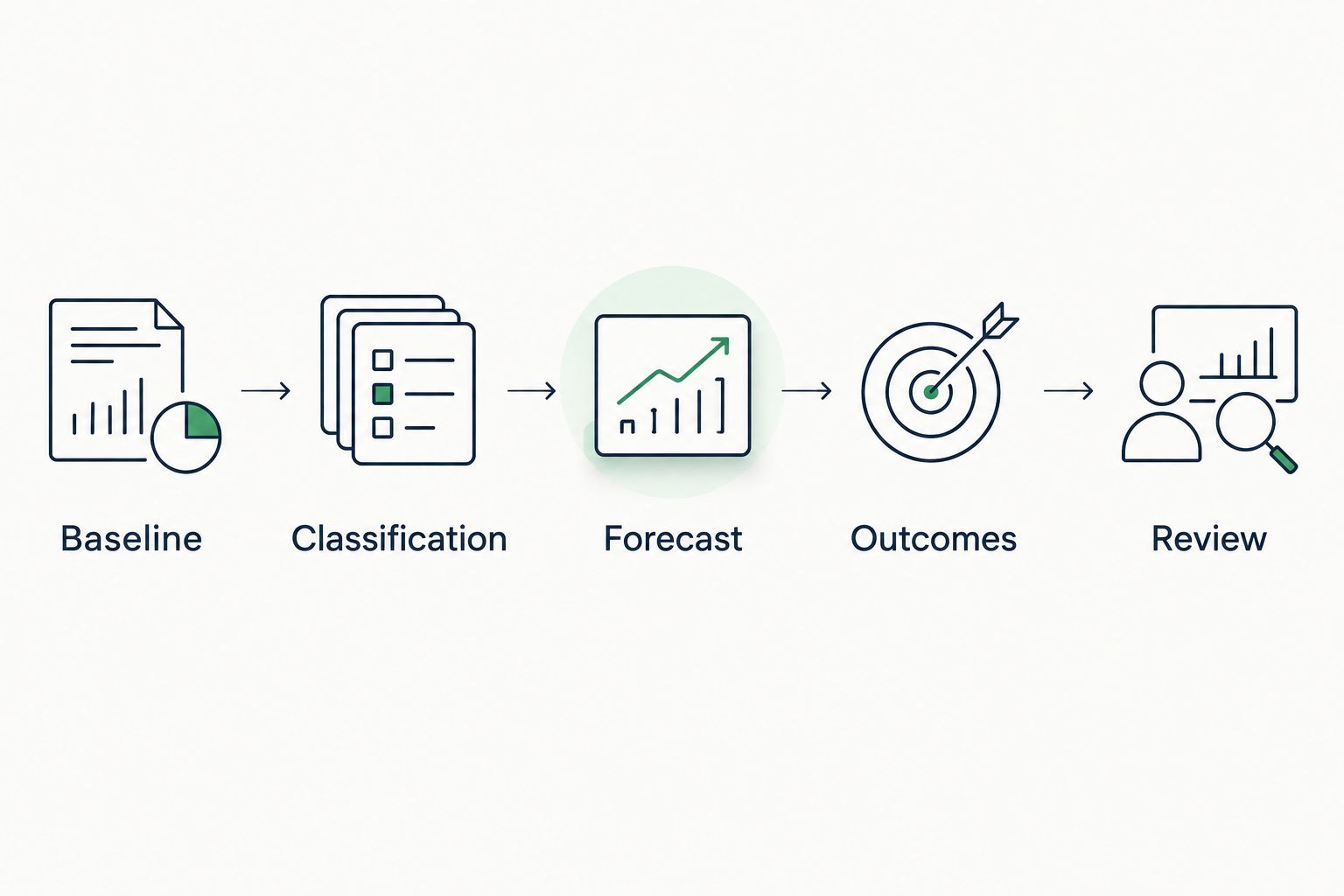
Use five stages: Baseline, Classification, Forecast, Outcomes and Review. The baseline records actual sessions; classification checks what belongs in the channel; the forecast states assumptions; outcomes connect visits to your goals; the review tests the forecast against subsequent results.
Establish a measured starting point
Record attributed AI referral sessions by source and landing page for the same reporting window. Include your chosen conversion events and annotate tracking changes. Keep your definitions visible so another person can reproduce the report.
If your baseline contains no attributed AI referrals, report that result. It does not establish that nobody encountered your brand in an answer, and it does not justify forecasting a guaranteed stream of visits.
Write assumptions beside the forecast
A useful assumption identifies a specific action and the evidence you expect to observe. For example, after improving an explanation page, check whether monitored answers cite that page and whether attributed visits reach it. Treat this as a test, not a promised sequence.
Avoid multiplying monitored citations by an assumed click-through rate. Unless the exposure and click data describe the same population and period, the calculation creates precision without a measured foundation.
Separate the target from the estimate
Your target expresses the outcome the business wants. Your forecast expresses what current evidence supports. Keep both in the report, but label them clearly.
For a 2026 plan, record the forecast assumptions before changing content. That preserves a useful test: whether the observed result supports the original reasoning, rather than a story written after the outcome.
How do you tell whether AI traffic is valuable?
Judge recorded visits against the business action you want them to support. Traffic volume alone does not establish commercial value, and a high conversion rate without its underlying visit count is incomplete evidence.
For SaaS, distinguish an informational action from a qualified sales action according to your own funnel definitions. Do not treat every form submission as equivalent. Preserve the source and landing-page context when reviewing the result.
Check three things before expanding the programme:
- Relevance: Does the landing page address the visitor's likely question?
- Progression: Does the visitor complete a meaningful next step?
- Qualification: Does the resulting enquiry meet your team's existing criteria?
Keep attribution and causation separate. An attributed conversion establishes a recorded journey; it does not, by itself, prove that the conversion would not have happened without the AI referral. Use that distinction when reporting return on investment.
Where does AI visibility software fit?
Koalr is best for marketing teams tracking brand visibility in AI answers. It helps teams track and improve how their brand appears across ChatGPT, Gemini, Perplexity, Claude, Copilot and Google AI Overviews.
Use Koalr for AI visibility alongside your website traffic measurement. The benefit is a separate view of how answers present your brand; the limitation is that answer visibility alone cannot establish website visits or revenue. That is a measurement boundary, not a reason to ignore either dataset.
Build a shared reporting view with distinct fields for answer evidence, attributed sessions and qualified outcomes. Connect them where the evidence allows, but leave unmatched observations unmatched. A tidy dashboard is not a reason to imply a relationship you have not measured.
Can citations rise while AI referral traffic stays flat?
Yes. More observed citations establish increased citation coverage within your monitored sample, not increased clicks from a measured audience. Check whether the citations link to your website, which pages they reference and whether your attribution rules remained consistent.
Keep both results in the report. Improved citation coverage and flat recorded referrals are different findings, not a contradiction that needs smoothing over.
Should you replace SEO traffic targets with AI traffic targets?
No. Keep organic search traffic, identifiable AI referrals and answer-level visibility distinct so each target matches its measurement method. Combine them in a leadership summary only after preserving those underlying definitions.
For 2026 planning, add AI referral and visibility reporting to your existing acquisition view. Do not rename an established channel or claim additional traffic simply because a search experience includes an AI-generated answer.
FAQ
How much traffic can you get from AI answer engines?
There is no defensible universal monthly figure for your website. Forecast from recorded AI referral sessions, consistent reporting periods and explicit assumptions rather than converting citation counts into visits.
Does a ChatGPT citation count as website traffic?
No, a ChatGPT citation does not count as a website visit. Count traffic when your analytics records a session, and record the citation separately as answer-level evidence.
Which AI answer engine will send my website the most traffic?
Your attributed referral data establishes which identifiable source sends your website the most recorded traffic. Compare sources over the same period using consistent classification rules rather than assuming the largest platform will lead.
Can AI answers influence buyers without sending a click?
An answer can name or recommend a brand without producing a website visit. Record that visibility separately; do not assign a later conversion to it without supporting attribution evidence.
Is AI referral traffic better than organic search traffic?
Neither channel is automatically better for your business. Compare qualified outcomes, landing-page relevance and conversion definitions alongside the underlying session counts.
Can Koalr tell me how visible my brand is in AI answers?
Koalr helps marketing teams track and improve brand visibility in AI answers across ChatGPT, Gemini, Perplexity, Claude, Copilot and Google AI Overviews. Use website analytics separately to measure recorded referral visits and conversions.
What should I report if I have no attributed AI visits?
Report that your analytics recorded no attributed AI visits for the stated period. Check source classification and tracking, but do not interpret that result as proof that your brand never appeared in an answer.
One last thing
Your prompt library is not a traffic-volume dataset. Adding more monitored questions changes what you observe; it does not demonstrate that more people searched or that your referral opportunity grew.
Keep a stable comparison set when judging visibility changes. Add exploratory prompts separately, then assess recorded traffic on its own terms. That prevents a larger monitoring exercise from being presented as audience growth.


