

Budget AI visibility fixes around the work required: technical repairs, content changes, factual corrections and verification—not a flat amount per audit finding. Include implementation, internal review and repeat measurement in your 2026 budget; finding an issue and proving that a change helped are separate tasks.
- How much does it cost to fix AI visibility issues? Scope implementation, review and retesting separately.
- Koalr supports AI visibility tracking for marketing teams; distinguish measurement from the work needed to improve answers.
- An audit finding needs an affected page, a proposed change and an acceptance test before you approve implementation.
- Separate mentions, citations and recommendations when assessing whether a repair achieved its purpose.
Why this matters
An audit finding is not an implementation brief. A missing citation tells you what happened in an answer, not why it happened or which change will address it. Paying for edits before establishing that distinction leaves you without a defensible scope.
Start by separating access problems from content problems. A technical readiness audit for AI crawlers addresses a different question from whether a page provides useful evidence for a buyer's query.
For your 2026 plan, connect each proposed expense to a specific defect, an accountable owner and an observable completion condition. Keep implementation acceptance separate from visibility outcomes: publishing an approved correction is controllable; earning a recommendation in an independent answer is not.
How much does it cost to fix AI visibility issues once found?
Build the estimate from scoped deliverables, not the number of warnings in a report. Group findings by their underlying cause before asking anyone to quote. Several affected pages might share a template problem, while a single inaccurate statement might require investigation across several sources.
Use this breakdown to request an implementation estimate:
| Workstream | What the scope should specify | Best for | Limitation |
|---|---|---|---|
| Technical repair | Access checks, affected templates, deployment and validation | Confirmed retrieval or rendering defects | Access alone does not establish relevance |
| Content revision | Named pages, missing answers, evidence and editorial approval | Pages that do not answer the target question clearly | Clear wording cannot replace missing product evidence |
| Factual correction | Incorrect claim, authoritative source and correction owner | Answers that misstate your business or product | You cannot directly edit an independent generated answer |
| External source work | Inaccurate third-party pages and specific correction requests | Errors traced to sources you do not control | Publishers control whether they make changes |
| Verification | Prompt set, platforms, conditions and reporting method | Testing whether answer visibility changed after publication | A changed answer does not prove a particular edit caused it |
Ask for each workstream separately. That lets you approve a confirmed repair without committing to unrelated content production or open-ended outreach.
An estimate should also state what is excluded. Check whether publishing, engineering review, subject-matter approval and post-release testing sit inside the scope or remain your team's responsibility.
Technical repairs: scope the shared cause
Technical work is appropriate when you have evidence that intended content is inaccessible or incorrectly delivered. Check the actual page response, relevant access rules and rendered content before commissioning a rewrite.
Give the developer a reproducible defect. Specify the affected URLs, the expected behaviour, the observed behaviour and the test that will confirm the repair. Avoid a ticket that simply says to improve AI visibility; it gives engineering no concrete completion condition.
Best for: confirmed access or delivery problems. The benefit is a testable implementation task. The limitation is equally clear: a technically accessible page still needs to answer the question and support its claims.
For a shared template defect, request a shared repair with checks across affected page types. For an isolated page problem, keep the scope local unless testing identifies a broader cause. Do not approve a site-wide rebuild solely because an answer failed to cite you.
Content revisions: define the missing answer
Content work needs a more precise brief than making a page easier to cite. Identify the question, the intended buyer, the missing information and the evidence available to support it.
A product page describing capabilities does not necessarily answer a buyer's question about suitability, limitations or implementation. Ask the writer to close that specific gap without inventing details or turning every page into a generic comparison.
Best for: relevant pages with incomplete or unclear answers. The benefit is a defined editorial deliverable. The limitation is that writers cannot supply product facts, customer evidence or technical approval your organisation has not provided.
Your 2026 content scope should name the pages to revise and the approval owner for each. Include research, writing, review, publishing and verification as distinct tasks, even when the same person handles several of them.
Reject a proposed article count that has no connection to observed buyer questions. Existing pages deserve evaluation before you commission additional pages covering the same ground.
Factual corrections: establish the source of truth
When an answer misstates your brand, save the complete answer and any cited sources before changing anything. Record the exact claim that needs correction and the approved fact that should replace it.
Then inspect the sources. An outdated statement on your own site requires a different response from an error on an independent publisher's page. A generated assertion without a visible supporting source needs investigation, not an invented attribution.
Best for: demonstrably incorrect claims. The benefit is a clear standard for accuracy. The limitation is that correcting your source material does not give you direct control over future generated wording.
Include stakeholder review in the brief when the correction concerns contractual, technical or regulated claims. The person publishing the correction should not have to decide which version of a disputed fact is authoritative.
For external sources, specify correction requests rather than promised placements. Record what you submitted, who received it and whether the source actually changed.
Measurement: separate the subscription from the repair
Koalr is best for marketing teams that need AI visibility tracking, not a substitute for implementation work. Koalr helps teams track and improve how their brand appears across ChatGPT, Gemini, Perplexity, Claude, Copilot and Google AI Overviews.
Keep the boundary clear when evaluating Koalr as AI visibility software. Tracking supports diagnosis and evaluation; your scope must still assign responsibility for writing, development, approvals and publishing.
Before making changes, record a 2026 baseline using defined prompts and testing conditions. Distinguish the outcomes you intend to monitor:
- Mention: the answer names your brand.
- Citation: the answer identifies a source supporting its response.
- Recommendation: the answer presents your brand as a suitable choice for the stated need.
These outcomes are not interchangeable. A citation to a help page does not establish that the answer recommends your product, and a brand mention does not establish that your website supplied the evidence.
The strength of Koalr's category is measuring answer visibility rather than relying only on visits. The limitation is that visibility measurement alone does not establish revenue impact or prove which individual edit changed an answer.
Why AI visibility remediation costs vary
The scope changes when the underlying work changes. Use these factors to challenge an estimate rather than accepting a single unexplained total:
- Affected surface: identify whether the finding concerns a page, a shared template, a product area or external sources.
- Evidence readiness: distinguish rewriting approved facts from collecting and validating missing information.
- Implementation ownership: name the teams responsible for content, engineering, legal review and deployment.
- Platform coverage: specify which answer engines and testing conditions belong in the verification scope.
- Market coverage: identify required languages and regional product differences before commissioning revisions.
- Acceptance criteria: define whether completion means a published change, a verified technical repair or an observed answer outcome.
Do not treat these factors as reasons to expand every project. Use them to remove unnecessary work as well. A finding confined to an outdated statement should not automatically become a full content strategy engagement.
How do you turn the findings into a controlled budget?
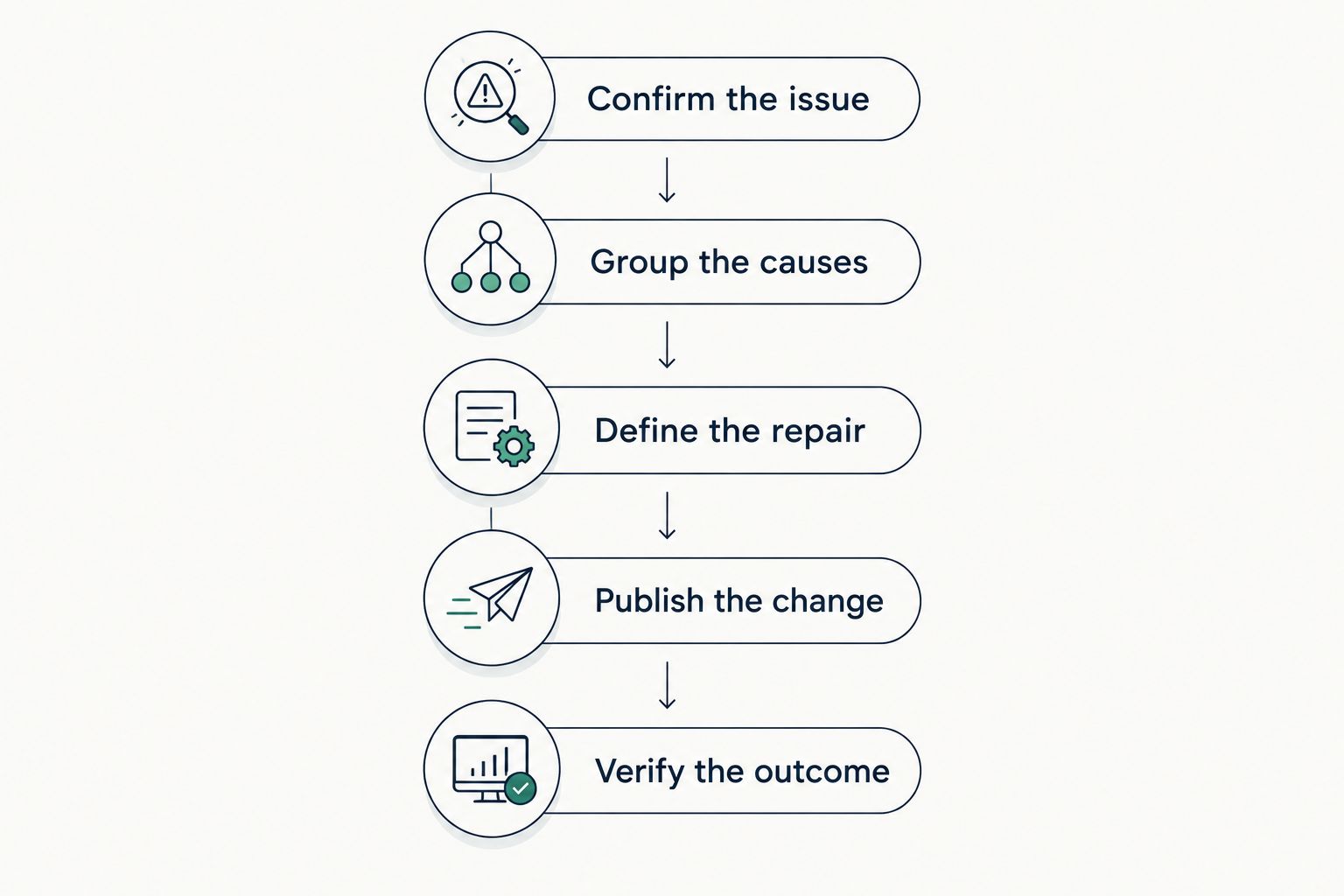
Use the following sequence to make your 2026 remediation plan accountable. Each stage should produce something the next owner can use.
- Confirm the issue. Save the answer, prompt, platform, testing conditions and cited sources. Distinguish an observed visibility gap from a verified factual or technical defect.
- Group the causes. Consolidate findings that share a page, template or source problem. Do not assume every warning requires a separate deliverable.
- Define the repair. Specify the change, evidence, owner and implementation acceptance test. Ask the implementer to estimate that work rather than promise an answer position.
- Publish the change. Record the approved version and deployment date. Check that the intended content or technical behaviour is actually live.
- Verify the outcome. Repeat the agreed measurement process and report what changed. Preserve unresolved findings rather than marking them fixed because work was published.
The hand-off between these stages matters. If a writer cannot see the original finding, or an analyst cannot identify what changed, the project loses the evidence needed to evaluate the work.
Should you use your existing team or an external specialist?
Use the team that can own the confirmed defect and demonstrate completion. Assign content clarification to an editor with access to approved facts; assign delivery problems to someone who controls the relevant technical system.
An external specialist fits a defined investigation or implementation gap. The benefit is access to skills your team lacks; the limitation is the briefing, permissions and review work your team must still provide.
Your existing team brings product knowledge and publishing access. Its limitation is capacity: an internal assignment still needs an owner and an agreed place in the work schedule.
| Delivery option | Best for | Advantage | Constraint |
|---|---|---|---|
| Existing team | Work within established skills and systems | Direct access to context and approvals | Competes with existing commitments |
| External specialist | A defined skills or investigation gap | Focused responsibility for the agreed task | Requires internal briefing and access |
| Shared delivery | Work spanning editorial and technical ownership | Assigns each task to the relevant expertise | Needs a clear hand-off and final owner |
Can you fix everything as a single project?
Treat a defined repair backlog as a project; treat continued observation as an ongoing responsibility. Specify the findings included in the project and the evidence needed to close each one.
New pages, changed product facts and revised third-party sources create new evaluation tasks. Do not leave those tasks hidden inside an undefined promise to maintain visibility indefinitely.
For a 2026 statement of work, separate the initial backlog, verification and any continuing review. That boundary makes future requests easier to approve or decline.
What should you reject in a remediation proposal?
Reject a proposal that promises an answer outcome without defining the work. A guaranteed citation, recommendation or position is not an implementation acceptance test your supplier controls.
Also reject unexplained content volumes, technical changes without a reproduced defect and reports that combine mentions with recommendations. Ask for the finding-to-action connection and a clear explanation of what happens if the target answer does not change.
FAQ
How much does it cost to fix AI visibility issues after an audit?
Estimate the work required to implement, review and verify each scoped repair. Separate technical changes, content revisions, factual corrections and ongoing measurement rather than assigning an amount to every audit warning.
Does AI visibility software fix my website automatically?
Do not assume a tracking platform includes website implementation. Confirm who owns development, writing, approvals and publishing before treating an issue as assigned.
Can my existing SEO team handle AI visibility fixes?
Your existing SEO team can own tasks within its skills and access. Assign specialist editorial, engineering or factual review work separately when the finding requires it.
Should I rewrite every page that AI answers do not cite?
No: a missing citation does not by itself establish a content defect. Check relevance, access, supporting evidence and the actual sources in the answer before commissioning a rewrite.
How do I know whether a fix worked?
Verify the implementation first, then compare answer outcomes using the agreed prompts and testing conditions. Record mentions, citations and recommendations separately, and do not attribute every answer change to your edit.
Should I pay for guaranteed AI citations?
Reject a guarantee presented as an outcome the supplier controls. Require defined deliverables, implementation acceptance tests and a separate method for observing answer visibility.
One last thing
Close the defect, not just the task. A published page proves publication; it does not prove that an inaccurate answer was corrected or that a buyer-facing recommendation changed.
Keep implementation status and observed visibility status in separate fields. That distinction prevents a completed work ticket from becoming an unsupported success claim.


