

A new page has no fixed deadline for appearing as a source in AI answers: publication, discovery and citation are separate events, and citation is not guaranteed. For your 2026 reporting, measure the first observed citation against a defined prompt set rather than promising a number of days after publication.
- How long does it take for a page to get cited by AI answer engines? There is no fixed deadline.
- Separate discovery, citation and recommendation: evidence of one does not prove the others.
- Koalr is best for marketing teams tracking brand visibility across AI answers; tracking does not guarantee citations.
- Record publication and first observed citation separately, using consistent prompts and saved source links.
How long does it take for a new page to get cited by AI?
There is no dependable publication-to-citation countdown. A page must be accessible and relevant to the question, but neither condition guarantees that an answer engine will select it as a source.
Define the questions you want the page to answer before measuring elapsed time. A prompt library for AI visibility tracking gives you a consistent basis for checking whether the page appears.
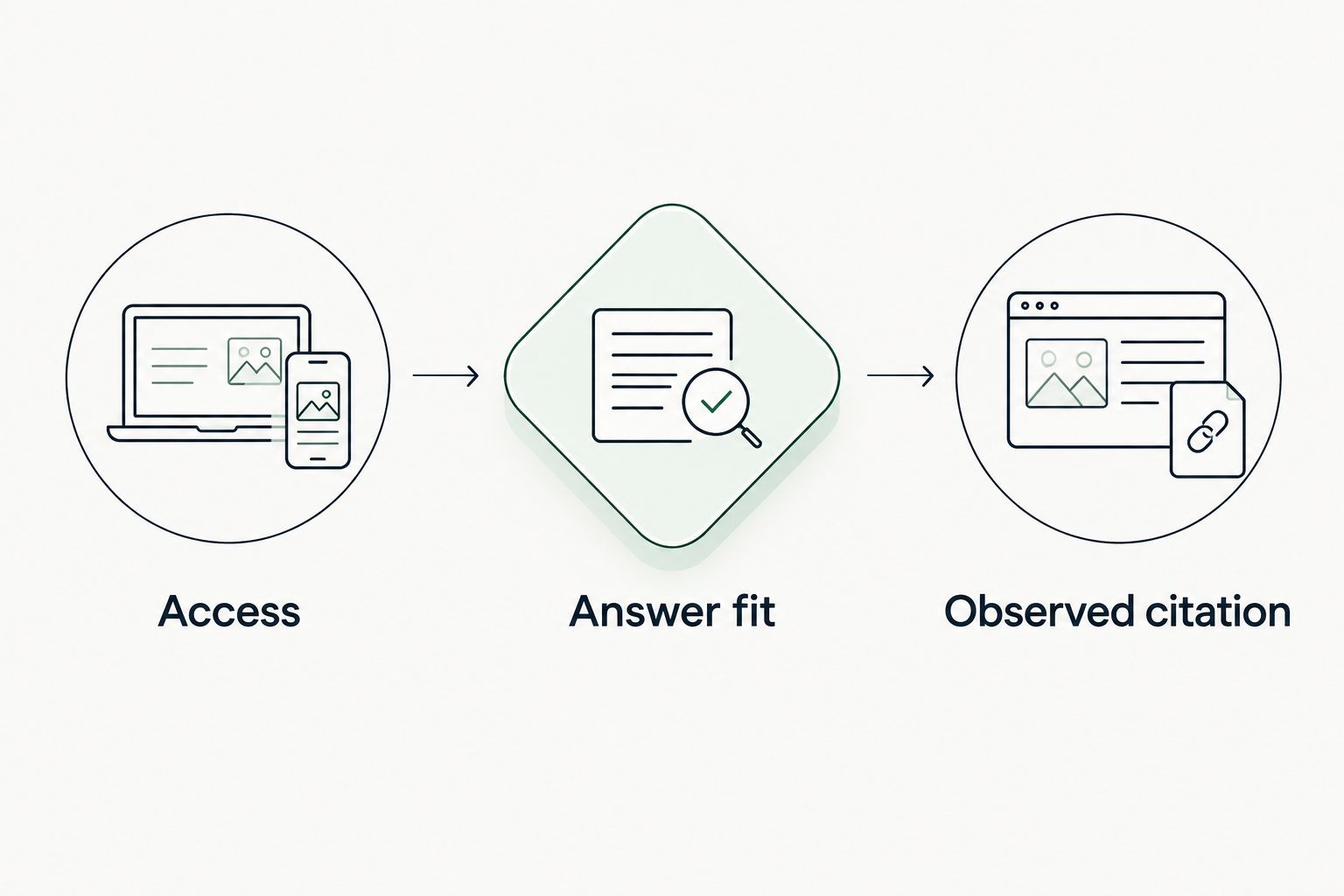
Use these 3 checkpoints for each new page:
- Access: Confirm that the intended public URL loads and that relevant crawler access is not blocked.
- Answer fit: Check whether the page directly supports the question in your monitoring prompt.
- Observed citation: Save an answer containing a source link that resolves to the intended page.
These checkpoints are diagnostic, not a universal description of every engine's internal process. Passing an access check does not prove source selection, and a brand mention does not prove that the new page was used.
Keep 2 dates in your reporting: publication and first observed citation. The interval between them describes your observation, not an engine-wide processing time.
Why this matters
A deadline changes how your team interprets silence. If you expect every new page to earn a citation after a fixed wait, you risk treating an access problem as patience—or rewriting useful content because your test never asked the right question.
For a 2026 content programme, separate delivery milestones from outcome milestones. Publishing and validating a page are tasks you control; another system selecting that page as evidence is not.
Judge the blockage before judging the elapsed time. Your next action should follow the evidence: fix access, improve the answer, refine the prompt set or continue observation.
Discovery is not a citation
Discovery, citation and recommendation answer different questions. Keep them separate in your launch report so that progress in one does not become an unsupported claim about another.
| Checkpoint | Evidence to retain | What it establishes | What it does not establish |
|---|---|---|---|
| Access | A successful page fetch and relevant access checks | The page is accessible in the tested conditions | That an answer engine has selected it |
| Search discovery | An indexing result in the search service checked | That service recognises the URL | Visibility across every AI platform |
| Citation | A saved answer with a source link to the page | The page was cited in that observed answer | Repeated visibility for other questions |
| Brand mention | The brand appears in the answer text | The answer names the brand | That the new page supplied the evidence |
| Recommendation | The answer explicitly suggests the brand for a need | A recommendation occurred in that answer | A click, conversion or universal endorsement |
Open the source link. A reference to your homepage, an older guide or a third-party profile is not evidence that the newly published page earned the citation.
Likewise, a page appearing in ordinary search results does not settle whether it appears in generated answers. Preserve both observations, but do not merge their labels.
Search-enabled answers: check the source link
For an answer that searches the web, inspect the returned sources rather than inferring visibility from the wording. The decisive evidence for a page-level citation is a source link that resolves to your target page.
A correct description of your business is not enough. That description might be supported by another page, and the answer itself does not establish how recently any source was discovered.
Treat each platform and answer mode as a separate observation in your 2026 baseline. Do not turn a result from one interface into a claim about all the places buyers ask questions.
Answers without source links: do not count a citation
An answer without a source link does not provide a verifiable page citation, even when its wording resembles your content. Record any brand mention separately.
This distinction prevents a measurement error: assuming that an answer mentioning a newly published fact proves the new page was used. Similar wording is not source attribution.
For page-level reporting, label the result precisely: brand mentioned, page citation not observed. That is a usable finding, not a failed test.
Why time to first citation varies
Elapsed time alone does not identify the cause of a missing citation. Use these factors to direct your investigation, without assigning an unsupported number of days to any of them:
- Access conditions: Authentication, crawler restrictions or failed requests can prevent access through the route being checked. Test access before rewriting the content.
- Discovery route: A search-index check describes the service inspected. It is not proof that every answer engine has discovered the page.
- Question fit: A broad company introduction does not necessarily answer a narrow implementation question. Match the page's evidence to the monitored query.
- Evidence quality: Unsupported claims give readers no basis for verification. Include attributable facts, clear explanations and sources where they are needed.
- Source alternatives: An answer can cite another page covering the same question. Inspect the selected source before deciding what your page lacks.
- Observation coverage: Your prompt set, testing conditions and observation schedule determine what you can detect. An untested question remains outside your findings.
These are investigation categories, not a ranking formula. Fixing an issue removes that issue; it does not purchase a place in the answer.
How should you monitor a newly published page?
Use a repeatable process that lets someone else verify the finding. The goal is not to produce a promising screenshot; it is to connect a specific page with a specific observed answer.
Establish the baseline
Record the exact public URL, publication date, intended buyer question and relevant market. Note whether the page replaces an existing resource, because an older URL appearing in an answer is a different result from the new URL appearing.
Run the intended questions before making further edits. Without a baseline, you cannot distinguish a newly observed citation from one your team simply had not checked before.
Keep the test conditions consistent
Retain the prompt wording, platform, answer mode, language and observation time. Use fresh conversations when your aim is to compare standalone answers rather than personalised follow-up exchanges.
Avoid combining different questions into a single pass-or-fail result. A page answering an implementation question and a page supporting a supplier recommendation serve different needs.
Save the answer and inspect the destination
Capture the answer text and its source links. Open the relevant link and check the destination, including any redirect, before assigning the citation to your page.
If the destination is another resource, record that resource instead. Source attribution loses its value when a domain-level appearance gets reported as success for every page on the domain.
Compare observations before making changes
Keep page changes beside the observation history. Record what changed and when, then compare like-for-like prompts rather than mixing rewritten questions with rewritten content.
For your 2026 report, use “first observed citation” consistently. That wording preserves the distinction between when a citation occurred in a saved test and when it first occurred anywhere.
Koalr is best for marketing teams tracking brand visibility across AI answers. Its role is measurement and improvement of brand appearance; using an AI visibility platform does not make a new page eligible for a guaranteed citation date.
What should you change when citations do not appear?
Change the page only after identifying a specific weakness. Rewriting without a diagnosis makes the next observation harder to interpret.
| Response | Best for | Benefit | Limitation |
|---|---|---|---|
| Technical correction | A documented access or indexing issue | Removes the identified technical obstacle | Does not establish relevance or selection |
| Content revision | A page that does not directly answer the target question | Makes the answer and supporting evidence clearer | Does not guarantee a citation |
| Prompt-set revision | Tests that do not reflect the intended buyer question | Improves the usefulness of monitoring | Breaks direct comparisons unless changes are recorded |
| Continued observation | A page with no identified access or answer-fit problem | Preserves a clean baseline | Does not itself improve the page |
Start with the narrowest justified change. If the cited competitor explains a process your page only names, add the missing explanation—not another paragraph claiming expertise.
If the answer cites an official source for a regulatory fact, repeating the same fact does not automatically make your page the better source. Identify what useful interpretation or practical guidance your page contributes, and support it.
Can a new page be cited before a model is retrained?
Retraining is not a prerequisite for an answer system to use a page retrieved from the web at answer time. Live retrieval and information stored in model parameters are different mechanisms.
Do not make retraining schedules your explanation for every missing citation. First establish which answer mode you tested and whether it returned web sources.
Does an indexed page automatically become an AI source?
Indexing does not automatically produce a citation. It establishes a discovery state in the search service checked, not a promise of selection in an AI-generated answer.
Keep indexing evidence in your technical record and citation evidence in your answer record. Both matter, but they answer different questions.
When should you stop waiting and investigate?
Investigate when you have a specific failed check, not when an arbitrary countdown expires. A blocked page needs an access fix; an irrelevant answer needs a content or prompt review.
Set a documented review schedule for your 2026 programme, but describe it as your team's operating cadence. A review date is not an expected citation date.
FAQ
How many days does a new page need before AI answer engines cite it?
There is no fixed number of days that guarantees a citation. Measure publication to first observed citation for a defined prompt set, platform and testing context.
Can I speed up a citation by submitting my page for indexing?
Index submission is not a citation request. Use the relevant search service's discovery tools where appropriate, then verify AI citations separately.
Does a brand mention mean my new page was cited?
A brand mention does not establish that your new page was cited. Check for a source link that resolves to the intended page and record mentions separately.
Should I rewrite a page if an AI answer does not cite it?
Rewrite only when you identify a content weakness relevant to the tested question. Check access, question fit and the sources actually selected before changing the page.
Can Koalr guarantee when my page will get cited?
Koalr's AI visibility tracking does not establish a guaranteed citation date. Use tracking to observe brand appearance and guide improvements, not to promise source selection.
Do I need to check every AI platform separately?
Record each platform and answer mode separately. An observed citation in one test does not establish visibility in another platform or mode.
What should I report if I still cannot find a citation?
Report that no citation was observed within the tested prompt set and observation period. Include the test conditions rather than describing the page as absent from every possible AI answer.
One last thing
Your first detected citation is not necessarily your first citation. If monitoring starts after publication, the observation history cannot establish what happened before the first check.
Use “first observed” in the dashboard, launch report and leadership update. That small wording choice keeps a useful measurement from becoming a claim your evidence cannot support.


