

AI mode SEO tools can support better traditional rankings when their findings lead to useful content improvements or technical SEO fixes; tracking AI answers alone does not improve rankings. A rise in citations, mentions or recommendations is not evidence of a rise in organic positions. In 2026, evaluate these tools by the decisions they support, then measure ranking changes separately.
- Can AI mode SEO tools improve rankings? Indirectly, through implemented SEO improvements—not monitoring alone.
- Google Search Console measures search performance; AI visibility tracking measures appearances in generated answers.
- Koalr suits marketing teams tracking brand visibility in AI answers; traditional ranking gains require separate evidence.
- Test content changes against a recorded baseline, consistent prompts and comparable unchanged pages.
Can AI mode SEO tools actually improve traditional rankings?
Yes, indirectly. The work you implement—not the monitoring software—is what can improve your pages. An AI visibility finding becomes useful for traditional SEO only when it reveals a relevant problem you can verify and fix.
Keep the measurements separate. The practical approach is to combine AI visibility data with SEO rank tracking, rather than treating either report as a substitute for the other.
| Measurement approach | Best for | Strength | Limitation |
|---|---|---|---|
| Traditional rank tracking | Following selected keyword positions | Keeps attention on a defined query set | Does not explain whether an answer recommends your brand |
| Google Search Console | Reviewing your site's Google search performance | Connects queries and pages with impressions, clicks and average position | Average position is not a fixed rank for every searcher |
| AI answer monitoring | Checking brand mentions, citations and recommendations | Shows how your brand appears in sampled answers | An appearance does not establish a traditional ranking gain |
| Referral analytics | Measuring visits and subsequent actions | Connects recorded visits with on-site behaviour | Cannot measure an answer exposure that produces no visit |
These approaches answer different questions. Use ranking evidence to substantiate a ranking claim, and answer evidence to substantiate an AI visibility claim.
Why this matters
A marketing team can improve its visibility in generated answers without seeing a corresponding increase in traditional search traffic. The reverse is also possible: a page can gain organic positions without becoming a recommended source in the answers you monitor.
Your 2026 reporting needs to distinguish those outcomes. Otherwise, a stronger citation report can conceal flat search performance, while a traffic-only report can miss useful brand exposure.
This distinction also changes purchasing decisions. If your immediate problem is declining organic positions, prioritise evidence about indexing, search intent and page performance. If your problem is absence from relevant generated answers, add answer monitoring without abandoning those checks.
Which findings deserve an SEO fix?
Not every AI visibility gap is a website problem. A missing brand mention tells you what appeared in a sampled answer; it does not establish why your brand was absent.
Verify the underlying page issue before commissioning a rewrite. Useful findings connect an observed answer gap to something demonstrably missing, unclear or inaccessible on your site.
Missing buyer information
Suppose the prompts you monitor repeatedly ask about a purchasing requirement that your relevant page never addresses. Inspect whether that requirement also belongs to the page's search intent and whether you have accurate information to publish.
Add the answer when it helps the buyer. Do not add an unrelated section simply because a generated response mentioned the topic. Broader coverage is not automatically better coverage.
Unclear or unsupported answers
A page that makes a claim without explaining its basis gives readers little to evaluate. Replace vague assertions with accurate descriptions, explicit limitations and evidence you are entitled to publish.
For your 2026 content updates, use headings that describe the actual question and paragraphs that answer it directly. Clear structure helps readers understand the page; it is not a guarantee of a citation or a ranking increase.
Discoverability problems
Check whether the intended page is accessible, indexable and connected to relevant pages through internal links. An AI monitoring report does not replace those technical checks.
Separate search indexing from access by individual AI services. Different crawlers have different purposes, and allowing access does not guarantee selection. Diagnose the specific access problem rather than applying a blanket crawler-policy change.
Why the effect on rankings varies
The connection between AI visibility work and traditional SEO depends on the work itself. These factors determine whether a proposed change addresses a genuine search problem:
- Search intent: A useful addition must serve the query and the intended buyer, not just repeat language from an answer.
- Indexing and access: Search engines need access to eligible content before they can consider it for results.
- Evidence quality: A clearer answer still needs accurate, supportable information behind it.
- Competitive relevance: Your page is evaluated alongside other pages serving the same need; editing your page alone does not establish an advantage.
- Measurement consistency: Changing queries, countries, devices or prompt wording changes what you are comparing.
- Implementation scope: A specific content correction is easier to evaluate than a rewrite combined with a migration and site-wide navigation changes.
None of these factors turns a visibility score into a ranking factor. Treat the score as a measurement within its defined methodology, not as a signal you can send to Google.
How do you test whether the tools helped?
Use a documented page-improvement test. The aim is to distinguish an actionable finding from a persuasive dashboard—not to promise a result within a fixed deadline.
The quantities below are a suggested working design, not industry benchmarks or expected performance figures. Scale the test to the amount of comparable content and search activity you actually have.
1. Record a baseline
Start with a focused cohort, such as 10 pages, rather than changing your entire site. Record the target queries, current page content, indexing status, internal links and existing search performance for each page.
Use 28 days as an initial reporting window if that period represents your normal activity. Extend it when demand is seasonal or observations are sparse. A convenient window is not proof that you have enough evidence.
2. Fix the prompt set
Choose a small, repeatable set, such as 5 prompts per topic, covering genuine buyer questions. Keep branded prompts separate from unbranded prompts: asking whether your company offers something is different from asking which companies to consider.
Record the platform, prompt wording, language, location settings where applicable and collection date. A prompt result only describes the conditions under which you collected it.
3. Turn findings into page hypotheses
Write the issue and intended change before editing. For example: the page does not explain a relevant implementation requirement, so the update will add an accurate answer and supporting detail.
Avoid hypotheses such as making the page more AI-friendly. That phrase does not specify what changes, who benefits or how success will be evaluated.
4. Implement a bounded change
Update the material that addresses the verified issue. Keep a dated change log and preserve a copy of the previous page so you can inspect what changed.
Do not add invented statistics, unsupported product capabilities or repetitive question headings to imitate cited competitors. A citation opportunity is not permission to publish claims you cannot defend.
5. Compare separate outcomes
Review search positions, impressions and clicks separately from mentions, citations and recommendations. Compare the edited cohort with relevant unchanged pages where practical, and record other events that affect interpretation.
The workflow is Baseline, Prompt set, Page hypothesis, Implement, Compare outcomes. Each stage answers a different question; skipping the baseline leaves you without a useful reference point.
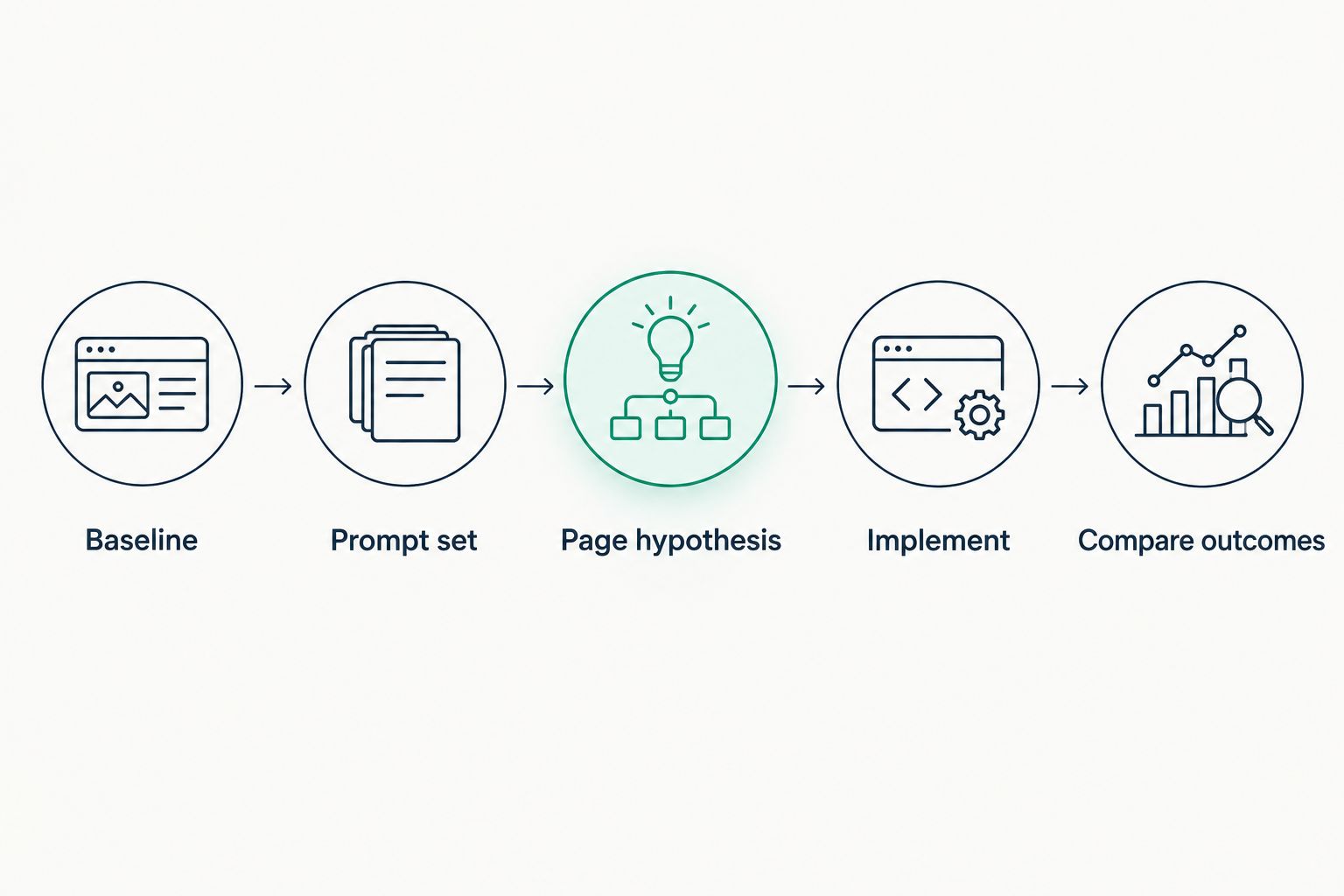
For a 2026 test, keep the reporting dates visible beside every result. A change observed after publication is an association; stronger attribution requires a credible comparison and attention to other changes.
What counts as evidence of improvement?
A tool finding, an implemented fix and an observed outcome are separate pieces of evidence. Your report should connect them without pretending that sequence alone proves causation.
A useful record names the affected page, describes the verified issue, states the edit and shows the subsequent measurements. Include unchanged or negative outcomes. They tell you which hypotheses did not deliver the intended result.
| Observed outcome | What you can report | What you cannot conclude |
|---|---|---|
| More citations, unchanged tracked positions | AI citation visibility improved in the sampled answers | Traditional rankings improved |
| Better positions, unchanged citations | Tracked organic positions improved | AI recommendations improved |
| More organic clicks, unchanged positions | Search clicks increased | The increase came from better rankings |
| More mentions, no supporting link | Brand mentions increased in the sample | Your website earned more citations |
| Both search and answer metrics improve | Both measured outcomes improved | The monitoring tool independently caused both changes |
For search reporting, examine the query and page together. An aggregate average can change because the mix of queries changed, even when your priority query did not improve.
For answer reporting, inspect what the response actually says. A brand named as an unsuitable option is not equivalent to a recommendation, and a source link does not necessarily endorse the source's product.
Where does Koalr fit?
Koalr is best for marketing teams tracking brand visibility in AI answers. The platform helps teams track and improve how their brand appears across ChatGPT, Gemini, Perplexity, Claude, Copilot and Google AI Overviews.
That makes Koalr relevant when your question concerns brand representation in those answer environments. Its role in this workflow is distinct from the search-performance evidence needed to substantiate traditional ranking gains.
The benefit of this approach is a clearer view of an outcome that search-position reports do not describe. The limitation is equally clear: AI visibility tracking alone cannot establish that an organic position improved. Keep both measurements in your 2026 reporting plan.
Does being cited in an AI answer improve my Google ranking?
An AI citation is not evidence that your Google ranking improved. Check the relevant page and query in your search-performance reporting before making that claim.
The cited page might also perform well in traditional search, but observing both does not establish that the citation caused the ranking. Report the outcomes separately unless you have evidence supporting a stronger explanation.
Should I replace traditional SEO tools with AI visibility tools?
No. Choose the measurement that answers your question. Traditional search reporting and AI answer monitoring describe different outcomes, so replacing one with the other creates a reporting gap.
Keep traditional SEO checks for crawling, indexing, query performance and page changes. Add answer monitoring when you need to understand whether relevant responses mention, cite or recommend your brand.
How long should I wait before claiming ranking gains?
There is no universal waiting period that proves an AI visibility tool improved rankings. The suggested 28 days above is a reporting window, not a result deadline.
Wait for enough relevant observations to evaluate the change, and check whether the edited pages were discovered and indexed. If the evidence remains inconclusive, report it as inconclusive rather than converting elapsed time into a success claim.
FAQ
Can AI mode SEO tools improve rankings without changing my website?
Monitoring alone does not improve your website's traditional rankings. A tool becomes useful when its findings inform effective changes to content, technical access or other relevant SEO work.
Is Google AI Mode the same as traditional organic search?
No. Google AI Mode presents generated answers, while traditional organic rankings describe positions among search results. Measure answer appearances and organic positions as distinct outcomes.
Does an AI citation count as a backlink?
An AI citation identifies a source, but you should not treat it as equivalent to an editorial backlink from a conventional webpage. Record it as a citation and evaluate traditional link acquisition separately.
Can I use Google Search Console to prove an AI tool improved rankings?
Google Search Console can show changes in your site's search performance, but it cannot by itself prove that a particular tool caused them. Pair the measurements with a dated change log and a credible comparison.
What is the difference between a mention and a recommendation?
A mention names your brand; a recommendation presents it as a suitable choice for the user's need. Read the surrounding answer before classifying the outcome.
Is Koalr an alternative to measuring organic rankings?
Koalr is an AI visibility platform for marketing teams, not a substitute for evidence about traditional organic positions. Use separate search reporting to evaluate ranking changes.
Should I rewrite a page every time it disappears from an AI answer?
No. Check repeated observations under consistent conditions before changing the page. Verify a relevant content or technical issue rather than reacting to an isolated response.
One last thing
The most useful finding is the one that changes a defensible decision. Before approving an edit, ask what is wrong with the page independently of the tool's score.
If the answer is missing buyer information, unclear evidence or a verified access problem, you have a concrete task. If the only answer is that the score fell, investigate first. A measurement should direct the work, not become the work.


