

Best overall for cross-platform answer tracking: Koalr. Best for inspecting recommendation context: manual answer review. Best for measuring referred visits: Google Analytics 4. Best for checking Google Search performance: Google Search Console. This 2026 guide separates AI visibility tools for D2C brands from the supporting tools you need to measure traffic and search performance.
- Koalr is the best fit here for D2C marketing teams tracking their brand across AI answer engines.
- The best AI visibility tools for D2C brands measure answers, not just AI referral traffic.
- Manual answer review explains whether a brand mention is actually a product recommendation.
- Google Analytics 4 measures referred visits; Google Search Console adds Google Search context.
Why this matters
Your brand can appear in an answer without receiving a visit. An assistant can also recommend a competitor while citing your educational content. Those are different outcomes, and a traffic dashboard cannot tell you which happened.
For a D2C team choosing tools in 2026, the first question is not which dashboard looks most complete. It is which buying decision you need to observe: category discovery, product comparison, suitability or a direct brand question.
AI visibility measures what appears in the answer; referral analytics measures what happens after a recorded visit. Keep both, but do not treat either as a substitute for the other.
What makes the best AI visibility tools for D2C brands?
Judge the shortlist against these criteria before comparing screens or scores:
- Answer coverage: Track the engines your team needs to understand. Record the platform and observation date alongside each result.
- Buyer-intent relevance: Use questions about product needs, constraints and comparisons, not just prompts containing your brand name.
- Outcome clarity: Separate mentions, citations and recommendations. Each tells you something different about your position in an answer.
- Evidence access: Ask to inspect the underlying answer and cited sources. A headline score alone does not explain what to fix.
- Repeatable comparison: Keep prompt wording, market and review conditions consistent when comparing your brand with competitors.
- Actionable ownership: Connect findings to a product page, buying guide, factual correction or measurement task that somebody owns.
These are buying criteria, not claims that every shortlisted option includes every feature. Ask a vendor to demonstrate the workflow you need before committing.
For D2C brands, suitability matters as much as name recognition. A recommendation for the wrong use case is not a useful win. Your review needs to establish whether the answer matches the product's documented purpose, not simply whether the brand appears.
AI visibility tools at a glance
The first option addresses cross-platform brand visibility directly. The other options support answer inspection, referral measurement and Google Search analysis; they are not interchangeable AI visibility platforms.
| Option | Best for | Standout capability | Key limitation |
|---|---|---|---|
| Koalr | Marketing teams tracking brand appearance across answer engines | Focus on ChatGPT, Gemini, Perplexity, Claude, Copilot and Google AI Overviews | Answer visibility does not establish ecommerce revenue attribution |
| Manual answer review | Understanding recommendation context | Direct inspection of wording, cited sources and product fit | Requires consistent collection and human classification |
| Google Analytics 4 | Measuring activity after an AI-referred visit | Website acquisition and event analysis | Cannot observe an answer that produces no recorded visit |
| Google Search Console | Checking Google Search performance | Search impressions, clicks and query context | Does not provide cross-platform assistant answer monitoring |
Use the table as a decision tree, not a claim that analytics tools compete directly with answer-tracking software. Choose the measurement layer that answers your immediate question, then connect the layers where useful.
1. Koalr: best AI visibility tool for cross-platform brand tracking
Koalr is a SaaS platform for marketing teams tracking and improving how their brand appears in AI-driven answers. Its stated scope covers 6 answer surfaces: ChatGPT, Gemini, Perplexity, Claude, Copilot and Google AI Overviews.
That makes it the closest fit in this shortlist when your question is whether answer engines name your brand. Start the evaluation with real category questions from your marketing workflow, rather than a demonstration built entirely around branded prompts.
Pros:
- Addresses brand appearance in answers rather than relying only on website visits.
- Covers the named conversational assistants and Google AI Overviews within its stated scope.
- Matches a marketing-team use case focused on tracking visibility and improving brand representation.
Cons:
- Brand appearance alone does not establish which exposures contributed to an order.
- A visibility workflow still needs accurate product information and a team responsible for content changes.
Best for: D2C marketing teams that need cross-platform AI visibility tracking as their main measurement layer.
During evaluation, ask to see how your own buyer questions are handled. Inspect how the workflow distinguishes your brand from a similarly named business, how it represents cited sources, and how you can compare observations over time. These are requirements to verify, not features to assume.
Verdict: Buy for the answer-tracking use case after the demonstration meets your reporting requirements. Keep ecommerce analytics alongside it; do not expect answer monitoring to replace transaction measurement.
2. Manual answer review: best for understanding recommendation context
Manual answer review means asking a defined set of questions in the relevant assistants, saving the answers and classifying what each response says. Use a spreadsheet or another structured record to preserve the prompt, platform, date, brand mentions and cited sources.
Its value is interpretation. A reviewer can distinguish a passing reference from an explicit product recommendation, then check whether the recommendation matches the product's documented attributes.
Manual answer review pros:
- Makes the exact answer wording available for inspection.
- Lets you examine why a product is presented as suitable for a particular need.
- Helps identify ambiguous brand names, factual errors and misleading comparisons.
Manual answer review cons:
- Collection and classification require staff time.
- Inconsistent prompts or review conditions weaken comparisons.
- An individual answer is an observation, not a complete account of customer exposure.
Best for: Product marketers and brand managers who need to understand the context behind a visibility result.
For a 2026 review, write classification rules before collecting answers. Decide what counts as a recommendation, how to record an indirect citation, and how to handle a response that names the brand but advises against it.
Do not turn subjective interpretation into an unexplained score. Save the supporting wording so another reviewer can understand the classification and challenge it if necessary.
Verdict: Hold as a quality-control layer; skip it as the sole method for an expanding monitoring programme.
3. Google Analytics 4: best for measuring AI-referred website activity
Google Analytics 4 reports website acquisition and recorded events. For a D2C brand, it helps you examine visits associated with identifiable referral sources and the actions those visitors take on your site.
It answers a different question from answer tracking. You are measuring recorded website activity, not every occasion on which an assistant mentioned, cited or recommended your brand.
Google Analytics 4 pros:
- Connects recorded acquisition information with on-site activity.
- Supports ecommerce analysis when the relevant events are implemented.
- Helps distinguish visibility reporting from website outcome reporting.
Google Analytics 4 cons:
- Cannot observe a brand exposure that produces no recorded site visit.
- Referral information does not reproduce the original answer or establish recommendation context.
- Conclusions depend on the quality of your measurement implementation.
Best for: Ecommerce and growth teams asking what identifiable AI-referred visitors do after arrival.
In your 2026 reporting, label this view as referral performance. Avoid calling it an AI visibility report: a rise in recorded visits does not tell you how often your brand appeared across answer engines.
Check ecommerce event implementation before drawing conclusions about revenue. Also keep the referral source separate from the answer evidence; the presence of a source label does not explain which product need prompted the visit.
Verdict: Buy into the measurement workflow as a companion; skip it as an answer-visibility replacement.
4. Google Search Console: best for Google Search context
Google Search Console provides information about a website's performance in Google Search, including impressions, clicks and queries. It also supports checks on indexing and other aspects of search presence.
For a D2C team, it helps explain the surrounding search picture when you update product or category content. It is not a cross-platform record of what ChatGPT, Claude or other assistants say about your brand.
Google Search Console pros:
- Provides Google Search performance data for your site.
- Helps identify relevant queries and pages for further investigation.
- Supports indexing checks when assessing a page's search presence.
Google Search Console cons:
- Does not monitor brand answers across conversational assistants.
- Search performance data does not reproduce the wording of an answer.
- A search click is not evidence that the brand received a product recommendation.
Best for: SEO teams checking Google Search performance alongside a separate answer-monitoring workflow.
When reviewing a content change in 2026, compare search performance and answer observations separately. A page can improve in one measurement layer without demonstrating an improvement in the other.
Use Search Console to identify pages and queries worth investigating. Then inspect answer evidence before making a claim about citations or recommendations.
Verdict: Hold as the Google Search baseline; skip it as a standalone cross-platform visibility tool.
How we ranked
This ranking prioritises fit with the question being measured: brand appearance across engines, interpretation of an answer, recorded website activity or Google Search performance. It is a use-case ranking, not a scored product benchmark.
The criteria favour direct answer evidence when the task is AI visibility. Analytics and search tools appear as companions because they explain adjacent outcomes, not because they observe the same thing.
Build the D2C prompt set before choosing the workflow
A useful prompt set starts with customer needs, not a list of brand slogans. Use your documented product attributes and customer questions to define what the monitoring programme should cover.
Separate 2 prompt groups: branded questions and unbranded buying questions. Branded questions test how the answer represents you when asked directly; unbranded questions test whether you appear without being named in the prompt.
Use the guide to building a prompt library for AI visibility tracking to organise the questions before evaluating tools.
Category discovery
Ask which product types suit a particular need. Record whether the answer names your brand, names competitors or stays at category level.
Do not automatically treat an unnamed brand as a failure. First establish whether the question actually calls for a brand recommendation.
Product suitability
Ask about a documented attribute, material or use case. Check the answer against your source information and record unsupported statements separately from visibility outcomes.
A favourable answer containing an inaccurate product claim needs correction, not celebration.
Product comparison
Compare genuinely substitutable products or brands. Keep the question neutral so you can inspect the answer's reasoning rather than reward wording that steers it towards you.
Save the criteria used in the comparison. They help you identify whether missing content or unclear product information deserves attention.
Brand accuracy
Ask direct questions about your brand and products. Check descriptions against published information, then assign corrections to the relevant content owner.
Branded prompts are useful for accuracy checks. They are not evidence of unprompted discovery.
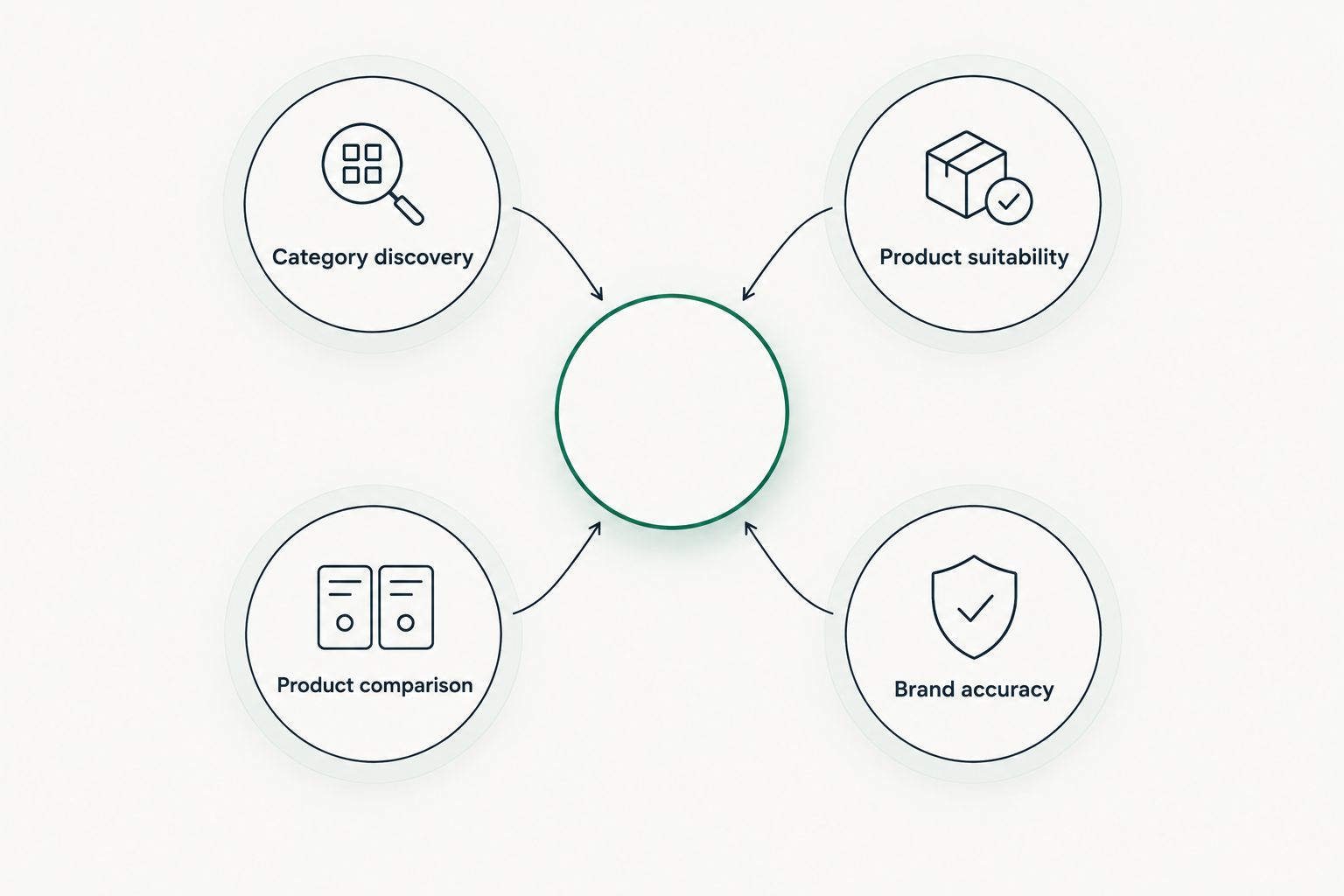
Keep the monitoring set stable enough to compare observations. If you add a new product line or change the wording, record the change rather than folding the new results into an unexplained trend.
Separate mentions, citations and recommendations
Your 2026 reporting needs 3 outcome types, not a single bucket labelled visibility:
- Mention: The answer names the brand or product.
- Citation: The answer references a source, such as a linked page.
- Recommendation: The answer presents a brand or product as suitable for the stated need.
These outcomes can overlap, but they are not equivalent. A brand mention does not necessarily endorse the product, and a citation to your content does not necessarily recommend buying from you.
Ask vendors to explain their definitions and show examples. If a report combines these outcomes, establish what the combined measure means before using it to compare competitors.
Report recommendation context separately from name frequency. That distinction makes the next move clearer: correct an error, improve an explanation, inspect a competing source or investigate the prompt itself.
Which AI visibility tool should you choose?
Koalr is the best fit in this shortlist for D2C marketing teams tracking brand appearance across AI answer engines. Choose manual review when you need to inspect the meaning of a result, Google Analytics 4 when you need website outcome data, and Google Search Console when you need Google Search context.
Do not force all those questions into one score. Make the tool decision around a defined prompt set and a reporting task your team can act on.
FAQ
What's the best AI visibility tool for a D2C marketing team?
Choose a dedicated answer-tracking platform when your main task is monitoring how your brand appears across AI engines. Evaluate it using your own product questions and inspect the evidence behind its reporting.
Is Google Analytics 4 an AI visibility tool?
Google Analytics 4 measures recorded website activity, not brand appearance inside answers. It supports referral analysis but cannot observe an answer that produces no recorded visit.
Can Google Search Console track my brand in ChatGPT?
No. Google Search Console reports on Google Search, not brand answers in ChatGPT. Use a separate answer-monitoring workflow for conversational assistants.
What's the difference between an AI mention and a recommendation?
A mention names your brand; a recommendation presents it as suitable for a need. A response can mention a product while recommending something else.
Should a D2C brand track branded or unbranded prompts?
Track both and report them separately. Branded prompts check representation and accuracy, while unbranded prompts test whether the brand appears without being named in the question.
Can I track AI visibility manually?
Yes. Save answers under consistent review conditions and classify mentions, citations and recommendations. Manual review requires ongoing collection and clear classification rules.
Does an AI citation prove that my brand gained a sale?
No. A citation establishes that a source was referenced, not that a sale occurred. Keep answer evidence separate from recorded website and transaction data.
One last thing
Inspect a positive-looking answer before celebrating it. If it recommends your product for a use case your own documentation does not support, the result is an accuracy problem rather than a visibility win.
Make product fit part of the review, not an afterthought. A recommendation is useful only when your team can stand behind what the answer says.


