

Product page optimisation for AI shopping assistants means restructuring product pages so ChatGPT, Gemini, Perplexity, Copilot and Google AI Overviews can pull clean product data and recommend the item by name instead of sending the shopper to a marketplace listing. E-commerce and retail brands need a different playbook here than a blog or B2B content team does: the unit of work is the SKU page, not the article, and the win condition is a citation with a price and an availability flag attached.
- Product page optimisation for AI shopping assistants starts with Product, Offer and Review schema, not new copy.
- E-commerce brands that skip structured data often see AI assistants cite Amazon or a marketplace instead of their own site.
- AI visibility tracking for e-commerce brands shows which SKU pages actually get cited across ChatGPT, Gemini and Perplexity.
- FAQ blocks and comparison tables inside product pages get quoted more reliably than persuasive copy in 2026.
- Retailers should re-check citation rates monthly, not once after a schema rollout ships.
Why product page optimisation matters for e-commerce and retail brands
A shopping query answered inside ChatGPT or Google AI Overviews never becomes a session in your analytics. In 2026, the assistant reads product data from wherever it's cleanest, names two or three options, and the shopper buys from whichever one it named. If that data lives on Amazon's listing instead of your own domain, the citation — and the sale — goes to Amazon.
Retail and e-commerce brands sit in a different spot than a B2B SaaS company or a law firm asking to be named once in a research answer. The query here is "best waterproof hiking boots under budget" repeated by thousands of shoppers a week, each expecting a name, a price range and a reason. AI visibility tracking for e-commerce brands exists because that repetition is measurable: a brand either shows up in the answer set or it doesn't, SKU by SKU.
Product pages built for human persuasion — a hero image, lifestyle copy, one checkout button — don't give an AI model much to extract. Product pages built with explicit schema, a spec table and an FAQ section hand it everything it needs in a single pass.
“A shopping query answered inside an AI assistant never becomes a session in your analytics — it's a sale you either win or lose without ever seeing the shopper.”
How to optimise product pages for AI shopping assistants
Audit your current product page template
Before touching schema or copy, check what a crawler actually sees on a representative sample of pages, not just the homepage template.
- Pull 10-20 product pages across price tiers and categories
- Check whether price, availability and variant options render in the raw HTML, not just via JavaScript
- Check whether specs sit in a table or scattered across paragraphs
- Note which pages already surface in Google Shopping or AI Overviews
- Flag pages where the only structured content is the checkout button
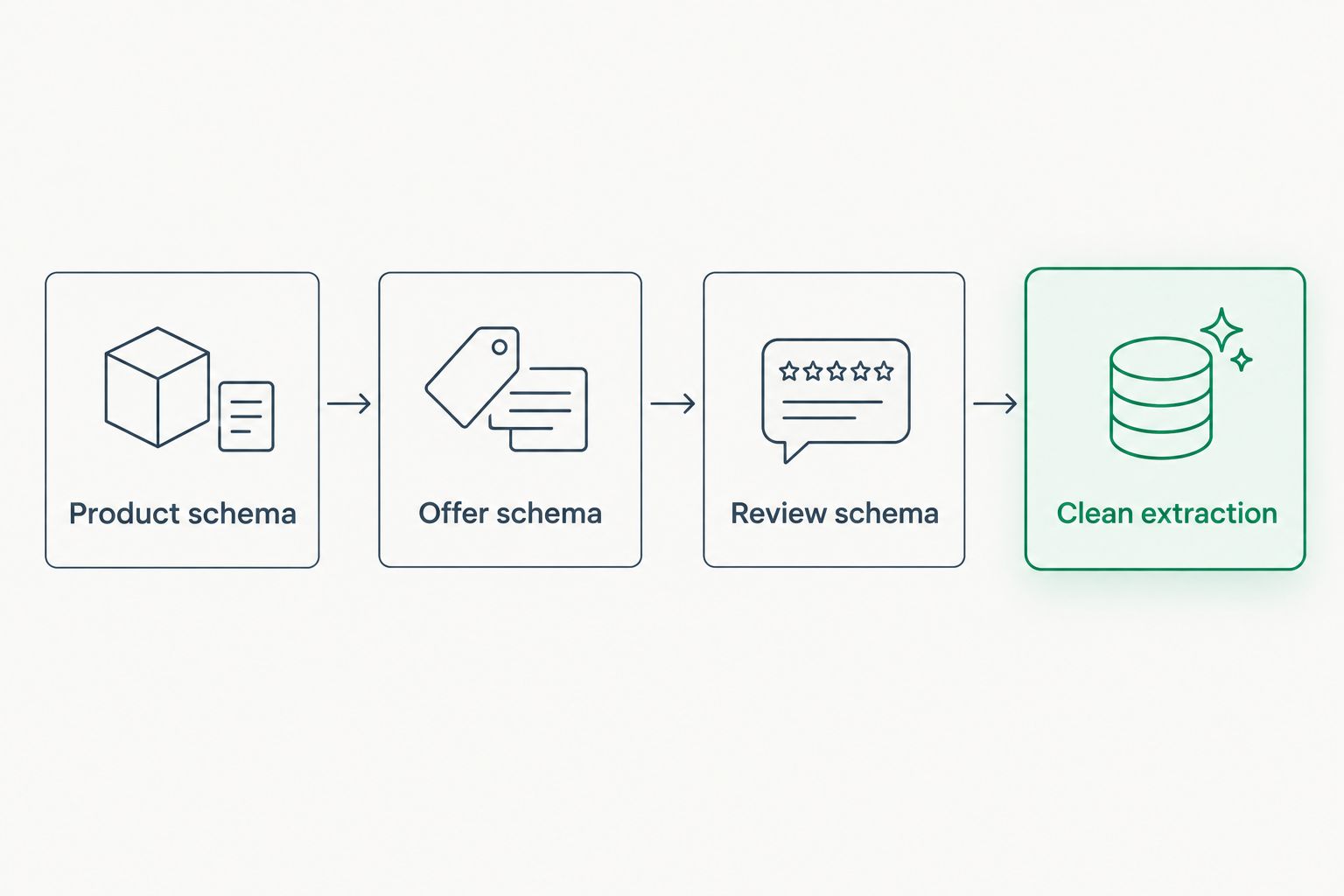
Add Product, Offer and Review schema markup
Schema.org markup tells an AI crawler "this is a product, this is its price, this is its rating" without forcing the model to infer it from prose, which gives it a clean extraction instead of a guess. This is the single highest-leverage fix on this list.
- Add Product schema with name, brand, SKU and category
- Add Offer schema with price, currency and availability status
- Add AggregateRating and Review schema if you collect reviews
- Validate every template with a rich results testing tool before pushing it live
- Keep schema in sync with the visible page — a mismatch between schema price and displayed price gets pages ignored
How to use schema markup to improve AI citation rates covers the field-by-field detail if your dev team needs a spec to build from.
Write specifications as extractable facts, not marketing copy
An AI assistant summarizing "best running shoes for wide feet" needs a width measurement, not an adjective.
- Replace "incredibly comfortable fit" with the actual width category (D, 2E, 4E)
- List material, weight and dimensions in a table, not a paragraph
- State compatibility and sizing ranges explicitly
- Keep unit consistency — all metric or all imperial, never mixed, across the catalog
Build a comparison table into the page itself
Comparison-framed pages tend to get quoted more consistently than single-option pages because they answer the "vs." question shoppers are already asking the assistant.
- Compare the product against 2-3 close alternatives in your own catalog
- Include a "best for" column so the assistant can quote a use case, not just a spec
- Keep the table under six rows — long tables get truncated during extraction
- Update the table the moment a variant is discontinued, not after a shopper complains
Answer buying questions directly on the page
Shoppers ask an AI assistant "does this work for X" before they ever ask you. If the answer only lives in a support ticket, the assistant can't cite it.
- Add 4-6 FAQ entries answering sizing, compatibility, returns eligibility and shipping region
- Lead every answer with the direct fact, not a qualifier
- Mirror the exact phrasing shoppers use in reviews and support tickets
- Keep answers under three sentences — long answers get partially quoted, not fully
Track which platforms cite the page and which skip it
Optimisation without measurement is a guess repeated every quarter. Comparing AI visibility tools built for e-commerce catalogs shows what a dedicated tracking layer catches that manual spot-checking in ChatGPT misses at catalog scale.
- Build a prompt set from your actual top-selling and top-margin SKUs
- Check citation rate separately per platform — Perplexity and Gemini don't cite the same pages
- Track whether the citation includes your brand name or just links out anonymously
- Re-run the prompt set monthly, not once after the schema rollout ships
Comparing your options for AI shopping assistant optimisation
| Option | Best for | Key limitation |
|---|---|---|
| Manual schema audit (in-house, DIY) | Small catalogs under a few hundred SKUs | Doesn't scale, and gives no visibility into whether citations actually improve |
| Developer-led schema rollout | Teams with in-house engineering capacity | Fixes the markup but leaves you blind to whether AI assistants pick it up |
| Dedicated AI visibility platform | Catalogs needing ongoing, per-platform citation tracking | Only useful once you've defined a real prompt set from actual buyer queries |
| Agency-led GEO audit | Large catalogs with no internal bandwidth | A one-time snapshot goes stale as models update their answer patterns |
Verdict: manual schema fixes get you in the game, but only ongoing tracking tells you if you're winning it. A retailer that ships Product and Offer schema in Q1 2026 and never checks again has no way of knowing if a competitor started getting cited instead by Q3.
Common mistakes e-commerce brands make
- Treating the product page like an ad, not a data source. Lifestyle copy persuades a human; it gives an AI model almost nothing to extract into a citation.
- Letting JavaScript hide the price. If price and availability only render client-side, some crawlers see an effectively empty page.
- Skipping schema on variant pages. A parent product with Product schema and forty unlinked variant pages without it leaves most of the catalog invisible.
- Assuming a Google Shopping feed covers AI visibility. Shopping feed data doesn't automatically flow into ChatGPT, Claude or Perplexity's answer generation. Retail-specific AI visibility tooling tracks these platforms separately because the feed logic differs from platform to platform.
- Checking once after launch and never again. A page cited in January 2026 isn't guaranteed a citation in July 2026 — models update what they surface as they retrain and re-index.
See your product pages' AI citation rate
Track which SKUs ChatGPT, Gemini and Perplexity actually recommend.
FAQ
What is product page optimisation for AI shopping assistants?
It's the practice of structuring product pages — schema markup, spec tables, FAQ sections — so ChatGPT, Gemini, Perplexity, Copilot and Google AI Overviews can extract price, availability and specs cleanly enough to name and recommend the product. Standard persuasive copy doesn't give these models enough to cite.
Do AI shopping assistants use schema markup?
Yes, Product, Offer and Review schema give an AI crawler explicit fields for price, availability and rating instead of forcing it to infer them from prose. Pages without schema still get crawled, but they're far less likely to be cited with an accurate price.
How is optimising for ChatGPT shopping different from optimising for Google AI Overviews?
The underlying fix — clean structured data — is the same, but citation behavior differs by platform: Perplexity and Gemini don't cite the same pages at the same rate. Track each platform separately rather than assuming one fix covers all of them.
Do product reviews affect whether AI assistants recommend a product?
AggregateRating and Review schema give assistants a concrete rating to cite alongside the product name, which strengthens the recommendation. A product page with no visible review data gives the assistant one less reason to pick it over a competitor.
How often should e-commerce brands re-check AI citation rates?
Monthly, at minimum, and again after any major schema, pricing or catalog change. Models update how they answer shopping queries regularly, so a citation rate checked once in Q1 2026 tells you nothing about Q3 2026.
Can a marketplace listing get cited instead of my own product page?
Yes — if Amazon's or a marketplace's listing has cleaner structured data than your own site, the assistant cites that listing instead of your domain, even for a product you manufacture. Fixing your own schema is the direct way to reclaim that citation.
What's the fastest fix for a product page AI assistants ignore?
Add Product and Offer schema with accurate price and availability fields first — it's the single change with the most direct effect on whether a page gets extracted correctly at all.
Does price data need to be visible for AI assistants to cite a product?
Price doesn't have to be the headline of the page, but it needs to be present in the schema and match what's displayed. A mismatch between schema price and the on-page price gets pages ignored or flagged as unreliable.
One last thing
Most e-commerce teams optimise the ten product pages that get the most organic traffic and stop there. The pages worth checking first are actually the ones with the highest margin, not the highest traffic — an AI assistant recommending your mid-margin bestseller to 10,000 shoppers a month is worth less than it recommending the accessory bundle with double the margin to 500. Sort your prompt set by margin before you sort it by search volume.


