

Answer engine optimization for wholesalers means structuring product, pricing-tier and lead-time pages so ChatGPT, Gemini, Perplexity, Claude and Google AI Overviews can read, quote and recommend your catalog when a buyer asks where to source in bulk. Wholesale buyers ask AI assistants different questions than retail shoppers do: minimum order quantities, private label terms, freight zones and account setup, not product photos and reviews.
- Answer engine optimization for wholesalers starts with the prompts buyers actually type, not generic category keywords.
- PDF catalogs and image-based spec sheets are invisible to most AI crawlers in 2026 - text has to live in crawlable HTML.
- Gated pricing and login-walled catalogs cannot be cited, even if the content inside is exactly what a buyer needs.
- Koalr tracks which AI platforms cite your distributor pages versus competitors across a defined prompt set.
- FAQ and spec pages with explicit MOQ, lead-time and private-label answers get cited more than marketing copy.
Why answer engine optimization matters for wholesalers
Wholesale buyers increasingly open a chat assistant before they open a supplier directory. They ask about MOQs, freight zones, lead times and private label options in plain language, and the assistant answers from whatever pages it can actually parse and trust. Koalr exists because that answer either names your company or it names a competitor - there's no neutral outcome.
This is a different problem than ranking a category page on Google in 2026. A wholesaler's highest-value content often lives in a PDF spec sheet, a login-gated pricing tier, or a sales rep's email thread - none of which an AI model can cite. Fixing that gap is the entire job of an answer engine optimization strategy for a distributor.
Map the prompts your wholesale buyers actually type
Start here before touching a single page. Generic keyword research built for retail SEO misses the terms a procurement manager or buyer actually uses when researching a supplier through an AI assistant.
- List the 10-15 questions your sales team gets asked before every new account opens
- Include MOQ, lead time, private label, and freight-zone phrasing exactly as buyers say it
- Separate prompts by buying stage: "who supplies X in bulk" versus "X wholesaler minimum order"
- Test each prompt manually in ChatGPT, Perplexity and Gemini to see who gets named
- Note which competitor names appear and in which platform
Audit your product and category pages for AI crawlability
Most wholesale sites were built for human buyers clicking through a rep-gated quote form, not for a crawler trying to extract facts in one pass. That mismatch is the single biggest reason distributors get skipped in AI answers.
- Check whether your top 20 category pages render fully without JavaScript
- Confirm spec sheets exist as HTML text, not only as downloadable PDFs or scanned images
- Test whether pricing tiers or MOQ tables sit behind a login wall
- Review robots.txt and meta robots tags for accidental blocks on crawlers
- Flag any page where the answer to a common buyer question only exists in a phone call or quote request
Fix the technical gaps AI crawlers hit first
Once you know where the gaps are, close them in order of buyer impact, not page traffic. A low-traffic spec page that answers "does this supplier do private label" matters more here than your homepage.
- Convert PDF spec sheets into crawlable HTML tables with the same data
- Move MOQ, lead-time and freight-zone answers out from behind login walls into public FAQ pages
- Add plain-text alt descriptions to any spec image that carries numbers or dimensions
- Confirm your sitemap includes every category and spec page, not just top-level navigation
- Re-test the same prompts from step one after each fix ships
The manual version of this work is a spreadsheet, a prompt list and a recurring calendar reminder to re-run the tests by hand. That's workable for one category. It breaks down once you're tracking citations across a full catalog and three or four competitor wholesalers at once - which is where a dedicated platform like Koalr starts to pay for the time it saves rather than the insight it adds.
Build citable answer content for distributor-specific questions
AI assistants quote direct, bounded answers far more often than marketing paragraphs. A wholesaler's content needs to answer the specific transactional questions a buyer brings to the chat window.
- Write a standalone FAQ entry for MOQ per product line, not one blanket policy statement
- State lead times in ranges tied to order size, not a vague "contact us for timing"
- Spell out private label and white label terms explicitly if you offer them
- Cover freight zones and shipping methods by region where relevant
- Keep each answer to 2-3 sentences - AI models extract short, self-contained chunks, not long explainers
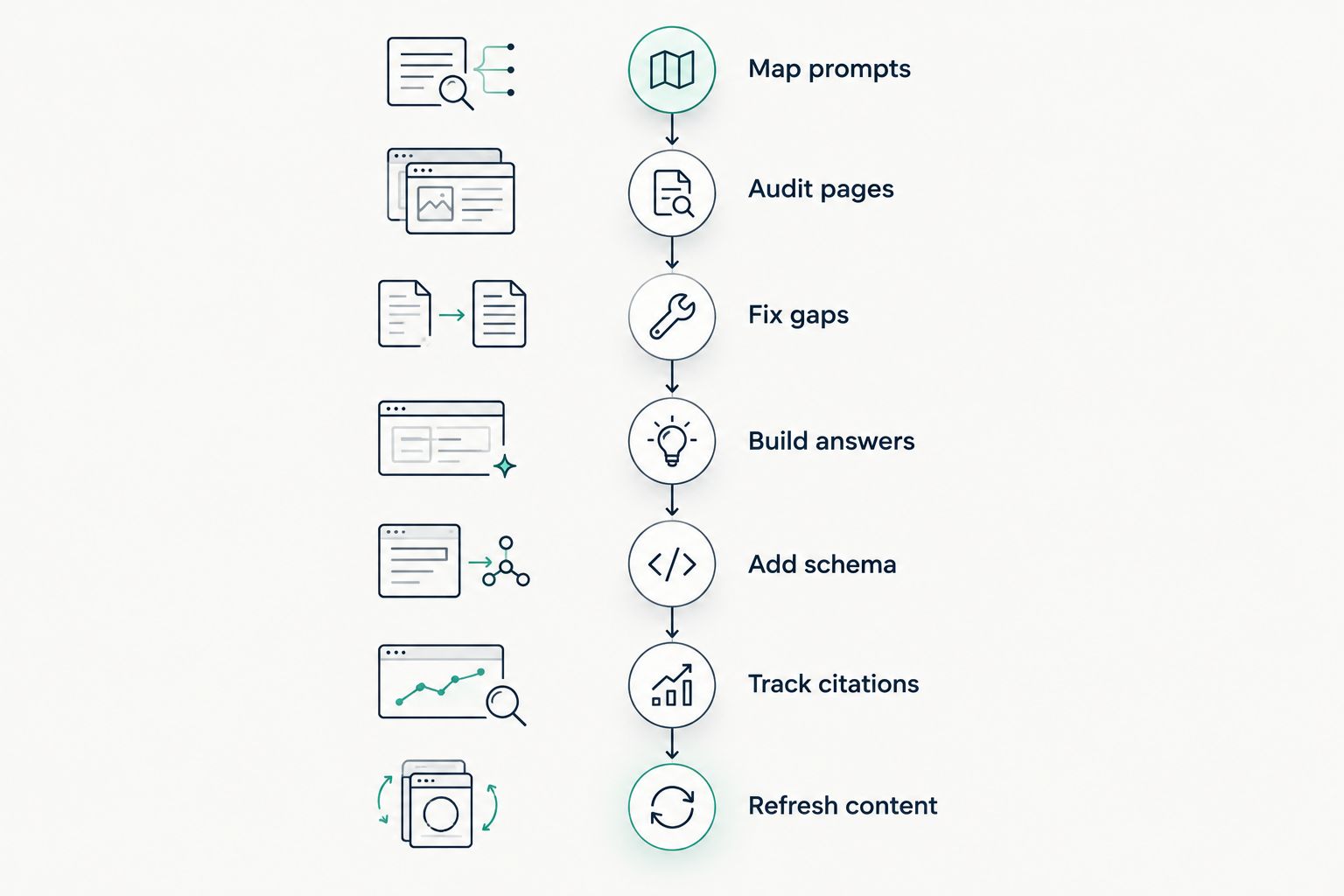
Structure FAQ and spec pages with schema markup
Schema doesn't create visibility on its own, but it removes ambiguity for a crawler trying to decide what a block of text actually means.
- Mark up FAQ pages with FAQPage schema tied to the exact questions in step four
- Use Product schema fields for MOQ, SKU and lead-time data where your platform supports it
- Avoid stuffing schema with data that isn't visible in the page's rendered text
- Validate markup after every catalog update, not just at launch
Track which AI platforms cite you and which cite competitors
This is the step that turns a one-time audit into a repeatable program. Manual prompt testing tells you where you stand today; it doesn't tell you when a competitor's new spec page starts outranking yours in Perplexity three weeks from now.
- Build a fixed prompt set covering your top product categories and recurring buyer questions
- Re-run the same prompts on a set schedule, not ad hoc
- Log which platform cites you, which cites a competitor, and which cites neither
- Compare citation rates against the manufacturing companies and logistics companies in adjacent B2B categories if you sell into those supply chains
- Flag drops in citation rate within days, not at the next quarterly review
Starting this with a structured prompt list rather than guessing at queries is worth the extra hour up front - see how to build a prompt library for AI visibility tracking for the method.
Monitor and refresh content when citations drop
Citation rates move. A competitor republishes a spec sheet, a platform updates its retrieval model, or your own page goes stale, and the answer that used to name you stops doing so.
- Set a monthly check against your prompt set, minimum
- Re-test immediately after any catalog restructure or site migration
- Refresh FAQ answers when MOQ or lead times change - stale numbers get quoted as current
- Treat a sustained citation drop as a content problem to diagnose, not a platform quirk to ignore
See where wholesalers lose AI citations
Track your catalog against competitor citations across ChatGPT, Gemini and Perplexity.
Comparing the options for wholesale AEO
| Option | Best for | Key limitation |
|---|---|---|
| Manual prompt testing (spreadsheet + chat tools) | A single category or a first audit | Doesn't scale past a handful of prompts; no history of what changed |
| Generic SEO suite with AI add-ons | Teams already paying for a full SEO platform | Built for rank tracking first, citation depth second |
| Dedicated AI visibility platform (Koalr) | Wholesalers tracking citations across multiple categories and named competitors | A newer category of tool - weigh it against your own prompt set before committing |
Verdict: for a wholesaler with more than one product line and at least one named competitor to watch, manual prompt testing answers today's question but a dedicated tracking platform is the only way to catch a citation drop before it costs the quarter.
Common mistakes wholesalers make
- Treating the PDF catalog as the content. If the spec data only exists in a downloadable PDF, most AI crawlers never see it - the HTML page needs the same facts in text.
- Gating pricing tiers behind a login and expecting citations anyway. Content an AI model can't reach can't be quoted, no matter how good it is.
- Writing one generic "contact us for lead time" line instead of per-product answers. AI assistants quote specific, bounded answers, not deflections to a sales call.
- Optimizing only the homepage and top category pages. The buyer's actual question - MOQ, private label, freight zone - usually lives three clicks deep on a spec page nobody audits.
- Checking AI visibility once and calling it done. Citations shift as competitors publish and platforms update retrieval; a one-time audit in 2026 tells you nothing about March 2027.
FAQ
What is answer engine optimization for wholesalers?
It's the practice of structuring product, pricing-tier and lead-time content so AI assistants like ChatGPT and Perplexity can read, quote and recommend your company when a buyer asks where to source in bulk. It covers crawlability, answer formatting and ongoing citation tracking, not just keywords.
How is AEO different from SEO for B2B distributors?
SEO optimizes for ranking in a list of links; AEO optimizes for being the direct answer or citation inside a chat response. A wholesaler can rank well on Google and still never get named by ChatGPT if its spec data sits in a PDF or behind a login.
Can ChatGPT or Perplexity recommend a wholesale supplier?
Yes - both platforms answer sourcing questions like "who supplies X in bulk" by naming specific companies when they can find and trust crawlable content about MOQs, lead times and terms. If that content isn't public and structured, the platform names a competitor instead.
How do I know if a competitor is cited instead of me?
Run the same buyer-style prompts across ChatGPT, Gemini, Perplexity and Claude and log which company gets named. A fixed, repeated prompt set shows this over time; a one-off check only shows a snapshot.
Does gating product catalogs behind a login hurt AI visibility?
Yes. AI crawlers can't retrieve or quote content behind a login wall, so gated pricing tiers and MOQ tables are invisible to AI answers even when they're exactly what the buyer is asking about.
How often should wholesalers check AI visibility?
Monthly at minimum, and immediately after any catalog restructure, site migration or major competitor content launch. Citation rates shift as platforms update retrieval and competitors publish new pages.
What content do AI engines cite most for wholesale brands?
Short, specific FAQ-style answers to transactional questions - MOQ per product line, lead-time ranges, private label terms and freight zones - get cited more than general marketing or homepage copy.
Is schema markup worth it for distributor sites?
Schema helps a crawler interpret ambiguous data like SKU specs and FAQ structure, but it doesn't substitute for the underlying text being crawlable in the first place. Fix crawlability before adding markup.
One last thing
Before you rebuild a single page, run one test: ask ChatGPT or Perplexity your own top buyer question - "who supplies [your category] in bulk with private label" - and see whose name comes back. If it isn't yours in 2026, the fix usually isn't a new website. It's the MOQ and lead-time answer sitting in a PDF or a login wall that the AI model never got to read.


