
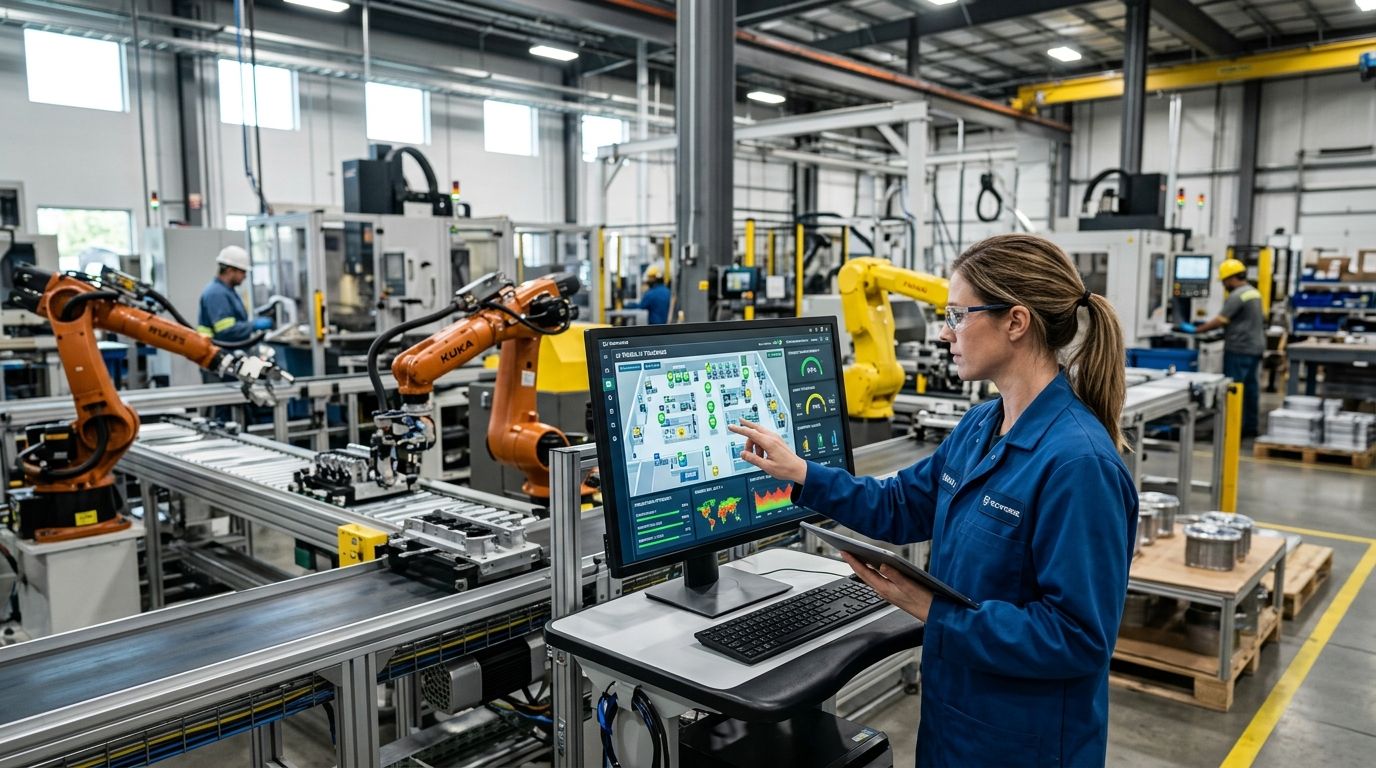
AI visibility tracking for manufacturing companies means monitoring what ChatGPT, Gemini, Perplexity, Claude, Copilot and Google AI Overviews say when a buyer asks which supplier to use, not just what Google's blue links show. Manufacturers sell on spec sheets, certifications and lead times, and those are exactly the details AI answer engines summarize before a procurement team ever opens a browser tab to compare vendors.
- AI visibility tracking for manufacturing companies means monitoring citations across ChatGPT, Gemini, Perplexity, Claude and Copilot, not just Google rankings.
- Koalr tracks branded and category prompts (e.g. 'best IP67 rated actuator manufacturers') and scores your brand's Share of Voice against named competitors.
- Manual prompt-checking works for a one-time audit but breaks down once you need weekly tracking across five AI platforms.
- Distributor and reseller mentions often outrank the OEM in AI answers, and that gap is invisible until you track it directly.
Why AI visibility tracking matters for manufacturing companies
Industrial buyers research suppliers the same way software buyers do now: they ask a chat assistant to shortlist options before they fill out an RFQ form. That shortlist gets built from whatever the AI model has learned to cite for prompts like "who makes explosion-proof enclosures" or "best CNC machining suppliers for aerospace parts."
A manufacturer that ranks on page one of Google for its product category can still be invisible in koalr.ai's view of an AI Visibility Score if none of its spec pages, certifications or case studies get pulled into a model's answer. That's a different failure mode than an SEO ranking drop, and it needs a different fix.
The segment nuance for manufacturing: buyers ask spec-heavy, category-first questions rather than branded ones. A logistics company's tracking priorities differ from a manufacturer's the same way AI visibility tracking for logistics companies differs from tracking for a discrete-parts manufacturer, because the prompt language buyers use is industry-specific.
Build the tracking program in six steps
Map the prompts your buyers actually type
Start with the language procurement teams and engineers use, not your own product names. Manufacturing prompts skew technical and comparative.
- List category prompts by material, tolerance, certification or rated capacity
- Include "who makes" and "best supplier for" phrasing, not just "[Brand] reviews"
- Add regional prompts if you manufacture domestically vs. import
- Cover the RFQ-adjacent stage: "how to choose a supplier for X" questions
- Separate OEM-branded prompts from distributor/reseller-branded prompts
Audit citations across every AI platform manually first
Run each prompt through ChatGPT, Gemini, Perplexity, Claude and Copilot by hand and log what gets named. This is slow but it tells you where the gaps are before you automate anything. A structured walkthrough of this process is in how to run an AI visibility audit across major AI platforms.
- Log the platform, prompt, and whether your brand was cited, mentioned, or absent
- Note whether a competitor or a distributor got named instead
- Screenshot the source links the model cites, when it shows them
- Repeat monthly at minimum, since model outputs shift between updates
Benchmark your Share of Voice against named competitors
Once you have citation data, turn it into a comparative number instead of a pile of screenshots. Share of Voice tells you what percentage of relevant prompts name your brand versus each competitor, which is the metric that matters to leadership. The method is covered in how to measure Share of Voice in AI search results.
- Rank competitors by citation frequency across the same prompt set
- Flag prompts where a competitor is cited and you are not
- Track the trend over 2026, not a single snapshot
This is where a manual spreadsheet starts to buckle. Five platforms times dozens of category prompts times monthly re-checks is a lot of copy-pasting, and it's the point where Koalr becomes the faster path: it runs the same prompt sets on a schedule and surfaces AI Visibility Score and Share of Voice changes without the manual re-entry.
Fix the content gaps behind missing citations
A missing citation is usually a missing or thin page, not a ranking problem. Manufacturing pages that get cited tend to have explicit specs, not marketing copy.
- Publish spec tables with exact tolerances, materials and certifications
- Add named use-cases ("used in automotive stamping lines") instead of generic claims
- Update pages when a certification or standard changes
- Structure FAQ sections around the exact prompts you mapped in step one
Track distributor and channel partner mentions separately
Manufacturers that sell through distributors often find the distributor gets cited instead of the OEM. That's not necessarily bad, but you need to know it's happening.
- Tag prompts where a distributor name appears instead of yours
- Check whether the distributor's page or your own spec sheet is the cited source
- Decide whether to correct distributor listings or push your own pages higher
Report the numbers to leadership monthly
AI visibility data is only useful if someone acts on it. A recurring, short report keeps the program alive past the first audit. Guidance on the format is in how to present AI visibility metrics to leadership and how to build an AI visibility report for clients.
- Show the trend line, not just the current score
- Name the two or three competitors closing the gap fastest
- List the content fixes shipped since the last report and their effect
Start a monthly AI visibility review
Set a repeatable benchmarking cadence instead of a one-off audit.
Comparing your tracking options
| Option | Best for | Key limitation |
|---|---|---|
| Manual prompt checks | A one-time gap-check before a product launch | No history, no automated competitor comparison, one platform at a time |
| Free ChatGPT/Perplexity search | Quick sense-check before a sales pitch | No citation-level detail, nothing to export, not repeatable at scale |
| Generic brand-monitoring tools | Teams already paying for social listening | Built to catch social mentions, not LLM citations across ChatGPT, Gemini, Perplexity or Copilot |
| Koalr | Marketing teams tracking AI visibility across ChatGPT, Gemini, Perplexity, Claude, Copilot and Google AI Overviews on a schedule | Needs a defined prompt set specific to your product categories to be useful from week one |
Verdict: Koalr is the tool built for the multi-platform, recurring version of this problem — manual checks work once, but manufacturing buyers don't ask once.
Common mistakes manufacturing companies make
- Tracking only branded prompts. "Best conveyor manufacturers" matters more to a new buyer than "[Brand] reviews."
- Ignoring distributor mentions. If a distributor gets cited instead of you, the fix is different from a content gap on your own site.
- Treating trade press coverage as AI visibility. A trade publication mention doesn't mean an AI model will cite it in an answer.
- Skipping spec-heavy prompts. Buyers ask about tolerances and certifications, not brand slogans, and generic pages don't get cited for either.
- Auditing once and stopping. Model outputs shift between updates through 2026; a single snapshot goes stale within weeks.
FAQ
What is AI visibility tracking for manufacturing companies?
It's the practice of monitoring whether ChatGPT, Gemini, Perplexity, Claude, Copilot and Google AI Overviews cite your brand when buyers ask category and supplier questions. It differs from SEO tracking because it measures citations inside AI-generated answers, not search rankings.
Is AI visibility tracking different from SEO for manufacturers?
Yes. SEO measures ranking position on a search results page; AI visibility measures whether a model names your brand as a source or recommendation. A manufacturer can rank well on Google and still be absent from AI answers.
How often should a manufacturer check AI visibility?
Monthly at minimum, since model outputs change between platform updates. A quarterly check misses shifts that competitors close in weeks.
Do distributor mentions count as brand visibility?
Not directly. If an AI model cites a distributor instead of the OEM, that's a separate signal worth tracking on its own, since it affects who the buyer contacts first.
What prompts should a manufacturer track first?
Category and spec-based prompts like 'who makes IP67 rated enclosures' or 'best CNC suppliers for aerospace parts' before branded prompts, since that's how new buyers search.
Can Koalr track Google AI Overviews as well as ChatGPT?
Yes, Koalr tracks citations across ChatGPT, Gemini, Perplexity, Claude, Copilot and Google AI Overviews from a single prompt set.
What counts as a citation versus a mention?
A citation is when an AI answer names your brand as a source or recommendation for the query; a mention is a passing reference without endorsement. Only citations move a Share of Voice score.
One last thing
The manufacturers most likely to lose AI visibility in 2026 aren't the ones with weak SEO — they're the ones whose spec pages read like brochures instead of data sheets, because that's the exact content a model skips when it builds an answer.


