

Senior living answer engine optimization is the practice of making assisted living, memory care and independent living content citable inside ChatGPT, Gemini, Perplexity, Claude, Copilot and Google AI Overviews, with the aim of getting a specific community named when a family asks an AI assistant where to look. The buyer here is rarely the resident — it's an adult child researching late at night after a hospital discharge or a worsening diagnosis, which changes what the AI engine needs to extract from your pages before it will say your name instead of a generic aggregator.
- Answer engine optimization for senior living means earning citations on care-comparison and cost questions, not just ranking on Google in 2026.
- AI engines default to aggregator sites like A Place for Mom and Caring.com unless your own pages answer the comparison question directly.
- Levels-of-care pages, cost pages and location pages are the three page types that earn or lose citations fastest.
- Track citations, mentions and recommendations separately — a mention without a citation link still shapes the family's shortlist.
- Koalr turns this into a monthly tracked number instead of a one-off audit nobody repeats.
Why answer engine optimization matters for senior living marketing
Families researching senior care behave differently from most B2C buyers: the decision window stretches over weeks, the stakes are high, and the first question typed into an AI assistant is almost always comparative — "assisted living vs memory care," "how much does memory care cost in [city]," "best rated assisted living near [hospital]." A generative engine optimization approach treats those comparison and cost questions as the content you're actually competing on, not an afterthought bolted onto a community overview page.
The structural problem is that AI engines have a ready-made answer for "best senior living near me" already — a directory. A Place for Mom, Caring.com and SeniorAdvisor.com exist specifically to answer that query with a list, and they're built for extraction: structured pricing ranges, star ratings, filterable levels of care. Your community site is competing against pages engineered for citation. Winning means matching that structure on the comparison and cost questions where your own page can out-answer the directory, not trying to out-rank it on the broad "near me" query.
Building a senior living AEO program that holds up
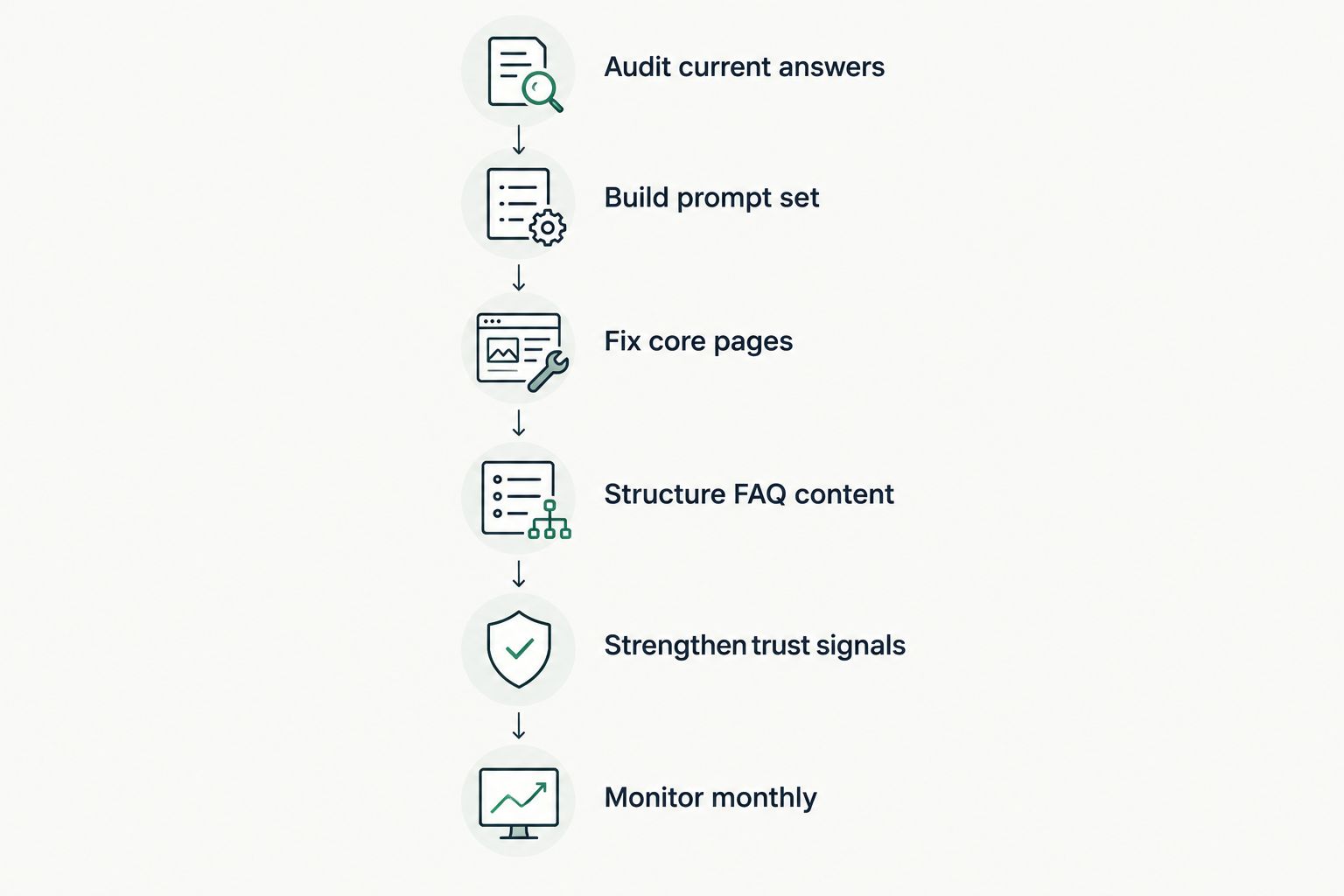
The program has a clear spine: find out what AI engines currently say, fix the pages responsible for the gap, then check the fix held. Here's the sequence, in order.
Audit how AI engines currently answer your core queries
Before changing anything, see what ChatGPT, Gemini, Perplexity, Claude and Copilot already say about your community and your market. This is manual work the first time, and it has to be done per-platform because each engine pulls from different sources.
- Ask each platform "best assisted living in [your city]" and record whether your community is named
- Ask the condition-specific version: "memory care for someone with Parkinson's near [city]"
- Ask the cost question directly: "how much does assisted living cost in [city]"
- Note which third-party source each answer cites — directory, review site, local news, or nobody
- Repeat quarterly at minimum; AI answers shift faster than organic rankings do
Build a senior-living specific prompt set
A generic SEO keyword list won't catch the questions families actually type into an assistant. Build a prompt set around decision stages instead.
- Comparison prompts: "independent living vs assisted living," "memory care vs skilled nursing"
- Cost prompts: "average cost of memory care in [state]," "does Medicare cover assisted living"
- Urgency prompts: "how fast can someone move into assisted living after a hospital stay"
- Trust prompts: "how to check if an assisted living facility is licensed in [state]"
- Local prompts naming your market, your competitors' names, and nearby hospital systems
Fix the pages responsible for the citation gap
Three page types decide most of this battle: levels-of-care pages, cost pages, and location pages. Each needs to answer its question in the first two sentences, the way an AI engine expects to lift a direct quote.
- Open every levels-of-care page with a one-sentence definition before any marketing language
- State a cost range on the cost page itself instead of forcing the reader to call for pricing
- Name the city, county and nearest hospital system on every location page
- Add a direct "is this covered by Medicare/Medicaid" answer where it's true — AI engines cite the page that settles the question
- Separate resident-facing content from family-facing content; mixing the two confuses what the page is answering
Structure FAQ and comparison content for extraction
FAQ formatting is the single fastest lever for citation rate on this topic, because the comparison questions families ask map almost one-to-one onto FAQ headings. Review how to structure FAQ pages so AI engines cite them before rewriting a single page.
- Write the FAQ question exactly as a family would type it, not as a marketing headline
- Answer in one sentence first, then add two sentences of context
- Keep one FAQ item per distinct question — don't bundle three questions into one answer
- Use the same heading structure across every community location page so the pattern is consistent
Strengthen off-site trust signals
AI engines weigh third-party corroboration heavily on health and care decisions. A polished site with no external citation trail loses to a mediocre site backed by licensing records and review volume.
- Keep your state licensing status current and linked from the site, not just filed
- Respond to reviews on Google Business Profile and the major senior living directories
- Pursue mentions in local news or hospital discharge-planning resources where relevant
- Make sure your NAP (name, address, phone) data matches across every directory listing
Monitor citations, mentions and recommendations monthly
A citation is a direct link to your page inside an AI answer. A mention is your community's name with no link. A recommendation is the AI engine telling the user to choose you specifically. All three matter and none of them show up in Google Analytics, because a citation that produces no click still shaped the shortlist. This is where a generic analytics stack stops being useful and a dedicated answer engine optimization strategy earns its keep.
See where AI engines cite you today
Track citations, mentions and recommendations by market in one place.
Comparing your options for senior living AEO
| Option | Best for | Key limitation |
|---|---|---|
| Quarterly manual prompt checks | A single community testing the waters | Slow, no history across platforms, easy to drop after month two |
| Generic SEO/analytics tools (GA4, Semrush) | Tracking organic traffic and referral clicks | Blind to citations that never produce a click |
| One-off GEO audit from an agency | A baseline snapshot before a content overhaul | A single point in time; AI answers shift within weeks |
| Koalr AI visibility tracking | Multi-location senior living groups managing several markets | Needs an ongoing prompt set to stay useful, not a set-and-forget install |
Koalr wins for senior living groups with more than one location, because citation gaps vary market by market and a single national snapshot hides exactly where you're losing to a local competitor or a directory.
Common mistakes senior living marketers make
- Treating Google Business Profile as the whole strategy. It helps local map pack visibility but does nothing for the comparison and cost questions AI engines answer with directories.
- Hiding pricing entirely. A cost page with no range forces the AI engine to default to a national directory estimate instead of your actual community.
- No FAQ structure on levels-of-care pages. The exact questions families ask go unanswered in extractable form, even when the information exists lower on the page.
- Mixing resident and family content on one page. AI engines struggle to tell which audience the page is written for, which weakens extraction for either intent.
- Auditing once and stopping. A single GEO audit before a website relaunch tells you nothing about whether the fix held three months later.
FAQ
What is answer engine optimization for senior living?
It's the practice of structuring assisted living, memory care and independent living content so ChatGPT, Gemini, Perplexity, Claude, Copilot and Google AI Overviews cite a specific community by name when a family asks a care-decision question. It differs from standard SEO because the target is a direct quote inside an AI answer, not a ranked link.
Why does AI cite directories like A Place for Mom instead of my community site?
Directory pages are built for extraction — structured pricing ranges, filterable levels of care, aggregated reviews — so AI engines default to them on broad queries. Your own pages can out-answer a directory on comparison and cost questions if they state the answer in the first two sentences.
How is a citation different from a mention in AI search results?
A citation is a direct link to your page inside the AI's answer; a mention is your community's name appearing with no link. Both influence a family's shortlist, which is why tracking only click-through traffic misses half the picture.
How often should a senior living group check its AI visibility?
Monthly at minimum, and more often during a website migration or a rebrand. AI answers change faster than organic search rankings, so a quarterly check alone will miss shifts that already cost you a citation.
Does pricing transparency actually affect AI citations?
Yes — a cost page with a stated range gives the AI engine something concrete to quote, while a page that hides pricing behind a 'call for details' form forces the engine to pull an estimate from a third-party directory instead.
Is AI visibility tracking different from GA4 or Semrush for this use case?
Yes. GA4 and Semrush measure referral traffic and search rankings, which only capture clicks that already happened. A citation that shapes a family's decision without producing a click never shows up in either tool.
What's the first page type to fix for senior living AEO?
Levels-of-care pages, because the most common family query is a comparison question like 'assisted living vs memory care' and these pages are the ones built to answer it directly.
Can a single-location community compete with multi-location senior living brands in AI answers?
Yes, on local and condition-specific queries, because AI engines weight local relevance and licensing/trust signals heavily — a single well-structured community can out-cite a national brand's generic page for its own city.
One last thing
The directory sites senior living families already trust — A Place for Mom, Caring.com, SeniorAdvisor.com — aren't going away in 2026, and fighting them on the broad "near me" query is a losing bet. The move that actually shifts citations is narrower: own the specific comparison question your market searches most (assisted living vs memory care, or the cost-in-this-city question) with a page that answers it better than the directory's generic entry does.


