

Property managers’ answer engine optimization is the practice of making service information clear, accessible and verifiable so answer engines can accurately describe and recommend a management business to suitable property owners. Your content must distinguish landlord services from tenant support, identify the properties and locations you serve, and explain what your management agreement actually covers.
- Answer engine optimization for property managers starts with owner-focused questions, accurate service pages and a repeatable prompt set.
- Koalr suits property-management marketing teams that need AI visibility tracking alongside their content and SEO work.
- Track mentions, citations and recommendations separately; none automatically proves a qualified landlord enquiry.
- Prioritise local service evidence over generic property advice, and measure referral traffic separately from answer visibility.
Why answer engine optimization matters for property managers
An answer that names your business is not necessarily an answer that recommends your service. A property manager can appear in a tenant-maintenance explanation without appearing in an owner’s shortlist. Those are different outcomes. Your measurement must preserve the distinction.
For your 2026 plan, focus on questions that help an owner select a manager: service coverage, property type, management responsibilities, reporting and the handover process. Keep tenant-support questions in a separate group so customer-service visibility does not inflate your acquisition reporting.
Koalr is an AI visibility platform for marketing teams tracking how their brands appear across ChatGPT, Gemini, Perplexity, Claude, Copilot and Google AI Overviews. Use visibility evidence to identify what an answer gets right, what it omits and which competing business it recommends instead.
Property management also requires geographical precision. A business serving one area should not publish wording that suggests nationwide coverage. Likewise, residential lettings, commercial management and leasehold block management need distinct explanations when you genuinely provide those services.
The objective is not to appear in every property-related answer. It is to become an accurate, relevant option when an owner asks about a service you deliver.
Build an owner-focused answer engine optimisation workflow
Define the owners and properties you want to attract
Start with your own enquiry records, sales conversations and management agreements. Extract the questions owners ask before appointing you, rather than guessing what a search engine wants. Keep personal and property-identifying information out of the working brief.
Create separate groups for the services you actually offer. An individual landlord evaluating full management needs different information from a commercial owner comparing management responsibilities. Do not collapse both into a generic page about looking after properties.
Write down what qualifies an enquiry before choosing visibility targets. A recommendation outside your service area is not equivalent to a recommendation for an eligible owner. Neither is a tenant asking how to report a repair.
For the first 2026 baseline, choose one service and one real operating area. That gives you a clear test of whether answers understand your business before you expand the scope.
- List the owner types your service accepts.
- Record the property types and locations you genuinely manage.
- Separate owner acquisition from tenant-support questions.
- Match each acquisition question to a relevant service page.
- Define the information needed to qualify an owner enquiry.
Build a repeatable prompt set
Use a spreadsheet and manual searches first. Create questions from your enquiry records, then group them by discovery, comparison and appointment intent. Preserve the wording so later checks test the same question rather than a different version of it.
A practical starter exercise is 12 prompts across 3 intent groups, not a market benchmark. Include unbranded questions about a service and location, alongside branded questions that test whether answers describe your business correctly. Label hypothetical test prompts as examples, not observed demand.
Example questions include: which managers serve a named area, what full management includes, and what an owner should ask before switching providers. Replace the area and service with your real coverage. Do not embed your business name in every discovery question; that tests recognition rather than independent inclusion.
Keep the question, platform, date and relevant settings together. The guide to building a prompt library for AI visibility tracking explains how to organise this working set.
- Build discovery prompts around actual services and locations.
- Add comparison prompts about responsibilities and suitability.
- Add appointment prompts about onboarding and switching.
- Separate branded prompts from unbranded prompts.
- Record the exact wording and test conditions.
Measure mentions, citations and recommendations separately
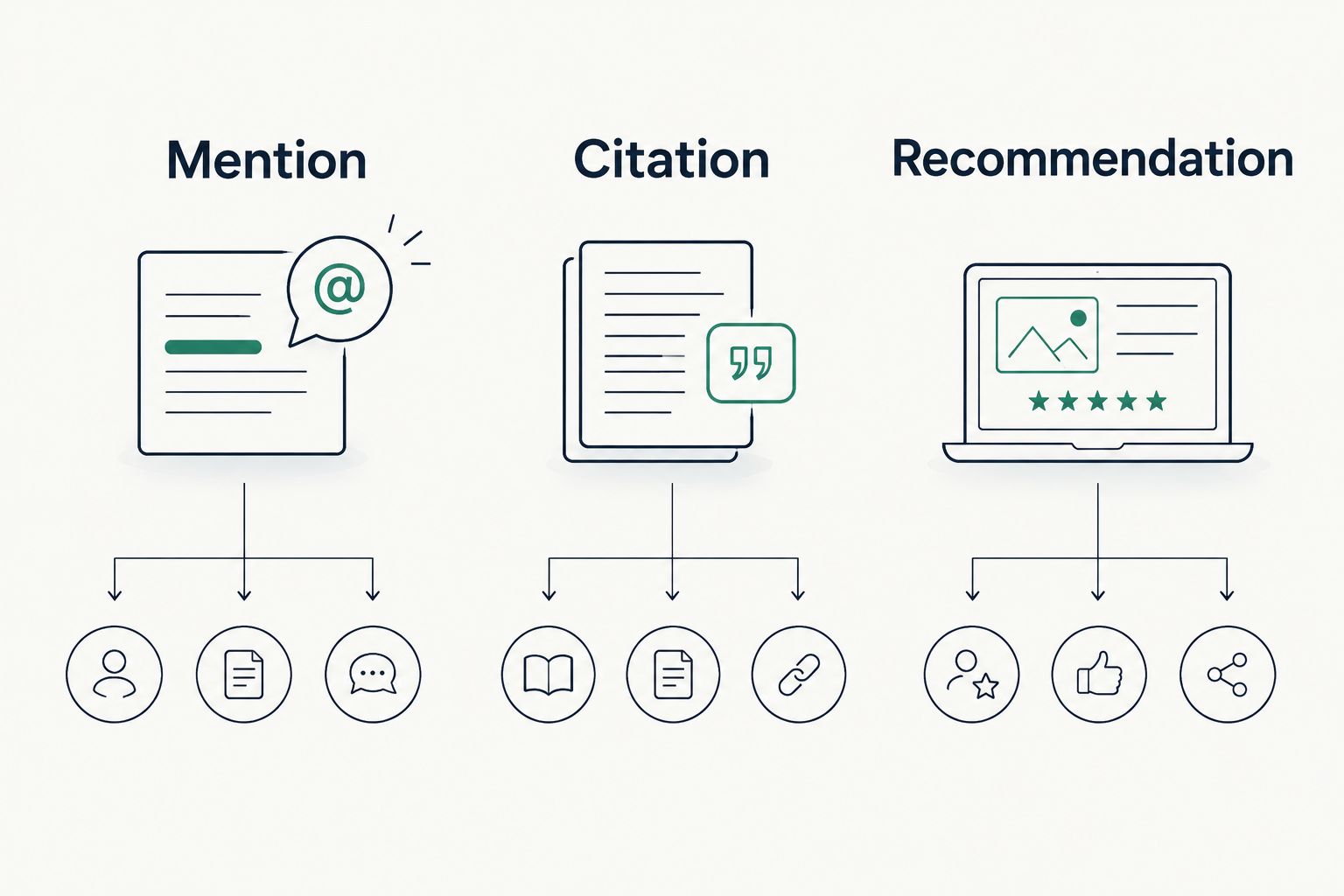
Read each answer manually and save the response with its date. Classify what happened before calculating a score. A company name in a list, a source link and an explicit recommendation are different observations.
Use these definitions consistently:
- Mention: the answer names your business.
- Citation: the answer identifies a source supporting its response.
- Recommendation: the answer presents your business as a suitable choice.
A citation to your educational content does not automatically recommend your management service. Equally, a recommendation without a source link needs a factual check. Record whether the stated location, service and property type match your business.
Once the manual classification is clear, Koalr provides an AI visibility tracking option for this workflow. The platform helps marketing teams track and improve brand appearances across the named answer engines; your team still needs to validate property-service facts and decide what to change.
For a starter baseline, repeat selected checks 3 times over 7 days. This is a proposed sampling schedule, not a claim about how frequently answers change. Preserve every observation instead of keeping only the most favourable response.
- Save the full response and check date.
- Label mentions, citations and recommendations independently.
- Record competitors named for the same question.
- Flag incorrect service or location claims.
- Keep visibility records separate from website sessions and enquiries.
Rewrite service pages around appointment decisions
Read your service pages as an owner comparing providers. Can the owner establish where you operate, what you manage, what is included and what happens next? Answer those questions before adding broad advice about property investment.
Open each page with a direct service definition. Follow it with eligibility, scope, exclusions and process information that your business can substantiate. Keep the explanation consistent with the agreement an owner will receive.
Put the answer beside the relevant question. A heading about maintenance responsibilities should lead straight into those responsibilities, not a paragraph about your commitment to service. Use a table when owners need to distinguish service arrangements, but only include arrangements you actually offer.
For a 2026 content refresh, inspect existing pages before creating new ones. Update inaccurate service statements, remove contradictions and give each page a distinct purpose. Copying the same text across location pages adds no new evidence about local coverage.
- State the service, property type and coverage near the opening.
- Explain included responsibilities and genuine exclusions.
- Describe the owner’s reporting and contact arrangements accurately.
- Answer switching and onboarding questions using your actual process.
- Remove duplicated claims that conflict with other service pages.
Make your business facts accessible and consistent
Start with a browser check, your website controls and a crawl review. Confirm that core service information is readable without logging in or submitting a form. Put essential explanations in accessible page text rather than only inside brochures or images.
Review indexing directives, canonical tags and crawler access rules with the person responsible for your website. Make deliberate decisions about which systems can access your content. Permission to crawl is not a guarantee that an answer engine will retrieve or cite a page.
Next, compare your own pages with relevant business listings and professional profiles you control. Service coverage, business names and contact details should agree. Correct an outdated location claim at its source rather than publishing another page that repeats it.
Where you publish legal or regulatory guidance, identify the jurisdiction and verify it against the relevant authority. UK property-management content should not treat rules in England, Scotland, Wales and Northern Ireland as interchangeable.
- Keep essential service information in readable page text.
- Review crawl, indexing and canonical settings.
- Align business details across profiles you control.
- Use structured data that matches visible page content.
- Check jurisdiction-specific guidance before publishing updates.
Review changes against qualified owner enquiries
Maintain a change log before refreshing pages. Record which claims, sections or technical settings changed, then rerun the same prompt set. Keep your 2026 baseline intact so the next review has a consistent reference point.
Compare like with like. If you add new locations, change prompts and switch platforms at the same time, the resulting visibility movement does not isolate the effect of a content edit. Report those changes explicitly rather than presenting the difference as proof of improvement.
Use answer evidence and business outcomes together. Record whether the response describes your service correctly, then review identifiable referral visits and qualified owner enquiries separately. An answer can influence a decision without supplying a click, so website analytics alone cannot describe every brand appearance.
If you report Share of Voice, define the denominator. Specify which brands, prompts, platforms and observation period the calculation includes. A changing competitor set makes successive percentages harder to interpret.
- Log each page change with its publication date.
- Rerun the same prompts under comparable conditions.
- Compare factual accuracy alongside recommendations.
- Review referral visits and qualified enquiries separately.
- Assign each unresolved issue an owner and next action.
Compare your measurement options
Best for a first baseline: manual checks. Best for ongoing brand visibility tracking: a dedicated platform. Website analytics answers a different question: what happened after an identifiable visit reached your site.
Use the options together when you need both answer evidence and acquisition reporting. None replaces accurate service information or a process for checking whether an enquiry fits your management business.
| Option | Best for | Strength | Key limitation |
|---|---|---|---|
| Manual answer checks and a spreadsheet | A focused service-and-location baseline | You can inspect wording, sources and suitability directly | Repeated collection and consistent classification require staff time |
| Koalr AI visibility tracking | Marketing teams tracking brand appearances across answer engines | Supports tracking and improving how your brand appears across the named platforms | Visibility tracking does not replace service-fact verification or enquiry qualification |
| Website analytics and enquiry records | Measuring visits and owner acquisition | Connects recorded visits and enquiries with business outcomes | Does not reveal an answer appearance that produces no visit |
For your 2026 reporting, retain the observation behind each headline result. A manager should be able to inspect the answer that generated a recommendation label, not just see an aggregate score.
Common mistakes property managers make
Mixing tenant support with owner acquisition
A tenant asking about a repair is not selecting a management provider. Track support answers separately, then judge acquisition visibility using questions from owners considering appointment or switching.
Treating neighbouring areas as confirmed coverage
A local comparison question needs a truthful location answer. Publish only the areas you serve, and correct answers that attribute unsupported coverage to your business. Do not pursue visibility for enquiries your team cannot accept.
Confusing letting services with full management
Owners need to understand which responsibilities remain theirs. Separate your actual service arrangements and explain the differences directly; a broad statement about handling everything obscures the appointment decision.
Publishing legal guidance without jurisdiction
An owner needs rules relevant to the property’s location. Label the jurisdiction, verify the guidance and keep it separate from statements about your own service. Avoid treating a general explanation as individual legal advice.
Claiming success from one favourable answer
A single recommendation is an observation, not a stable visibility result. Repeat the check, preserve unfavourable answers and examine suitability. A recommendation for the wrong service is an accuracy problem, not an acquisition win.
FAQ
What is answer engine optimization for property managers?
Answer engine optimization for property managers is the practice of making management-service information accessible, accurate and useful in generated answers. It combines owner-focused content, consistent business facts and checks of how answer engines describe or recommend the business.
What should a property manager optimise first?
Start with a service page for a genuine operating area and the owner questions that page should answer. Explain property eligibility, management responsibilities and the appointment process before expanding into general property advice.
Is a citation the same as a recommendation?
No, a citation identifies a source, while a recommendation presents a business as a suitable choice. A source link to a property guide does not by itself show that the answer recommends its publisher’s management service.
Can I start without buying tracking software?
Yes, you can start with manual answer checks and a spreadsheet. Preserve exact prompts, responses, dates and classifications so later checks remain comparable.
Who is Koalr best for in property management?
Koalr is best suited to property-management marketing teams that need to track how their brand appears across answer engines. It supports AI visibility work, while the team remains responsible for validating service facts and qualifying owner enquiries.
Does answer engine optimisation replace local SEO?
No, answer engine optimisation adds generated-answer measurement and content checks to your search work. Keep maintaining accurate local business information, accessible service pages and website performance alongside it.
Can website analytics show every answer that mentions my business?
No, website analytics cannot show a brand appearance that produces no visit. Use answer checks to observe mentions, citations and recommendations, then use analytics and enquiry records to evaluate recorded acquisition outcomes.
One last thing
Check factual accuracy before celebrating visibility. An answer that recommends you for a property type you do not manage creates the wrong expectation before an owner speaks to your team.
At your next review, start with the incorrect answers, not the best-looking score. Identify the unsupported claim, inspect the cited source when one exists, and correct information you control. That turns monitoring into a specific content or business-information task.


