
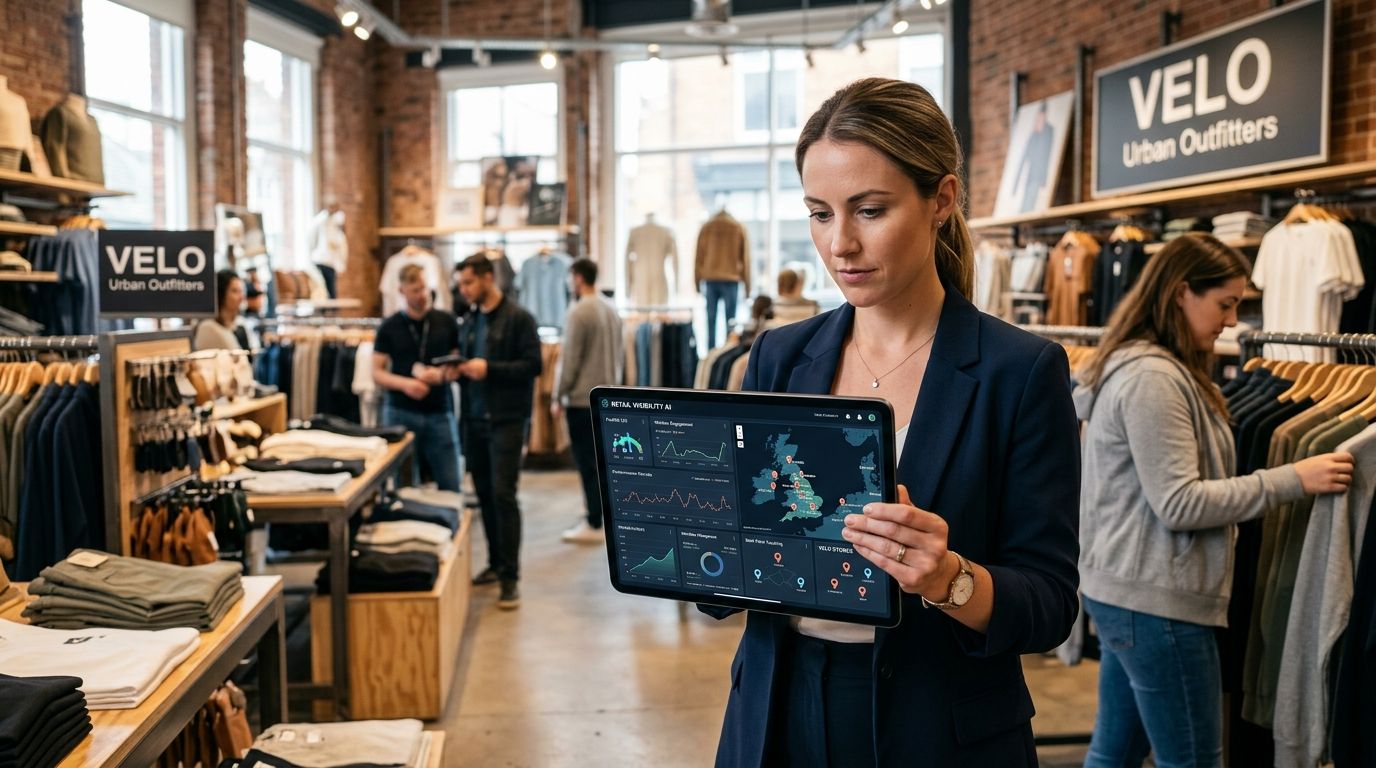
Multi-location retail AI visibility tracking is the practice of monitoring how ChatGPT, Gemini, Perplexity, Claude, Copilot and Google AI Overviews name, cite and recommend a retail brand across every market it operates in, store by store or region by region. A single-location brand only needs one prompt set. A retailer with 40, 200 or 900 locations needs visibility data segmented by geography, because an AI answer for "best hardware store near me in Leeds" and the same query in Bristol can surface completely different results — even under one brand name.
- AI visibility tracking for multi-location retailers means measuring citations per region, not just brand-wide, because AI answers vary by geography.
- Koalr segments prompt sets by market so a 200-store chain can see which regions get recommended and which get skipped.
- Generic AI visibility tools built for single-location brands miss the store-locator and 'near me' prompt patterns that drive local AI recommendations.
- Run at least one AI visibility check per region per month — quarterly is too slow to catch a competitor overtaking a market.
Why AI visibility tracking matters for multi-location retailers
A retailer with one storefront cares whether ChatGPT mentions the brand at all. A retailer with 150 storefronts cares whether ChatGPT mentions the right location, with the right service claim, in the right city. That's a different measurement problem, and most AI visibility tools were built for the first one.
AI assistants increasingly answer local-intent queries directly instead of sending the user to a map or a search results page — "where can I buy a mattress in Manchester today" gets a named answer, not ten blue links. If the AI names a competitor's nearest branch and skips yours, you lose the customer before they ever open a search engine. That's the gap ai visibility tracking for multi-location retailers is built to close: seeing per-market citation gaps that a single national dashboard hides.
Retail chains also face a structural problem SaaS and B2B brands don't: franchise or regional pages compete with the parent brand for the same AI citation. Tracking has to separate "the brand got cited" from "this specific location got cited," or the data tells you nothing you can act on.
Build a location-tiered prompt set, not one national prompt set
The most common mistake in retail AI visibility work is running one flat list of brand-category prompts and assuming it represents every market. It doesn't.
- Group locations into tiers (flagship cities, secondary metros, small-town branches) and write prompts for each tier separately
- Include "near me" and city-named variants for every tier, not just the flagship market
- Add category-plus-location prompts a shopper would actually type into ChatGPT or Perplexity ("best outdoor gear shop in Bristol")
- Track prompts in the phrasing local customers use, not the phrasing your brand uses internally
- Rebuild the prompt set whenever you open, close or rebrand a location cluster
Separate citations from mentions and recommendations at the location level
A citation is the AI naming your brand with a source link or clear reference. A mention is your brand name appearing in the answer without being the recommendation. A recommendation is the AI actively telling the user to go to you. Multi-location retailers need all three tracked per region, because a brand can be well-cited nationally while a specific region gets zero recommendations.
- Log citation rate, mention rate and recommendation rate separately for each region, not blended into one visibility score
- Flag regions where the brand is mentioned but a competitor gets the recommendation
- Check which specific location or store page the AI is citing when it does cite you
- Watch for AI answers citing an outdated location (closed branch, old address) as this damages trust at the point of conversion
- Compare recommendation rate month over month per region to catch a competitor's momentum early
Audit your location and store pages for citation-worthy content
AI engines pull from pages that answer a query cleanly — hours, services, specialties, local context. Thin "find a store" pages with no unique content rarely get cited even when the brand is well known.
- Add FAQ-style content answering the questions shoppers actually ask about that specific location (parking, stock, appointment booking)
- Make sure structured data (LocalBusiness schema, opening hours, service area) is present and accurate on every location page
- Keep location pages current — an AI engine that cites a closed store once will hesitate to cite the brand again
- Write distinct, location-specific copy instead of templated boilerplate repeated across every store page
- Cross-link nearby location pages so AI crawlers understand the network, not just isolated storefronts
The manual version of this work is a spreadsheet: run the same 15-25 prompts across five AI platforms for every regional cluster, log results by hand, repeat monthly. It works at 10 locations. It breaks down past 50, because the volume of prompt-platform-region combinations grows faster than any team can track by hand.
This is where a dedicated AI visibility platform earns its place — not as a first step, but as the point where manual tracking stops scaling. Koalr's AI Visibility Score and Share of Voice metrics can be segmented by market, so a 200-store retailer sees which regions are winning AI citations and which are losing ground to a regional competitor, without rebuilding a spreadsheet every month.
Benchmark against the right competitor per region, not one national rival
A national chain's biggest AI visibility threat in Leeds might be a local independent retailer with sharper location pages — not the other national competitor the marketing team watches by default.
- Identify the top three competitors AI engines actually cite in each regional prompt set, not the ones ranked highest in traditional search
- Track Share of Voice against those regional competitors separately from the national competitive set
- Watch for regional or independent retailers gaining recommendation share in specific cities
- Re-run the competitive check quarterly, since AI-cited competitor sets shift faster than organic search rankings
Report AI visibility by region to the people who can act on it
A blended, brand-wide AI visibility score is close to useless for a multi-location retailer's regional marketing leads. They need their market's number.
- Build a regional breakdown view before the monthly marketing review, not a single national figure
- Share month-over-month citation and recommendation trends by region with local store or franchise marketing owners
- Flag any region where recommendation rate drops two months running as a priority fix, not a footnote
- Present findings alongside one clear action per underperforming region, not just the raw score
See your AI visibility by region
Track citations, mentions and Share of Voice across every market your stores operate in.
Comparison: tracking options for multi-location retailers
| Option | Best for | Key limitation |
|---|---|---|
| Manual prompt spreadsheet | Chains under 15 locations testing the concept | Doesn't scale past a handful of regions; no historical trend view |
| Generic AI visibility tool (single-brand focus) | Single-location brands or one flagship market | No native region or store-cluster segmentation |
| Enterprise reputation monitoring platform | Large chains already tracking review sentiment | Built for reviews and social listening, not AI citation or recommendation tracking |
| Koalr | Multi-location retailers needing regional AI Visibility Score and Share of Voice | Requires an initial prompt-set build per region before benchmarks stabilize |
The verdict: a spreadsheet works below 15 locations; past that, a retailer needs a platform built to segment AI Visibility Score and Share of Voice by market, which is exactly the gap Koalr is built to close for multi-location brands in 2026.
Common mistakes multi-location retailers make
- Running one national prompt set and calling it done. A brand-wide score hides the three regions quietly losing recommendation share to a local competitor.
- Ignoring closed or moved locations in AI answers. An AI citing a shuttered store sends a shopper to a dead address, and that's a worse outcome than not being cited at all.
- Treating franchise or regional pages as duplicate content instead of citation assets. Thin, templated location pages rarely get cited even when the national brand is well known.
- Benchmarking only against the competitor the head office tracks. Regional AI answers often favor a local independent the national team has never checked.
- Reviewing AI visibility quarterly instead of monthly. By the time a quarterly report flags a regional drop, a competitor has often held the recommendation for two months already.
FAQ
What is AI visibility tracking for multi-location retailers?
It's the practice of measuring how AI assistants like ChatGPT, Gemini and Perplexity cite, mention or recommend a retail brand broken down by region or store cluster, rather than one blended national score. Multi-location chains need this because AI answers to local queries vary market by market.
How is this different from local SEO tracking?
Local SEO tracking measures rankings in Google's organic and Maps results. AI visibility tracking measures whether an AI assistant names or recommends your brand directly in its answer, which is a separate signal that doesn't always correlate with search rank.
How often should a multi-location retailer check AI visibility?
Monthly at minimum, per region. Quarterly reviews are too slow to catch a regional competitor gaining recommendation share before it costs measurable foot traffic.
Can one AI visibility score represent an entire retail chain?
No. A blended national score hides regions where the brand is losing citations to a local competitor. Multi-location retailers need scores segmented by market or store cluster.
Do closed store locations affect AI visibility?
Yes. AI engines can continue citing outdated addresses or hours from stale location pages, sending shoppers to a closed store, which damages trust even when the brand is otherwise well cited.
What's the difference between a mention and a recommendation in AI answers?
A mention is your brand name appearing in the answer without being the suggested choice. A recommendation is the AI actively telling the user to go to your brand. Multi-location retailers should track both separately per region.
Does Koalr track AI visibility by region?
Koalr's AI Visibility Score and Share of Voice metrics can be segmented by market or store cluster, which is the structure multi-location retailers need instead of a single brand-wide figure.
One last thing
The location page an AI engine cites is rarely the flagship store's page — it's usually whichever regional page has the clearest FAQ content and the most current structured data. A retailer with 300 stores and thin templated pages will lose AI citations to a five-store independent competitor with sharper local content, every time.


