
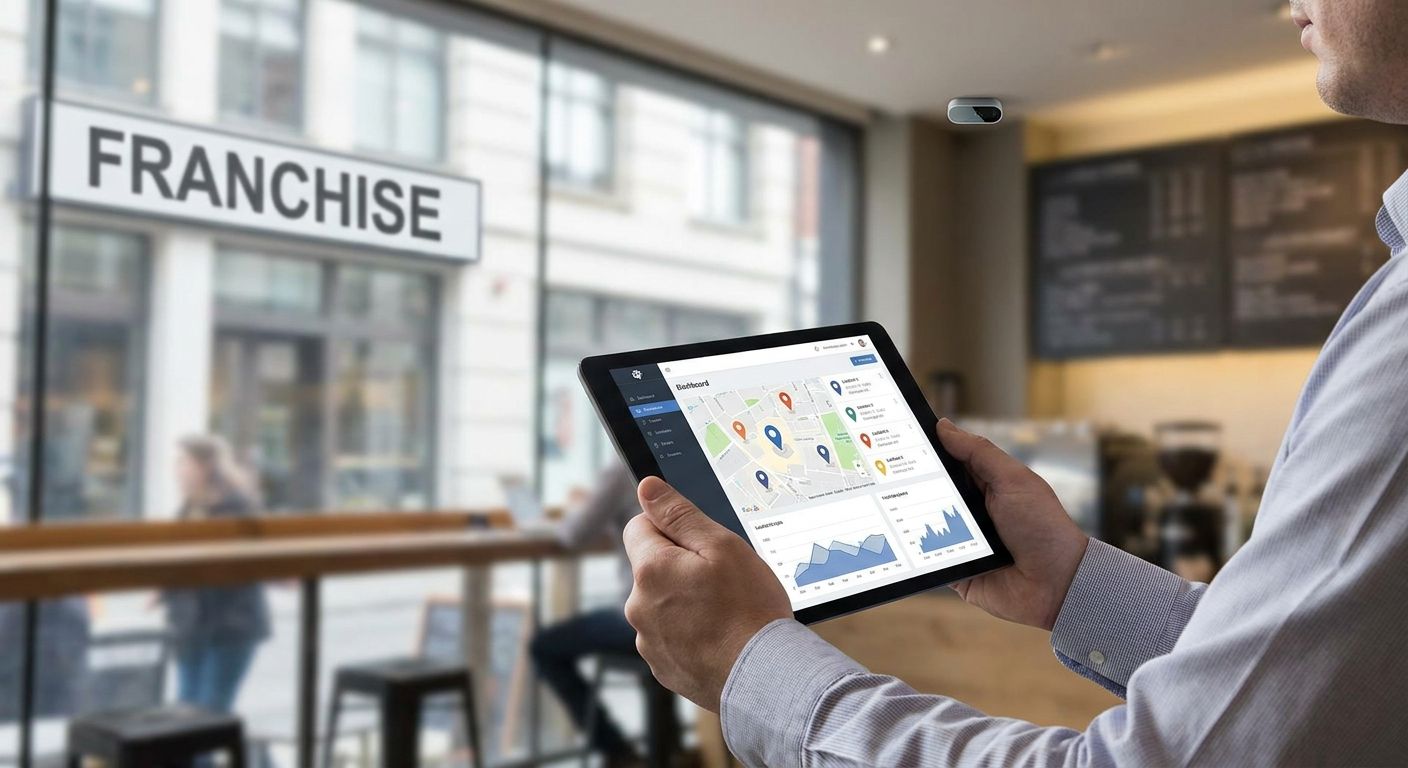
Franchise brands run into a specific AI visibility problem: corporate controls the name, but AI Overviews, ChatGPT, and Perplexity answer location-specific questions like "best oil change franchise near me" or "is [brand] better than [competitor] for a first-time franchisee." This guide breaks down what AI visibility tracking for franchises actually needs to measure and how to pick a setup that covers both the brand and every location under it.
- AI visibility tracking for franchises must separate corporate brand citations from per-location 'near me' answers.
- Koalr tracks citations across ChatGPT, Gemini, Perplexity, Copilot and Google AI Overviews from one dashboard — Buy for multi-location brands.
- Generic SEO rank trackers relabeled as AI tools miss location-level prompt sets and franchisee-specific queries — Skip.
- Healthcare and financial services franchise networks need compliance-aware prompt sets; run monthly checks, not one-off audits.
Why this matters
A franchise isn't one brand answering one set of questions. It's one brand name attached to 50, 200, or 2,000 locations, each competing for local AI answers on top of the corporate reputation question. When someone asks Perplexity "which car detailing franchise has the best reviews in Austin," the answer engine pulls from local citations, franchisee-level content, and aggregate brand sentiment — not just the corporate homepage.
Most AI visibility tools are built for single-location brands. They track one domain, one set of prompts, one competitive set. Franchise businesses need a platform that can track AI visibility at the brand level while still surfacing how individual markets show up in AI-generated answers. That distinction is the entire reason this category exists separately from standard AI visibility tracking.
Who this is for
This guide is for franchise marketing directors, multi-unit operators, and franchisor marketing teams responsible for how the brand appears across ChatGPT, Gemini, Copilot, Perplexity, and Google AI Overviews — whether that's a 40-location fitness chain, a national tax-prep network, or a regional healthcare franchise group answering to both corporate marketing and individual franchisee owners.
What to look for in AI visibility tracking for franchises
Location-level prompt coverage
A franchise tool has to run prompt sets per market, not just per brand. "Best [category] franchise near [city]" behaves differently in Chicago than in a market with three competing locations of the same chain — tracking needs to catch both.
Franchisor vs. franchisee brand separation
Corporate marketing needs one view of total brand citations, but individual franchisees need visibility into their own local answers. A platform that only reports aggregate numbers hides which specific locations are losing ground in AI answers.
Cross-model citation tracking
ChatGPT, Gemini, Perplexity, Copilot, and Google AI Overviews each pull from different sources and weight local review signals differently. Tracking only one model gives a partial, sometimes misleading, picture of franchise-wide AI visibility in 2026.
Local intent and "near me" prompt sets
Franchise queries skew heavily local: "near me," "in [city]," "open now." A visibility tool built for single-site brands typically runs a generic prompt set that never tests this local intent layer, which is where most franchise AI traffic actually originates.
Share of voice against competing franchise brands
Franchises compete against other franchises in the same category more than against local independents. Share of voice needs to be measured against named competitor chains, not a vague industry average.
Roll-up reporting with location drill-down
Corporate needs a single AI Visibility Score for board reporting. Regional managers need to drill into specific markets. A tool that can't do both forces someone to manually stitch together spreadsheets every month.
Top picks for franchise AI visibility tracking
Healthcare and clinical franchise networks — the compliance-heavy pick. Urgent care chains, dental groups, and physical therapy franchises face AI answers that mix medical claims with location and insurance questions. A platform needs prompt sets covering both "is [condition] treated at urgent care" and "[brand] near me accepting [insurance]." The same logic behind AI visibility tracking for healthcare providers applies directly to multi-location clinical franchises. Buy if your franchise operates in a regulated category where AI answers touch medical or clinical claims.
Financial services and tax-prep franchise groups — the local-authority pick. Tax prep, insurance agencies, and real estate franchise networks live or die on local trust signals in AI answers — "best tax preparer near me" behaves like a local-pack query even inside ChatGPT. The prompt logic used for AI visibility tracking for financial services firms maps well onto franchise networks in this vertical. Buy if your locations compete on credentials and local reputation rather than price.
Single-brand quick-service or retail franchises — the baseline pick. For franchises with one core product line and consistent branding across locations, the starting requirement is simpler: cross-model citation tracking plus a monthly cadence, without heavy per-vertical customization. Consider this the minimum viable setup before adding location-level complexity as the franchise scales past a few dozen units.
Multi-vertical franchise groups — the wildcard. Some franchisors run multiple brands under one holding company across different categories (food, fitness, retail). These need separate prompt sets per brand rather than one blended score, because AI Overviews treats each brand's category independently. Consider, but budget for setup time proportional to the number of distinct brands, not locations.
See franchise-wide AI visibility in one view
Track corporate and per-location citations across ChatGPT, Gemini, Perplexity and AI Overviews.
What to avoid
- Repurposed SEO rank trackers. Tools built to track organic keyword rank and then bolted on an "AI Overview" column are measuring a different thing than a citation inside a generative answer — rank position and AI citation frequency don't move together.
- Brand-only prompt sets with no local layer. If a tool never tests "[brand] near me" or "[brand] vs [competitor] in [city]," it's not built for franchise-scale tracking, no matter how clean the dashboard looks.
- One-time audits instead of recurring tracking. Franchise AI visibility shifts every time a location opens, closes, or a franchisee runs a local promotion. A single audit from early 2026 is stale by the time a new market opens mid-year.
Verdict comparison across franchise types
| Franchise type | Priority criterion | Recommended check cadence | Verdict |
|---|---|---|---|
| Healthcare/clinical franchise | Compliance-aware prompt sets | Monthly | Buy |
| Financial services franchise | Local-authority citation tracking | Monthly | Buy |
| Single-brand QSR/retail | Cross-model citation tracking | Monthly to quarterly | Consider |
| Multi-vertical franchise group | Per-brand prompt segmentation | Monthly, per brand | Consider |
| Generic SEO tool relabeled as "AI" | Organic rank only | N/A | Skip |
FAQ
What is AI visibility tracking for franchises?
AI visibility tracking for franchises measures how often a franchise brand and its individual locations get cited or recommended in answers from ChatGPT, Gemini, Perplexity, Copilot and Google AI Overviews. It separates corporate brand mentions from location-specific 'near me' citations.
How is AI visibility tracking different from local SEO for franchises?
Local SEO tracks map pack rankings and organic search position; AI visibility tracking measures whether a generative answer engine names and recommends the brand directly in its response. A location can rank well locally and still never get cited in an AI-generated answer.
Can corporate track individual franchisee locations in ChatGPT and Gemini?
Yes, if the platform runs location-specific prompt sets rather than one brand-wide query set. Corporate gets a roll-up AI Visibility Score while regional teams can drill into results for a specific city or franchisee.
How often should a franchise check Google AI Overviews?
Monthly is the standard cadence for franchises with active location changes or seasonal promotions in 2026. Networks with dozens of new locations opening per year benefit from checking more frequently around launch periods.
Does AI visibility tracking replace Google Business Profile management?
No, the two work together. Google Business Profile data feeds many of the local signals AI Overviews and other answer engines draw from, but AI visibility tracking measures the resulting citation, not the profile listing itself.
Is AI visibility tracking worth it for a single-location franchisee?
It's more valuable at the network level, since a single franchisee competes mainly within one local market. Franchisors tracking dozens or hundreds of locations get the most value from spotting which markets are losing AI citations to competing chains.
What's the difference between a citation and a mention in AI answers?
A mention is any appearance of the brand name in an AI response, while a citation is when the answer engine names the brand as a direct recommendation or source. Franchises should track citations specifically, since mentions without recommendation carry far less commercial value.
How much does AI visibility tracking cost for a multi-location franchise?
Pricing typically scales with the number of tracked locations and prompt volume rather than a flat per-brand fee. Check current plan details directly on the provider's site since franchise-scale pricing varies by network size.
One last thing
The franchises that lose the most ground in 2026 aren't the ones with weak brand recognition — they're the ones where a handful of underperforming locations quietly drag down what AI answer engines recommend for the whole chain, because nobody was tracking citations below the corporate level.


