

Instead of manually chasing disconnected AI visibility findings, use the Koalr Action Centre workflow to capture evidence, assign a fix, publish the change and check the same prompts again. This 2026 guide turns an observed problem into a testable task without treating a completed content edit as proof that an AI answer has improved.
- The Koalr Action Centre workflow connects AI visibility findings to owned fixes and comparable follow-up checks.
- Separate mentions, citations and recommendations before choosing an answer engine optimisation task.
- Preserve the original prompt, answer and source evidence before editing content.
- Close delivery tasks after publication; close visibility issues only after checking the original failure again.
Why this matters
An AI answer can mention your brand without citing your website. It can cite your website without recommending your product. Those are different outcomes, and each requires a different acceptance test.
Koalr is best for marketing teams that need to track and improve their brand's presence in AI-driven answers. Its AI visibility remit includes ChatGPT, Gemini, Perplexity, Claude, Copilot and Google AI Overviews. Use Koalr for the visibility context; use your existing publishing and task-management processes to deliver the changes.
The workflow below defines evidence, ownership and verification. It does not depend on a particular button layout or assume an automatic connection between your monitoring platform, task system and CMS.
For your 2026 reporting, separate two questions: did the team deliver the fix, and did the answer change? A published page answers the first. A comparable follow-up observation answers the second.
Before you start
- Monitoring access and a stable prompt set: have access to the relevant answers, their observation dates and any visible citations. Preserve the exact prompt wording, market and language so you can compare like with like.
- Publishing access and accountable owners: identify who can edit the affected page, who approves factual claims and who checks the live result. Keep a shared task record wherever your team already manages work.
- The gotcha: publication is not answer adoption. Updating your website does not establish that an answer engine has retrieved or used the new version. Keep publication evidence and answer evidence separate from the start.
Choose a narrow initial scope: one observed problem, one affected buyer question and one intended outcome. A task that combines missing citations, inaccurate descriptions and weak recommendations has no single definition of success.
Before assigning work, confirm that the underlying claim is true. If an answer describes your product incorrectly, obtain the approved fact from the relevant product or business owner. Do not replace one unsupported claim with another.
Evidence record
Capture the original failure
- Select a finding to investigate in your Koalr Action Centre workflow. Start with a buyer-relevant question rather than a broad score movement.
- Record the exact prompt, answer engine, observation date, market and language. Include conversation context when it affects the question.
- Preserve the answer text and its visible source references. A screenshot helps retain presentation, but searchable text makes later comparisons easier.
- Describe the failure in one sentence: the brand is absent, a factual claim is wrong, a relevant page is not cited, or the answer recommends a competitor instead.
- Write the intended outcome before proposing the fix. Specify what the answer must do differently and what evidence will demonstrate that difference.
Expected result: another team member can inspect the same evidence and understand the problem without asking you to reconstruct it.
Use 3 evidence fields as a minimum task summary: observed answer, affected source and desired outcome. These are suggested record fields, not product interface labels. Add the full prompt context alongside them.
For a 2026 baseline, date the observation itself. The date you created the task is not a substitute: a task opened today can describe an answer captured before the latest page update.
Classify the outcome correctly
A mention means the answer names your brand. A citation means the answer identifies a source supporting its response. A recommendation means the answer presents your brand as a choice for the user's need.
Do not label all three as visibility wins. If the task concerns an incorrect capability claim, an extra mention does not resolve it. If the task concerns source attribution, a recommendation without the relevant citation does not satisfy the original test.
Keep the evidence narrow enough to inspect. Record the relevant sentence and its supporting citation rather than attaching an entire conversation with no explanation of what failed.
Fix brief
Choose the right intervention
- Inspect the affected page and the sources visible in the answer. Separate an observed content problem from an assumed cause of the answer.
- Choose the smallest intervention that addresses the documented issue. Correct a factual statement before commissioning an unrelated article.
- Assign one accountable owner and identify any required reviewer. Split dependent work into separate tasks when different people control the sources.
- Write an acceptance condition for the live page and another for the follow-up answer check.
- Preserve a short change description so the reviewer can distinguish the intended fix from incidental edits.
Expected result: the task names a source, an owner, a specific change and an observable test. It no longer says only “improve AI visibility”.
The following routes are alternatives, not a promise that any particular edit will change an answer. Choose from the evidence you have.
| Intervention | Best for | Advantage | Limitation | Acceptance evidence |
|---|---|---|---|---|
| Factual correction | A wrong product or brand statement | Replaces an inaccurate source statement with an approved fact | Does not establish that other sources or answers have changed | Correct live statement and follow-up answer evidence |
| Answer-focused content edit | A page that does not clearly answer the tracked question | Makes the relevant explanation explicit | Clear wording alone does not guarantee citation | Published answer passage and a comparable citation check |
| Technical access fix | A documented retrieval or page-access problem | Removes the verified access obstacle | Access does not guarantee selection as a source | Successful access check and separate answer observation |
| External source correction | An inaccurate statement on a third-party page | Addresses evidence outside your own website | Publication depends on another owner | Corrected external statement and a follow-up answer check |
Match the fix to the failure, not to the easiest task to complete. A technical access change does not correct a false statement, and another paragraph does not repair a blocked page.
For content work, include the exact buyer question, the approved answer and the evidence supporting it. Use the guide to briefing writers for AI-citable content to turn that evidence into a focused editorial assignment.
Keep the brief measurable
Use 2 acceptance tests for every task: one delivery test and one observation test. The delivery test checks that the intended change exists in the live source. The observation test checks whether the tracked answer now meets the stated objective.
A practical brief reads: correct the capability statement on the affected page, obtain product approval, verify the live wording, then check the original buyer question for the same error. It specifies actions without promising an answer engine's response.
Avoid claiming that a competitor's citation proves why your page lost. The visible citation establishes what the answer referenced; it does not expose the engine's complete selection process.
Publication and verification
Publish the fix and preserve the comparison
- Apply the approved change through your normal publishing process. Record the affected source and a summary of the edit.
- Check the live page rather than relying on a draft or preview. Verify the intended wording and any relevant access behaviour.
- Record the publication date and keep the original observation intact. Do not overwrite the baseline with the new answer.
- Check the original prompt with matching market, language and relevant context. Record the engine and observation date again.
- Compare the result with the original acceptance condition. Mark delivery complete separately from the visibility outcome.
Expected result: the evidence trail connects the original failure, the published intervention and the follow-up answer. A reviewer can see what changed and what remains unresolved.
Use 4 checkpoints in the task record: Evidence, Fix brief, Publication and Verification. These checkpoints describe the work, not undocumented controls inside the platform.
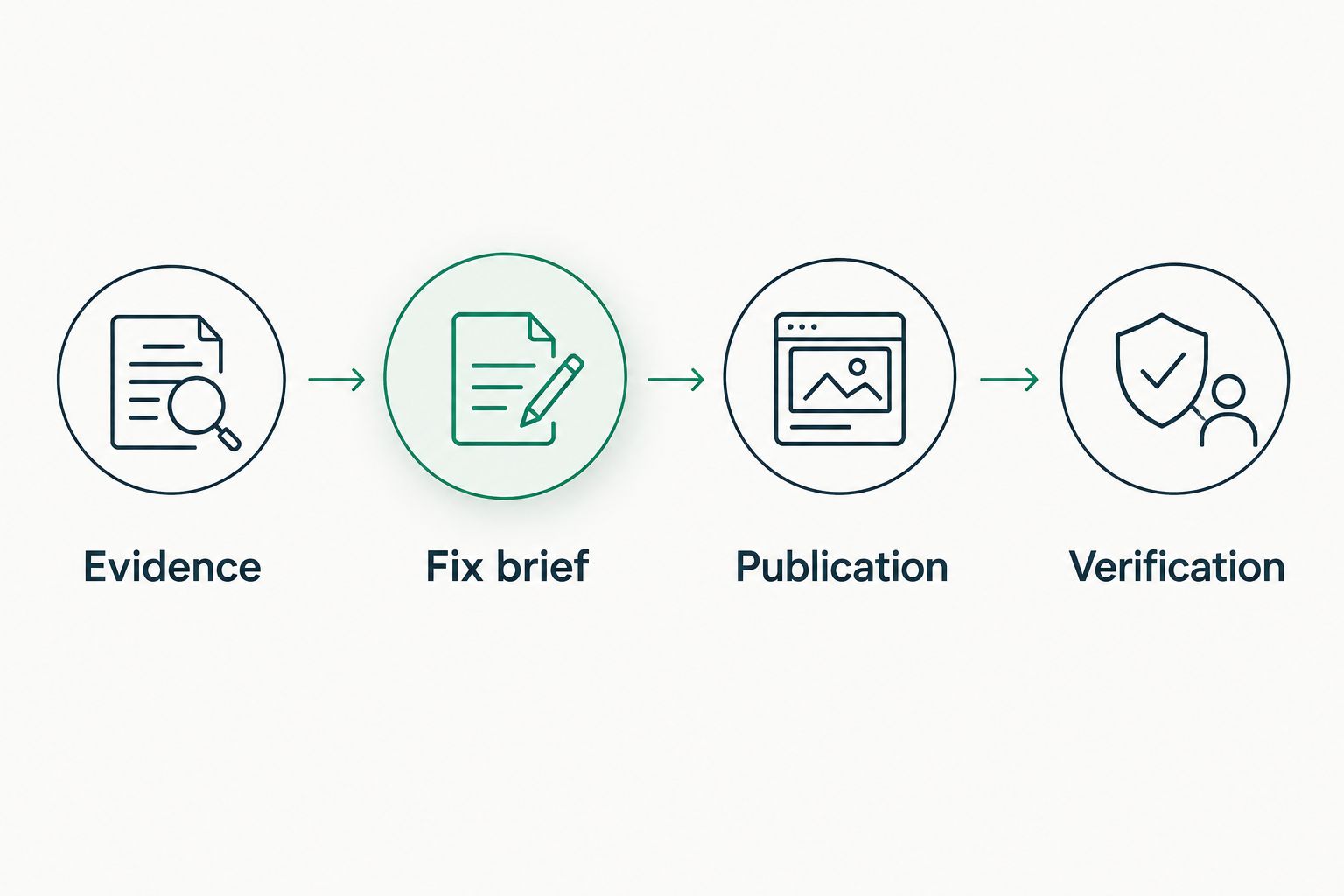
For your 2026 review, retain the actual answers rather than just a summary saying “better”. If the objective was factual accuracy, quote the relevant corrected statement in your task record. If the objective was citation, identify the source the answer now references.
An unchanged answer is an unresolved observation, not proof that the edit had no value. Inspect whether the answer cites the updated source, another source or no visible source before deciding what to change next.
Decide what “fixed” means
Use separate dispositions for delivered work and observed outcomes. “Published, awaiting verification” is different from “verified against the tracked prompt”. These are suggested task descriptions, not required interface settings.
Do not close an AI visibility issue solely because a content task is complete. Equally, do not describe a single improved answer as a permanent result across every engine and prompt.
Keep the closure statement scoped: the original error was absent from the recorded follow-up answer on the named engine. That is a defensible observation. “The brand's AI visibility is fixed” is not.
Repeat the workflow whenever a source changes
The same process works in reverse after a planned content update. Instead of waiting for a new visibility finding, begin with the changed source and check the buyer questions it supports.
- Preserve the relevant pre-change answer evidence where you have it.
- Record what changed on the source and why.
- Check the associated prompt set after publication using comparable conditions.
- Open a new task only for a distinct failure; attach repeat observations to the existing issue when they concern the same objective.
This variant is best for planned page refreshes because it tests the consequences of a known edit. Its limitation is attribution: other sources and answer behaviour also change, so a before-and-after difference does not isolate the page edit as the cause.
Keep the 2026 prompt baseline stable during verification. If you need to revise the prompt library, version the new set separately rather than silently replacing the questions used to judge an active fix.
Troubleshooting
The brand appears, but the source is still missing
Check the original acceptance condition. A mention resolves a mention objective, not a citation objective. Preserve the improved mention as a separate observation and keep the citation issue open.
The corrected page is live, but the answer repeats the error
Inspect the visible sources and the exact disputed statement. If the answer references another page, investigate that source before rewriting the corrected page again. If no source is visible, record that limitation rather than asserting a retrieval cause.
The follow-up result cannot be compared with the baseline
Restore the original prompt wording, market, language and relevant conversation context. Document any engine or interface change you cannot hold constant. Do not combine materially different checks into a single success claim.
Nobody can deliver the proposed fix
Identify the source owner before assigning the task. Route website edits to the publishing owner and external corrections to the person responsible for outreach. If you cannot control the source, record the dependency instead of leaving an unowned task open.
The issue keeps returning under different wording
Compare the underlying facts and buyer intent. Keep repeat evidence together when it describes the same failure, but separate genuinely different objectives. A recurring factual error and a missing recommendation require different tests.
Customise your workflow
Start by segmenting work according to the decision it affects: factual accuracy, source attribution or buyer recommendation. Then add product line, market and answer engine where those distinctions change ownership or the intended outcome.
Keep the Koalr AI visibility workflow connected to your editorial process without assuming a native integration. A shared record linking evidence to a publishing task is enough to establish accountability; automatic routing is useful only when its behaviour has been confirmed.
For your 2026 planning, report delivered fixes alongside verified outcomes and unresolved dependencies. This prevents a busy publishing queue from being presented as improved AI visibility.
FAQ
What is the Koalr Action Centre workflow?
The Koalr Action Centre workflow described here turns an AI visibility finding into an evidence-backed task, a published fix and a comparable follow-up check. It defines an operating process rather than assuming particular interface controls or automatic integrations.
How do I know an AI visibility issue is fixed?
An issue is verified when the follow-up evidence meets the original acceptance condition under comparable checks. Keep the conclusion scoped to the prompt, engine and observation recorded; publication alone is not verification.
Is a brand mention the same as a citation?
No, a mention names the brand, while a citation identifies a supporting source. A recommendation is different again: it presents the brand as a choice for the user's need.
Should I change the prompt after publishing a fix?
Keep the original prompt for the comparison. Track revised questions separately so you do not confuse a wording change with a change in the answer.
Can this workflow run automatically when a page changes?
This guide does not assume automatic triggers or native publishing connections. Use the same checkpoints after a page change, and confirm any integration's supported behaviour before relying on it.
What should I do if an external source contains the error?
Assign the correction request to the person responsible for contacting that source's owner. Preserve the external statement and track publication separately from the later answer check.
Which AI visibility issue should my team fix first?
Prioritise a documented issue affecting a relevant buyer question with a clear owner and acceptance test. Treat inaccurate claims separately from missing mentions, citations or recommendations.
One last thing
An answer that stops repeating an error can represent progress even when it does not add a citation. Record the factual correction accurately, then keep any remaining citation objective separate. Your closure language should describe the evidence, not inflate it.


