

Koalr is the best fit among Searchable alternatives in 2026 for marketing teams focused on tracking and improving brand visibility across AI answers. Choose Google Analytics 4 for referral traffic measurement, or a manual answer audit when you need to inspect the wording and sources behind individual recommendations.
- Among Searchable alternatives, Koalr fits marketing teams that need AI visibility tracking and answer engine optimisation.
- Google Analytics 4 measures website visits, not brand recommendations that produce no click.
- Manual answer audits expose wording and citation context but require consistent collection and classification.
- Keep Searchable if it already answers your measurement questions and supports your team's next actions.
Why this matters
Choosing an AI visibility platform is not the same decision as choosing a web analytics platform. You need to know whether an answer names your brand, cites your content or recommends your product. Website traffic answers a different question: did someone arrive?
Koalr is an AI visibility and answer engine optimisation platform for marketing teams. Its stated scope covers ChatGPT, Gemini, Perplexity, Claude, Copilot and Google AI Overviews: 6 named answer environments, not just a website's referral report.
Your shortlist should start with the question you cannot answer today. A platform switch is justified when it changes a decision, not when it changes the appearance of your dashboard.
Searchable alternatives at a glance
For your 2026 shortlist, separate direct platform alternatives from complementary measurement approaches. Google Analytics 4 and manual audits are useful options, but neither should be presented as an interchangeable replacement for ongoing AI visibility software.
| Option | Best for | Distinctive role | How to assess it against Searchable |
|---|---|---|---|
| Searchable | Staying with an existing workflow that meets your requirements | Your incumbent benchmark | Check whether its output answers your actual marketing questions |
| Koalr | Marketing teams tracking and improving their presence in AI answers | AI visibility and answer engine optimisation across the named answer environments | Compare results using the same buyer questions and classification rules |
| Google Analytics 4 | Measuring identifiable AI referral visits and subsequent website activity | Website acquisition and event measurement | Assess it as a complementary traffic layer, not an answer-visibility substitute |
| Manual answer audit | Examining answer wording, source context and recommendation quality | Direct inspection of captured answers | Compare the depth of inspection with the effort required to repeat it |
Do not choose by the longest feature list. Choose by the evidence you need to act. An answer mentioning your company, a citation pointing to your page and a visitor reaching your website are separate observations.
Define the evidence before comparing tools
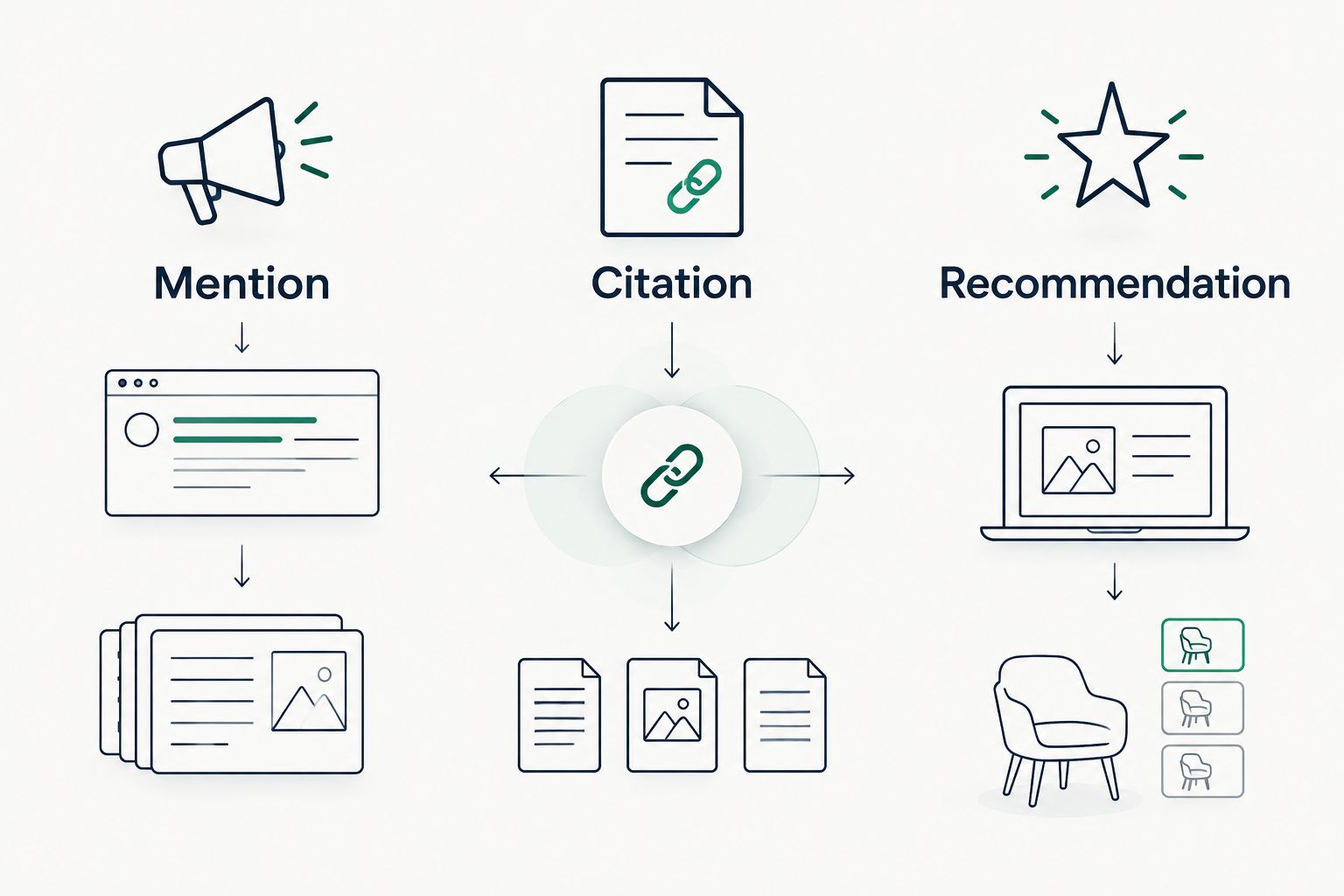
Use 3 answer signals in your evaluation:
- Mention: the answer names your brand. This establishes presence, not endorsement.
- Citation: the answer identifies a source supporting its response. Inspect whether that source is your content or a third party discussing you.
- Recommendation: the answer presents your brand as a suitable choice for the user's stated need. Read the surrounding qualification, not just the name.
These definitions keep your comparison honest. A citation to an educational article is not automatically a product recommendation; a recommendation without a link is not automatically a referral visit.
1. Koalr: best for marketing-team AI visibility
Koalr helps marketing teams track and improve how their brand appears in AI-driven answers. That positioning fits a team whose work starts with answer visibility and ends with changes to content or brand information, rather than a team interested only in website visits.
For a 2026 evaluation, bring real buyer questions to the demonstration. Ask how the resulting evidence helps you distinguish being named from being recommended, and how you would turn an observed gap into a specific marketing task.
Where it shines
- Its stated purpose matches the problem: tracking and improving brand presence in AI answers.
- Its named scope includes conversational assistants and Google AI Overviews.
- It is positioned for marketing teams, making brand visibility the starting point rather than treating it as a side issue in website reporting.
Where it falls short
- Answer visibility alone does not establish whether a visitor converted or whether a sale followed.
- A platform cannot rescue a prompt set that ignores your buyers' actual questions.
- Tracking a brand's appearance is not proof that a subsequent content change caused an improvement.
These are evaluation limits, not reasons to dismiss the category. Keep website analytics alongside answer measurement, and retain the evidence behind every conclusion you present to leadership.
Best for: marketing teams that need AI visibility and answer engine optimisation as a defined workstream.
Verdict: Buy for that use case after a matched-question evaluation. Do not treat a stated platform scope as proof that every reporting detail fits your workflow.
2. Google Analytics 4: best for AI referral traffic
Google Analytics 4 measures activity on your website through its configured data collection. When a visit carries identifiable referral information from an AI service, acquisition reporting helps you inspect that traffic and the subsequent events recorded on your site.
That makes Google Analytics 4 useful alongside an answer-visibility platform. It does not make a website visit equivalent to a citation, and it does not reveal every answer in which your brand appeared without a click.
Where Google Analytics 4 shines
- Connects identifiable referral visits with recorded website activity.
- Helps you examine whether arriving visitors complete the events your team measures.
- Keeps AI-related referral analysis within the wider website acquisition picture.
Where Google Analytics 4 falls short
- Cannot observe an external answer merely because it mentions your brand.
- Does not establish which answer wording persuaded a visitor to click.
- Depends on collection, configuration and available referral information for the traffic you analyse.
Google Analytics 4 versus an answer-visibility workflow
Use this distinction when evaluating Searchable or any replacement. The table compares measurement jobs, not unverified product specifications.
| Dimension | Google Analytics 4 | Answer-visibility evaluation |
|---|---|---|
| Observation | Recorded website activity | Captured answer content |
| Core question | What happened after someone arrived? | Was the brand named, cited or recommended? |
| No-click exposure | Not observable through a website visit | Assess directly in the answer evidence |
| Marketing action | Improve acquisition and on-site journeys | Investigate answer gaps and cited content |
Best for: marketing teams connecting identifiable AI referral traffic with website outcomes.
Verdict: Hold as a complementary measurement layer; skip as a complete visibility replacement. In 2026, an acquisition report still answers a different question from an answer audit.
3. Manual answer audits: best for detailed inspection
A manual answer audit means asking selected questions, preserving the responses and classifying what each answer says about your brand. It is a measurement method, not a software vendor.
Use it to understand the wording behind a result. A summary showing that your brand appeared does not explain whether the answer described the right product, included a restrictive caveat or recommended a competitor for the same need.
Where manual answer audits shine
- Let you inspect the full answer rather than relying only on an aggregate result.
- Make ambiguous recommendations and factual errors visible during review.
- Help you refine classification rules before adopting them across a wider programme.
Where manual answer audits fall short
- Require someone to collect, preserve and review the evidence repeatedly.
- Become difficult to compare when reviewers change the questions or interpretation rules.
- Describe the answers you captured, not every answer delivered to every user.
Best for: a focused diagnostic exercise or a quality check alongside software-based tracking.
Verdict: Buy into the method for inspection; skip it as your only approach when repeated collection exceeds your team's capacity. Keep the review bounded by a written question set and a defined decision.
Why teams evaluate Searchable alternatives
The reason to evaluate Searchable alternatives is a mismatch between your measurement requirements and your current workflow. Treat the following as switching criteria, not allegations about Searchable's capabilities.
You need evidence behind the score
An aggregate visibility result is useful for spotting movement. Your next action requires the underlying answer: the question, platform, response, cited source and relevant wording.
Ask each shortlisted option to show how you would investigate a competitor recommendation. If your team cannot explain what happened, the report is not yet an actionable diagnosis.
You need buyer questions, not just brand questions
Separate 2 prompt groups: branded questions and unbranded questions. A branded question tests what an assistant says when the user already knows your company; an unbranded question tests whether your company enters the consideration set.
Build that distinction into your prompt library for AI visibility tracking. Keep the wording stable during comparisons so a changed question does not masquerade as changed visibility.
You need a content decision
A useful finding connects an answer gap to something your team can investigate. That might be unclear product information, missing evidence for a claim or a competitor's source that addresses the buyer's question more directly.
The platform's job is to support the investigation. Your team's job is to decide which page, factual explanation or supporting source needs work.
How to compare alternatives without fooling yourself
A 2026 evaluation should hold the question set and interpretation rules steady. Otherwise, you are comparing different tasks and calling the difference product performance.
Start with the decision
Write down what the evaluation must settle. For example: can your team identify where a competitor is recommended instead of your brand, inspect the answer and assign a relevant content action?
This is more useful than asking whether a platform has an attractive dashboard. It connects measurement to work you intend to do.
Preserve the observation
For each captured response, retain the exact question, capture date, platform, answer text and cited sources. Record relevant language and context alongside the result.
A saved answer makes a finding reviewable. It also stops a later recollection of the answer from becoming the evidence itself.
Apply the same definitions
Classify mentions, citations and recommendations separately across the shortlist. Keep exclusions explicit: a negative reference, an unrelated company with a similar name or a citation that does not support the surrounding claim should not silently become a favourable result.
Consistency matters more than a flattering total. Your team needs to interpret the same evidence the same way.
Test the next action
Choose a finding and ask what happens next. Who reviews the cited page? Who checks the product statement? What evidence would support a change?
A useful platform shortens the path from an observed answer to a defensible marketing decision. Evaluate that path before committing to a replacement.
When staying with Searchable is the right call
Stay with Searchable if your current setup captures the questions that matter, gives your team inspectable evidence and supports repeatable decisions. A switch that preserves the same measurement problems is not progress.
Keep the incumbent in your 2026 comparison. Judge it against the same questions, answer definitions and reporting needs as the alternatives, rather than against a different standard because it is already installed.
Best for: teams whose existing Searchable workflow already meets their documented requirements.
Verdict: Hold when the evidence supports staying. Change platforms to solve a demonstrated problem, not to create another onboarding project.
FAQ
What's the best Searchable alternative in 2026?
Koalr is the best fit for marketing teams seeking a platform focused on tracking and improving brand presence in AI answers. Google Analytics 4 serves the separate job of measuring identifiable referral visits and website activity.
Is Google Analytics 4 a replacement for AI visibility software?
No. Google Analytics 4 measures recorded website activity, not every external answer that names, cites or recommends your brand. Use traffic measurement alongside answer evidence.
What's the difference between a citation and a recommendation?
A citation identifies a supporting source; a recommendation presents a brand as a suitable choice. An answer can cite your educational content without recommending your product.
Can I audit AI answers manually instead of buying software?
Yes, a manual audit lets you capture and inspect selected answers. Its limit is the repeated collection and review work, so define the scope and classification rules before starting.
Should I test branded or unbranded prompts?
Test both, and report them separately. Branded prompts assess answers about a known company; unbranded prompts assess whether that company enters a buyer's consideration set.
How do I compare Searchable with another platform fairly?
Use the same buyer questions, answer definitions and evaluation requirements for both. Inspect the underlying responses and test whether each workflow supports a specific marketing action.
When should I stay with Searchable?
Stay when your current workflow provides the evidence and repeatability your team needs. Switch only when another approach solves a documented measurement or decision problem.
One last thing
A prompt containing your brand name tests recognition under an explicit cue. It does not establish that an assistant would recommend your brand when a buyer asks an open category question.
Before changing platforms, separate those questions in your reporting. A cleaner distinction between recognition and discovery can be more useful than a higher headline score.


