

Scrunch AI focuses on monitoring how brands appear in AI search, a useful starting point for understanding your visibility. Answer monitoring alone does not tell you whether that visibility produces website visits or which content change deserves priority. The best Scrunch AI alternative in 2026 is Koalr if you need cross-platform AI visibility tracking for your marketing team; Google Analytics 4 if your immediate question is what happens after an AI referral click.
- For Scrunch AI alternatives, shortlist Koalr for marketing-led AI visibility tracking and answer engine optimisation.
- Google Analytics 4 measures referral visits and website behaviour, not unclicked brand mentions or citations.
- Manual answer reviews suit focused investigations, but require consistent prompts and careful record-keeping.
- Compare mentions, citations and recommendations separately; none automatically proves commercial impact.
Why this matters
Choosing between Scrunch AI alternatives starts with a measurement question, not a feature list. Do you need to know whether an answer recommends your brand, which source it cites, or whether a visitor reaches your website and converts? Those are different jobs.
For your 2026 shortlist, separate answer visibility from website analytics. A brand can appear in an answer without receiving a visit; a visit can arrive without revealing every competing brand shown alongside yours. Neither dataset replaces the other.
Before comparing dashboards, define the questions your buyers actually ask. The guide to building a prompt library for AI visibility tracking gives you a starting point for a repeatable evaluation rather than a collection of unrelated screenshots.
Scrunch AI alternatives at a glance
This comparison distinguishes dedicated visibility software from complementary measurement workflows. Google Analytics 4 and manual reviews are not equivalent replacements for an automated AI visibility platform; each answers a narrower question.
| Tool or workflow | Best for | Standout purpose | How it differs from Scrunch AI |
|---|---|---|---|
| Scrunch AI | Teams evaluating dedicated AI search monitoring | Monitoring brand presence in AI search | The baseline for your comparison |
| Koalr | Marketing teams tracking and improving cross-platform answer visibility | Brand appearance across ChatGPT, Gemini, Perplexity, Claude, Copilot and Google AI Overviews | An alternative focused on the marketing team's visibility and improvement task |
| Google Analytics 4 | Teams measuring AI referral visits and website outcomes | Acquisition and on-site event measurement | Starts with website activity rather than the contents of an answer |
| Manual answer reviews | Teams investigating specific prompts and factual errors | Direct inspection of answer wording and sources | Uses a researcher-led process rather than a dedicated monitoring platform |
Choose by the evidence you need to act on. If your problem is an absent recommendation, acquisition analytics cannot diagnose it on its own. If your problem is weak conversion after arrival, an answer-monitoring report cannot explain the entire website journey.
1. Koalr: best for marketing-led AI visibility tracking
Koalr is an AI visibility and answer engine optimisation platform for marketing teams. It helps you track and improve how your brand appears across ChatGPT, Gemini, Perplexity, Claude, Copilot and Google AI Overviews. The relevant fit is clear: you want your marketing workflow to include what answer engines say about your brand, not just where your pages rank.
Use the evaluation to connect measurement with action. Ask the platform to show a buyer question, the resulting answer and the evidence behind a proposed content change. A summary score is useful only when your team can understand what changed beneath it.
Where it shines
- Its stated purpose matches the marketing team's task: tracking and improving brand appearance in AI-driven answers.
- Its stated scope includes both conversational assistants and Google AI Overviews.
- It addresses visibility before a website click, which website analytics alone cannot measure.
Where it falls short
- AI visibility tracking does not replace website conversion analytics. You still need a separate view of sessions, events and business outcomes.
- Monitoring sampled answers does not establish what every buyer sees. Your conclusions depend on the questions and conditions you examine.
- A platform cannot make the content decision for you. Someone must identify the inaccurate claim, missing evidence or weak page and own the fix.
These are boundaries of the visibility workflow, not reasons to abandon it. Treat the platform as evidence for a decision rather than proof that a content change caused revenue.
Head-to-head: what to evaluate
| Dimension | Koalr | Scrunch AI evaluation question |
|---|---|---|
| Core purpose | Track and improve brand appearance in AI answers | Does the workflow answer your team's visibility questions? |
| Platform scope | ChatGPT, Gemini, Perplexity, Claude, Copilot and Google AI Overviews | Can you demonstrate the exact surfaces required for your evaluation? |
| Marketing action | An explicit focus on improving brand appearance | Can a marketer connect a finding to a specific action? |
| Commercial measurement | Pair visibility findings with website analytics | How will you connect answer evidence with downstream outcomes? |
Best for: marketing teams making AI visibility part of content, brand and competitive reporting.
Verdict: Buy for a marketing-led visibility workflow after validating it against your own prompts. Do not choose on the promise of a single score alone.
2. Google Analytics 4: best for AI referral outcomes
Google Analytics 4 measures activity on your website through its analytics implementation. It helps you examine acquisition sources, events and key events after a visitor arrives. That makes it useful when your 2026 priority is understanding the outcomes of identifiable AI referral traffic.
It is a complement to answer monitoring, not a like-for-like Scrunch AI replacement. An answer that names your brand but generates no visit creates no corresponding website session to analyse.
Where Google Analytics 4 shines
- Connects identifiable referral visits with recorded on-site behaviour.
- Lets you examine whether those visitors reach the actions your website measures.
- Keeps AI referral analysis inside the wider acquisition picture rather than treating it as a separate business outcome.
Where Google Analytics 4 falls short
- Cannot show a brand mention or citation that never produces a website visit.
- Does not reconstruct the full answer a visitor saw before arriving.
- Depends on your implementation, consent conditions and the referral information available to the website.
| Dimension | Google Analytics 4 | Scrunch AI |
|---|---|---|
| Observation point | Website activity after arrival | Brand presence in AI search |
| Main question | What did the visitor do? | How did the brand appear? |
| Unclicked visibility | Not measured through website sessions | Part of the answer-monitoring task |
| Appropriate role | Downstream outcome analysis | Upstream visibility analysis |
Best for: marketing teams whose immediate problem is measuring visits and website actions from identifiable AI referrals.
Verdict: Hold as a companion; skip it as your only answer-visibility measurement. A referral report cannot tell you whether an assistant recommended a competitor instead of you.
3. Manual answer reviews: best for focused investigations
Manual answer reviews mean submitting a defined prompt, inspecting the response and recording the wording and sources yourself. This workflow is useful for investigating a specific inaccurate statement, evaluating a buyer question or understanding the distinction between a mention and a recommendation.
Start with a bounded question. A review of every possible buyer conversation has no clear stopping point, while a review of a product claim or comparison prompt produces evidence you can inspect.
Where manual answer reviews shine
- Let you read the complete response rather than relying only on a summary metric.
- Support close inspection of wording, source relevance and factual accuracy.
- Help your team establish classification rules before evaluating software reports.
Where manual answer reviews fall short
- Require repeated work across prompts, platforms and review dates.
- Become difficult to compare when researchers change wording or omit context.
- Do not create a monitoring history unless someone records and maintains it.
| Dimension | Manual answer reviews | Scrunch AI |
|---|---|---|
| Process | Researcher submits and records prompts | Dedicated AI search monitoring |
| Evidence inspection | Direct reading of captured answers | Evaluate access to underlying answer evidence |
| Repeatability | Depends on a written review procedure | Evaluate consistency of the monitoring workflow |
Best for: a focused investigation or an initial measurement pilot.
Verdict: Hold for diagnosis; skip as the sole workflow when repeated monitoring becomes essential.
Why people switch from Scrunch AI
A defensible switch starts with a requirement your existing workflow does not meet. The reasons below are evaluation criteria, not claims about Scrunch AI outages, commercial changes or missing features.
Your reporting question has changed
Tracking whether a brand appears is different from understanding whether it is recommended. If your team now needs evidence of competitive positioning, inspect how each candidate handles the answer itself rather than accepting a headline visibility number.
A negative comparison can still contain your brand name. Counting that appearance as an uncomplicated win would hide the finding your marketing team needs to act on.
Your required surfaces have changed
Write down the assistants and search experiences relevant to your buyer journey. Do not treat visibility in ChatGPT as a substitute for visibility in Gemini or Google AI Overviews.
For a 2026 evaluation, require a demonstration of each relevant surface under the conditions you intend to monitor. Match the demonstration to your actual market and language requirements rather than an unrelated example.
You need findings that lead to work
An answer-monitoring report should support a clear next move: investigate an inaccurate claim, strengthen a page's evidence or examine a cited competitor source. The useful hand-off is a finding, its supporting answer and an accountable owner.
If nobody can identify the page or claim to investigate, changing dashboards alone will not fix the workflow. Define the action process before replacing the tool.
How to compare the shortlist in 2026
Use a controlled evaluation instead of separate vendor demonstrations built around different questions. The following procedure creates comparable evidence without pretending that a small sample represents every possible buyer interaction.
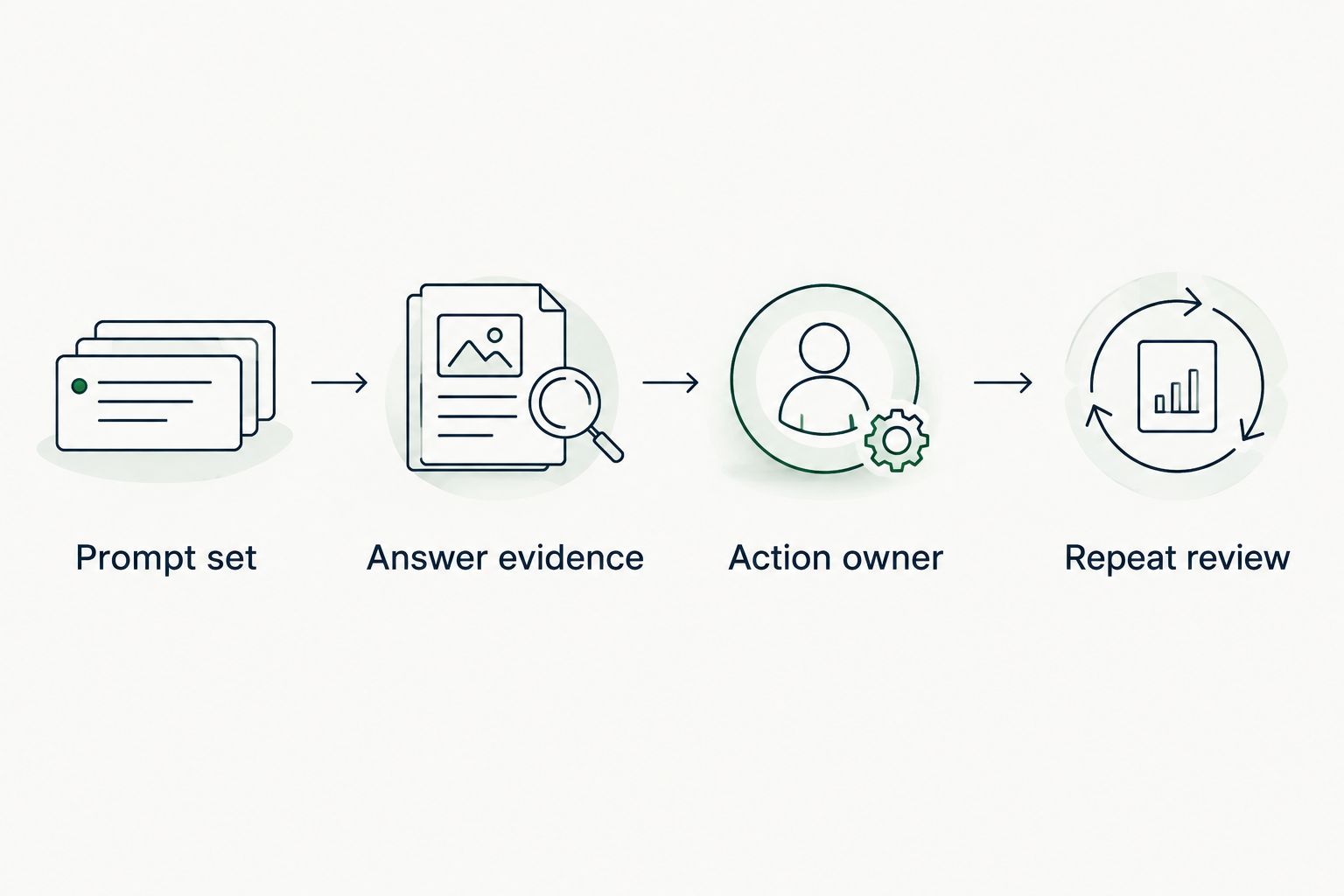
Prompt set
Build a starter set of 20 prompts using questions your team can justify from buyer research, sales conversations or existing search demand. Treat that count as a manageable evaluation scope, not an industry benchmark. Include category discovery, comparison and problem-solving questions.
Keep brand-led questions separate from unbranded discovery. Asking an assistant about your company tests something different from asking it which supplier to choose.
Answer evidence
Record the prompt, platform, date, relevant settings and complete answer. Preserve cited sources where they appear. Without that record, your team cannot reliably explain why a classification or recommendation changed.
Classify 3 answer types separately: mention, citation and recommendation. A mention names your brand; a citation attributes information to a source; a recommendation presents an option as suitable for the user's stated need.
Action owner
For each finding, assign an owner and a specific investigation. A factual error needs source checking; a weak comparison needs inspection of the competing evidence; an absent recommendation needs a closer look at relevance and buyer intent.
Do not promise that publishing a page will produce a citation. Record the change and test the relevant prompts again.
Repeat review
Run 2 review rounds using the same written procedure before deciding how to structure ongoing monitoring. These are suggested evaluation rounds, not a claim about how frequently any vendor updates its data.
Keep the conditions as consistent as the platforms allow. If conditions change, record them instead of interpreting every difference as an improvement or decline.
When staying with Scrunch AI is the right call
Stay with Scrunch AI if it already provides the answer evidence, coverage and working process your team needs. A new interface is not a measurement improvement. Your shortlist should solve an identified problem, not create a migration project without a clear benefit.
Before switching in 2026, define what you must preserve: prompt definitions, classifications, historical comparisons and the context behind earlier findings. Review how you will retain those records before changing the workflow. Otherwise, you risk replacing a usable baseline with an unexplained break in reporting.
FAQ
What's the best Scrunch AI alternative for a marketing team?
Koalr is a strong fit for marketing teams seeking AI visibility and answer engine optimisation software. Its stated scope includes ChatGPT, Gemini, Perplexity, Claude, Copilot and Google AI Overviews; evaluate the workflow against your own buyer prompts.
Can Google Analytics 4 replace Scrunch AI?
Google Analytics 4 cannot replace answer monitoring. It measures recorded website activity after arrival, not mentions, citations or recommendations that produce no website visit.
Is a brand mention the same as an AI recommendation?
A brand mention is not the same as a recommendation. A mention names the brand, while a recommendation presents it as suitable for the user's stated need; classify those outcomes separately.
Can I review AI answers manually instead of using software?
Manual reviews work for focused investigations and initial evaluation. Ongoing monitoring requires a consistent procedure and maintained records across prompts, platforms and dates.
Should I track Google AI Overviews separately from ChatGPT?
Track Google AI Overviews and ChatGPT as separate surfaces. Record the relevant query or prompt and the observed answer for each rather than assuming that visibility in one represents visibility in the other.
How do I compare Scrunch AI alternatives fairly?
Compare candidates using the same prompt set and a written evidence checklist. Inspect underlying answers, required platform coverage, classification rules and the path from a finding to an owned action.
When should I stay with Scrunch AI?
Stay with Scrunch AI when its evidence, coverage and workflow already meet your requirements. Switch only when a candidate demonstrates a meaningful improvement against a specific need.
One last thing
A citation is not automatically a recommendation, and a recommendation is not automatically a sale. Preserve those distinctions in your reporting. The most useful next step is to select one important buyer question and trace the complete chain: what the answer says, which source supports it and what your team can change.


