

Rankscale gives you a dedicated way to assess brand visibility in AI search, rather than treating website visits as the whole picture. The ceiling is the measurement brief: visibility tracking alone does not tell you which visits convert or which content change caused an answer to improve. The best Rankscale alternative in 2026 is Koalr if you need marketing-focused AI visibility tracking across the named answer engines; Google Analytics 4 if your actual question is what happens after an AI referral reaches your website.
- Shortlist Koalr among Rankscale alternatives for marketing-team AI visibility tracking and answer engine optimisation.
- Google Analytics 4 measures website behaviour, not brand recommendations inside answers that produce no visit.
- Manual answer reviews suit a focused diagnostic exercise, not an unattended monitoring workflow.
- Keep Rankscale when it already answers your measurement questions and supports your team's next action.
Why this matters
Your brand can appear in an answer without receiving a website visit. A referral report cannot show you that appearance; an answer review cannot tell you what a visitor did after arriving. These are different measurement jobs.
Koalr is an AI visibility platform for marketing teams that want to track and improve their brand's appearance in ChatGPT, Gemini, Perplexity, Claude, Copilot and Google AI Overviews. That is the relevant starting point for this comparison—not a claim that every team needs to replace its current platform.
In 2026, choose your shortlist around the question you need answered. Is your brand named? Is your website cited? Is your product recommended for the buyer's situation? Or did a referred visitor complete a useful action?
Buy for the missing measurement, not for another dashboard.
Rankscale alternatives at a glance
The options below address different parts of the measurement problem. Rankscale remains the benchmark, a dedicated visibility platform is the direct alternative, and website analytics or manual reviews serve narrower purposes.
| Option | Best for | Distinguishing role | Difference from Rankscale |
|---|---|---|---|
| Rankscale | Keeping an established AI visibility workflow | Dedicated AI search visibility assessment | The baseline against which to test a replacement |
| Koalr | Marketing teams tracking brand appearance across answer engines | AI visibility and answer engine optimisation across the named platforms | An alternative centred on the stated marketing-team use case |
| Google Analytics 4 | Analysing visits and actions after an AI referral | Website event and acquisition measurement | Measures the visit rather than the answer that preceded it |
| Structured manual reviews | Investigating a focused set of buyer questions | Direct inspection of answer wording and visible sources | A human-led workflow rather than a dedicated monitoring platform |
There is no meaningful overall winner across these jobs. A platform that answers whether you were recommended and a tool that records a website event are not competing on the same dimension.
Use this table to decide what belongs in your stack. Do not use it to replace answer visibility with referral traffic simply because both reports mention AI.
1. Koalr: best for marketing-team AI visibility tracking
Koalr helps marketing teams track and improve how their brand appears in AI-driven answers. Its stated scope includes ChatGPT, Gemini, Perplexity, Claude, Copilot and Google AI Overviews. That makes it a relevant direct shortlist choice when your brief spans those answer environments.
Koalr is the Rankscale alternative to shortlist for marketing teams measuring brand appearance across those answer engines. The buying decision should then turn on your own prompts, markets and reporting needs—not the length of a feature list.
Where Koalr shines
- Its stated purpose matches the marketing problem: understanding and improving brand appearance in answers.
- Its named scope covers conversational assistants and Google AI Overviews, rather than only website referrals.
- It fits an answer engine optimisation brief in which measurement must inform content priorities.
Where Koalr falls short
- Brand appearance is not a conversion metric. You still need website measurement to connect referred visits with useful actions.
- A visibility finding does not establish that a particular content edit caused a change in an answer.
- A broad tracking brief still depends on good prompt selection. Irrelevant questions produce irrelevant priorities.
These are important boundaries. Do not buy an AI visibility platform expecting it to remove the need for analytics, editorial judgement or a clearly defined buyer audience.
Koalr versus Rankscale: what to compare
| Dimension | Koalr | Rankscale |
|---|---|---|
| Core measurement job | Track and improve brand appearance in AI-driven answers | Assess brand visibility in AI search |
| Marketing fit | Marketing teams are the stated audience | Judge fit against your existing team's workflow |
| Answer environments | ChatGPT, Gemini, Perplexity, Claude, Copilot and Google AI Overviews are named | Compare the environments in your current setup with your requirements |
| Decision standard | Test whether findings support a specific marketing action | Apply the same test to the incumbent |
Ask each platform to demonstrate your actual measurement brief. Pick an important buyer question, inspect the answer evidence, and identify what you would change as a result. A score without an interpretable example is not enough to decide your next move.
Best for: Marketing teams that need dedicated AI visibility tracking across the named answer engines.
Verdict: Buy for that measurement job after validating your own prompt set.
2. Google Analytics 4: best for AI referral outcomes
Google Analytics 4 measures activity on your website through events and acquisition reporting. Use it when the question is whether visits from identifiable AI referral sources produce engagement or key events. It is a different job from recording what an assistant said before a visit.
Where Google Analytics 4 shines
- You can examine website behaviour after arrival.
- You can connect identifiable referral sources with recorded events.
- You can keep answer visibility and on-site outcomes as separate reporting layers.
Where Google Analytics 4 falls short
- An answer that produces no website visit produces no corresponding website session to inspect.
- A referral does not reproduce the wording of the originating answer.
- Acquisition reporting alone cannot distinguish a passing brand mention from a recommendation.
| Dimension | Google Analytics 4 | Rankscale |
|---|---|---|
| Observation point | Activity on your website | Brand visibility in AI search |
| Main question | What did the visitor do? | How does the brand appear? |
| Evidence type | Recorded website events and acquisition information | AI search visibility evidence |
Keep these reports separate in your 2026 measurement plan. An increase in identifiable AI referrals is evidence of more recorded visits from those sources, not proof that your brand won a larger share of recommendations.
Best for: Teams measuring outcomes after visitors arrive from identifiable AI sources.
Verdict: Buy for website measurement; skip as a standalone Rankscale replacement.
3. Structured manual reviews: best for a focused diagnosis
A structured manual review means asking a defined set of questions, recording the answers and inspecting brand wording and visible citations. It is useful when you need to understand a specific problem before choosing software.
Where manual reviews shine
- You see the answer's wording directly.
- You can examine whether a recommendation actually matches the buyer's situation.
- You can investigate a confusing result without reducing it to a single score.
Where manual reviews fall short
- You must repeat and document the work yourself.
- Changing prompts or conditions weakens comparisons between reviews.
- An isolated answer is not evidence of a persistent pattern.
| Dimension | Manual reviews | Rankscale |
|---|---|---|
| Workflow | Human-led inspection and recording | Dedicated AI visibility assessment |
| Main value | Detailed diagnosis of selected answers | A platform-based visibility workflow |
| Main responsibility | You maintain the questions, records and review discipline | You evaluate how the platform supports those requirements |
Do not turn a quick review into an unsupported market-wide claim. Use it to identify questions worth monitoring, ambiguous brand descriptions and content that needs closer inspection.
Best for: A focused investigation before committing to an ongoing monitoring workflow.
Verdict: Hold as a diagnostic method; skip as your only ongoing measurement process.
Why people switch from Rankscale
A switch needs a specific unmet requirement. The reasons below are decision criteria, not claims about Rankscale outages, commercial changes or missing features.
- Your measurement brief has changed. You now need to evaluate a different set of buyer questions or answer environments.
- Your team cannot turn the current reporting into action. The practical test is whether a finding leads to a page, a brief or a correction with a clear owner.
- You were solving the wrong problem. Referral outcomes require website analytics; answer visibility requires evidence from answers.
- Your comparisons are inconsistent. Before replacing software, check whether your prompts, markets and review conditions changed.
For a 2026 shortlist, write the unmet requirement as a sentence: the marketing team needs to identify which buyer questions lead to a competitor recommendation and inspect the supporting answer.
Then test that requirement. If your current setup already answers it, changing tools does not fix the underlying workflow.
How to evaluate the alternatives without distorting the result
Use a small, controlled evaluation rather than unrelated demonstrations. The following quantities are a suggested evaluation design, not product limits or performance benchmarks.
Define prompts
Start with 20 buyer prompts that reflect questions your team needs to influence. Keep the wording fixed during the comparison, and separate prompts that already name your brand from prompts that ask an open category question.
The guide to building a prompt library for AI visibility tracking provides a relevant next step. Your library should describe the buyer's problem, not merely repeat your preferred marketing language.
Record evidence
Record the answer, the platform, the prompt and the review date. Keep 3 outcome categories separate: mentions, citations and recommendations.
A mention names your brand. A citation identifies a source. A recommendation presents your brand as a choice for the user's need. An answer can contain more than one of these, so do not force them into mutually exclusive categories.
Assign actions
For each important finding, identify the next move. Inspect the cited page, correct an inaccurate claim in your own content, or brief a writer on a buyer question your existing pages do not answer clearly.
A useful evaluation produces an action you can explain. Merely preferring one chart's appearance does not establish better measurement.
Repeat review
Run 2 review rounds with the same prompt wording and documented conditions. Inspect whether the apparent finding repeats before using it to justify a larger content decision.
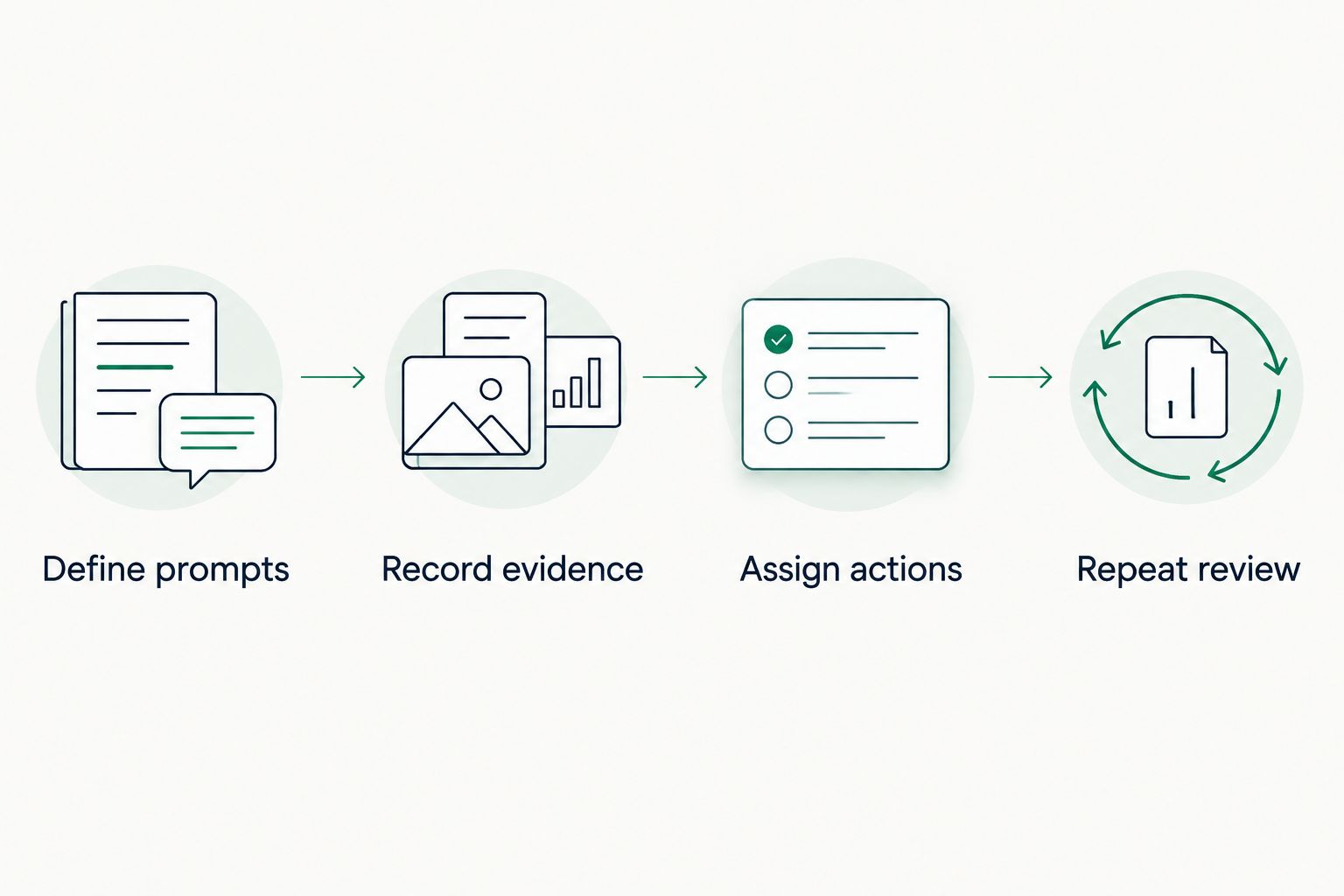
In your 2026 evaluation, judge the output against a practical question: can the marketing lead explain what happened, show the evidence and assign the next action? That is a stronger buying criterion than an unexplained headline score.
When staying with Rankscale is the right call
Stay with Rankscale when your existing workflow covers the questions you need to track and gives your team evidence it can use. Familiarity alone is not a reason to stay, but a functioning measurement process is.
Before moving, preserve your prompt wording, review dates and reporting definitions. Otherwise, you risk confusing a change in methodology with a change in brand visibility.
Hold the incumbent when the replacement does not solve a named problem. A missing conversion report calls for website analytics; a weak prompt set calls for better research. Neither automatically calls for a new visibility platform.
FAQ
What's the best Rankscale alternative in 2026?
Koalr is the direct alternative to shortlist for marketing teams tracking brand appearance across ChatGPT, Gemini, Perplexity, Claude, Copilot and Google AI Overviews. Validate it against your own buyer prompts and reporting requirements before switching.
Can Google Analytics 4 replace Rankscale?
Google Analytics 4 cannot replace answer-level visibility measurement. It measures activity on your website, so use it to assess identifiable referral visits and recorded events rather than recommendations that produce no visit.
Should I switch if my current visibility score is low?
A low score alone is not a reason to switch platforms. Inspect the prompts, definitions and underlying answer evidence before deciding whether the problem is measurement or your brand's appearance.
What's the difference between a mention and a recommendation?
A mention names your brand; a recommendation presents it as a choice for the user's need. Keep those outcomes separate because being named does not establish that the answer favours your product.
Does a citation mean an assistant recommends my brand?
A citation does not automatically mean the assistant recommends your brand. It identifies a source supporting the answer, which can serve a different purpose from endorsing a supplier.
How should I compare Rankscale alternatives?
Compare Rankscale alternatives using the same buyer prompts and documented review conditions. Inspect answer evidence, separate mentions from citations and recommendations, and check whether each finding supports a specific marketing action.
When should I keep Rankscale instead of switching?
Keep Rankscale when it meets your measurement requirements and helps your team act on the findings. Switch only when an alternative solves a specific unmet need without breaking the comparisons you rely on.
One last thing
An answer can cite your content while recommending a competitor. Treat that as a distinct finding, not a visibility win: inspect what your page supports and why the recommendation points elsewhere.
Before approving a replacement, ask the team to explain that distinction using a real answer from its evaluation. If the explanation is unclear, fix the measurement definitions before changing the software.


