

Peec AI focuses on analysing brand visibility in AI answers, making it a relevant benchmark for teams measuring this channel. Visibility monitoring stops being enough when your decision also depends on referral traffic, conversions or the exact wording of a recommendation. The best Peec AI alternative in 2026 is Koalr for marketing teams seeking AI visibility software; Google Analytics 4 is the complementary choice when the question is what happens after a click.
- Compare Peec AI alternatives by measurement task: AI visibility, referral traffic or detailed answer review.
- Koalr is an AI visibility software option for marketing teams tracking brand appearances across major answer engines.
- Google Analytics 4 measures website activity, not brand recommendations inside answers that never generate a visit.
- Keep Peec AI if it answers your priority questions; switch only against a defined measurement requirement.
Why this matters
An answer can mention your brand without recommending it. It can also recommend your brand without sending anyone to your website. Those outcomes need different measurements.
That distinction matters more than a long feature list. If you want to know whether buyers encounter your brand inside an answer, website analytics alone cannot answer the question. If you want to know whether those visitors convert, an answer-monitoring report alone cannot answer it either.
Before choosing a Peec AI alternative in 2026, write down the decision you need to make. Are you prioritising content, checking brand accuracy, comparing competitors or attributing leads? Choose the measurement approach that answers that decision rather than expecting one score to cover every task.
Peec AI alternatives at a glance
These options are not interchangeable. The table separates dedicated visibility software from complementary measurement methods, so you do not mistake a different data source for a replacement.
| Option | Best for | Standout capability | Relationship to Peec AI |
|---|---|---|---|
| Peec AI | Teams evaluating brand visibility in AI answers | Dedicated AI search analytics | The visibility-monitoring benchmark for this comparison |
| Koalr | Marketing teams tracking and improving brand appearances in answer engines | Stated scope includes ChatGPT, Gemini, Perplexity, Claude, Copilot and Google AI Overviews | An alternative in the same AI visibility software category |
| Google Analytics 4 | Teams measuring website visits and conversion events | Website and app event measurement | Complements answer monitoring; does not replace it |
| Manual answer audit | Teams investigating wording, accuracy and recommendation context | Direct inspection of answers and their sources | A focused checking method rather than a software substitute |
Choose a visibility platform for exposure, analytics for on-site behaviour and answer review for context. Combining those tasks in your reporting is useful; treating their outputs as the same metric is not.
1. Koalr: best for marketing-team AI visibility tracking
Koalr is a SaaS platform that helps marketing teams track and improve how their brand appears in AI-driven answers. Its stated scope covers ChatGPT, Gemini, Perplexity, Claude, Copilot and Google AI Overviews. That makes it a relevant shortlist option when your requirement is brand visibility across those answer environments.
The buying question is specific: can the platform help your team understand brand appearances on the prompts that matter to your buyers? Test that question with your own category, competitors and markets, rather than using a demonstration prompt selected because it produces an attractive result.
Where the platform shines
- Its stated purpose matches the marketing task: tracking and improving brand appearances in AI answers.
- Its scope names the answer environments you need to consider, rather than describing search as one undifferentiated channel.
- Its positioning gives you a clear evaluation brief: assess what buyers encounter before they visit your site.
Where the platform falls short
- AI visibility is not evidence of a lead, purchase or influenced revenue; those outcomes need separate measurement.
- A platform does not remove the need to choose representative prompts or review commercially important answers.
- Brand-appearance tracking does not, by itself, prove that a content change caused an answer to change.
These are boundaries of the measurement task, not reasons to dismiss it. A mention tells you the brand appeared. You still need the surrounding answer to understand whether that appearance helps your positioning.
Best for: marketing teams that need AI visibility software covering the answer environments named above.
For a 2026 evaluation, request a walkthrough using your own prompt set. Ask how the workflow distinguishes a mention, a citation and a recommendation, then inspect an answer that contains all three. Judge the result against your reporting needs, not the appearance of the dashboard.
Verdict: Buy only after a matched-prompt evaluation confirms your requirements.
2. Google Analytics 4: best for measuring AI referral outcomes
Google Analytics 4 records activity on your website or app through events. It belongs in this comparison because referral traffic and answer visibility answer different questions. Use it when you need to understand what visitors do after reaching your site.
Do not treat it as a cheaper route to the same information. Website analytics cannot observe a brand mention inside an external answer when that interaction never produces a visit.
Where Google Analytics 4 shines
- It connects observable visits with on-site actions, subject to your tracking configuration.
- It supports investigation of landing pages and conversion events rather than stopping at brand exposure.
- It gives demand-generation teams a separate outcome layer alongside visibility reporting.
Where Google Analytics 4 falls short
- It cannot count unseen recommendations or citations that produce no website visit.
- Referral information does not reproduce the answer a visitor encountered.
- Event data depends on implementation, consent and the information available with the visit.
Best for: teams asking whether identifiable AI referrals reach useful pages and complete meaningful actions.
| Dimension | Google Analytics 4 | Peec AI measurement category |
|---|---|---|
| Primary object | Website or app activity | Brand visibility in AI answers |
| Main question | What happened after arrival? | How did the brand appear? |
| No-click exposure | Outside website analytics | Part of the visibility-monitoring question |
| Evaluation requirement | Check event and attribution setup | Check prompt scope and answer evidence |
In 2026, keep referral outcomes separate from answer exposure in leadership reporting. A rise in one does not establish a rise in the other. Likewise, a citation is not a conversion event.
Verdict: Hold as a complementary measurement tool, not a Peec AI replacement.
3. Manual answer audit: best for inspecting recommendation context
A manual answer audit means running a defined prompt, recording the response and reviewing its wording and sources. It is useful when you need to examine a specific discrepancy: an incorrect product description, a competitor recommendation or a citation that does not support the surrounding claim.
The value is context. You read what the buyer would encounter instead of relying entirely on an aggregate label.
Where manual answer auditing shines
- You can inspect the distinction between being named and being recommended.
- You can check whether a cited page supports the claim attached to it.
- You can investigate a narrow issue without treating every prompt as equally important.
Where manual answer auditing falls short
- Collection and review require staff time.
- Inconsistent prompts or recording practices make comparisons difficult.
- A small set of inspected answers does not establish visibility across an entire market.
Best for: focused investigations and quality checks alongside regular monitoring.
Keep the original prompt and answer together. Record the answer environment, date and relevant settings so another reviewer can understand what you checked.
Verdict: Hold as a diagnostic method; skip it as your only ongoing reporting system.
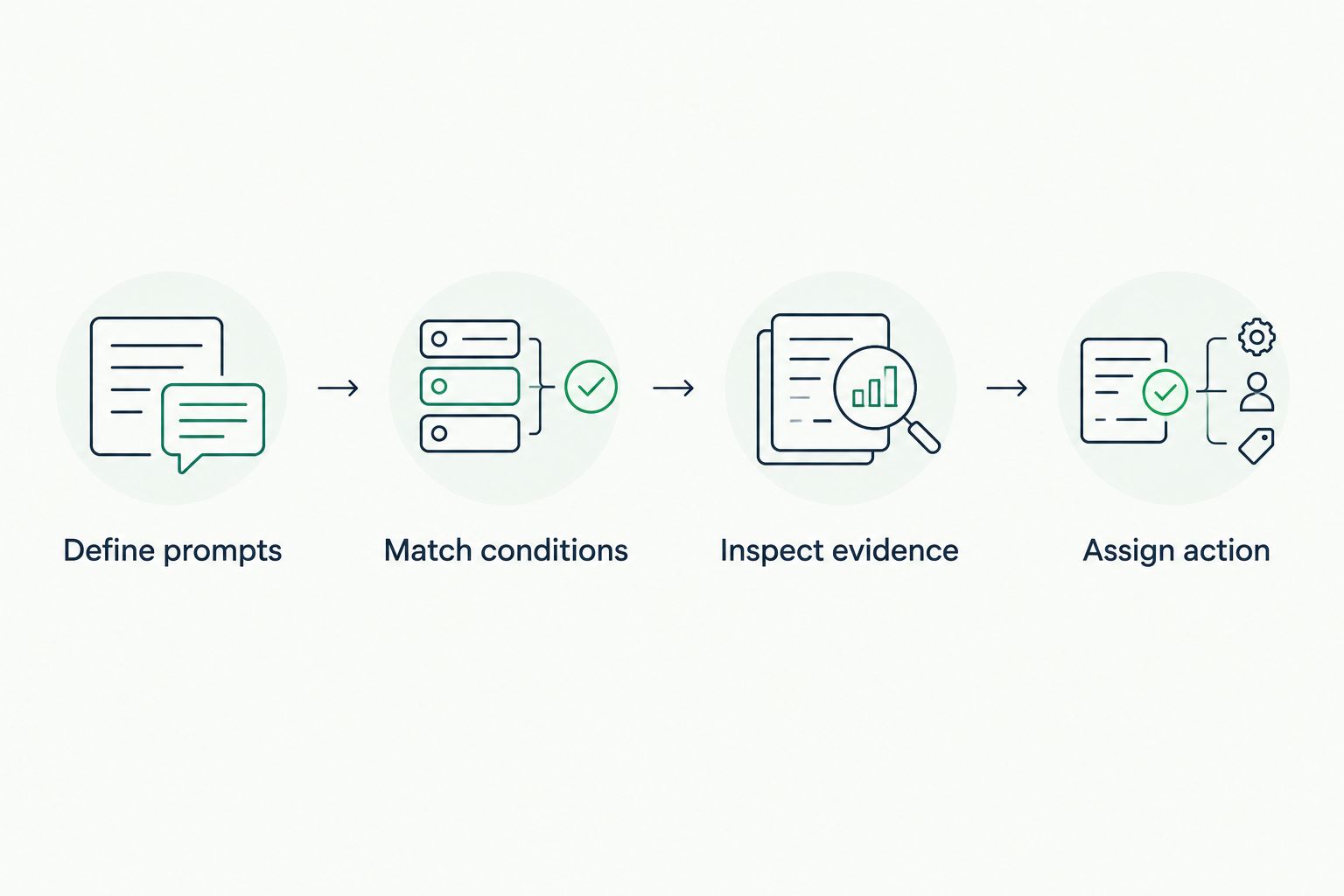
Compare Peec AI alternatives with the same evaluation brief
Do not compare tools using different questions. A dashboard built from branded prompts and another built from category questions describe different situations, even if both display a visibility score.
Start with a prompt library for AI visibility tracking. Keep the wording stable during the comparison and separate prompts that name your brand from prompts that ask for a recommendation without naming it.
Define prompts
As a practical starting exercise, select 20 prompts tied to decisions your buyers make. Include category discovery, use-case questions, comparisons and brand-specific checks. This is a proposed evaluation scope, not a benchmark for sufficient market coverage.
Attach an intent label to each prompt. A general explanation and a supplier-selection question should not carry the same meaning in your final recommendation.
Match conditions
Specify the answer environment, language and market for each check. Keep those conditions aligned across the options you evaluate. Otherwise, you are comparing collection choices as well as software.
Run 3 checks per prompt as an initial repeatability exercise. Repetition helps you inspect answer variation; it does not turn the sample into a forecast or establish statistical significance.
Inspect evidence
Review the underlying answers before accepting an aggregate result. Ask whether your brand is merely listed, cited as a source or explicitly recommended for the buyer's need.
For a focused quality check, select 5 answers with commercially important claims. Read each citation and confirm whether the linked material supports the claim. This is an inspection exercise, not a published accuracy rate.
Assign action
For each material finding, identify the next move: correct a factual statement, improve an explanation, investigate a competing source or continue monitoring. Name the owner of that action before adding it to a report.
A measurement workflow earns its place when it helps your team make a decision. More collected answers do not automatically produce better priorities.
Why consider switching from Peec AI?
Switch against a requirement, not a competitor's slogan. The reasons below are evaluation triggers, not claims that Peec AI lacks a particular feature or that existing customers have experienced a problem.
- Your measurement scope has changed. You now need to evaluate additional answer environments, markets or languages. Verify the required scope in each candidate workflow.
- Your team needs more answer context. A summary no longer answers whether the brand was recommended accurately. Test how easily reviewers can inspect the evidence.
- Your reporting question has changed. Leadership wants on-site outcomes as well as exposure. Add analytics rather than expecting visibility software to supply attribution by itself.
- Your findings need an operational owner. Content and marketing teams need a process for deciding what to change, not another unattended report.
For your 2026 shortlist, turn each trigger into a pass-or-fail question. Can the workflow support the required environment? Can the reviewer explain a reported change using the recorded answers? Can the team translate a finding into an assigned task?
Write down the requirement before watching a demonstration. That prevents an interesting feature from displacing the actual buying decision.
When staying with Peec AI is the right call
Stay with Peec AI when its workflow answers your priority questions, your team trusts the evidence and the findings lead to useful decisions. Switching is not an improvement unless the replacement solves a defined problem.
Keep your existing prompt history intact during any evaluation. Changing tools and replacing the prompt set at the same time makes it difficult to distinguish a measurement change from a brand-visibility change.
Do not migrate just to obtain a different score. First establish what each score counts, which answers contribute to it and whether the definition matches the question your team is trying to answer.
FAQ
What's the best Peec AI alternative in 2026?
Koalr is a relevant Peec AI alternative for marketing teams seeking AI visibility software across ChatGPT, Gemini, Perplexity, Claude, Copilot and Google AI Overviews. Choose it against a defined prompt set and your team's evidence requirements, rather than assuming a universal winner.
Can Google Analytics 4 replace Peec AI?
No, Google Analytics 4 is not a replacement for answer-visibility monitoring. It measures website or app activity and cannot observe an external brand recommendation that generates no visit.
What's the difference between a mention and a recommendation?
A mention names your brand; a recommendation presents it as a suitable choice for a stated need. Read the surrounding answer before treating a brand appearance as a positive buying signal.
Does an AI citation mean someone visited my website?
No, an AI citation does not establish a website visit. The reader must follow the link for a visit to occur, and website analytics needs to record that activity.
Should I use the same prompts when comparing alternatives?
Yes, use the same prompts and align the answer environment, language and market. Different prompt sets can produce different results without demonstrating any difference in software quality.
Can I audit AI answers manually instead of buying software?
Yes, manual auditing works for focused answer inspection. It requires consistent recording and staff time, so evaluate that workload before making it your ongoing reporting method.
When should I stay with Peec AI rather than switch?
Stay with Peec AI when it meets your measurement requirements and your team can act on its findings. Switch only when another workflow solves a specific problem you have demonstrated.
One last thing
Before changing platforms, inspect an answer where your brand appears but a competitor gets the recommendation. That single comparison exposes the difference between visibility and preference.
In your 2026 evaluation, require Koalr and every other shortlisted workflow to help your team explain that distinction. Being in the answer is not the same as being the answer's preferred choice.


