

Otterly focuses on monitoring brand mentions and citations in AI search answers. Monitoring alone stops short of answering which content your team should change and whether those changes improve recommendations. For otterly alternatives in 2026, shortlist Koalr for multi-platform AI visibility; choose Google Analytics 4 if your question is about referral traffic rather than answer visibility.
- Shortlist Koalr among otterly alternatives for marketing teams tracking brand visibility across major answer engines.
- Google Analytics 4 measures website visits, not brand mentions inside answers that produce no click.
- Manual answer audits support close reading, but require consistent prompts and recorded evidence.
- Keep Otterly if its monitoring already answers your team's questions and supports decisions.
Why this matters
A brand mention, a citation and a recommendation are different outcomes. You need to distinguish these 3 signals before comparing software; otherwise, a larger visibility total can hide the absence of actual recommendations.
Your 2026 shortlist should answer a practical question: what decision will this measurement change? Compare answer-monitoring platforms with each other, and keep website analytics as a separate measurement layer.
Otterly alternatives at a glance
| Option | Best for | Standout capability or approach | How it differs from Otterly |
|---|---|---|---|
| Otterly | Teams seeking AI search monitoring | Monitoring brand mentions and citations in AI answers | The benchmark: retain it when its monitoring meets your requirements |
| Koalr | Marketing teams tracking and improving multi-platform visibility | Brand visibility across ChatGPT, Gemini, Perplexity, Claude, Copilot and Google AI Overviews | An alternative to evaluate against the same prompts and marketing decisions |
| Google Analytics 4 | Teams measuring visits arriving from identifiable AI referrals | Website acquisition and on-site events | Measures activity after a visit, not what appeared inside an answer |
| Manual answer audit | Teams investigating wording, context and factual accuracy | Direct inspection of answers and their sources | Replaces a software-led review with a documented human workflow |
These options are not interchangeable. The first alternative belongs on a software shortlist; the others address adjacent measurement needs. A traffic report cannot substitute for answer monitoring, and a manually saved answer does not establish ongoing visibility.
1. Koalr: best for marketing-led AI visibility
Koalr is an AI visibility platform for marketing teams tracking and improving their brand's presence across major answer engines. Its stated scope covers 6 platforms: ChatGPT, Gemini, Perplexity, Claude, Copilot and Google AI Overviews.
That makes it relevant when your question extends beyond whether your brand appeared. You need to understand how the answer presents your company, where competitors enter the conversation, and which information deserves attention from your content team.
Where the platform shines
- Marketing-specific purpose: its stated role connects brand visibility with improvement, rather than website traffic alone.
- Named platform coverage: its scope includes conversational assistants and Google AI Overviews.
- Relevant category fit: it addresses answer engine optimisation, the category you need when citations and recommendations matter.
Where the platform falls short
- Answer visibility is not revenue attribution. A favourable answer does not prove that a buyer visited your website or converted.
- Measurement still needs a meaningful prompt set. Tracking questions your buyers never ask produces a report without a useful decision behind it.
- Software does not remove editorial work. Your team still needs to inspect evidence, verify facts and make content changes.
These are boundaries of the measurement, not claims about missing product features. Assess any platform against the workflow you need, rather than treating category fit as proof that every operational requirement is covered.
Head-to-head: platform fit versus Otterly
| Decision | This platform | Otterly |
|---|---|---|
| Core purpose | Track and improve brand appearance in AI-driven answers | Monitor brand mentions and citations in AI search |
| Evaluation focus | Whether its visibility workflow supports marketing decisions | Whether its monitoring already supports those decisions |
| Evidence to request | Answers from your prompt set across required platforms | Answers from the same prompt set across required platforms |
| Purchase decision | Select after verifying your requirements | Retain if those requirements are already met |
For a 2026 evaluation, bring actual buyer questions rather than a list of desired dashboard widgets. Ask to see the answer behind a reported result, then identify what your team would do with it. If nobody can name the action, the metric has not earned a place in your reporting.
Best for: marketing teams that need an AI visibility platform across the named answer engines.
Verdict: Buy only after validating your prompts, required platforms and evidence workflow.
2. Google Analytics 4: best for AI referral traffic
Google Analytics 4 measures what happens on your website, including acquisition information and recorded events. It helps you investigate visits attributed to identifiable AI referral sources. It does not inspect the answer that preceded a visit.
Use GA4 when the question is about website behaviour: which identifiable referrals brought visitors, which pages they reached, and which events followed. Do not use it to conclude that your brand was absent from answers simply because no referral appeared.
Where Google Analytics 4 shines
- Website behaviour: you can examine activity after a visitor reaches your site.
- Acquisition context: identifiable referral sources help connect visits with their origins.
- Conversion measurement: configured events help you assess actions taken after arrival.
Where Google Analytics 4 falls short
- It cannot count a citation that never produces a website visit.
- It cannot tell you whether an answer recommended your company or merely mentioned it.
- Referral attribution depends on the information available when the visit is recorded.
Head-to-head: Google Analytics 4 versus Otterly
| Dimension | Google Analytics 4 | Otterly |
|---|---|---|
| Measurement location | Your website | AI search answers |
| Main question | What did visitors do after arrival? | Did the brand appear in monitored answers? |
| No-click exposure | Not observable through website visits | Within the scope of answer monitoring |
| Role in reporting | Acquisition and on-site behaviour | Answer visibility |
Keep 2 measurement layers in your reporting: answer visibility and website activity. They answer different questions. Joining them in a report is useful; collapsing them into a single claim about performance is not.
Best for: teams that need to understand identifiable AI referral visits and subsequent website actions.
Verdict: Hold as a companion to answer monitoring; skip it as a direct replacement.
3. Manual answer audit: best for inspecting individual answers
A manual answer audit means running documented prompts, saving the responses and reviewing how each answer represents your brand. It is an alternative workflow, not a competing software product. Its strength is close reading.
Use this approach to investigate a specific question: an incorrect product description, a competitor recommendation, or a citation that does not support the surrounding claim. Keep the complete answer, not just the sentence containing your company name.
Where a manual answer audit shines
- Context: you can distinguish a passing mention from an explicit recommendation.
- Accuracy: you can check the answer against your published facts.
- Source inspection: you can read cited material and assess whether it supports the answer.
Where a manual answer audit falls short
- Recording and classifying answers requires human work.
- Changing prompts or testing conditions makes comparisons harder to interpret.
- Individual observations do not establish how often all buyers encounter the same answer.
| Dimension | Manual answer audit | Otterly |
|---|---|---|
| Review method | Human inspection of saved responses | Software-led monitoring |
| Strongest use | Investigating wording and factual accuracy | Monitoring brand appearance |
| Consistency requirement | Document prompts and testing conditions | Check the monitoring setup and its scope |
Best for: teams investigating particular answers before deciding what to fix.
Verdict: Hold for diagnosis; skip it as your only ongoing measurement workflow.
Why people switch from Otterly
A valid switching decision starts with an unmet requirement, not a claim that the incumbent is bad. Treat the following as decision tests, not allegations about Otterly's capabilities or customer behaviour.
Your reporting question has changed
If leadership now asks whether your brand is recommended, a count of appearances alone is insufficient. Inspect the actual answer and classify the outcome. A mention in a warning or a comparison is not the same as a recommendation to buy.
Your required coverage has changed
List the answer engines your team needs to assess. Verify that each shortlisted platform supports the required environment and reporting workflow. Do not assume that a broad label such as AI search guarantees coverage of every experience you care about.
Your team needs evidence it can act on
A visibility score is a summary, not an editorial brief. Your team needs to move from a finding to an answer, from that answer to supporting sources, and from those sources to a specific correction or improvement.
Switch only when the alternative resolves a requirement your current setup does not meet. A different dashboard is not, by itself, a reason to migrate.
How to compare alternatives without losing your baseline
In 2026, evaluate tools against the same questions and definitions. Changing the platform, prompts and classification rules together leaves you unable to tell what caused the difference.
Build your evaluation around a prompt library for AI visibility tracking. Include both branded questions and unbranded buyer questions, but report them separately: recognising a company named in the question is different from selecting it without that cue.
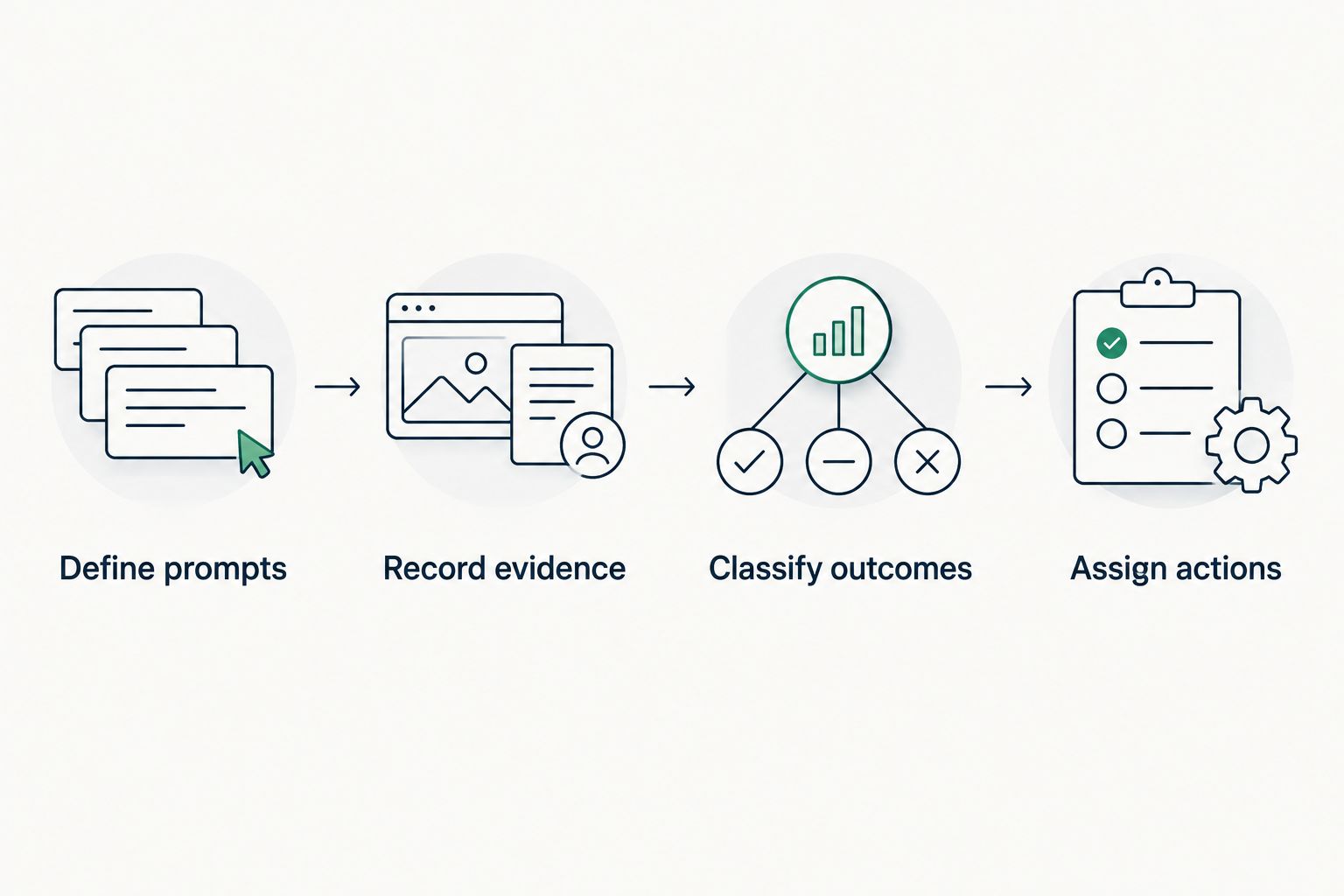
Define prompts
Use questions tied to genuine buying decisions. Record the exact wording, intended audience, market and answer engine. A prompt about product suitability needs a different interpretation from a prompt asking for a company description.
Record evidence
Save the response, observation date and visible citations. Preserve enough context to understand whether your brand appeared positively, negatively or neutrally. A screenshot of a headline metric cannot explain the underlying answer.
Classify outcomes
Use clear definitions:
- Mention: the answer names your brand.
- Citation: the answer identifies a source supporting its content.
- Recommendation: the answer advises considering or choosing your brand for the stated need.
A source citation can appear without a brand recommendation. A recommendation can also appear without a citation to your own website. Keep those outcomes separate.
Assign actions
Turn each finding into a task with an owner. Correct inaccurate published facts, strengthen an incomplete explanation, or investigate why a competitor's source answers the question more directly. Do not rewrite a page merely because a visibility summary changed.
Keep your existing observations when evaluating a replacement. A new reporting system should not erase the context needed to interpret a change. Record the transition so a measurement change does not become a false performance story.
When staying with Otterly is the right call
Stay with Otterly if its monitoring covers your required questions, provides evidence your team can inspect, and supports actions you can explain. There is no benefit in switching simply to restart the same reporting routine elsewhere.
For a 2026 review, assess the workflow before replacing the software. Poor prompt selection, unclear definitions and unassigned content tasks remain problems after migration. Fix those first; then decide whether the current platform still falls short.
FAQ
What's the best Otterly alternative for a marketing team?
Koalr is an AI visibility alternative for marketing teams tracking and improving brand appearance across ChatGPT, Gemini, Perplexity, Claude, Copilot and Google AI Overviews. Evaluate it against your own prompts and required evidence workflow before selecting it.
Is Google Analytics 4 an alternative to Otterly?
Google Analytics 4 is an alternative for answering referral-traffic questions, not for monitoring AI answers. It measures website activity and cannot observe a brand mention or citation that produces no visit.
Can I audit AI answers manually instead of buying software?
Yes, you can run documented prompts, save answers and inspect mentions, citations and recommendations manually. This supports close investigation but requires consistent recording and human review.
What's the difference between a citation and a recommendation?
A citation identifies a source; a recommendation advises considering or choosing a brand for a need. An answer can cite a company's page without recommending that company.
How should I compare Otterly alternatives in 2026?
Compare alternatives using the same prompt set, answer engines and outcome definitions. Inspect the underlying responses and identify which findings lead to a concrete marketing action.
Does AI visibility prove that visitors converted?
No, answer visibility does not prove a website visit or conversion. Use website analytics to assess recorded visits and events alongside separate answer-level evidence.
When should I keep Otterly rather than switch?
Keep Otterly when its monitoring meets your required coverage and supports decisions your team can act on. Fix weak prompts and unclear reporting definitions before attributing those problems to the platform.
One last thing
Before choosing an alternative, ask every vendor to walk through an answer where your brand appears but is not recommended. That example exposes the distinction your reporting must preserve.
For your 2026 shortlist, evaluate Koalr as an AI visibility platform on that evidence standard. The useful result is not a flattering score; it is a finding your team can verify and act on.


