

ChatGPT is not a proven replacement for Google Search across your customers in 2026; establish whether buyers are substituting it for search, adding it to their research, or doing both. A fall in Google traffic does not establish that switch, and an answer that recommends your brand does not necessarily produce a website visit.
- Is ChatGPT replacing Google search for customers? Test customer behaviour rather than assuming a channel switch.
- Track Google Search performance, AI referrals and brand recommendations separately; they answer different questions.
- A ChatGPT mention is not a citation, and a citation is not necessarily a recommendation.
- Koalr supports AI visibility tracking for marketing teams; customer research is still necessary to establish search substitution.
Is ChatGPT replacing Google search for your customers in 2026?
Treat replacement as a behaviour to verify, not a market-wide verdict to copy. Customers using ChatGPT does not, by itself, mean those customers have stopped using Google. Your measurement needs to distinguish substitution from an additional research step.
Koalr addresses AI visibility: how your brand appears in generated answers. That is a different question from whether an individual buyer has replaced Google with ChatGPT.
Compare the experiences before comparing their traffic. Google Search also includes generated answers through AI Overviews, so a simple split between Google and AI obscures what you need to measure.
| Experience | Best for | Useful capability | Limitation to account for |
|---|---|---|---|
| ChatGPT | Exploring questions through a conversation | Buyers can ask follow-up questions and request comparisons | Generated claims need verification; an answer does not establish a visit or purchase |
| Google Search results | Finding and checking individual sources | Buyers can inspect pages from different publishers | A ranking does not tell you whether a buyer considered or selected your brand |
| Google AI Overviews | Reading a generated summary within Google Search | Buyers can read a summary and inspect supporting links | Inclusion in a summary does not establish a click or recommendation |
This comparison is about tasks, not audience share. Use it to decide what evidence to collect, rather than to assign a winner without customer-level evidence.
Why this matters
A replacement claim carries a budget decision. If you assume Google is finished, you risk cutting work that still produces qualified demand; if you measure only website visits, you leave unanswered whether generated answers include your brand.
Neither mistake needs a prediction about the future. You need a clear account of where buyers discover options, how they evaluate them and which touchpoints produce measurable business outcomes.
For your 2026 marketing plan, separate visibility from acquisition. Visibility asks whether your brand appears in a relevant answer. Acquisition asks whether an identifiable visit, enquiry or purchase followed. One does not substitute for the other.
Keep SEO and answer visibility in the same plan, but do not collapse them into the same metric. Search rankings, citations and referrals describe different events. Reporting them separately makes the next action clearer.
What would actually count as replacement?
Replacement means a customer uses ChatGPT for a task they would otherwise have completed through Google. Merely using both services does not meet that definition. Neither does arriving from ChatGPT after checking several other sources.
Ask about a specific buying decision rather than general enthusiasm for a platform. A customer saying they use ChatGPT at work tells you little about how they found your product. A customer describing how ChatGPT created their shortlist gives you a research step to investigate.
Useful interview questions include:
- Where did you first encounter the category or problem?
- Which service did you use to find possible suppliers?
- What did you ask, in your own words?
- Where did you check the answer before making contact?
- Which research task, if any, did ChatGPT replace?
Keep the responses distinct. First discovery, shortlist creation and final verification are different jobs. Your team should not report a shortlist mention as proof that ChatGPT originated the entire purchase.
Self-reported answers also have limits. Buyers do not necessarily remember every touchpoint, so use interviews alongside referral records and search performance rather than treating recollection as complete attribution.
Why the answer varies by customer and task
The useful unit of analysis is the buying task. Grouping every search, conversation and website visit together hides the distinction you are trying to establish.
Use these factors to structure your assessment:
- Task intent. Finding a known website differs from asking for a supplier shortlist. Test each task separately.
- Buying stage. Problem exploration, product comparison and final verification need different evidence.
- Question specificity. A broad category question and a detailed requirements brief are different tests of brand visibility.
- Answer format. A list of links, a generated summary and a conversational response expose buyers to information differently.
- Verification needs. Ask where customers checked product claims, compatibility or contractual details before deciding.
- Market and language. Record the buyer's context so that a result from one market is not presented as evidence for another.
These factors define your research segments; they do not establish how frequently customers use each service. Build the segments first, then attach observed behaviour to them.
For SaaS teams, include requirements-led questions alongside category discovery. A prompt about a particular workflow tests a different buying situation from a prompt asking for well-known vendors. Keep both, but label them accurately.
How do you test whether your customers are switching?
Use a repeatable process that connects observed answers with customer behaviour. Prompt testing establishes what an engine returns; it does not establish how many buyers asked that question. Keep that boundary explicit throughout the review.
Define buyer tasks
Start with language from sales conversations, customer interviews, support questions and search queries. Group it into discovery, comparison and verification tasks. Remove internal terminology that buyers do not actually use.
Separate branded questions from unbranded questions. Asking whether your named product supports a workflow tests how accurately the engine describes you. Asking which products support that workflow tests whether you enter consideration at all.
Record answer evidence
Build a prompt library for AI visibility tracking with the question, intended audience, market and buying task. Record the engine, date, relevant settings and answer text when you run each test.
Keep the source links as well as the summary. A brand appearing in the prose and a brand-owned page appearing among the sources are different observations. You need the original response to check either one later.
Check customer behaviour
Ask customers which tools they used and what each tool helped them do. Compare their accounts with identifiable referrals and the questions raised during sales conversations.
Do not force agreement between the records. A buyer can describe using ChatGPT without an attributable ChatGPT visit appearing in your analytics. Record that as separate evidence rather than assigning an unobserved click.
Review business outcomes
Connect measurable visits to the outcomes your team already recognises, such as qualified enquiries or purchases. Keep unattributed research influence separate from attributed conversions.
Use the same task categories in your next 2026 review. If you change the prompt set, record the change; otherwise, a different selection of questions can look like a shift in visibility.
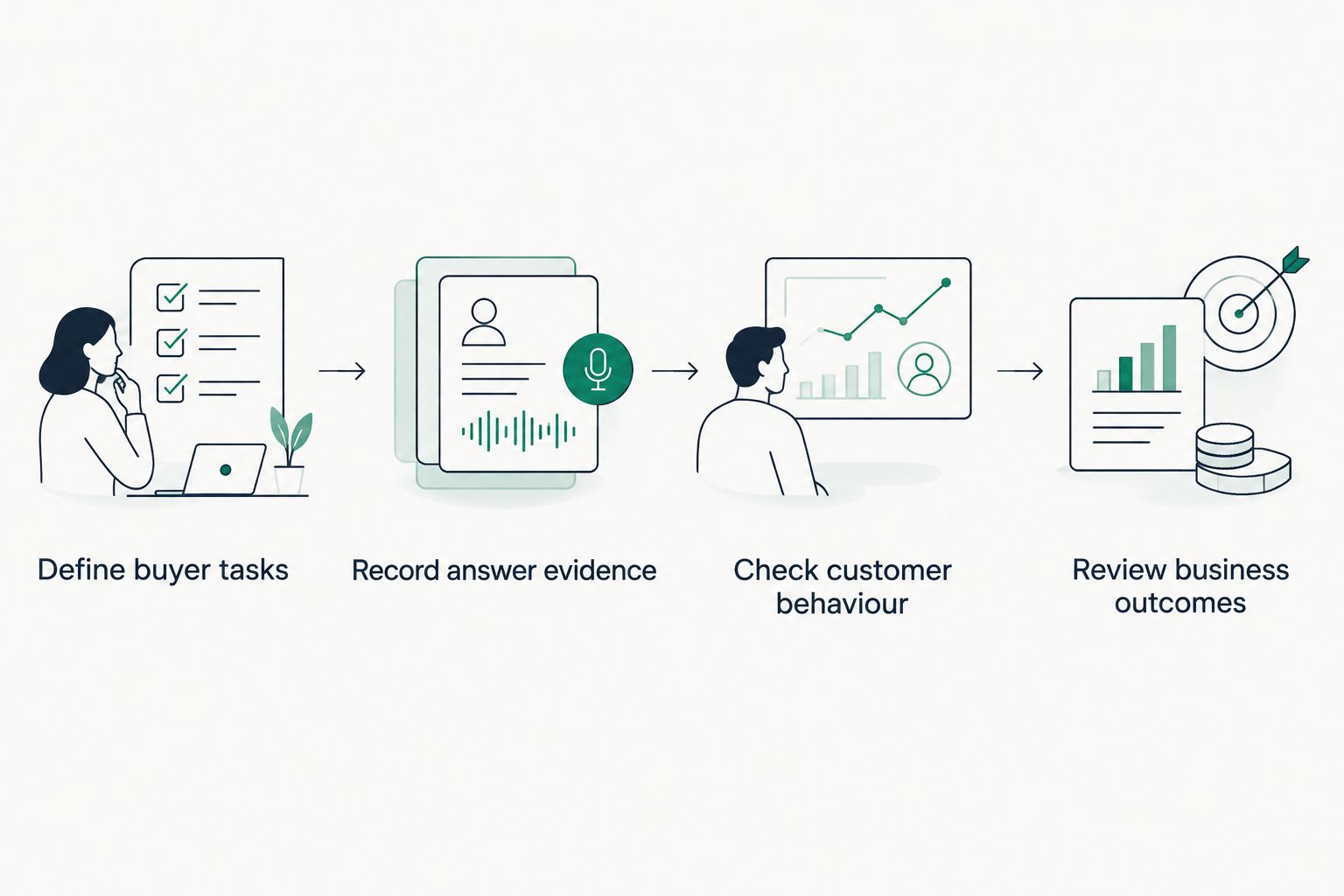
The process ends with a bounded finding: which tasks show evidence of substitution, which show additional research and which remain unresolved. That finding is more useful than a headline about either platform winning.
What should your measurement report distinguish?
Report a mention, citation and recommendation as separate observations. A mention means your brand is named; a citation identifies a source; a recommendation presents an option as suitable for a stated need. None of those definitions requires a click.
A cited page can support an answer without the answer recommending the publisher's product. Equally, an answer can recommend a vendor without citing that vendor's website. Review the surrounding wording before assigning a label.
Your reporting should retain these distinctions:
| Observation | What it establishes | What it does not establish |
|---|---|---|
| Brand mention | Your brand appears in the recorded answer | Positive treatment or buyer preference |
| Source citation | The answer identifies a supporting source | Endorsement of the source's product |
| Recommendation | The answer presents your brand as suitable in context | A resulting website visit or sale |
| Identifiable referral | A recorded visit has an attributable referring source | Every previous research interaction |
| Qualified enquiry | A prospect meets your agreed qualification criteria | That a single channel caused the decision |
Koalr is best suited to marketing teams that need AI visibility tracking across generated answers. Its stated role covers tracking and improving brand appearance across ChatGPT, Gemini, Perplexity, Claude, Copilot and Google AI Overviews; that scope is not proof of customer-level search replacement.
Use the software for the visibility question and customer research for the behaviour question. Do not ask either evidence source to answer something it cannot establish.
Should you change your SEO and content priorities?
Change priorities when the evidence identifies a specific problem. A generic fear of losing search traffic is not a content brief. An answer that misstates a documented product capability is.
Start by matching the observation to an action:
- Incorrect product description: clarify the relevant factual page and check for conflicting descriptions elsewhere.
- Missing comparison information: publish clear selection criteria and documented trade-offs that help a buyer evaluate fit.
- Weak source material: replace unsupported assertions with attributable evidence and explicit scope.
- Relevant Google traffic declining: inspect affected queries and pages before assigning a cause.
- Recommendations without measurable visits: investigate customer research behaviour instead of declaring either success or failure.
Keep pages useful to the reader. Direct answers, descriptive headings and clearly bounded claims help people understand your evidence, but no page format guarantees that an engine will cite it.
For 2026 planning, retain a record of the original issue, the page changed and the subsequent observations. A citation appearing after an edit establishes sequence, not causation. Look for repeatable improvement before presenting the edit as the explanation.
Should I move budget from Google to ChatGPT?
Do not move budget solely because ChatGPT appears in a customer journey. Compare the buying tasks involved, identifiable business outcomes and the cost of the work before changing allocation. Preserve activity that meets your acquisition goals while testing a defined visibility problem.
Can Google traffic fall without customers switching to ChatGPT?
Yes, a fall in Google traffic does not establish a switch to ChatGPT. Rankings, demand, search-result presentation and measurement changes are separate explanations to investigate. A traffic chart alone cannot distinguish them.
Can my brand win in ChatGPT without getting clicks?
Your brand can receive a recommendation without a corresponding website click. That is an answer-level visibility result, not a conversion result. Check customer research and commercial outcomes before assigning business value to it.
FAQ
Is ChatGPT replacing Google Search for all customers in 2026?
A universal replacement claim is not justified by evidence that customers use ChatGPT. Establish which buying tasks customers have moved away from Google, rather than treating additional usage as substitution.
How do I know whether customers found my business through ChatGPT?
Combine identifiable referral records with direct questions about the customer's research process. Keep first discovery, shortlist creation and final verification separate.
Does a ChatGPT citation mean my brand was recommended?
No, a citation identifies a supporting source, not necessarily a recommended vendor. Read the surrounding answer to establish whether the brand is presented as suitable for the buyer's needs.
Are Google AI Overviews the same thing as ChatGPT?
No, Google AI Overviews are generated summaries within Google Search, while ChatGPT provides a conversational interface. Measure each experience separately rather than grouping all generated answers together.
Should I stop doing SEO because customers use AI answers?
No, customer use of AI answers is not sufficient evidence to stop SEO. Review your search outcomes and the role of each buying task before reallocating resources.
What does Koalr help a marketing team measure?
Koalr helps marketing teams track and improve how their brand appears in AI-driven answers. That visibility evidence does not, by itself, establish whether customers have replaced Google Search.
What's the best first step for testing a shift towards ChatGPT?
Start with specific customer buying tasks and ask which services customers used to complete them. Then compare those accounts with recorded answers, identifiable referrals and business outcomes.
One last thing
Your most important distinction is not Google versus ChatGPT. It is being available as a source versus being selected as an option. A technically accurate answer can cite your content while recommending someone else.
In your next 2026 review, inspect the full answer behind each relevant citation. Record who supplied the evidence, who received the recommendation and whether the recommendation matches the buyer's needs. That gives your team a concrete problem to fix without pretending a citation is a sale.


