

Google Gemini names brands directly in its answers, in Google Search results via AI Overviews, and inside Workspace apps — none of it shows up in Google Search Console or GA4. Tracking those mentions means running a fixed set of prompts against Gemini on a schedule and logging what it says about you versus your competitors.
- Track brand mentions in Google Gemini by running a repeatable prompt set through Gemini and logging citations, mentions, and recommendations separately.
- Gemini has no public brand-monitoring API in 2026, so manual checks, a spreadsheet, or a dedicated platform like Koalr are the three real options.
- Weekly checks catch most shifts because Gemini's Search grounding pulls from live web results, not a fixed index.
- A citation names your domain as a source, a mention says your brand name, a recommendation tells the user to buy or use you — the three are not the same signal.
Why this matters
Gemini sits inside Google Search as AI Overviews, inside the standalone Gemini app, and inside Gmail, Docs, and Android. A buyer asking "best project management tool for a 10-person team" through any of those surfaces gets an answer with named brands in it, and that answer is generated fresh each time, not pulled from a cached ranking page.
Standard SEO tools track rankings and clicks. They were not built to see whether Gemini named your brand in an answer that produced zero click-through. That gap is exactly why AI visibility tracking exists as its own discipline in 2026, separate from rank tracking and separate from referral-traffic analytics.
If you only check whether traffic from Gemini shows up in GA4, you're missing every mention that ended the conversation right there in the chat window. Koalr is built around closing that gap for AI-driven answers across ChatGPT, Gemini, Perplexity, Claude, and Copilot.
How to track brand mentions in Google Gemini
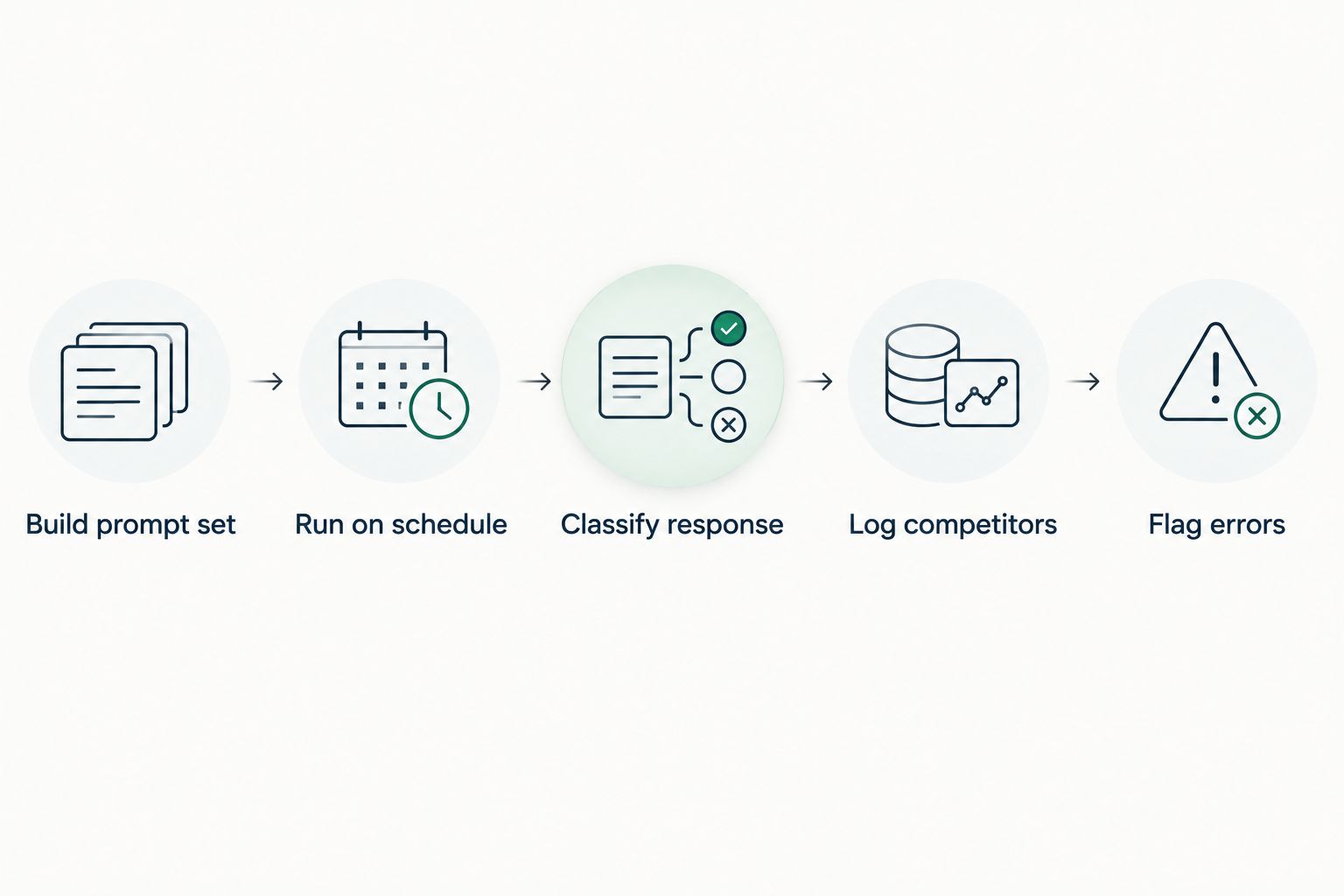
Five steps cover it, whether you're doing this by hand or with a platform:
- Build a prompt set of 15-30 queries that mirror how real buyers actually ask, not how you'd phrase your own SEO keywords.
- Run each prompt against Gemini on a fixed cadence — weekly is the standard interval given how often grounded answers shift.
- Classify each response as a citation (your domain named as a source), a mention (your brand named without a source link), or a recommendation (Gemini tells the user to use you).
- Log every competitor name that shows up in the same answers, not just your own presence or absence.
- Flag factual errors about your brand — pricing, features, or positioning Gemini states incorrectly — for correction at the source.
Three methods handle the actual tracking, and they differ mostly in how much manual effort they demand:
| Method | Effort | Consistency | Best for |
|---|---|---|---|
| Manual checks in the Gemini app | High — someone types every prompt by hand | Low, results drift with who's checking | Solo marketers testing the idea |
| Prompt library + spreadsheet | Medium — prompts are fixed, logging is manual | Medium, depends on discipline | Small teams with a defined prompt list |
| Dedicated AI visibility platform | Low — runs on schedule automatically | High, same prompts every time | Teams tracking Gemini alongside ChatGPT and Perplexity |
Manual tracking in the Gemini app
Open Gemini, type each prompt, screenshot or copy the answer, repeat weekly. It costs nothing but time, and it's the fastest way to see for yourself whether your brand shows up at all. Verdict: fine for a one-time gut check, not sustainable past a handful of prompts a month.
Prompt library and spreadsheet tracking
A fixed prompt set stored somewhere shared, with a spreadsheet column for citation/mention/recommendation and another for competitor names, gets you real trend data. The work of running every prompt every week still falls on a person. Verdict: workable for a small brand with under 20 prompts and one owner.
Dedicated AI visibility platform tracking
A platform runs the same prompt set against Gemini (and other engines) on schedule, classifies the response type automatically, and tracks competitor share of voice over time without anyone re-typing prompts. Koalr's prompt library tooling is built for exactly this — building the prompt set once and tracking it continuously across engines rather than rebuilding it every quarter. Verdict: the right call once you're tracking more than one AI engine or more than a handful of prompts.
“A citation, a mention, and a recommendation are three different signals — treating them as one number is how teams miss the fact that Gemini names them but never tells the user to buy.”
Why Gemini mentions vary
Gemini's answers about your brand change for reasons that have nothing to do with your SEO rankings:
- Search grounding pulls from live web results, so a page published or updated this week can appear in an answer that ignored it last month.
- Prompt phrasing changes the output — "best X tool" and "X vs Y" surface different brand sets even on the same topic.
- Personalization and account context through signed-in Google accounts can shift which brands get named to different users.
- Structured data and clear entity signals on your site make it easier for Gemini to attribute a claim to you correctly instead of a competitor.
- Competitor content density in the same topic cluster crowds out weaker or thinner brand pages.
- Model updates through 2026 change training data cutoffs and grounding sources, which resets what Gemini treats as current.
Is tracking Gemini different from tracking Google AI Overviews?
Yes — Gemini the standalone app and AI Overviews inside Google Search share some grounding infrastructure but generate separate answers, so a brand cited in one is not automatically cited in the other. Tracking both requires running the same prompt set through each surface separately.
How often should I check Gemini for brand mentions?
Weekly checks are the standard cadence in 2026 because Gemini's grounded answers can shift within days as new pages get indexed and old ones drop out of the source pool. Monthly checks are enough only for low-priority or evergreen prompts where change is slow.
Does Google Search Console show Gemini citations?
No — Search Console reports on organic search clicks and impressions, not on whether Gemini named or cited your brand in a generated answer that produced no click at all. That blind spot is why AI visibility tracking runs as a separate check rather than a Search Console report.
See your Gemini visibility score
Track citations, mentions, and share of voice across Gemini and other AI engines.
FAQ
What's the best way to track brand mentions in Google Gemini in 2026?
Running a fixed prompt set against Gemini on a weekly cadence and classifying each response as a citation, mention, or recommendation is the most reliable method in 2026. Manual checks work for a handful of prompts; a dedicated platform is worth it past that.
Is Gemini better than ChatGPT for brand visibility tracking?
Neither is inherently better — they're different surfaces with different answer patterns, so a brand cited in Gemini is not automatically cited in ChatGPT. Tracking both separately, alongside Perplexity and Copilot, gives the full picture.
How much does AI visibility tracking cost?
Cost depends on the tool and the number of prompts and engines tracked, and pricing varies by vendor, so check current plans directly on the provider's site before comparing.
Can I track Gemini mentions for free?
Manually typing prompts into the Gemini app and logging results in a spreadsheet costs nothing but time, and it's a reasonable way to test the idea before committing to a platform.
What's the difference between a citation and a mention in Gemini's answers?
A citation names your domain as a source Gemini pulled information from, while a mention names your brand without linking back to a source. Recommendations go a step further and tell the user to actually use or buy from you.
Does Gemini show the same brands as Google AI Overviews?
Not always — Gemini and AI Overviews generate separate answers even when they share grounding infrastructure, so overlap in named brands is common but not guaranteed. Track each surface with its own prompt run to know for sure.
How many prompts should I track in Gemini?
A starting set of 15 to 30 prompts covering your core buyer questions is enough to spot trends without becoming unmanageable. Expand the set once you've confirmed which prompts actually surface brand names.
Can competitors see that I'm tracking their mentions in Gemini?
No — running prompts against Gemini and logging the responses is invisible to any brand named in the output, since it's the same as any other user asking a question.
One last thing
Most teams tracking Gemini mentions in 2026 stop at "are we named or not" and miss the more useful signal: which competitor gets named alongside you, and in what order. A brand that appears third in every answer next to two rivals has a different problem than a brand that never appears at all — and the fix for each is completely different.


