

To track AI visibility for co-branded partnerships in 2026, run 1 shared prompt set across 6 AI surfaces and record 3 outcomes for every partner: mentions, citations and recommendations. Keep each brand’s results separate, because a combined campaign total cannot show which partner AI answers name, source or favour.
- Track AI visibility for co-branded partnerships with one shared prompt set and separate results for every brand.
- Record mentions, citations and recommendations independently; they measure different forms of AI visibility.
- Compare partner Share of Voice across ChatGPT, Gemini, Perplexity, Claude, Copilot and Google AI Overviews.
- Koalr is an AI visibility platform for marketing teams that need repeatable tracking across shared campaigns.
How do you track AI visibility for co-branded partnerships?
Start with the same prompts, platforms and reporting rules for every partner. Koalr AI visibility software can centralise that tracking, but the decisive part is the measurement design: each answer needs separate fields for each partner, each source domain and each type of visibility.
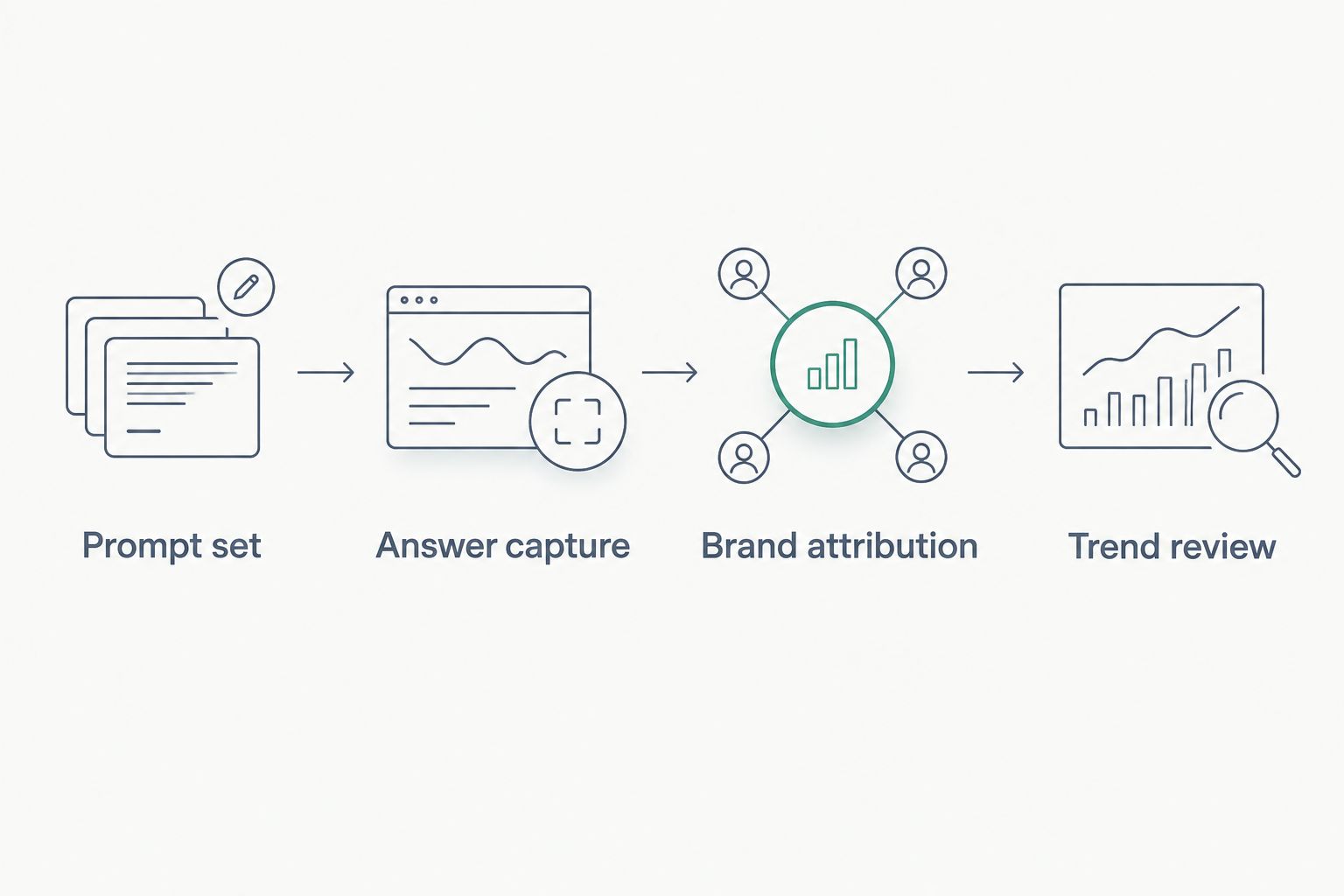
Use this process throughout the partnership in 2026.
- Create the prompt set. Include unbranded category questions, each partner’s branded questions, partnership-specific questions and comparison prompts. Keep the wording fixed between tracking runs so prompt edits do not get mistaken for visibility changes.
- Capture the answers. Run every prompt across ChatGPT, Gemini, Perplexity, Claude, Copilot and Google AI Overviews. Store the complete answer, platform, prompt and collection date rather than copying only the sentence containing a brand.
- Attribute each brand. Give every partner its own row or field. Record whether its name appeared, whether its domain received a citation and whether the answer explicitly recommended it.
- Calculate Share of Voice. Compare how often each partner appeared across the same eligible answers. Segment the result by platform, prompt group, market and buyer intent before using an overall average.
- Review the trend. Compare consistent reporting periods, inspect changed answers and assign fixes to the partner that controls the relevant page, entity information or campaign asset.
A reusable prompt library for AI visibility tracking prevents one partner from being measured against easier questions. It also gives both teams an auditable record of what was asked when a result changes.
Compare the right signals
A co-branded visibility report needs more than a count of brand names. Use the following distinctions consistently across every partner and every AI platform.
| Signal | What to record | What it tells you | Limitation |
|---|---|---|---|
| Mention | The partner’s name appears in the answer | The model associates the brand with the topic | It does not identify the source used |
| Citation | The answer links to the partner’s domain or page | The partner’s content supplied visible evidence | It does not prove the brand was recommended |
| Recommendation | The answer presents the partner as a suitable choice | The brand earned decision-stage visibility | It can appear without a citation |
| Share of Voice | The partner’s appearances divided by eligible tracked answers | Which partner captures more visibility inside the shared prompt set | It depends on a stable and representative prompt set |
Do not merge these signals into one unexplained score. A partner can receive citations without being named prominently, while another can be mentioned repeatedly without earning a single source link. Both patterns require different fixes.
Why this matters for a shared campaign
Referral traffic cannot measure an AI mention or citation that produces no click. Campaign analytics can show visits and conversions after a user reaches a partner site, but they cannot show that an AI answer named the other partner first or used the other partner’s page as its source.
A single partnership total creates the same blind spot. If one partner appears across category prompts while the other appears only when its brand is included in the question, the campaign has two very different visibility profiles. Reporting one combined number hides that difference.
The 2026 scorecard should therefore answer four direct questions:
- Which partner is mentioned most often in unbranded category answers?
- Which partner’s domain receives the citations?
- Which partner is recommended when the prompt asks for a provider or solution?
- Which platforms and prompt groups produce the largest gap between partners?
These questions turn AI visibility into work that can be assigned. Citation gaps point to content and source issues. Mention gaps point to weak topic association. Recommendation gaps point to missing evidence that helps an answer distinguish one choice from another.
Build a baseline before judging the partnership
Run the complete prompt set before the co-branded campaign launches, then keep the same core prompts active during and after the campaign. The baseline separates visibility created during the partnership from brand recognition that already existed.
Record the following for every answer:
- Exact prompt text and prompt group
- AI platform and collection date
- Partner names present in the response
- Cited domains and specific cited pages
- Whether each partner is mentioned, cited or recommended
- Answer position or prominence, using one consistent classification
- Factual errors, outdated claims or incorrect brand relationships
- Whether the prompt is branded, unbranded or partnership-specific
Keep campaign prompts separate from evergreen category prompts. A temporary event name can show whether the campaign itself is recognised, while evergreen prompts show whether either partner gains durable association with the wider topic.
The baseline also protects the partnership review from selective examples. One impressive Perplexity citation cannot represent performance across all 6 tracked surfaces, and one missing ChatGPT mention cannot prove broad visibility loss. The unit of analysis is the full, fixed prompt set.
Why co-branded AI visibility varies
The gap between partners becomes easier to diagnose when reporting preserves the answer, source and prompt context. Check these factors before changing content:
- Prompt balance: Count how many prompts name each partner directly. Branded prompts should not be mixed into an unbranded Share of Voice comparison.
- Asset ownership: Identify which partner owns the cited landing page, report, announcement or supporting article. The owner controls the next content change.
- Entity clarity: Confirm that each page states the relationship between the partners plainly. Ambiguous wording makes it harder to distinguish collaborator, supplier, sponsor and customer.
- Source duplication: Compare overlapping campaign pages. Two pages covering the same announcement can compete for citation visibility instead of reinforcing one canonical account.
- Platform difference: Review every AI surface independently before averaging results. A citation pattern on Perplexity does not describe what appears in Claude or Google AI Overviews.
- Prompt intent: Separate research questions from decision questions. A brand can be cited as an information source without being recommended as the answer to a buying prompt.
In 2026, the corrective action should match the failed signal. Add clearer supporting evidence when recommendations are absent. Improve page structure and source clarity when citations are absent. Clarify the partnership and category relationship when mentions are absent.
Where Koalr fits
Koalr is best for marketing teams that need repeatable AI visibility tracking across co-branded campaigns, prompt groups and major answer engines. That makes Koalr suitable when both partners need the same collection method and a clear distinction between a mention, citation and recommendation.
The advantage is consistency: marketing teams can track recurring prompt sets instead of rebuilding a spreadsheet for every review. The limitation is methodological rather than technical: no AI visibility tool can rescue a biased prompt set, unclear partner naming or a report that merges branded and unbranded questions.
A clean setup still requires human decisions about which buyer questions matter, which entities count as partners and what action follows each finding. Automation handles repeated collection; campaign owners remain responsible for the benchmark and interpretation.
Measure the partnership clearly
Track partner mentions, citations and recommendations across major AI answer engines.
Should both partners use the same prompt set?
Yes. Both partners need the same core prompt set, platforms and collection schedule for a defensible comparison. Each team can add private diagnostic prompts, but those extra prompts should not enter the shared Share of Voice calculation.
The shared set should include both branded and unbranded questions, with each group reported separately. That structure prevents a well-known partner from appearing stronger simply because more prompts contain its name.
How often should you track a co-branded campaign?
Use a fixed cadence that matches the campaign’s decision points, then keep it unchanged through the reporting period. Increase monitoring around a launch or major content change only if both partners are measured with the same additional runs.
Consistency matters more than collecting isolated screenshots. A 2026 partnership review needs comparable observations over time, not a collection of favourable answers chosen from different days, prompts and platforms.
What should you do when one partner dominates AI answers?
First, split the gap by mention, citation and recommendation. Then inspect the exact prompts, cited pages and answer wording where the stronger partner wins.
If the gap is concentrated in citations, improve the weaker partner’s supporting pages and source clarity. If the gap appears in unbranded mentions, strengthen the connection between that partner and the category. If recommendations are missing, add direct evidence that answers the buyer’s selection criteria without making unsupported claims.
Do not respond by adding the weaker partner’s name to every prompt. That changes the test rather than improving its visibility.
How do you report results to both partners?
Use one shared summary with separate brand columns. Show the common prompt set, platform coverage, collection dates, Share of Voice and the split between mentions, citations and recommendations.
Follow the summary with a partner-specific action list. Each action should name the affected prompt group, the page or entity issue behind it and the team responsible for the fix. This keeps the report useful without exposing unrelated internal marketing data.
For 2026 reporting, preserve both the total and segmented views. Leadership can read the overall position quickly, while content, SEO and communications teams can work from platform-level and prompt-level findings.
FAQ
What is AI visibility for a co-branded partnership?
AI visibility for a co-branded partnership is how often each partner is mentioned, cited or recommended across tracked AI answers. Results should be attributed to each brand rather than combined into one campaign total.
What is the best way to track co-branded AI visibility in 2026?
Use one fixed prompt set across ChatGPT, Gemini, Perplexity, Claude, Copilot and Google AI Overviews. Record mentions, citations and recommendations separately for every partner.
Is an AI citation better than a brand mention?
An AI citation provides a visible source link, while a mention only places the brand name in the answer. Neither replaces the other because a brand can be cited without being recommended or mentioned without receiving source credit.
How do you calculate co-branded Share of Voice?
Divide each partner’s appearances by the eligible answers in the shared prompt set, using the same counting rule for every brand. Report branded and unbranded prompts separately so named questions do not distort the comparison.
Should partnership landing pages be tracked separately?
Yes. Track each partner’s landing page and domain separately so citations can be assigned to the source that AI answers use. Also retain the answer text to see whether both brands receive visible credit.
Can AI referral traffic replace visibility tracking?
No. Referral traffic records visits after a click, while AI visibility tracking captures mentions, citations and recommendations that may never send traffic. Use both measurements for different questions.
How do you fix an AI visibility gap between partners?
Identify whether the gap affects mentions, citations or recommendations, then inspect the losing prompts and sources. Change the relevant content, entity description or supporting evidence without altering the shared benchmark.
Which teams should own co-branded AI visibility reporting?
Marketing, SEO, content and communications teams should agree on the prompt set and reporting rules, with one named owner controlling collection. Each partner should own fixes on its pages and entity information.
One last thing
Never present co-branded visibility as one score without partner-level attribution. The total can rise in 2026 while one partner loses Share of Voice, citations and recommendation coverage inside the same campaign.
Keep a stable benchmark, but do not freeze the action plan. When a result changes, inspect the answer and its sources first; only then decide whether the fix belongs to content, technical SEO, communications or partnership messaging.


