
There is no fixed deadline for AI engines to notice a website migration in 2026: discovering a new URL, citing it and using updated brand information are separate events. A working redirect does not prove an answer has changed, and a new citation does not prove every engine has processed the move.
- How long does it take for AI engines to notice a website migration? There is no fixed deadline.
- Separate URL discovery, citation changes and answer accuracy when assessing migration progress.
- Koalr helps marketing teams track brand visibility across AI answers; tracking does not control update timing.
- Keep prompt sets consistent and investigate technical failures before treating stale citations as a waiting problem.
How long does it take for AI engines to notice a site migration?
Measure migration progress by evidence, not an assumed number of days. A crawler reaching the destination, a search index recognising the replacement and an answer citing the new page show different things.
| Checkpoint | Evidence to collect | What it does not prove |
|---|---|---|
| URL discovery | Verified crawler requests for the destination | That the page is indexed or cited |
| Search index update | Relevant search inspection evidence for the destination | That every answer engine uses it |
| Citation update | An answer visibly cites the replacement URL | That other prompts have updated |
| Answer accuracy | The response uses current, correct information | That the information came from your website |
Use the website migration visibility tracking guide to keep these checks separate.
Why this matters
A migration can succeed technically while your answer visibility remains unsettled. You need to know whether the problem is access, source selection or inaccurate information before deciding what to fix.
For a 2026 migration, define success around the pages and buyer questions that matter to your business. A correct homepage citation is not enough if answers about your main product still link to retired documentation.
Keep three outcomes distinct:
- Mention: the answer names your brand.
- Citation: the answer provides a source reference or link.
- Recommendation: the answer presents your brand as a suitable choice.
A mention without a citation tells you nothing about which version of your website supplied the information. A citation without a recommendation does not establish that your brand is winning the buying decision.
Discovery: prove the new destination is accessible
Start with the migration mechanics. Do not use an answer engine as your first redirect-testing tool.
For a permanent move, check that each retired URL redirects to its relevant replacement using an appropriate permanent redirect, such as HTTP status code 301 or 308. The final destination should return HTTP status code 200 when it successfully serves the page.
Those codes describe server behaviour, not update speed. A 301 response cannot tell you when a future answer will cite the destination.
Check the full route rather than the opening response. A redirect can point to another redirect, an irrelevant page, an access challenge or a destination that fails to load.
Best for proving access: server checks and verified crawler logs. Their limitation is scope: a crawler request proves a request occurred, not that an answer engine selected the page as evidence.
Keep a record of the old URL, intended replacement, observed redirect and final response. That record gives your technical team a specific failure to reproduce instead of a vague report that the migration has not been noticed.
Indexing: separate search recognition from answer selection
For answer experiences that use web search, search discovery and indexing are relevant checks. They are not a universal view into every system that generates answers.
Google Search Central's site-move guidance describes processing a move on a per-URL basis. Use that distinction in your 2026 migration reporting: a recognised homepage does not establish that every product page, guide or help article has moved successfully.
Inspect important destination pages through the relevant search webmaster tools. Check indexability, canonical signals and whether internal links and sitemaps point to the intended destinations.
Best for diagnosing search eligibility: search inspection tools. The limitation is that eligibility does not establish citation selection; a page can be accessible and indexed without appearing in the answer you test.
Do not label an uncited page as undiscovered unless discovery evidence supports that diagnosis. Otherwise, you risk repeatedly requesting indexing when the real issue is that the replacement no longer answers the question well.
Citations: inspect the source URL and its destination
A citation to the new URL is direct evidence that the tested answer referenced that address. Keep the scope narrow: it establishes an observation for that prompt, engine and run.
An old URL in a citation needs closer inspection. Record the displayed citation URL, follow it and check where it lands; a stale-looking address that redirects to the correct replacement differs from a broken link or an unrelated destination.
Best for proving an observed citation change: saved answer evidence. Its limitation is variability: a successful answer does not establish the same result across other prompts, markets or engines.
Use these labels consistently:
- Old citation: the answer references the retired address.
- New citation: the answer references the replacement address.
- Correct answer: the response states the current information accurately.
An old citation can accompany a correct answer. A new citation can accompany an inaccurate answer. Record both the source reference and the claim rather than compressing them into a single migration status.
Why migration recognition varies
The useful question is not which engine is fastest. It is which dependency remains unresolved for the pages and answers you care about.
- Access controls: robots rules, authentication and security challenges affect whether the relevant crawler can retrieve a page.
- Redirect mapping: a relevant replacement preserves the route to the information; a generic destination does not preserve the original answer.
- Indexability signals: noindex directives, canonical tags and conflicting URL references affect search processing.
- Content changes: removing definitions, evidence or useful explanations changes what the replacement can support.
- Answer mode: an answer using web retrieval and an answer produced without browsing do not provide equivalent evidence of a site update.
- Third-party sources: external pages can continue to describe the old domain, name or product information after your own pages change.
These factors explain what to investigate. They do not provide a defensible countdown.
Fix an observable blocker before waiting for an unspecified refresh. If the destination is inaccessible or the redirect goes to the wrong page, more elapsed time is not the corrective action.
How do you measure progress without inventing a deadline?
Use a repeatable sequence that connects technical evidence to answer evidence. Keep your 2026 migration checks comparable by recording the same conditions before and after the move.
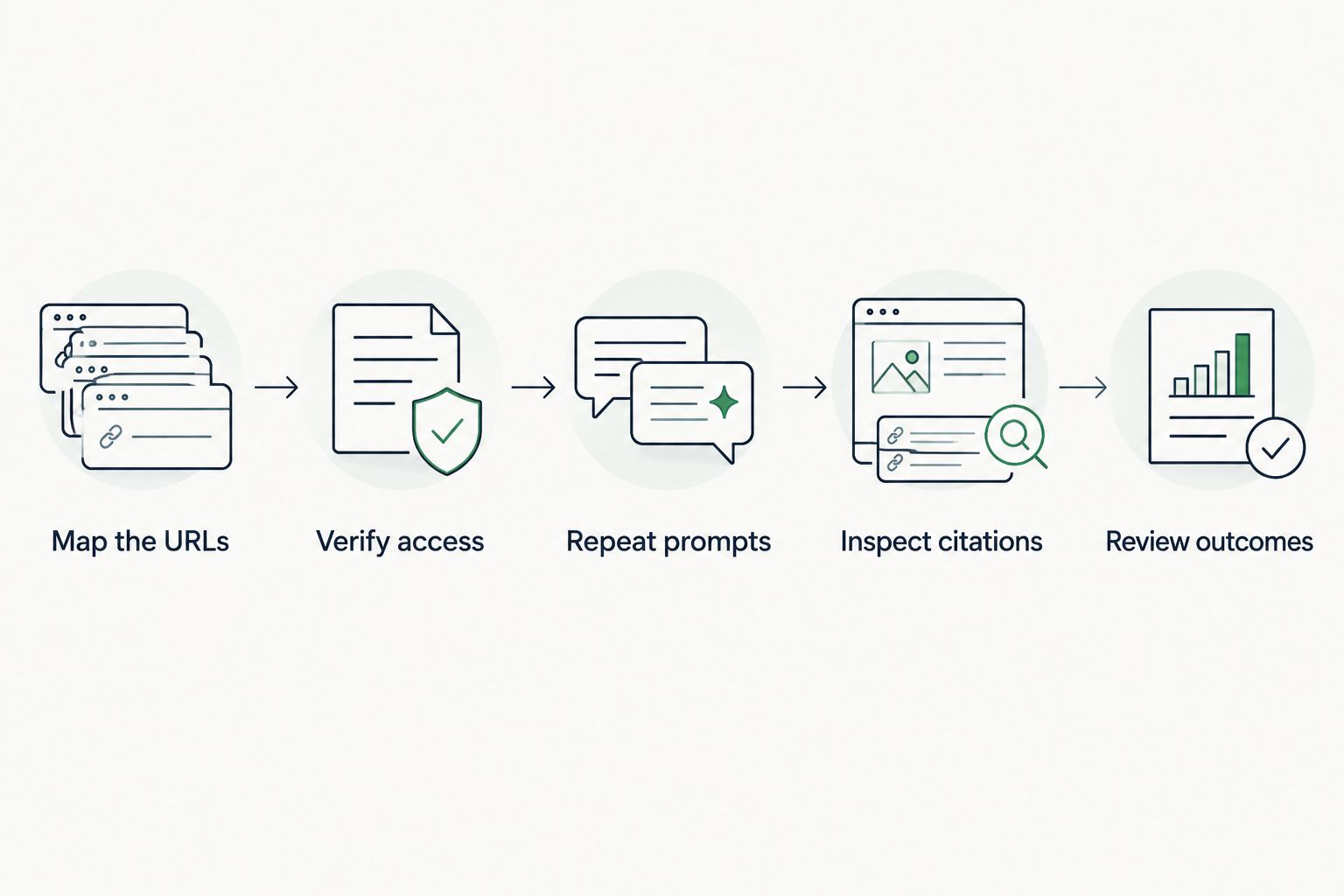
1. Map the URLs
Create an old-to-new URL map for pages that already attract valuable search visits, citations or buyer interest. Include the intended destination and whether the underlying information changed.
Separate a domain move from a content rewrite. If both happen together, a lost citation cannot automatically be attributed to the address change.
2. Verify access
Test redirects, final responses, canonical tags, internal links and sitemap entries. Check that production pages no longer carry staging restrictions.
Prioritise previously cited pages and commercially important destinations. Fixing an unrelated archived page does not resolve a broken source used in a buying answer.
3. Repeat prompts
Keep a stable set of branded and unbranded buyer questions. Record the engine, available model or mode information, language, market, browsing setting and run time.
Start fresh conversations for controlled comparisons. Preserve the wording rather than rewriting the prompt until you obtain the result you want.
4. Inspect citations
Save the answer, cited URLs and destination checks. Record mentions and recommendations separately from citations, then assess whether the response contains outdated claims.
Classify each problem precisely: missing brand, old citation, broken destination, incorrect claim or lost recommendation. Different failures need different fixes.
5. Review outcomes
Compare repeated observations against the pre-migration baseline. Look for persistent patterns across your fixed prompt set rather than treating an isolated answer as recovery or failure.
Assign a technical owner to access problems and a content owner to missing or inaccurate information. Keep unresolved findings open until the relevant evidence changes.
A tracking platform belongs at the answer-monitoring stage, alongside technical checks rather than instead of them. Koalr is best for marketing teams tracking brand visibility across AI answers.
Koalr helps marketing teams track and improve how their brand appears across ChatGPT, Gemini, Perplexity, Claude, Copilot and Google AI Overviews. Koalr's AI visibility tracking does not replace redirect validation, search inspection or server logs, and it does not establish a migration completion deadline.
Should you wait if AI answers still cite the old domain?
Wait only after checking that the old citation reaches the right replacement and that the replacement remains usable. Waiting is a monitoring decision, not a substitute for validation.
If the old URL returns HTTP status code 404, the requested resource was not found. HTTP status code 410 indicates that the resource is gone; neither response provides the forwarding behaviour of a permanent redirect.
Where a relevant replacement exists, investigate whether the old address should redirect to it. Do not redirect every retired page to the homepage merely to remove errors: that destination often fails to answer the original question.
If the route works but the answer repeats old information, inspect the cited sources. The outdated claim might appear on an external page rather than on your migrated website.
Does submitting a sitemap make AI engines update immediately?
A sitemap is a discovery aid, not an instruction to change an answer immediately. It does not demonstrate that a page has been indexed, selected as a source or cited.
Submit the appropriate sitemap through relevant search webmaster tools, keep its URLs aligned with the migration and continue checking destination pages. Do not treat submission confirmation as migration completion.
Does a migration require an AI model to be retrained?
A web-backed answer can reference a migrated page without a new model training cycle. Retrieval and training are different processes, so waiting for a model release is not a useful default migration plan.
Conversely, an answer generated without browsing does not prove the system has retrieved your replacement page. Record whether web retrieval was involved before interpreting the result.
This distinction matters when comparing engines. Test comparable answer modes instead of treating every response as evidence of the same update mechanism.
FAQ
How long does it take for AI engines to notice a website migration?
There is no fixed migration deadline that applies across AI engines. Check URL discovery, search indexing, citation changes and answer accuracy separately rather than assuming elapsed time proves completion.
Why does ChatGPT still link to my old website address?
An old citation alone does not identify the cause. Check its destination, whether the answer used web retrieval and whether the cited information remains accurate before deciding what to fix.
Does Google indexing my new domain mean AI Overviews have updated?
Indexing the new domain does not prove that a particular AI Overview cites its replacement pages. Inspect the relevant destination pages and the actual citations for the queries you track.
Will a 301 redirect transfer my AI citations automatically?
A 301 redirect signals a permanent move, but it does not prove that an answer will display the replacement URL. Verify the redirect and monitor citation URLs separately.
Can I force every AI engine to refresh my migrated website?
You cannot control every engine's answer updates through your website. Correct access problems, publish accurate replacement content and monitor repeated answers for evidence of change.
Should I track referral traffic or citations after a migration?
Track both because they answer different questions. Referral traffic records visits, while citation checks establish whether an observed answer referenced a source, including citations that produced no visit.
What should I report to leadership after a website migration?
Report technical migration health, observed citation changes and answer accuracy separately. Include the tested prompts, engines, dates and unresolved failures so the report does not imply broader recovery than the evidence supports.
One last thing
A new URL is not proof that an answer is current. Read the claim beside the citation and compare it with the replacement page; source freshness and answer accuracy are separate checks.
For your 2026 migration sign-off, require evidence for the important destination pages and buyer questions, not a single statement that the engines have noticed. Close technical failures when the implementation is fixed, and close answer findings when repeat checks support that decision.