
Yes—AI referral traffic can appear as direct traffic when the visit reaches your site without usable referral or campaign information. That is a normal attribution limitation, not proof that your tracking is broken or that all unexplained direct traffic came from AI. In 2026, the right response is to test the click journey and report identifiable AI referrals separately from unattributed visits.
- Is AI referral traffic showing as direct traffic normal? Yes, when usable source information is missing.
- GA4 direct traffic does not prove that a visitor typed your address or arrived from an AI answer.
- Test referral information, campaign parameters and redirects before changing channel rules.
- Koalr supports AI visibility tracking; visibility and website referral attribution answer different questions.
Why this matters
A customer can discover your brand in an AI answer without your analytics preserving that discovery source. The customer might follow a link, copy an address, or return later through another route. Those journeys do not leave identical evidence.
For your 2026 reporting, separate what you observed from what you suspect. Use the guide to tracking AI chatbot referral traffic in Google Analytics to establish the identifiable traffic segment first; investigate direct traffic without automatically relabelling it.
The distinction affects decisions. If you treat every direct visit to a cited page as an AI referral, you manufacture channel growth. If you treat identifiable AI referrals as the full measure of your visibility, you ignore answers that never produced a website visit.
Is it normal for AI referral traffic to show as direct traffic?
Yes. Google Analytics uses the direct classification when it lacks a clear referral source under its attribution and processing rules. An AI-originated visit can fall into that category, but a direct label does not identify the missing source.
Start with these 3 evidence types. Each answers a different question, and none replaces the others.
| Evidence type | Best for | What it establishes | Main limitation |
|---|---|---|---|
| Identifiable referrals | Measuring attributable website visits | Analytics received source information associated with an AI service | Excludes journeys whose source was not preserved |
| Controlled tests | Diagnosing a particular click journey | What happened under recorded browser, app and consent conditions | Does not establish how frequently that journey occurs |
| Answer observations | Measuring brand visibility | A recorded answer mentioned, cited or recommended your brand | Does not establish that someone visited or converted |
A missing referrer is evidence of missing attribution, not evidence of an AI source. Equally, an intact referrer does not guarantee that every report will display the visit as you expect. Session acquisition, user acquisition and attribution reports have different scopes.
Check the underlying source and medium before blaming a channel label. A custom channel group can organise recognised sources; it cannot recover information that was never collected.
Why AI referral attribution varies
There is no universal click journey across AI answers. These factors explain why attribution can differ without implying that every service behaves the same way:
- App hand-offs: An answer opened in an app can send a link to an external browser. Test whether that specific hand-off supplies referral information.
- Referrer policy: Browser and page policies control how much referrer information a destination receives. A full originating page address is not guaranteed.
- Copy-and-paste journeys: Copying an address into a browser does not carry the original page's referrer in the way a normal link navigation does.
- Redirect handling: Redirect chains can alter destination addresses or discard campaign parameters. Inspect the actual chain rather than assuming every redirect removes attribution.
- Measurement conditions: Consent choices, tag execution and acquisition-report scope affect what you can observe. They do not all result in a direct classification.
Do not use these explanations interchangeably. A copied address, a missing campaign parameter and an analytics tag that never fired are different problems. Each requires different evidence and a different response.
How do you check whether AI visits are becoming direct traffic?
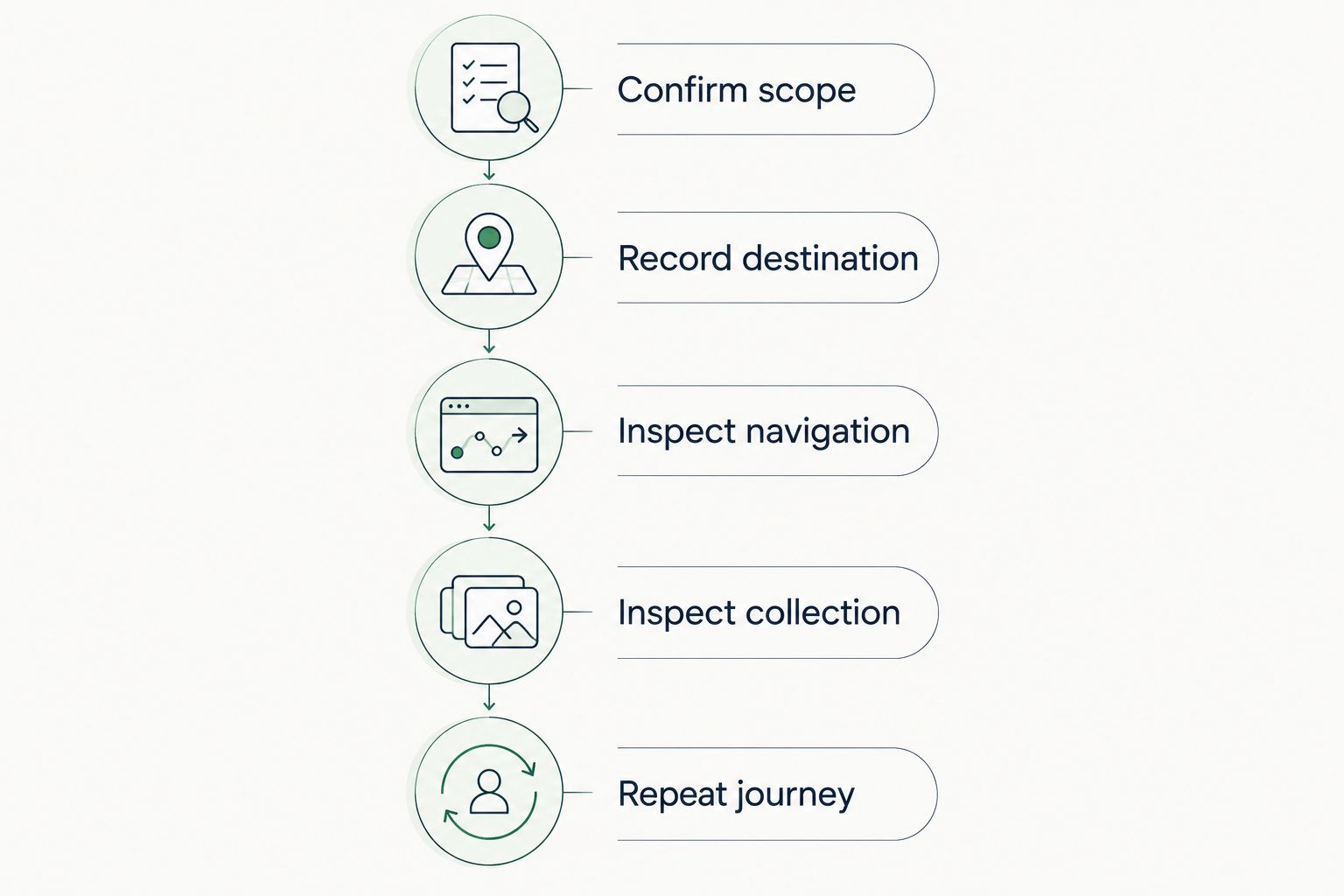
Use this 5-step diagnostic sequence for your 2026 audit. The objective is to trace an observed journey, not assign an estimated share of direct traffic to AI.
1. Confirm the report and acquisition scope
Open your traffic acquisition reporting and inspect session source and medium alongside the channel grouping. Record the date range, filters and reporting identity settings relevant to your analysis. Keep the scope consistent when comparing results.
Do not compare a user's original acquisition source with the source of a later session and call the difference a tracking fault. Also keep direct, referral and unassigned separate; they are not interchangeable labels for unknown AI activity.
2. Record a real answer and destination
Choose an answer that contains a link to your site. Save the prompt, platform, answer date, destination address and whether you used a browser or an app. Record the browser and consent state too.
Check whether the answer cites your own page or a third-party page that discusses your brand. A third-party citation does not create a direct referral to your website unless the user subsequently reaches it.
3. Inspect the incoming navigation
Follow the link while inspecting the browser's network requests. Check the incoming request's Referer header where available, the final destination address and any campaign parameters. The browser's document.referrer is another useful diagnostic signal.
Capture the redirects between the clicked address and the page that loads. If parameters disappear, identify the exact transition that removes them. An empty referrer alone does not explain whether the cause was the originating environment, a policy or the navigation method.
4. Inspect analytics collection
Check whether your analytics tag sends events and which page location and page referrer values it records. Use debugging tools to verify collection, then confirm the acquisition outcome in processed reporting.
Consent restrictions can limit or prevent collection. A visit that was not observed is not automatically a direct visit. Keep missing events separate from events collected without a usable source.
5. Repeat the journey under documented conditions
Compare 2 entry routes: following the answer's link and pasting the same destination address into a fresh browser session. Keep the destination fixed and record what changes. If an app journey matters to your audience, test it separately.
Use a fresh browser profile or another controlled setup to reduce interference from existing campaign and session state. These tests establish behaviour under your recorded conditions, not a platform-wide attribution rate.
Keep the test record beside your findings. Without the platform, destination, environment and collection evidence, another analyst cannot reproduce the result or distinguish a website issue from a navigation limitation.
What should you fix after the test?
Fix the demonstrated failure, not the direct traffic label. Your next action depends on where the evidence stops.
- Parameters disappear during a redirect: Correct parameter handling for links you control, then repeat the test through the same route.
- A recognised source sits outside your reporting segment: Update the segment or channel rule using the source you actually observed. Preserve the underlying source and medium.
- Analytics events fail to fire: Investigate tag execution and consent behaviour. Do not call this a referral-classification problem before collection works.
- The navigation supplies no source information: Document the limitation. Changing a channel rule cannot reconstruct the missing origin.
- Tests work but the historical report remains ambiguous: Report the successful test separately. It does not retrospectively identify the source of earlier direct sessions.
Campaign parameters help when you control the distributed link. They do not let you tag arbitrary citations inside an AI service, and they should not contain personal or sensitive information.
Avoid adding campaign tags to internal navigation as a workaround. That changes measurement inputs without identifying where the visitor originally came from. It also makes subsequent analysis harder to interpret.
Can you recover AI attribution from historical direct traffic?
Not reliably from the direct label alone. If the original source information was never collected, a new reporting rule cannot reconstruct it; other retained evidence must independently support any historical reclassification.
Does rising direct traffic prove that AI visibility is improving?
No—rising direct traffic does not prove improved AI visibility. Compare recorded answers, identifiable referrals and acquisition changes separately; movement in the same period is a reason to investigate, not proof of causation.
How should you report AI traffic alongside AI visibility?
Build your 2026 report around separate evidence layers. Keep the labels explicit so leadership can distinguish an observed source from a plausible discovery path.
Identifiable website acquisition
Report sessions and conversions with source information that supports inclusion in your AI referral segment. State the inclusion rule and acquisition scope. Keep the rule consistent across reporting periods, and annotate any changes.
This layer is best for analysing the behaviour of attributable visitors. Its limitation is equally clear: it excludes discovery that never becomes an identifiable website session. Do not describe it as all AI-influenced demand.
Observed answer visibility
Track whether relevant answers mention your brand, cite a source or recommend your offering. A mention names the brand; a citation points to a supporting source; a recommendation presents an option as a choice. Record those outcomes separately.
Koalr is best for marketing teams tracking how their brand appears in AI-driven answers. Koalr is an AI visibility platform covering ChatGPT, Gemini, Perplexity, Claude, Copilot and Google AI Overviews. Its role here is tracking brand appearances, not proving the origin of an unattributed website session.
Koalr AI visibility tracking and website acquisition reporting address different evidence layers. Neither a recorded answer nor a referral session, on its own, establishes the complete customer journey.
Attribution limitations
Include a short explanation of known blind spots, backed by your tests. Identify the tested environment and outcome rather than claiming that an entire platform always strips referral information.
Use this reporting language: Identifiable AI referrals measure attributable visits; answer observations measure visibility; direct traffic remains unattributed unless additional evidence establishes its source. That statement is more useful than a larger channel total built on assumptions.
Business outcomes
Connect identifiable sessions to the conversion events your organisation already uses. Keep the attribution model and conversion definition visible. Report self-reported discovery separately if you collect it, because a customer's answer and a session source are different forms of evidence.
A lead who reports discovering your brand through an AI answer provides useful context. That response does not justify relabelling every direct session from the same period, landing page or audience segment.
FAQ
Is AI referral traffic showing as direct traffic normal?
Yes, AI-originated visits can appear as direct when usable source information is absent. That possibility does not establish how much of your direct traffic came from AI.
Does direct traffic mean someone typed my website address?
No, direct traffic does not exclusively mean someone typed your address. Visits without a clear referral source can also receive a direct classification.
Can GA4 show visits from ChatGPT or Perplexity?
Yes, GA4 can report identifiable referrals when usable source information reaches analytics. Inspect session source and medium rather than assuming every visit from an AI service will carry an identifiable source.
Will a custom AI channel group recover missing referrals?
No, a custom channel group cannot recover a source that was never collected. It can organise sessions whose recorded source information meets your rules.
Should I tag links to measure AI referrals?
Use campaign parameters on external links you control when they serve a defined measurement purpose. They cannot identify the origin of untagged citations or copied addresses retrospectively.
Does an AI citation count as a website visit?
No, a citation does not count as a website visit. A user must reach your site and the visit must be measured before it appears in website analytics.
Can an AI visibility platform explain all my direct traffic?
No, observing brand appearances in AI answers does not identify every unattributed website visitor. Use visibility evidence alongside acquisition reporting without treating either as a complete customer journey.
One last thing
An empty referrer and a direct session are not the same measurement. One describes information available during navigation; the other is a processed analytics classification. Your 2026 diagnostic record should contain both wherever your measurement setup permits it.
Before changing a dashboard, ask for the clicked destination, redirect chain, collected event and report scope. A reproducible journey is stronger evidence than a direct traffic spike. Preserve that distinction, even when a bigger AI traffic number would make the report look better.