

Conductor brings enterprise SEO research and content workflows together, making it a strong benchmark for teams managing organic search at scale. The ceiling appears when your buying decision centres on a narrower job, such as measuring brand recommendations in AI answers rather than managing an entire search programme. The best Conductor alternative in 2026 is Koalr if you need focused AI visibility tracking; Semrush if you need broad SEO and paid-search research.
- Koalr leads this Conductor alternatives shortlist for marketing teams focused on AI visibility and answer engine optimisation.
- Semrush suits broad search research; Ahrefs suits backlink-led SEO; Screaming Frog suits technical crawling.
- A brand mention, a source citation and a recommendation are different outcomes. Measure them separately.
- Keep Conductor when its enterprise SEO and content workflows match the work your team actually does.
Why this matters
Choosing Conductor alternatives in 2026 starts with a question about scope: are you replacing an enterprise SEO platform, or solving a measurement problem inside it? Those are different purchases. A specialist tool can fit the second job without replacing the first.
AI visibility also asks a different question from traditional search reporting. Rankings show where a page appears in search results; answer-level monitoring examines what an assistant says about your brand. Referral analytics records visits, not every answer that names you without producing a click.
Separate 3 outcome types before comparing tools:
- Mention: the answer names your brand.
- Citation: the answer identifies a source supporting its response.
- Recommendation: the answer presents your brand as a choice for the user's need.
A cited page does not automatically make its publisher the recommended vendor. Your evaluation should preserve that distinction rather than compress every appearance into a positive result.
Conductor alternatives at a glance
This shortlist separates tools by their core purpose. It is not a claim that every platform provides equivalent coverage or that a specialist replaces an enterprise suite feature for feature.
| Tool | Best for | Standout focus | How it differs from Conductor |
|---|---|---|---|
| Conductor | Enterprise SEO and content programmes | Search research connected to content workflows | The benchmark for a broader search and content platform |
| Koalr | Marketing teams tracking AI-answer visibility | Brand appearances across major AI-answer platforms | A focused purchase for AI visibility and answer engine optimisation |
| Semrush | Teams researching organic and paid search | Keyword, competitor and advertising research | A search-marketing research alternative with a broad toolkit |
| Ahrefs | Backlink-led SEO and competitive research | Link analysis and organic-search research | A research-led alternative centred on SEO investigation |
| Screaming Frog SEO Spider | Technical SEO practitioners | Website crawling and on-site issue discovery | A specialist crawler rather than an equivalent content platform |
Choose by the decision you need to make, not by the longest feature list. An answer-monitoring task, a competitor keyword investigation and a technical crawl require different evidence.
1. Koalr: best for focused AI visibility tracking
Koalr is AI visibility and answer engine optimisation software for marketing teams that need to track and improve how their brand appears in AI-driven answers. Its stated scope covers ChatGPT, Gemini, Perplexity, Claude, Copilot and Google AI Overviews: 6 named answer surfaces.
That makes it the first shortlist choice when your central question is whether assistants present your brand to potential buyers. Evaluate the platform against the questions your customers actually ask, not just prompts containing your company name.
Where it shines
- Its stated purpose directly matches brand visibility in AI-generated answers.
- Its named scope includes both conversational assistants and Google AI Overviews.
- Its marketing-team focus fits a workflow in which findings inform content and positioning decisions.
Where it falls short
- AI visibility tracking is not, by itself, a replacement for every enterprise SEO and content-management requirement.
- Monitoring cannot guarantee that an assistant will recommend your brand.
- A narrow or brand-heavy prompt set gives you narrow evidence, regardless of which platform collects it.
The last limitation is operational. If you only test questions that already name your business, you are measuring recognition rather than discovery.
Head-to-head with Conductor
| Dimension | Koalr | Conductor |
|---|---|---|
| Core buying question | How does the brand appear in AI answers? | How should the team manage search and content performance? |
| Stated scope | AI visibility and answer engine optimisation | Enterprise SEO and content workflows |
| Named answer surfaces | ChatGPT, Gemini, Perplexity, Claude, Copilot and Google AI Overviews | Check the current offering against your required surfaces |
| Replacement test | Does it solve the answer-visibility brief? | Which existing workflows must remain intact? |
Best for: marketing teams whose immediate priority is understanding brand presence in AI answers.
Verdict: Buy for the AI visibility brief; do not treat it as an automatic full-suite replacement.
2. Semrush: best for broad search-marketing research
Semrush combines SEO research with paid-search and competitive research tools. It belongs on your shortlist when the replacement brief extends beyond organic content performance into how competitors attract search demand.
The useful distinction is breadth of research. If your team regularly moves between keyword opportunities, competing domains and advertising activity, assess those tasks together rather than buying separate tools without a workflow plan.
Where Semrush shines
- Keyword and competitor research support organic-search planning.
- Paid-search research provides another view of competitive search activity.
- Site auditing and rank tracking support ongoing SEO work.
Where Semrush falls short
- A broad toolkit requires you to decide which reports actually support recurring decisions.
- Migrating from Conductor still requires checking saved research, reporting and content workflows.
- Search research and traffic reports do not, on their own, establish whether an assistant recommends your brand.
Do not assume that familiar report names mean identical methodology. Check the definitions behind any metric you intend to compare with historical reporting.
Head-to-head with Conductor
| Dimension | Semrush | Conductor |
|---|---|---|
| Primary fit | Broad search-marketing research | Enterprise SEO and content programmes |
| Research emphasis | Organic and paid-search competition | Search opportunities and content performance |
| Practical evaluation | Run keyword, competitor and advertising tasks | Reproduce the current search-to-content workflow |
| Main migration question | Which toolkit functions will the team use? | Which established processes need replacement? |
Best for: teams that need organic and paid-search research in the same purchasing decision.
Verdict: Buy for broad search research; hold if the main requirement is a proven content workflow.
3. Ahrefs: best for backlink-led SEO research
Ahrefs is a strong candidate when your SEO work starts with investigating links, competing pages and organic-search opportunities. Its backlink analysis, keyword research and site-auditing capabilities support that research-led brief.
Choose the investigation you need to complete before judging the interface. Finding competing pages is useful; deciding which page to improve and why is the actual job.
Where Ahrefs shines
- Backlink research supports investigation of referring websites and competing link profiles.
- Organic-search research helps identify competing pages and keyword opportunities.
- Site auditing adds technical investigation to the research workflow.
Where Ahrefs falls short
- Research findings still need an owner, a content brief and an implementation process.
- Backlink evidence does not prove that an AI assistant cites or recommends a brand.
- Replacing Conductor requires checking workflow fit, not simply matching SEO feature categories.
Best for: SEO teams prioritising backlink analysis and competitive organic research.
Verdict: Buy for backlink-led investigation; hold if editorial operations are the main replacement requirement.
4. Screaming Frog: best for technical website crawling
Screaming Frog SEO Spider crawls websites to inspect technical and on-page elements. It is a specialist alternative when the job is to find crawlable issues, examine page data and support a technical audit.
This is the narrowest option in the shortlist. Treat it as a different tool category, not a smaller version of an enterprise search platform.
Where Screaming Frog shines
- Crawling exposes issues such as broken links and redirect chains.
- Page-level inspection supports checks of titles, headings and other on-site elements.
- Technical exports give practitioners evidence to organise fixes.
Where Screaming Frog falls short
- A website crawl does not measure what an assistant says about your brand.
- A crawler does not replace the wider research and content workflow described in an enterprise-platform brief.
- Technical findings still require prioritisation and implementation.
Best for: practitioners whose immediate deliverable is a technical website audit.
Verdict: Buy for crawling; skip as a direct replacement for an entire search programme.
How to compare the shortlist in 2026
Use the same evaluation brief for every vendor. Different demonstrations are difficult to compare when each vendor chooses the questions, competitors and pages that show its product best.
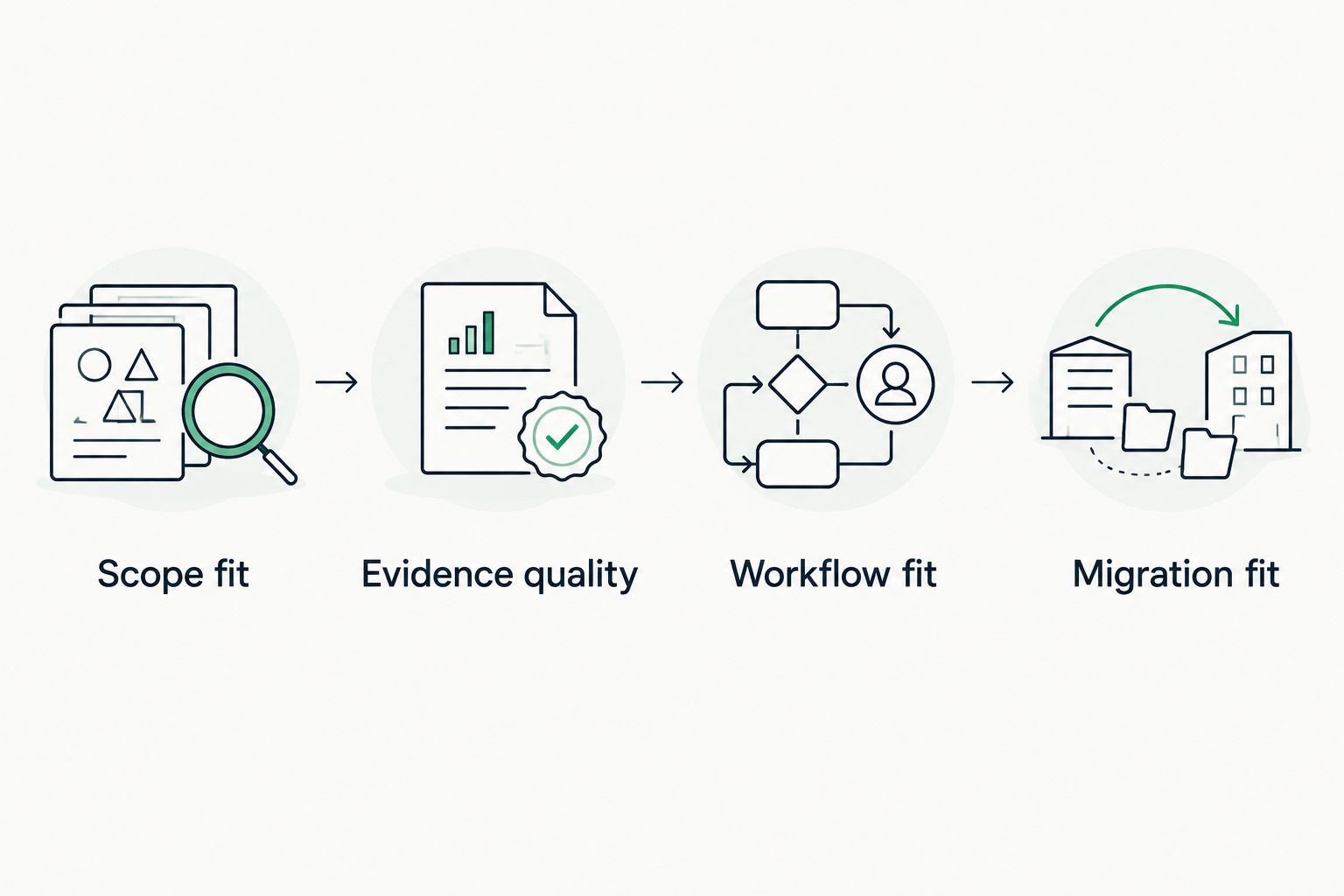
Run 4 evaluation checks: scope fit, evidence quality, workflow fit and migration fit. These are buying criteria, not a product score or a performance benchmark.
Scope fit
Write the required outcome before the feature list. For example: identify whether your brand appears in unbranded buying questions, investigate competitors' organic pages, or diagnose technical website issues.
For AI-answer monitoring, build the test around customer intent. The guide to building a prompt library for AI visibility tracking explains the supporting workflow.
Evidence quality
Ask to inspect the evidence behind the result. For answer monitoring, that means the prompt, answer text, platform, observation date and any cited sources; for technical auditing, it means the affected URLs and the detected issue.
A score without inspectable evidence is difficult to turn into an action. Request the underlying examples before deciding whether the summary is useful.
Workflow fit
Trace a finding to the person who will act on it. A competitive recommendation should become a positioning or content task; a technical finding should reach the person responsible for implementation.
Ask your team to reproduce a familiar task during the evaluation. That reveals whether the new tool supports the work rather than simply producing another report.
Migration fit
List the research, reporting and processes you need to preserve. Decide what to transfer, what to rebuild and what to retire before cancelling the existing platform.
Keep methodology changes visible. A new metric with a familiar name does not automatically continue the old reporting series.
Why people switch from Conductor
The valid switching reasons in this comparison are differences in task and scope, not unsupported claims about outages, service quality or changing contracts. A replacement decision should identify the work that is not being served by your current setup.
- You need a focused AI visibility workflow. The immediate requirement is to inspect brand appearances in assistant answers, with clear distinctions between mentions, citations and recommendations.
- You need broader search-market research. Organic and paid-search investigations belong in the same working brief.
- You prioritise backlink investigation. Link research is central to the decisions your SEO team makes.
- You need technical crawling. The deliverable is an actionable website audit rather than an enterprise content programme.
These reasons do not establish that Conductor lacks a particular capability. They establish what the replacement must accomplish. Compare the current offering with your requirements rather than relying on an outdated category label.
For a 2026 decision, separate a genuine replacement from an additional measurement layer. If the existing platform serves your SEO team and the missing evidence concerns AI answers, adding a specialist is a different decision from migrating the whole team.
When staying with Conductor is the right call
Stay with Conductor when its search research and content workflows match your team's actual requirements. A narrower product is not a better replacement simply because it focuses on the topic currently attracting attention.
Keep the platform if replacing it would leave essential work without an owner or a suitable tool. Before switching, demonstrate that the new setup can reproduce the tasks your team depends on.
Your 2026 shortlist should answer both questions: what evidence do you need next, and what established work must continue? An effective purchase addresses the first without accidentally breaking the second.
FAQ
What's the best Conductor alternative in 2026?
Koalr is the best fit on this shortlist for marketing teams focused on AI visibility and answer engine optimisation. Semrush suits broader search research, Ahrefs suits backlink-led SEO, and Screaming Frog suits technical crawling.
Is an AI visibility tool a complete replacement for Conductor?
An AI visibility tool is not automatically a complete replacement for an enterprise SEO and content platform. Compare the answer-monitoring requirement separately from keyword research, technical auditing and content workflows.
Should I choose Semrush or Ahrefs instead of Conductor?
Choose Semrush for a brief spanning organic and paid-search research; choose Ahrefs when backlink-led SEO investigation is central. Validate the recurring tasks and reporting requirements before migrating.
Can Screaming Frog replace Conductor?
Screaming Frog fits a technical-crawling requirement, not an equivalent enterprise search-and-content brief. It can serve the audit task without replacing the entire programme.
What's the difference between an AI mention and a citation?
A mention names your brand; a citation identifies a supporting source. Neither automatically means the assistant recommends your brand as the solution to the user's need.
Can website analytics measure every AI brand appearance?
Website analytics cannot record an AI brand appearance that produces no website visit. Referral reporting measures visits, while answer monitoring examines the response itself.
How should I evaluate Conductor alternatives before switching?
Evaluate scope fit, evidence quality, workflow fit and migration fit using the same brief. Require each shortlisted vendor to demonstrate the tasks your team actually needs to complete.
One last thing
The easiest evaluation mistake is to ask only questions containing your brand name. Those questions tell you how an assistant describes a known brand; they do not establish whether it introduces that brand when a buyer asks for a solution.
Use unbranded buying questions alongside branded accuracy checks. Keep those results separate in your report. Recognition and recommendation are different competitive outcomes, and your tool choice should reflect which one you need to improve.


