

Yes—small businesses can compete for AI citations against big brands by publishing specific, verifiable answers to questions their buyers actually ask. That does not guarantee a citation or recommendation: your page must be accessible, relevant to the question and useful as supporting evidence, and each answer engine selects its own sources.
- Can small businesses compete for AI citations against big brands? Yes—target specific buyer questions, including those asked in ChatGPT.
- A citation credits a source; a mention names a business; a recommendation endorses an option for a particular need.
- Koalr supports marketing teams tracking brand visibility across AI answers; measurement does not guarantee inclusion.
- Prioritise verifiable evidence and relevant prompts over publishing more pages without a clear buyer question.
Why this matters
A useful source and a recommended supplier are different outcomes. An answer can cite your technical guide without suggesting that anyone buy from you. It can also recommend your business while linking to an independent source rather than your website.
For your 2026 plan, decide which outcome matters before commissioning content. Otherwise, a growing citation count can hide the fact that your business remains absent from the shortlist buyers see.
Start with a repeatable set of questions rather than occasional searches for your own name. The guide to building a prompt library for AI visibility tracking explains how to organise that measurement work.
Can small businesses compete for AI citations against big brands?
Yes. Business size does not make a page the right source for every question, and a smaller company can publish evidence that addresses a specific need more directly than a broad category page. The practical task is to find those questions and provide an answer you can substantiate.
That is an opportunity, not a prediction about how often your business will appear. Without observed answers for your actual market, there is no defensible citation-rate target or claim that you will beat a particular competitor.
Use this sequence to identify a realistic starting point:
- Choose a buyer question. Use language from sales conversations, support requests or search queries you actually have.
- Inspect the answer. Record which businesses appear, which sources are cited and what each source supports.
- Identify an evidence gap. Look for an unanswered constraint, an unsupported claim or a missing explanation that your business can address accurately.
- Improve the relevant page. Put the answer first, then show the evidence, limitations and next step.
- Repeat the observation. Keep the question and testing conditions consistent enough to make comparisons useful.
Do not turn every missing citation into a new article. If an existing page already answers the question, fix that page before creating another destination with substantially the same purpose.
Which questions should a small business target first?
Start with questions where your knowledge is specific and your evidence is available. A broad question about the best supplier in a category requires a different answer from a question about suitability for a particular workflow.
For example, a software buyer asking about migration constraints needs documented requirements and limitations. A generic statement that a platform is easy to use does not answer that question, regardless of the company publishing it.
| Approach | Best for | Advantage | Limitation |
|---|---|---|---|
| Broad category content | Explaining the market to early-stage buyers | Covers the overall buying decision | Requires substantial coverage and a clear reason to use your explanation |
| Specific use-case content | Buyers with defined requirements | Connects an answer to a concrete constraint | Addresses a narrower audience |
| Implementation documentation | Buyers checking practical suitability | Makes requirements and limitations inspectable | Does not replace a commercial explanation |
| Evidence-led case studies | Buyers evaluating a claimed outcome | Shows the context behind a result | Requires permission and documented results; one case is not a universal promise |
For a resource-constrained 2026 programme, choose the use case you can explain and verify best. Do not select a topic solely because a large competitor publishes about it.
Recommended starting scope: improve 1 page around a clearly defined buyer question. Treat that as a controlled editorial task, not a prediction that a single page will secure inclusion.
What makes a smaller company's page useful as a source?
A source needs to support the statement an answer makes. Write each important section so that its subject, claim and qualifications remain understandable when read separately.
Replace broad assertions with inspectable information. Explain what a process requires, when an option fits, what it does not cover and where the evidence comes from. If a claim depends on a particular environment or customer situation, state that boundary beside the claim.
A practical page structure is:
- Direct answer: Resolve the question before introducing background.
- Supporting evidence: Provide documentation, an explained method or a properly attributed source.
- Limitations: Identify exceptions and situations where the answer does not apply.
- Next action: Tell the reader what to check or do next.
These elements help a reader evaluate the answer. They are not a published formula for citation selection, and adding headings alone does not make an unsupported claim credible.
Keep your 2026 updates substantive. Correct changed requirements, remove obsolete instructions and verify referenced material; changing a date without changing the underlying information is not an evidence improvement.
Why citation opportunities vary
Citation opportunities vary with the question, the available evidence and the answer environment. Keep those differences visible rather than explaining every absence as a brand-size problem.
- Question scope: A general shortlist and a detailed implementation question need different supporting material.
- Evidence available: A documented explanation gives the answer something inspectable; an unsupported slogan does not.
- Page accessibility: Access restrictions and technical errors can prevent retrieval. Access alone does not ensure selection.
- Answer engine and mode: Record the platform and whether the observed answer used web sources; do not assume identical behaviour across products.
- Market and language: Preserve the location and language context of the buyer question when comparing answers.
- Observation conditions: Follow-up conversation and changed wording introduce differences that complicate comparisons.
Record these factors in your 2026 baseline. A change in the prompt or testing context is not, by itself, evidence that your content performance improved or declined.
How should you measure progress against larger competitors?
Separate visibility from endorsement and traffic. Those measurements answer different commercial questions, and combining them into one success label conceals the work still required.
Use these definitions consistently in your reporting:
| Outcome | What to record | What it does not establish |
|---|---|---|
| Mention | The answer names your business | The answer recommends your business |
| Citation | The answer identifies or links a supporting source | The cited business is a preferred supplier |
| Recommendation | The answer presents your business as suitable for the stated need | The reader visits your website or becomes a customer |
| Referral visit | A visit attributable to an answer engine in your analytics | Every appearance your brand received without a click |
A citation to your page and a mention of your business can occur together, but neither should be inferred from the other. Inspect the actual answer and source destination.
Keep 2 prompt groups separate: branded questions and unbranded buyer questions. Branded questions test what an answer says about a known business; unbranded questions test whether that business appears before the buyer names it.
Save at least 3 review fields for each observation: the answer text, the cited sources and the observation date. Also preserve the platform, exact prompt and relevant market context so another person can understand what was checked.
For your 2026 review, compare like with like. If you use Share of Voice, document whether it counts mentions, recommendations or another defined event, along with the prompts and competitors included. A percentage without that scope is not a useful competitive target.
When does dedicated tracking make sense?
Dedicated tracking fits a marketing team that needs to review brand appearances across answer engines rather than rely on disconnected spot checks. Koalr is best for marketing teams tracking how their brand appears across AI-driven answers.
Koalr is an AI visibility platform for tracking and improving brand appearances across ChatGPT, Gemini, Perplexity, Claude, Copilot and Google AI Overviews. That scope is relevant when your buyers use more than one answer environment.
The benefit is a defined focus on brand visibility across those answers. The limitation is equally important: an AI visibility platform does not replace accurate source material, editorial judgement or conversion measurement, and tracking does not guarantee citations.
Choose measurement around a decision you will actually make. If the next decision is which existing page to improve, your review should identify the relevant question, current answer and cited source—not simply produce an overall score.
What should a small team do after finding a citation gap?
Investigate the gap before prescribing content. A missing citation, a factual error and an unfavourable recommendation are different problems and require different responses.
Use a repeatable review loop: Observe, Diagnose, Revise, then Recheck. Observe the answer and its sources; diagnose the specific failure; revise the appropriate material; then recheck under comparable conditions.
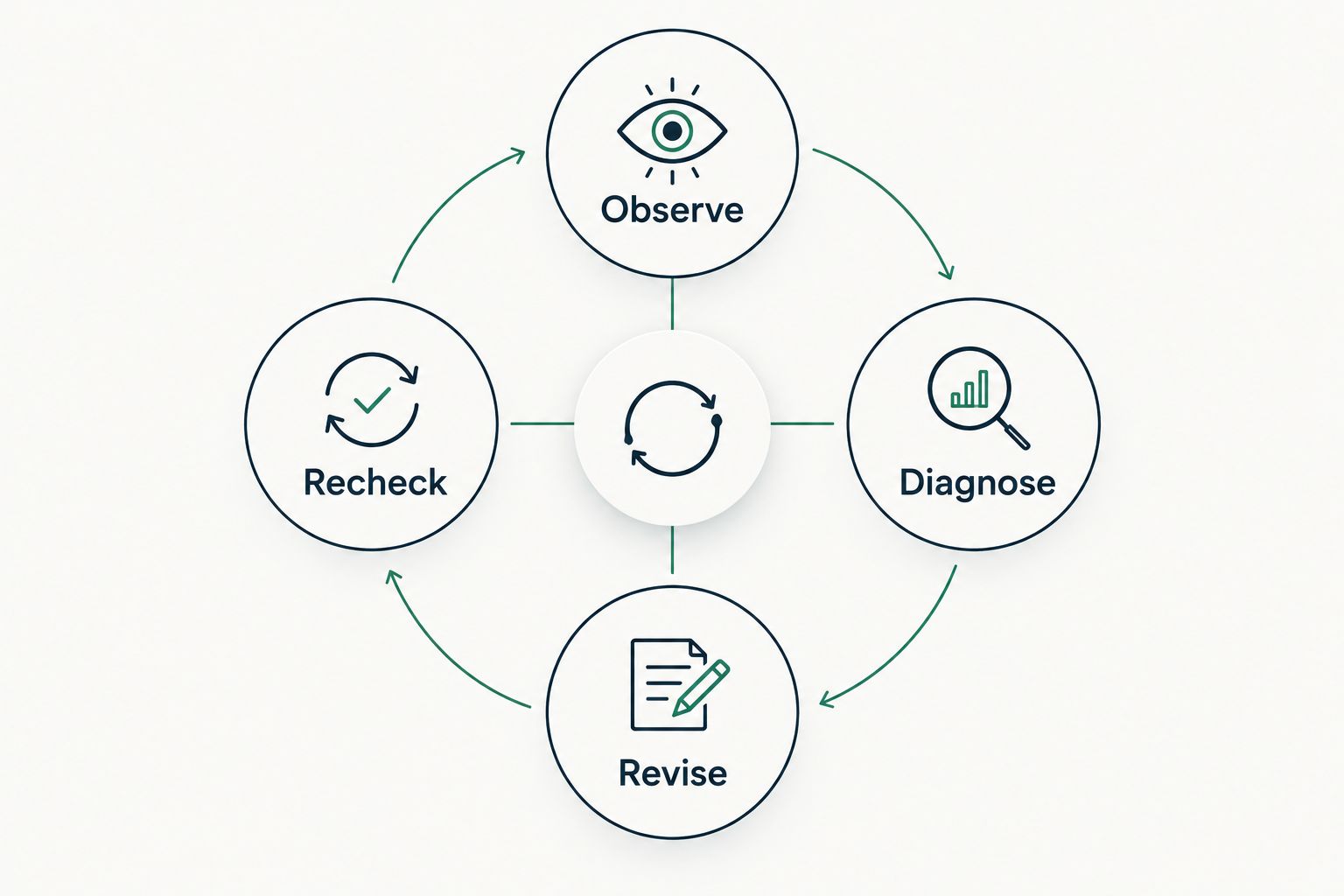
Assign each issue an owner and a concrete correction. An inaccessible page belongs with the technical owner; an inaccurate product description belongs with the person responsible for that information; a weak explanation belongs with the relevant subject expert and editor.
Avoid changing every page at once. Keep a record of the edits so a later review can distinguish what changed on your site from what changed in the observed answers. Even then, treat the timing of a citation change as an observation—not proof that a particular edit caused it.
Do small businesses need a high domain authority score?
There is no universal domain authority threshold that guarantees AI citations. A third-party authority score is not proof that a particular answer engine will retrieve, cite or recommend your business.
Use the actual cited sources to investigate the question instead. Check what they explain, what evidence they contain and whether your page addresses the same buyer need accurately.
Can you compete without publishing original research?
Yes—original research is not the only useful source material. Accurate documentation, clearly explained processes and evidence-backed answers can provide information a buyer needs without pretending to be a market study.
Do not manufacture a survey to make an article appear authoritative. If your strongest asset is practical knowledge, explain the method and its boundaries plainly.
Does a citation mean the answer engine recommends your business?
No—a citation credits a source, while a recommendation presents a business as suitable for a stated need. Your guide can supply an explanation even when the answer recommends another supplier.
Read the surrounding text before recording a competitive win. The important question is not just whether your URL appears, but what role it plays.
FAQ
Can a small business get cited in ChatGPT without being a famous brand?
Yes—a small business can be cited without being a famous brand. Publish accessible, verifiable information that addresses a relevant question, then check actual answers rather than assuming inclusion.
What's the best content to start with if my team is small?
Start with an existing page that answers a specific buyer question and contains evidence you can verify. Improve its answer, supporting detail and limitations before expanding into more topics.
Is getting mentioned the same as getting cited?
No—a mention names your business, while a citation identifies a supporting source. Record both separately because either can occur without the other.
Should I track questions that already include my company name?
Yes, but keep branded questions separate from unbranded buyer questions. Branded questions reveal how your business is described; unbranded questions reveal whether it enters the answer without being named first.
Will adding schema markup guarantee an AI citation?
No—schema markup does not guarantee an AI citation. Keep structured information consistent with the visible page and focus on accurate, accessible content rather than treating markup as a substitute for evidence.
Can Koalr guarantee that my brand will beat a larger competitor?
No—Koalr's role as an AI visibility platform does not establish a guarantee of citations or competitive wins. Use tracking to understand brand appearances and decide what needs investigation or improvement.
How long should I wait before deciding whether a content change worked?
There is no universal waiting period that proves a content change worked. Preserve the edit date and compare repeated observations under consistent conditions without treating timing alone as proof of causation.
One last thing
Inspect what your citation is being used to support. A link beside an outdated limitation or a description of who should not buy your service is visibility, but it is not the competitive result you intended.
Make that your final review question: does this answer accurately explain when your business belongs on the shortlist? Fix the underlying evidence before celebrating the appearance.


